Wednesday, July 24, 2019

Just my luck I forgot the sunscreen.


I may be alone in this, but my favorite outdoor seating at a picnic table -- especially in warm weather -- is one directly in the sun just feet away from shade but within spitting distance of a dumpster.

No shade for the tables on the other side, either, sans dumpster access. Last week you could have fried a fresh organic egg on them. Today it wasn't as bad.


Does anyone have information about the food truck that's been parking at the Farmers Market on Wednesdays? Just curious.

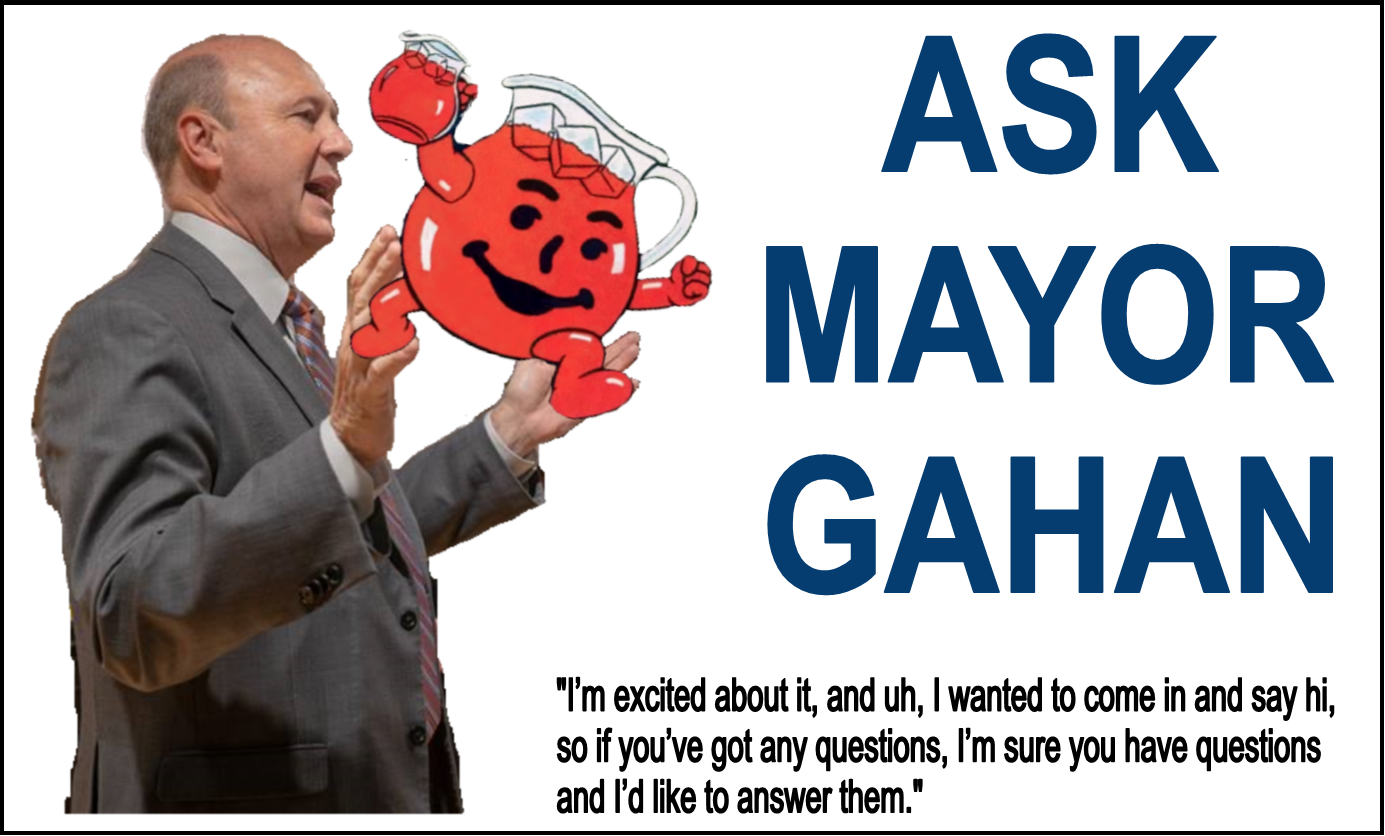
ASK MAYOR GAHAN: "My Boyfriend Sounds Like An Injured Hyena During Sex. Think I Can Turn a Quick Buck Off This?"


In an effort to show fairness and give equal time to the incumbent, NA Confidential is proud to present "ASK MAYOR GAHAN," an advice column in which our own Slick Jeffrey tries his level best to help ordinary people lead lives as flawlessly suburban as his own.

Dear Mayor Gahan,

Hi, I’m an avid reader who is wondering what you’re reading this summer. My current choice of books is A Heartbreaking Work Of Staggering Genius by Dave Eggers. What’s yours?

Thanks for the compliment. I’m a very stable staggering genius, you know. They love me in England. As for a book, I started reading “Tame Your Terrible Office Tyrant” but I couldn’t see the point. Now each night I have one of the city employees come over to the house and read to me from “Boss Tweed: The Story of a Grim Generation.”

Great bedtime stories are the best, and also being hand-fed grapes and fanned with palm fronds.

---

Dear Mayor Gahan,

What can you tell us about that horrible intersection at Bank and Main Streets? Your city engineer keeps saying there’s nothing he can do, but then he told the Board of Works there’d be an expensive study into the possibility of stop lights. Can’t you just make it a four-way stop for a couple hundred bucks, slow the cars and call it good?

Look, do I come to YOUR house and tell you how to run your own family? Okay, maybe I do, but I’ve had it up to here with citizens complaining about traffic.

First, whenever one of my employees lies, be aware he or she is doing it for me out of love and affection because my minions adore me, especially when I bring them Kool-Aid and Rice Krispies Treats. This is another way of saying that lying is what I make them do to keep their jobs.

Secondly, Mister Smarty Pants Strong Towns Member, do you have any idea how much of a campaign donation I get from assigning stop signs to the Street Department to erect (excuse my French, Soos)?

None, that’s how much. But that stop light study should bring in a thousand tasty smackers.

---

Dear Mayor Gahan,

About two weeks ago, our 5-month-old puppy began stepping into her water bowl, splashing the water around, and flipping the bowl over. She then likes to play in the water that is on the floor. (It’s not an issue with her food bowl.) We’ve taken to holding a small Tupperware container that she can drink out of until she splashes, and then we take it away. This is not sustainable. What can we do to keep our house dry?


Don’t you love Walt Disney? I mean the superhuman man himself, not just his fantastic empire of life-altering imaginary escapist theme parks.

Did I tell you that MY favorite hit song from Great Uncle Walt’s archive of movies is the very same one as his, called “Feed the Birds,” about the pigeon lady in Mary Poppins?

This great man liked the song so much that he’d drop by the music department office just when they were busiest and request a personal performance of “Feed the Birds,” and if anyone griped, he’d fire them.

Try this with your dog. If it doesn't work, there's always a TIF area. Now if you'll excuse me, plenty of beaks need wetting.

---

Mayor Gahan returns next week to answer, accept donations and fill out your absentee ballot. Previously:

Here's our new weekly advice column: ASK MAYOR GAHAN.

There won't be any new restaurants in New Albany this week.


Thanks for indulging this test of NA Confidential's theory that any post explicitly mentioning restaurants or food in the title can be relied upon to quintuple the views of the ones that don't.

A savory food porn image doesn't hurt. Consequently you might be interested in this link.

Agree or disagree?

Those of us in the biz know the struggle is real, and has been for quite a while.

We’ve just lived through the greatest period of restaurant growth in U.S. history. Here’s why it’s ending, by Laura Reiley (Washington Post)

A new book explains the sudden death of the golden age of dining out in America

We’ve just been through America’s belle epoque of restaurants.

What’s more, the party is over and most of us are blithely unaware. The restaurant industry is frequently the precursor for a market correction, an early harbinger of a bear market or even a recession to come. And some experts are saying that an unfortunate confluence of factors — oversaturated restaurant markets, rising labor and food costs, weak sales, changing consumer tastes and loyalties, a shrinking middle class, declines in mall traffic, bank and investor skittishness about returns on investments — means the near future looks bleak.

This is the thesis of “Burn the Ice: The American Culinary Revolution and Its End,” a new book by James Beard Award-winning food journalist Kevin Alexander ...

Tuesday, July 23, 2019

Losing basketball games to dogs, or why "This Is Going to Get Worse."


Burmila's thoughts are angry, gloomy, dark and largely accurate -- and the melancholy isn't confined to Trumpism.

This is Going to Get Worse, by Ed Burmila (The Baffler)

“Send her back” is what Trumpism has been all along

WATCHING A VIRTUALLY ALL-WHITE CROWD of viciously angry, red-faced people chanting “Send her back!” at the mention of Representative Ilhan Omar during the President’s latest herrenvolk rally was horrifying. But the real horror is that this, sixteen months out from the election, is just the tip of an iceberg. This is bad and it will get worse. Much worse.

The Democratic Party has little to offer in terms of solace, merely a promise to fail in the same way as before.

It will get worse because the Democratic Party still believes that the mushy center is the place to campaign against Trump, that white votes are the only votes worth winning, that people of color or young people will never vote so why bother giving them a reason to, and that, in the brilliant words of Chuck Schumer, “for every blue-collar Democrat we lose in western Pennsylvania, we will pick up two moderate Republicans in the suburbs in Philadelphia.”

The following passage cuts closest to the bone. I may have arrived at the tail end of the Boomers, but in the final analysis, their narcissism wins out.

It will get worse because an entire generation of people under forty has already been written off to a life of lowered expectations and debt peonage—a generation that might get more riled up by the politics of Social Security and Medicare had they not already resigned themselves to the reality that neither will exist when, if, they reach old age. None of the relevant social, political, or economic institutions are undergoing an intergenerational transition of power; instead, Boomers have decided simply to stay at the helm until death comes, and since nobody except them has ever mattered it’s no big deal if everything burns down on their way out.

Posterity will affirm it: "Was the Automotive Era a Terrible Mistake?"


“When it came my turn to present, the solution I proposed for trips of less than a mile -- and more than half of urban trips are this short -- was shoes, available since 1600 BC.”
-- Samuel I. Schwartz

I've heard it said that drugs rewire the brain. This may or may not be true, but to me, driving definitely does. We become something different when we're behind the wheel, and for the most part the difference is unpleasant.

Was the Automotive Era a Terrible Mistake? by Nathan Heller (The New Yorker)

For a century, we’ve loved our cars. They haven’t loved us back.

In America today, there are more cars than drivers. Yet our investment in these vehicles has yielded dubious returns. Since 1899, more than 3.6 million people have died in traffic accidents in the United States, and more than eighty million have been injured; pedestrian fatalities have risen in the past few years. The road has emerged as the setting for our most violent illustrations of systemic racism, combustion engines have helped create a climate crisis, and the quest for oil has led our soldiers into war.

Every technology has costs, but lately we’ve had reason to question even cars’ putative benefits. Free men and women on the open road have turned out to be such disastrous drivers that carmakers are developing computers to replace them. When the people of the future look back at our century of auto life, will they regard it as a useful stage of forward motion or as a wrong turn? Is it possible that, a hundred years from now, the age of gassing up and driving will be seen as just a cul-de-sac in transportation history, a trip we never should have taken?

And this.

It is odd, then, that we still look to the mid-century for evidence that cars proved their necessity and worth. Tell someone that you cannot drive, and they respond as if you had confessed an intimate eccentricity, like needing to be walked on with high heels before bed. “Re-e-eally! ” the reply goes. “How do you . . . ?”

The answer is planes, trains, buses, ferries, cabs, bikes, feet, and the occasional shared ride: almost anywhere in the world can be reached this way for less than the amortized cost of a car and its expenses.

And this.

The original sin of cars, the problem from which other problems emerged, was commercial pressure for private ownership—for the car to be a personal vehicle in your garage rather than a shared technology woven into the transportation network, as early electric cars would have been. The costs of this decision can be seen on every curb: the typical American vehicle spends ninety-five per cent of its life parked.

It appears this 95% of a car's time parked is spent by its owners bitching and moaning about the period of 5% movement.

Jimmy's Music Center has a new owner and will become Kentuckiana Music Center in a new location.


Dark green is the new color for the downtown building we've come to associate with Jimmy's Music Center, currently being renovated by Steve Resch's crew -- but just the corner building at Market and Pearl, because there have always been two of them, joined long ago for commercial purposes and painted as one.

May, 2019 Google street view.

We were out of town when Anna Blanton announced the purchase of Jimmy's Music Center and a forthcoming move to the corner of Pearl and Elm opposite Harvest Homecoming's headquarters, which many of us remember as the space that never housed the cider bar.


Jimmy Gaetano and family have been running Jimmy's Music Center for a very long time, and on August 10 there'll be a Celebration of Jimmy’s Music Center in the Biergarten at Floyd County Brewing Company.

Monday, July 22, 2019

Sangria class and tasting at Pints&union on Sunday, August 11.


Sangria is an alcoholic punch. The word itself derives from the Spanish for "blood" and there are numerous ways to make it.

Here in Hoosierland it's only July, and we'd mistaken to imagine the summer heat abating any time soon. Better that we acquire coping skills, like learning about sangria from a skilled professional bar man.

Learn how to make fresh summer sangrias with our beverage director Calvin Philley, try samples of FIVE delicious & refreshing house-made sangrias, and leave with the recipes so you can make this tasty summer drink at home!

Ticket includes sangria class, samples of 5 sangrias, complimentary meat and cheese, & take-home recipe cards.

Sunday, August 11, 2019 at 4:00 p.m. -- 6:00 p.m.
Pints&union, 114 East Market, New Albany, Indiana 47150
Tickets $25 at Eventbrite
21+ only

Everyday architecture deserves respect, like these modular Yugoslav kiosks.

K57 modular kiosk, from the article.

My attention was grabbed by the article's lead photo (above), which immediately got me thinking about the two days I spent in Slovenia 32 years ago (below).


Looks like the same model to me, grouped at the market square in Ljubljana. There is less similarity with the ones I saw in Skopje, Macedonia, but it's close.


The article is fascinating with numerous links.

Why Everyday Architecture Deserves Respect, by Darran Anderson (CityLab)

The places where we enact our daily lives are not grand design statements, yet they have an underrated charm and even nobility.

Architecture is not simply the stage set in which we live our lives. It is also a reflection of how we live our lives and who we are. An integral aspect to this is the unfolding of time. What happens when our needs, desires, and beliefs change, and the structures we have built no longer facilitate them?

Architectural preservation is often an issue of grandeur, both in a sense of size and richness, and decay. When we think of buildings that already been lost, they are almost always imposing structures—cathedrals, skyscrapers, temples. Yet the places where we enact our daily lives, and which reflect them even more than grand architectural statements, are smaller, more seemingly trivial and thus more vulnerable.

To appreciate the charms of small structures, it is useful to remind ourselves that we primarily interact with architecture from a ground level rather than the god’s-eye view employed in films and renderings. The architecture of day-to-day urban life is driven by utility and merges so integrally into our tasks that we barely notice it as architecture. There have been visionary architects who have recognized and celebrated the underrated nobility of everyday life, and there are some superlative little wonders scattered around our cities.

Specifically ...

Le Corbusier’s seaside Cabanon remained a curious and charming one-off wooden cabin, despite his intention to roll it out as a series of nearby holiday homes. By contrast, there’s the streamlined fiberglass K67 kiosk by Saša J. Mächtig that flourished, for a time, in Slovenia. Being modular, adapting to fit the role and size required, the kiosk allowed “the possibility of growth and change,” in the words of the architect.

SHANE'S EXCELLENT NEW WORDS: Which free-spending mayor borrowed "moving forward" first, Mike Moore or Jeff Gahan?


Both Mike Moore and Jeff Gahan have embraced variations of "moving forward" as campaign slogans as they seek lifetime employment.


I suppose the Aussies wouldn't think much of either candidate, as revealed in this article from 2010.

'Moving forward' slogan treats us like imbeciles, says speechwriter, by John Masanauskas (Herald Sun)

JULIA Gillard's constant use of the slogan "moving forward" was treating voters like imbeciles, says a former Labor speechwriter.

Author Don Watson said yesterday he was turned off by the PM's election launch speech on Saturday, in which she used the phrase 24 times.

"It is the cliche of our times. When she started trotting it out I walked away after five minutes. I couldn't stand it any more," he said.

Mr Watson, who has railed against management-speak in books such as Death Sentence, couldn't understand why today's politicians used such language. "I don't know why they think it's a winner. And if it is a winner, then I'm even more dumbstruck. It's hard to imagine what the alternative to 'moving forward' is. I don't know - moving backwards? I suppose that's what she's trying to establish.

"People think the only way you can make a political point or persuade people of an argument is to treat them like imbeciles. It's like training a dog."

Note that imbecilic is an adjective: "Imbecilic (comparative more imbecilic, superlative most imbecilic), like or as an imbecile; so senseless as to be laughable; absurd, foolish, stupid, idiotic."

Moore (R) and Gahan (also an R, but a D for the sake of today's argument) aren't the first two politicians from theoretically opposite parties to share a slogan. This, also from 2010:

Name That Campaign, by Richard Whittaker (Austin Chronicle)

Gov. Perry's new slogan sounds awfully familiar

Texas Democratic Party: Hey, maybe you can get a cut of Perry's t-shirt sales!

If there's one thing that Democrats and Gov. Rick Perry can agree on it's that Perry's new campaign slogan, Moving Texas Forward, is a great slogan: So great, in fact, that it's been the Texas Democratic Party's slogan for the last four years.

Then there's this, from 2012.

Punctuation Nerds Stopped by Obama Slogan, 'Forward.' By Carol E. Lee (Wall Street Journal)

From Both Sides of the Aisle, a Question: Is Ending It With a Period Weird?

The. Obama. Campaign. Slogan. Is. Causing. Grammarians. Whiplash.

"Forward." is the culprit. It was chosen to reflect the direction Mr. Obama promises to take the country if re-elected. It also is designed to implicitly convey the opposite: that likely Republican nominee Mitt Romney would set the nation in reverse.

Simple enough. Except the moment seven characters became eight, things got complicated. Period. Even for some in the president's orbit, the added punctuation slams the brakes on a word supposed to convey momentum.

"It's like 'forward, now stop,' " said Austan Goolsbee, the former chairman of the National Economic Council who still advises the Obama campaign. He added, "It could be worse. It could be 'Forward' comma," which would make it raise the question: "and now what?"

The president signed off on his own slogan, but evidently isn't sold. "Forward! Period. Full stop," he has joked to his campaign staff, according to an Obama adviser.

On that, if on nothing else, Mr. Obama has bipartisan support.

"It's sort of a buzz kill," said Rep. Pete King (R., N.Y.).

The period was a subject of a spirited debate as Mr. Obama's senior advisers and outside consultants spent hours in a conference room at their Chicago campaign headquarters deliberating over the perfect slogan, according to an adviser who was in attendance.

Does a period add emphasis? Yes! Does it undermine the sense of the word? Maybe!

David Axelrod, the president's longtime messaging guru, is a champion of the period. "There's some finality to it," Mr. Axelrod said. For those who think it stops "forward" in its tracks, he has a suggestion: "Tell them just to put two more dots on it, and it'll seem like it keeps on going."

The period debate hasn't been confined to the upper echelons of the Obama campaign. Politicians, grammarians and designers who brand people and products have noticed it, too.

"There's been some speculation that the period really gives the feeling of something ending rather than beginning," said Catherine Pages, an art director in Washington, D.C.

In 1992, George H.W. Bush's line, "Who do you trust?" generated chatter about the use of "who" versus "whom." Dwight Eisenhower's 1952 slogan "I like Ike" is clearly a sentence, but didn't include a period. George W. Bush's "Yes, America Can" slogan included a comma; Mr. Obama's "Yes We Can" chant four years later did not.

Meanwhile, the title of the super PAC supporting Mr. Romney, "Restore Our Future," seems to bend the rules of space and time, if not grammar.

Those who brandish red pens for a living are divided on whether Mr. Obama's campaign slogan passes muster.

"It would be quite a stretch to say it's grammatically correct," said Mignon Fogarty, author of "Grammar Girl's 101 Troublesome Words You'll Master in No Time." "You could say it's short for 'we're moving forward.' But really it's not a sentence."

The only single words that properly end with a period are verbs, Ms. Fogarty added, or interjections such as "wow."

The hilarious Deaf Gahan on Twitter has "drumpfed" them all.


In New Albany's case, the best way for the city to be moving forward is to be sending Gahan backward for a return to veneer sales.

One fine anniversary evening at Brooklyn and The Butcher.


Some time back we resolved to observe our 15th wedding anniversary with a visit to Brooklyn and The Butcher. We customarily enjoy eating at the bar, and took our places at the end of it.


The original plan was for drinks and appetizers, but the evening blossomed into a full meal and everything about it was excellent.


I've no intention of going into great detail, and it should suffice to say the experience at Brooklyn was well executed at all levels. For us an evening like this is a splurge, and I'm not going to suggest otherwise. Lately we've been eating more often at home; cooking always has been enjoyable for me, and a measure of household austerity is necessary for those like us who enjoy traveling. 


My overarching point is gratitude for a variety of dining options in New Albany. While it's undeniable that we're not "regulars" at Brooklyn, it's also true that we have not set foot in one of Louisville's steak houses since The Butcher opened in 2016.

When "airing it out," it's wonderful to have an upper tier establishment within walking distance of the house. Of course at other times microwaving a sausage and dripping mustard on my shirt does the trick.

All most of us ever seek is an element of choice, and thanks to the efforts of so many food and drink entrepreneurs like the Halls (and their contractor partners), this is what we now have in downtown New Albany. We aren't in a position to support them as often as we like, but we support them as often as we can.

Thanks to everyone at Brooklyn and The Butcher for a great evening.

Sunday, July 21, 2019

Mr. and Mrs. Confidential celebrate 15 years of marriage.


As this adventure through life has progressed, we've come to understand that there are quite a few opportunities to celebrate in the dead center of summer.

Diana was born on the 5th of July, a day after the 4th of July national birthday, and July 6 is the anniversary of her reclamation of British citizenship. The 21st is our wedding anniversary, and my family reunion (mom's side) always falls on the same weekend. August 3 is my birthday, and August 1 is Pints&union's birthday.

Rather than risk giving too little attention to these milestones, we've resolved to celebrate for a whole month. It's the least we can do.

Today (Sunday) was our 15th wedding anniversary. Yesterday we spent in Madison at the reunion, and earlier this evening there was a very fine meal at Brooklyn & The Butcher (There'll be more to say about this in a separate post).

The traditional 15th wedding anniversary gift is crystal. I hoped we might make do with this photo of the Rogaška Crystal shop in downtown Ljubljana, Slovenia, where we'll be visiting in November.


They might at least allow a selfie from the sidewalk before rousting us for vagrancy.

Happy anniversary to the missus, my partner in life. We fit, and we complete each other. This is a state of affairs I never imagined having the good fortune to enjoy, and you can bet I'm grateful for it.

It's Sunday, and the "Jeffersonville Good News and Proselytizing Tribune" has lots of content addressing the publisher's narrow version of Christianity.


When we first began exposing the pewspaper's propensity for weekly down home camp meetings (just imagine the Jehovah's Witness heading for your door but tripping on the rolled-up copy of Tom's and Nancy's sermon) one of the staffers replied on Twitter that since some readers are Christian, it's perfectly acceptable to offer two weekly Sunday evangelism columns.

But of course. Other readers are atheists, pagans or Zoroastrians; some ride motorcycles, savor S&M or birdwatch; there are square dancers, vintage automobile fetishists and stamp collectors.

None of THEM get a single column, much less two, but when it comes to advocating for the one true religion, Bill Hanson pulls the strings and employees who know better have little choice except cringing.

Millenarian sects wait patiently for a reign of holiness that never seems to arrive. Me? I just keep waiting for the newspaper to devote as much space to local Democratic Party corruption as it does to scratching the publisher's nonsensical itch.

Jeffersonville News and Tribune hits rock bottom as evangelism columnist Tom May argues for theocratic fascism, Pence-style.

Saturday, July 20, 2019

Dicky, meet Jeffrey: "I Am Not A Crook: How A Phrase Got A Life Of Its Own."


Funny dude, that Richard Nixon. From 2013, this explanation.

'I Am Not A Crook': How A Phrase Got A Life Of Its Own (NPR)

Forty years ago Sunday, then-President Richard Nixon first uttered the now infamous phrase, "I am not a crook." Nixon made the declaration during a press conference in Orlando, Fla., amid charges related to the Watergate break-in and subsequent scandal. Host Arun Rath explores the five little words that brought down the presidency.

At least he's stunningly consistent: "Tom Friedman Has No Idea What He’s Talking About."


I first became aware of Thomas L. Friedman when my pal Barrie and I read From Beirut to Jerusalem (1989), which described Friedman's feelings about Israel in the context of his work as a young reporter in the Middle East during the 1980s.

The book seemed solid to me, particularly the chapter called "Hama Rules," which bluntly detailed the horrifying violence directed against internal dissent by the elder Assad in Syria circa 1982, thus providing a preview of son Bashar's predictable instincts during the country's recent civil war.

However this passage at Wikipedia suggests that I didn't necessarily have a wider frame of reference at the time.

It received the 1989 National Book Award for Nonfiction and also the Cornelius Ryan Award. In a book review for The Village Voice, Edward Said criticized what he saw as a naive, arrogant, and orientalist account of the Israel–Palestine conflict.

There's little sense in belaboring the point, which comes down to this: As my frame of reference widened, Friedman's credibility shrank in proportion. His article last week, as dissected here by Elie Mystal, was like an itemized list of centrist wrong-thinking in response to Trumpism.

I haven't read a column by Friedman for a very long time, and propose to double down on what is proving to be a correct decision on my part.

Tom Friedman Has No Idea What He’s Talking About, by Elie Mystal (The Nation)

Every pundit urging moderation was wrong in 2016, and they’re wrong now.

There is one, and I’ll argue only one, thing that Thomas Friedman gets right in his latest New York Times column “‘Trump’s Going to Get Re-Elected, Isn’t He?’”—and that one thing is the fact that people are asking that question a lot. The fear is palpable. The fear is real that somehow the Democratic Party will fail to the meet the unique danger posed by the incumbent president.

Fear can be a powerful motivator, but fear also causes people to make bad arguments and promote silly things. Thomas Friedman is afraid, and it shows. His prescription for the Democrats to confront the danger of Donald Trump is well-meaning inanity, the kind you find in a squirrel who hears a hawk and runs around in a circle because it can’t remember where the tree is.

The particular hawk that seems to have set Friedman off this time was the first round of Democratic debates. Friedman watched them and did not like what he saw. He was “shocked.” No, really, he used the word “shocked” five times to describe the ideas he heard from Democrats, which is an interesting word choice considering Donald Trump is the president of the United States. Maybe he expected Democrats to offer the same kind of fiscally conservative, socially moderate, wildly unpopular policies that served Jeb! so very well against Trump?

From Friedman:

Dear Democrats: This is not complicated! Just nominate a decent, sane person, one committed to reunifying the country and creating more good jobs, a person who can gain the support of the independents, moderate Republicans and suburban women who abandoned Donald Trump in the midterms and thus swung the House of Representatives to the Democrats and could do the same for the presidency. And that candidate can win!

But please, spare me the revolution! It can wait.

This poor man has it so twisted around that he’s decided it’s the Democrats who are threatening to nominate somebody indecent and insane.

Friday, July 19, 2019

New Albany knows all too well how highways ruined cities.


"If a factory is torn down but the rationality which produced it is left standing then that rationality will simply produce another factory. If a revolution destroys a government, but the systematic patterns of thought that produced that government are left intact, then those patterns will repeat themselves...There's so much talk about the system. And so little understanding."
-- Robert Pirsig, Zen and the Art of Motorcycle Maintenance

Interstate 64 and the Sherman Minton Bridge severed New Albany's west side and destroyed the city's first public park. Whether "ruined" is the best word to describe the situation, it can be posited with confidence that the interstate irreparably altered for the worse this place where we live, while enabling suburbanization out yonder.

We've managed to take back some of what was lost, though the interstate's perpetual noise and visual blight is always there to remind us of the price we've paid.

Philly Fed economists: Here’s how highways ruined your city, by Darryl C. Murphy (Plan Philly)

No one should be denied a good taco, but the Vine Street Expressway has often deterred Jeffrey Lin from visiting a nearby taqueria for lunch.

The Federal Reserve Bank of Philadelphia economist channeled that frustration into a working paper about the negative effects of highways on cities.

“Just the experience of getting there is so unpleasant,” he said. “That was kind of one early inspiration for thinking what are the effects of highways on cities.”

Lin and senior economist Jeffrey Brinkman took a broad look at how highways have contributed to suburbanization, and the subsequent decline of U.S. cities during the 20th century ...

Dead Man Blues: "There’s a bunch of gross stuff, besides human bodies, hiding under graveyards."


Honestly, I just needed an excuse to listen to this Jelly Roll Morton song.

Here Lies E. Coli, by Sarah Laskow (Atlas Obsucra)

There’s a bunch of gross stuff, besides human bodies, hiding under graveyards.

For millennia, groups of people have set aside special places to inter their dead, but as the world’s population has grown, so have the problems with concentrating dead bodies in this way. “Cemeteries can be regarded as special kinds of landfills,” the World Health Organization wrote in a 1998 report, and, like any landfill, they come with pollution risks. There have been few comprehensive studies of their environmental hazards, but in some cases—a cemetery that keeps flooding, for instance—the dangers of contamination are clear. With cemeteries sometimes converted into parks and playgrounds, or surrounded by dense development, environmental scientists are increasingly trying to understand the real dangers hidden in cemetery grounds.

Thursday, July 18, 2019

Deaf Gahan vows to save Woodstock 50: "We'll TIF that bad boy right into Bicentennial Park."


In a hurried pajama-clad press conference adjacent to Mark Seabrook's house, Gahan vowed to raze public housing over the weekend if enough space could be cleared for Woodstock 50 to be held on Bono Road.

"Like we've said all along," intoned Dear Leader, "our TIF zones are healthy, and as we all know, music festivals as economic development generate big-time donor kickbacks from the Port-A-Let suppliers."

Michael Lang was unavailable for comment.

Woodstock 50 Organizers “Considering All Options” After Unanimous Permit Rejection, by Madison Bloom (Pitchfork)

The fate of the festival, originally slated to take place August 16-18, remains unknown

Woodstock 50 has issued a new statement on the status of the festival. In an email to Pitchfork, a Woodstock 50 spokesperson said that the event organizers are “considering all options at this point.”

The 50th anniversary of the iconic 1969 festival—slated to take place August 16-18—has encountered multiple setbacks since it was announced back in January. In April, ticket sales were delayed following the festival’s failure to obtain a required permit from the New York State Department of Health (DOH). Later that month, investors Dentsu Aegis Network pulled financial support, announcing that the festival had been called off.

In the months since those initial hurdles, Woodstock 50 has entered a legal battle with Dentsu, lost its event producer and original venue in Watkins Glen, New York, and was denied a permit for a new venue at Vernon Downs. On Tuesday (July 16), the town of Vernon voted unanimously to reject an appeal by festival organizers following the denied permit application. It marked the third attempt by the festival to move to Vernon Downs race track.

LIVE TO EAT: Chef Edward Lee's thoughtful essay "Restaurant Reviewing Needs a Revamp."


Marty Rosen points the way in a short post at Food & Dining Magazine, and Chef Lee takes it from there.

Writing for Mark Bittman’s new online food magazine Heated, Chef Lee recently penned an incisive essay that defends the importance of professional criticism but argues that our increasing diverse culinary culture calls for equally diverse journalism.

His tagline is telling: “For those of us who cook from a culture that is outside the European vernacular, we may own our recipes, but we never owned the words that described our foods. And it’s time we did.”

I suppose the future of the genre itself -- restaurant reviews as written by someone who knows something about food -- is up for grabs in a world where Yelp follies proliferate. When everyone knows everything, no one really knows anything, do they?

Restaurant Reviewing Needs a Revamp, by Edward Lee (Heated)

As chefs and diners move away from Eurocentric restaurants, food writing still needs to catch up

... I don’t want to dismantle a system that has documented America’s restaurants, but when the country’s most exciting restaurants are as diverse as the America we live in, how can we possibly rely on the old system? In the past two years, some of the best dishes I have eaten have been from restaurants that serve Sri Lankan food, Laotian food, Uzbek food, and Nigerian food. I am an expert in none of these cuisines. And I am going to make the bold assumption that neither is the food reviewer of the local paper who has been tenured there for the past 20 years. When diners are more interested than ever before in the foods of nations that have been ignored by history, how do we properly and intelligently review these restaurants?

One of the incredible byproducts of the food revolution in America is that we have an army of “foodies” that come in all shapes, colors, sizes, ages, and economic and social backgrounds. We are as discerning about our Michelin-starred meals as we are about our banh mi and our pupusas. In a near future, when Eurocentric restaurants may not be the dominant cuisine, when the new audience is going to demand more from a review than a list of italicized dishes, how do we adjust to this? At a time in the restaurant industry where we are going through a reckoning of what is right and wrong, is there a place where food criticism of “ethnic” cuisines can be more inclusive and respectful?

Edward Lee is the author of “Smoke & Pickles” and of “Buttermilk Graffiti,” winner of the 2019 James Beard Award for Best Book of the Year in Writing; the chef/owner of 610 Magnolia, MilkWood, and Whiskey Dry in Louisville, Kentucky; and culinary director of Succotash in Penn Quarter, Washington D.C. and National Harbor, Maryland.

ON THE AVENUES: I'm a citizen of the universe, but I can't take a photo to save my life.


While lounging at Pints&union on a recent Saturday afternoon I found myself chatting with estimable local photographer David Modica. Upon returning home to the lair and glancing at the mound of old travel slides waiting to be scanned and digitized, it occurred to me how much a practiced lensman like David could have achieved in the East Bloc during the late 1980s.

However a second thought arrived quickly on the heels of the first, this being the vague memory of conditions on the ground that rendered an already poor photographer like me even worse at shutter's snap -- this in addition to my prior observation that when you're carrying enough cheap slide film to last through a six-month trip, there does not exist the luxury to squeeze off dozens of shots from which to select the best.

Of course there’s no point denying that my wretchedness as a photographer was exacerbated by a reticence to be intrusive by pointing my camera at people who might conclude this well-heeled foreigner was seeking unflattering angles. Americans tended to be well-received within the communist perimeter at the time (a Polish man once told me the only person more popular in his country than Pope John Paul II was Ronald Reagan), but matters could get complicated if they thought you were laughing at them, as opposed to commiserating with them.

I've forgotten something else during the subsequent three decades of post-communist life. There was a certain measure of self-imposed restraint felt by many visitors based on advice in then-popular travel books to the effect that visiting a “police” state meant risking problems if you photographed taboo objects or potentially embarrassing social conditions.

As an aside, friends always used to ask me if it felt dangerous to holiday in the Eastern European worker’s paradise, and I'd say no, quite the contrary; it felt very safe if the word “safety” were to be defined by the absence of violence directed against us as tourists – as opposed to pervasive bullying by the government against people living there.

In fact while abroad in 1989 I was pickpocketed, drugged and robbed, and also had my credit card stolen -- in France, Spain and Austria, respectively, not Czechoslovakia, East Germany or the Soviet Union. The one time I can recall feeling disconcerted while traveling was in 1985 when soldiers with machine guns were posted on street corners throughout Istanbul, Turkey -- a capitalist country, by the way -- because there’d only recently been a military coup. Too much Midnight Express, I suppose, although it proved to be a delightful stay otherwise.

Being a westerner in a communist country meant that one way or another, we were supplying the regime with much needed hard currency, whether via an official change bureau or by means of the helpful conduit of a black marketer. Either way, like water running downhill, “real” western money was destined to find its way to the government in the end. Acordingly, we were encouraged to spend it.

Still, there were behavioral boundaries. Only the universally adored Australians could get away with rowdiness without apparent consequence. It’s just a gift they seem to have. Addressing photography, I can remember being told not to take pictures of people waiting in line to buy things, a common sight in the USSR (less so elsewhere in the Bloc). Military installations were verboten, too, along with other locales and buildings of strategic significance, with the precise definition being left to the government’s whim.

Much of this was bluff, and yet it could be daunting. Did hospitals count? Sports stadiums? Breweries? There was no way of knowing. Once in Moscow we happened upon a tangled pile of exposed film on the ground. It was very easy to imagine it being yanked from a camera, even if we didn’t witness the policeman in the act.

How would the gatekeepers have reacted to a tourist with a camera documenting the exterior of the central prison in Prague just down the street from where I stayed in 1989 with the family of my friend, where Vaclav Havel had been incarcerated for what proved to be the final time only a couple months before I arrived? I knew what the building represented, but I left it alone. The simple point is that I didn't want to risk it, and we can add a high degree of self-editing in terms of shot selection on top of my other inhibitions.

Besides, I was born to take lousy pictures and to live vicariously through the practiced eye of artists like Modica. Had he been along for the ride, he’d have found a way to capture the essence.

---

There’s a quote I’ve been trying to locate for years.

At this point I’m forced to concede the words I recall may or may not have been spoken, even if I continue to insist they were uttered by the track and field star Edwin Moses during the 1984 Summer Olympics in Los Angeles.

It was a hideous spectacle, the Games of the XXIII Olympiad. Good intentions notwithstanding, the modern Olympics have been politicized from the very start, as I suspect they also were in ancient Greece. Apart from the year 1984 serving as a convenient pretext for rereading of George Orwell’s novel of the same name, it also was an election year and the very pinnacle of the Cold War, Reaganism and Thatcherism.

Not unexpectedly the Hollywood filmmaker David Wolper was enlisted to “produce” the Olympics for global television, with every last movie gimmick trick from the arsenal of the Ben Hur generation in La La Land duly deployed and exaggerated for patriotic effect. Unfortunately for the RayGunners, all this mind-boggling garishness was not witnessed in person by the Warsaw Pact nations; they all boycotted the Olympics except for Nicolae "Conducator" Ceausescu’s Romania, for which the US State Department happily rewarded the dictator with enough slack to oppress his own people for another five years.

At some point amid the propaganda extravaganza Moses won yet another medal and was interviewed by a fawning broadcaster, who was no doubt scandalized to hear the athlete comment that he considered himself a citizen of the universe – or something like that.

I can’t actually prove Moses said it, but no matter. If he did not, someone else did, and either way it was a light bulb moment for me. I’d long been arguing about the impossibility of “proving” irrational religious beliefs, but it suddenly became clear that mankind’s enduring instinct for sectarianism and tribalism, amplified to deafening pitch with the inception of the modern nation state’s industrialized toolmaking, predates religious superstition. Religion is a mere symptom, not the disease.

Consequently, for me this notion of mindless patriotism in the sense of publicly demonstrating one’s “love” of country in knee-jerk, childlike ways is pure nonsense, every bit as much as the blind worship of objects, whether they come in the form of a saint’s toenail, a totem or a flag. Humans have brains, and it might be helpful to use them on occasion. Love might be a many splendored thing, but it’s better directed at other humans and not debatable abstractions that serve primarily to reinforce existing power structures.

That’s because we’re humans first. I was born the same way those guys on the “other” side were, and ultimately I’ll die in precisely the same fashion as someone from Tibet, Chile or South Africa. The rest of it is sheer serendipity, and should be regarded as such. Surely we have better things to do with the brief time we have.

Yes, “go back to where you came from” has returned to the news cycle.

Sentiments like this always have been primeval screams favor an abysmally ignorant point of view, especially as they pertain to “love” of a nation state founded on the basis of welcoming humans from elsewhere to come slaughter and enslave the ones already here.

It’s even less defensible from the perspective of humanity as a whole, although in this as in most all similar circumstances, the eternal imperatives of capital accumulation, and the concurrent preservation of wealth and privilege for the few, depend on the reinforcement of arbitrary divisions.

The disease isn’t limited to Americans, although we seem to be in the process of perfecting it. It’s neither a Republican nor a Democratic affliction, as it flourishes across the political spectrum. When you rant at another human being to conform to your precepts or else get the hell out, the sound you’re hearing off in the distance is the One Percent laughing uproariously all the way to the bank. The fewest with the most simply adore the ease with which you are distracted.

Some readers are red-faced: But what about our brave men and women in the military, fighting to preserve our freedom?

Well, wouldn’t it be great if the deprived weren’t compelled by threat of violence to preserve wealth and power by killing others who are in precisely the same predicament?

Since the dawn of civilization wars have been fought by humans who quite honestly are chosen to die for someone else’s money, property, status and religion, not their own. Violence is an abomination at any level of the human experience, but it doesn’t get much worse than when it is amalgamated and wielded at the nation state’s massive economy of scale.

I respect the soldiers quite a lot -- so much so that I’d like to join with other fellow humans to determine ways of making their sacrifices less predictably common. If this requires a certain redirection of pitchforks, all the better.

Today’s column closes with the thoughts of Jason Williamson, one half of the Sleaford Mods, an English punk band.

“Racism is not the answer to your misery or feelings of alienation. It just isn’t. It never was. It’s just one of the many tools to keep you locked in a small room for the entirety of your life. Thank you. Look after each other. If you can.”

---

Recent columns:

July 11: ON THE AVENUES: Trieste, New Albany and the meaning of nowhere.

July 4: ON THE AVENUES: The 2019 remix, "You want some fries with your redevelopment?"

June 27: ON THE AVENUES: Mourning (and alcohol) in America, circa 1984.

June 18: ON THE AVENUES: Let's lift our voices for another verse of "Talking Seventh Inning Blues."

Wednesday, July 17, 2019

The late John Paul Stevens was there when Babe Ruth did, or did not, call his shot in the 1932 World Series.


John Paul Stevens has died, and coverage of his passing is rightly focused on his Supreme Court tenure. But the drop-dead incredible thing about Stevens -- as sportswriter Dave Zirin pointed out immediately upon hearing about Stevens' death -- is that he almost certainly was the last living witness to Babe Ruth's alleged called shot in 1932.

It boggles the mind of a baseball fan.

Stevens lived long enough to witness the Cubs winning the 2016 World Series and ending a championship drought that predated him by more than a decade. He said he experienced October anguish up close as a child: in 1929, when he attended Game 1 of that Fall Classic at Wrigley Field, and in 1932, when he was on hand for Game 3, aka the day Babe Ruth called his shot. The Cubs lost both games. He recounted those visits in this Chicago Tribune article.

Speaking of which, I missed news of the death in March of Ruth's last surviving daughter. Ironically, her married name was Stevens.

Back to Justice Stevens, and Charlie Pierce calls this shot.

John Paul Stevens Saw What Was Coming, by Charles P. Pierce (Esquire)

The retired Supreme Court Justice is dead at 99 years old.

It can be argued, and convincingly, too, that things began to go sideways in this country on December 12, 2000, when the Supreme Court handed down its decision in the case of Bush v. Gore, which handed the presidency to George W. Bush. In his dissent, Justice John Paul Stevens saw it coming.

What must underlie petitioners’ entire federal assault on the Florida election procedures is an unstated lack of confidence in the impartiality and capacity of the state judges who would make the critical decisions if the vote count were to proceed. Otherwise, their position is wholly without merit. The endorsement of that position by the majority of this Court can only lend credence to the most cynical appraisal of the work of judges throughout the land. It is confidence in the men and women who administer the judicial system that is the true backbone of the rule of law. Time will one day heal the wound to that confidence that will be inflicted by today’s decision. One thing, however, is certain. Although we may never know with complete certainty the identity of the winner of this year’s Presidential election, the identity of the loser is perfectly clear. It is the Nation’s confidence in the judge as an impartial guardian of the rule of law.

This part sounds important, too.

He was a Republican judge, appointed by an unelected Republican president, who lived long enough and served long enough to become the leader of what became the liberal wing of the Supreme Court. How much did things change over his 35 years on the Supreme Court? Appearing with Rachel Maddow on Tuesday night, longtime Supreme Court chronicler Linda Greenhouse pointed out that Stevens was the first Supreme Court justice confirmed after Roe v. Wade was decided and, not only were his confirmation hearings not televised, but Stevens was not asked a single question about abortion.