Showing posts with label Live to Eat. Show all posts

Tuesday, June 02, 2020

LIVE TO EAT: Those new clothes you're wearing, well, they're a tad threadbare. That's regrettable.


I was working on this post when a notice from my former business popped up on social media feeds.


Good for them.

Pints&union will return next Tuesday, June 9. In exactly what format is, as yet, unknown.

I know it's frivolous to be writing much of anything without acknowledging the Black Lives Matter protests taking place in Louisville, just a few miles from my house. To me they're entirely justified protests, and government's response has been horrendous. Mayor Greg Fischer is underwater, and should resign.

This said, it has been utterly fascinating to see which local food service operators have spoken up about the protests -- during which admired BBQ chef David McAtee was killed by police -- and which have continued hawking their wares on the street corner as though nothing important was occurring, just as they were doing following the pandemic reopening period, as though science had been a ghastly imposition the previous months.

By the way, it may surprise you to learn that COVID-19 did not agree to take a holiday amid the unrest.

Yes, there is a considerable schism within the ranks of local restaurateurs. It was there before, albeit more hidden than not, and kept in check by commonalities and shared experiences. There always were narcissists on one-side and the public minded on another; the coronavirus then pulled back the curtain, and now protests for simple human injustice have sealed the deal.

And yet, in spite of it all, I retain a certain loyalty to the segment, if not some of the less defensible bad actors populating it. I'm not "outing" anyone; they've outed themselves, and I'm confident that lots of folks who "get it" can "see it" clearly without me pointing.

However, speaking for myself alone, it's just not going to be possible for me to be close with some of them any longer. It's going to be difficult for me to patronize them. I intend to keep it to myself, but some of the shrillness and superstition masquerading as public health (and justice for all) have been repugnant.

History sometimes offers us the chance to stand up and be counted. Some restaurateurs are seizing this moment, others not so much. I wish there weren't a scorecard now, but it's there. I can't NOT look at it.

My friend and boss Joe Phillips is on the right side of history.


And here:

Why some restaurants are keeping their doors closed in states that have reopened, despite backlash, by Ashlie Stevens (Salon)

“I have a huge problem with people choosing profit over people. And I would rather go bankrupt"

At Pints & Union, a pub in New Albany, Ind., a skeleton crew readies for a rush of Saturday evening to-go orders. Save the sounds of that kitchen prep, it doesn't feel much like a restaurant anymore. The smell of beer has been replaced by the smell of bleach, while the wooden booths have long been sanitized and subsequently covered in plastic. Occasionally, a pedestrian tries to open the bright red front door —rattling it against its navy frame — but it's been locked for weeks.

Takeout orders are now called into the restaurant and paid for via phone; once they are ready and the customer is outside, only then is the door briefly opened by a masked and gloved employee who places the carryout bag on a small table nearby to be retrieved.

According to owner Joe Phillips, this is the way Pints & Union is going to operate for the foreseeable future as a way to prevent the continued spread of the novel coronavirus. This is despite the fact that Indiana Governor Eric Holcomb cleared all restaurants in the state (save those in three "hotspot" counties: Marion, Lake, and Cass) to open at 50% capacity as of May 4.

"There's a lack of testing in southern Indiana," Phillips said. "There's only one place you can get tested locally — it's the health department — and it's only open on Saturdays from 11 to 1, and you have to have symptoms. So no one is getting tested."

However, in late March, the chief medical officer at Baptist Health in New Albany called Floyd County, in which the city is located, a "hotspot for the coronavirus" after over 20 people tested positive.

The amount of unknowns about the virus and its spread is, Phillips said, his largest deterrent against reopening.

"I have a huge problem with people choosing profit over people," Phillips said. "And I would rather go bankrupt."

Monday, May 11, 2020

LIVE TO EAT: 50% of Indiana goes first. Getting your queue on, or keeping to the curbside?

Habana Blues.

These past few days I've been reminded of forgotten topics in history, as in the late 1980s, when those in the profession of analyzing Eastern Europe commonly debated what would happen if communism ever fell.

Essentially: We already know how to transform a capitalist economy into a communist one. But we don't know how it's done the other way around. 

Similarly, today is RO Day, the grand reopening for Indiana's restaurateurs. If food service operators so desire, they may place 50% of your ass in a seat and begin the process of implementing a new normality, subject to a great many mandates and restrictions, few of which will be clear to anyone -- operator or customer -- until doors actually are unlocked.

ON THE AVENUES: COVID tolls for thee -- whatever, so hurry up and get your ass back into this seat.


It is my personal belief that this reopening process is coming too soon in terms of public health, and inescapably, there'll be a social/political/cultural aspect to it which stands to be divisive -- although it might be plausibly argued that American society already is divided and wasn't about to come any closer together, pandemic or not, in an election year.

I continue to marvel at the results of The Fat Lamb's informal polling over the weekend at Facebook, in which the Louisville eatery asked its customers how they felt about a possible return to on-premise dining, as opposed to the curbside carryout regimen that has evolved over the past two months.

The result was not unexpected, but the veritable landslide came as a great surprise, even to me; the last time I looked, the score was approximately 145 in favor of continued curbside (with little or no likelihood of coming inside), and four, maybe five preferring to be seated again at a table. But even they expressed a cheerful willingness to continue take-aways if so ordained.

Treading lightly, I can imagine the results at a typical sports bar -- say, Hoopsters in Jeffersonville -- being slightly different, perhaps even 145 - 5 in favor of re-entry.

Not being critical, mind you; the choice to reopen or not is theirs, although you have to wonder what's going to be showing on the televisions at area sports bars.

Tiddliwinks?

I put together a pants-down survey at Food & Dining Magazine, listing restaurants intending to reopen this week, and some that aren't. Clearly, there is a division of opinion among owners and operators. It's to be expected. They're all different people, with different stories and personalities.

The food and drink industry plainly is divided, though not yet acrimoniously so. No one knows exactly how this reopening will play out, and beginning today, an experiment will begin yielding demonstrable results, which will inform further measures.

Individual conscience plays a role in all our lives, decisions and actions. We've arrived at one of those points in history, hopefully not to be forgotten, where individual conscience is of paramount importance, even more so than usual.

Here's the article. You'll have to click through to see the names of the restaurants.

Now or later? Reopening Southern Indiana restaurants — or not yet

Today is Monday, May 11. Indiana restaurants may reopen at 50% capacity, and the Indiana Restaurant and Lodging Association has released these guidelines for them, as outlined in the organization’s “Hoosier Hospitality Promise” and published at the Indianapolis Star.

Here’s what you can expect:

  • All staff, including in the kitchen, will wear masks.
  • All staff will pass a health check or complete a health survey prior to each shift.
  • Hand sanitation stations will be available upon entry and exit from restaurants.
  • All tables, chairs and common areas will be cleaned regularly.
  • Menus and condiments will be single-use. Utensils will either be single-use or cleaned after every use.
  • Each restaurant will have a designated employee to oversee safety and sanitation measures.
  • Bar seating will be closed, with no live entertainment.
  • Tables will be limited to 10 or fewer guests.
  • Physical barriers will be used to separate tables, booths and bar stools.
  • Communal serving areas such as buffets will be closed.

If patrons have been exposed to COVID-19 or have symptoms, they are asked to not dine in restaurants and order takeout instead. Restaurants will be limited to 50% capacity until June 14, at which time they will increase to 75% capacity. According Indiana’s plan, restaurants will be able to operate at full patron capacity beginning July 4. Bars will be closed until June 14 and will be able to operate at full capacity on July 4, pending continued positive trends.

Following in no particular order is a non-comprehensive seat-of-the-pants survey of independently owned establishments in Southern Indiana that have commented publicly about their reopening plans in the run-up to May 11.

I exchanged messages with a few of the owners, and otherwise gleaned information from their social media posts and local news reports. Even if not explicitly stated, it is reasonable to assume that all these restaurants will continue their curbside carryout and delivery programs during the coming weeks, but of course there is no substitute for contacting them directly to be sure.

Finally, to repeat, this is a survey; if your business has been omitted from either list, just e-mail me and I’ll update: foodanddiningmagazine@gmail.com

Sunday, April 05, 2020

LIVE TO EAT: Randy Smith offers "a grass-roots campaign to support and sustain local eateries."


It's an excellent strategy for helping your favorite eateries without jumping through hoops. Just invest in your future meals by helping them pay the light bills now.

Thanks to Randy for contributing this idea. Have you purchased gift cards from your favorite independent local businesses? Tell me about it.

---

To the Editors:

Hi, guys. My spouse and I, as we've aged, are eating out less frequently. Part of that is a habit of healthy eating, but, frankly, my own business had never really contributed much to our household income.

We've also ramped up our travel via vacations, taking about 2 week-long vacations each year and a few long weekends. Necessarily, that boosts the number of occasions where we eat out. Someday I hope to share our favorite out-of-town dining experiences with you. We've had some great ones in Virginia, Ohio, Tennessee, Mississippi, Florida, West Virginia, Missouri, Illinois, Michigan, and Wisconsin.

At root, though, we have a few local independent restaurants we love.

I wanted to talk to you about a grass-roots campaign to support and sustain local eateries. Yes, there are other such campaigns. But independent restaurants are "independent" and rarely are willing to ask for help.

Can't we who aren't struggling right now throw a few bucks to them?

Here's my proposal. Pick your 3 favorite independent restaurants. Call them and buy a gift certificate of $25, $50, $75, or $100.

Maybe you order takeout, too, but the pure cash infusion now in exchange for sustaining those restaurants into the future seems to me to be an invaluable investment.

Three of our favorites have suspended operations until further notice, and I regret that I can't invest in their futures right now. But those who are hanging in right now can use our help. And those other three will value our patronage when they return to "normality."

We are investing $75 each in Aladdin's Cafe on Bank Street, and Israel's Delicias de Mexico Gourmet on Market Street.

We stand ready to do the same for Cups and Cones on Vincennes Street, Hing Wang on Spring Street, and New Albanian on Plaza Drive. If you know how we can do that, let us know.

These are our favorites. You'll have your own. Pick three of them and invest in their futures. After all, they are one of the biggest contributors to our quality of life in New Albany.

Randy Smith, formerly of Destinations Booksellers, et al.

Tuesday, March 17, 2020

LIVE TO EAT: These downtown New Albany restaurants are offering carry-out and curbside meals.


New Albany Social took some time off during the past year, but Kelly Ott Winslow posted this list on Monday evening, and it has been shared 1,596 times as of 10:10 a.m. on Tuesday.

That's simply fantastic.

Please remember that although the restaurants listed have always prepared food to go, our new abnormal means that virtually all of them are reinventing themselves on the fly without much of a road map.

As an example, I know for a fact that city officials are working on plans to help define the word "curbside" (reserved parking spaces) to assist in the effort of restaurants being social with take-away food albeit with minimal human contact, but in this and other considerations it will take some time to work out the kinks.

Over at Food & Dining Magazine we'll be trying to push as much information as we can given the circumstances. All that can be said with any accuracy is that local restaurants and bars will be doing what they can to survive for the foreseeable future, and your patronage is crucial.

For bars with little or no food service, the COVID-19 "curve flattening" measures are tantamount to Our New Prohibition. I'll try to report about them, too.

Stay tuned.

Saturday, February 29, 2020

LIVE TO EAT: The Future of Food is Female, a conversation by and about female chefs, on March 2.


It's slightly mind-boggling that Chef Edward Lee's presence in Louisville dates back almost two decades to his famous road trip to the Kentucky Derby and an appointment with destiny at 610 Magnolia. Since then Lee has managed the difficult feat of having universal appeal without egregiousness, and arguably his most important current work is coming from The Lee Initiative.

Following is a Monday event we previewed over at Food & Dining Magazine. I'll be in attendance and plan to file a report at F&D on Tuesday or Wednesday.

The Future of Food is Female, a conversation by and about female chefs, on March 2

The LEE Initiative is an acronym for Let’s Empower Employment: “We started the LEE Initiative in Louisville, Kentucky in 2015 after we saw a need for more diversity, more training, and more equality in our own restaurants.”

For International Women’s Month, The LEE Initiative is teaming up with Kentucky to the World to present “The Future of Food is Female,” a program in the Republic Bank Foundation Speaker Series. The event takes place on Monday, March 2 at the Kentucky Center Bomhard Theater (501 West Main Street, Louisville). A reception begins at 5:30 p.m. and the program kicks off at 6:30 p.m.

Thursday, November 28, 2019

LIVE TO EAT: "Why do we celebrate Thanksgiving?"

Thanksgiving at Churchill Downs?

In 2016 we chose to spend the Thanksgiving holiday week in Catania, Sicily. Afterward more than one person asked me, "How do they celebrate Thanksgiving in Italy?"

"The same way as the 4th of July," I replied.

No snark intended; people forget the specific nature of national holidays.

I celebrated Thanksgiving while in Catania by eating a mixed grill of horse meat. There were no lamentations about the absence of turkey and the fixings; we'd long since stopped bothering with all that, and picked up Chinese on the big day. It was a household tragedy a few years back when Vietnam Kitchen stopped opening on Thanksgiving, although we still go there on Christmas Day.

Prior to Catania, the last time I'd been overseas for Thanksgiving was in 1991, during the English teaching gig in Košice, Czechoslovakia (now independent Slovakia). Given that the traditional "national dish" of Slovakia is bryndzové halušky, or potato dumplings with sheep's cheese and bacon bits, it's what I chose to eat on Thanksgiving Day, at a wine cellar with something resembling Tokaj.

For Thanksgiving in 2019 we're south of Slovakia, in Slovenia. Beer and sausages sound peachy keen to me, but whatever you choose to eat, drink and do today, here's food for thought.

Why do we celebrate Thanksgiving?, by Soleil Ho (San Francisco Chronicle)

I don’t really know what to do with Thanksgiving.

I enjoy flipping through recipes for sweet potato pie, roasted brussels sprouts and spiced cranberry sauce as much as anyone else, but it’s difficult to disentangle the holiday from our colonial history. It seems like we certainly try our hardest to do so.

When I was in elementary school, my teacher had my class draw straws to divide us up into Natives and Pilgrims; the former made feathered headbands out of brown construction paper, and the latter crafted black buckled hats. I think we sang a song about togetherness. (My mother-in-law, an elementary school teacher in the Midwest, tells me her school no longer does this. Another teacher who works in the North Bay says his school barely acknowledges the holiday in its curriculum. I’m curious to know what other schools do.)

Though one could argue that Thanksgiving can and should be an apolitical occasion, the persistent retelling of history that occurs around the holiday is steeped in our national myth making. We still popularly romanticize the origin of the holiday — and by extension, the origin of the country — as one where pilgrims from Europe broke bread with Native Americans, who freely gave and gave until there was nothing left to give. I’m sure I’ll get more than a few email responses that speak to that fact.

Yet so much ink has been spilled and so much breath has been expended in service of clearing up the story of the holiday. As Dennis Zotigh, a cultural specialist at the Smithsonian National Museum of the American Indian, writes, “Why should Native peoples celebrate Thanksgiving? Many Natives particularly in the New England area remember this attempted genocide as a factual part of their history and are reminded each year during the modern Thanksgiving.”

The responses to his question from Native folks from around the country vary. I was struck the most by one from a reader in Montana: “It’s important to share the whole, true story of the first Thanksgiving... I will say this, The generic idea of Thanksgiving, or taking the time to be with family and friends and give thanks for all the blessings in our lives, the big and small, is a great practice and should happen more often. I wonder how we can turn a negative into a positive? Can we have an honest Thanksgiving? Can we move forward and, if so, where do we begin?”

Is there more we can do than watch as the turkey dinner magazine and newspaper spreads are published on cue?

The idea of tapping Native American thinkers to comment on occasions like Columbus Day or Thanksgiving and surface what may be traumatic experiences for the benefit of a largely non-Native audience feels mostly crass to me, though I think the New York Times’ great piece featuring chef and activist Sean Sherman was a step in the right direction. Here at The Chronicle, we also ran a story over a recent Thanksgiving about how Northern California Pomo and Yurok Indians are striving to restore nearly lost food traditions.

Still, I would rather that Sherman or others get full-on columns in food publications so that, again, that subject matter isn’t relegated to holidays where we want to feel a bit absolved. It’s like a blushing acknowledgment, a wink to show that we can see the bigger picture, but the rest of the holiday goes on without issue.

To backtrack to what the writer from Montana wanted us to consider, what are some ways to reframe the holiday that might make space for all of these contradictions and complications? I’d love to hear from you if you have any suggestions that we could share with your fellow readers.

Wednesday, November 20, 2019

LIVE TO EAT: Knowing about Knorr and why it's "a staple in Mexican-American kitchens."


Recently while doing research to write magazine profiles of two local Mexican eateries, I stumbled across an article about Knorr, which is one of those exceedingly German phenomenons.

High quality is our food philosophy – one that’s been years in the making. Our story starts back in 1838, when Carl Heinrich Knorr opened a factory in Heilbronn, Germany, supplying chicory to the coffee industry.

He began to experiment with drying vegetables and seasonings, to preserve nutrition and flavor, leading, in 1873, to the launch of the first Knorr® dried soups across Continental Europe.

This breakthrough ushered in a string of advancements. From the launch of the nutritious ‘Erbswurst’, or pea soup, in 1889, to our pioneering Knorr® European sauce mix in 1908, creativity and innovation have been at the heart of everything our chefs do.

In 1912, we introduced something really exciting; the first Knorr® Bouillon cube.Now, families could enjoy delicious dishes at home without the need to make stock from scratch. This humble little product proved a hit! Just one example of how, with dedication and a lot of love, we always endeavour to help you cook better meals every day.

It comes from Germany, then adapts an unexpected Latin American twist.

How Knorr seasoning became a staple in Mexican American kitchens, by Ashlie D. Stevens (Salon)

This German seasoning brand is indispensable for that authentic umami and zing in Mexican & Latin American cuisine

There are maybe three aisles at the Mexican tienda closest to my apartment, each of which are absolutely packed with inventory all the way up to the roof, where rows of primary-colored piñatas and lanyards with sequined and laminated Virgin of Guadalupe appliques dangle from the ceiling tiles. It’s a place for the essentials: a single lime, mango juice, a packet of dried arbol chiles, tortillas — and Knorr-brand granulated chicken bouillon.

Secrets of Louisville Chefs?

While Anthony Lamas, James Beard-nominated owner of Seviche in Louisville, Kentucky, says he remembers it being used in both his mother's and grandmothers’ kitchens.

“Even non-Latinos, a lot of families in California cook with a Latino influence and know the secrets,” Lamas said. “It’s a great way to add some quick flavor since it has some citric acid and annatto, giving it a little extra flavor. It’s a must for Spanish rice, or any soup or stew.”

It's worth considering a small portion the next time we go shopping. I cook, albeit at a rudimentary level, and there's always something else to learn.

Monday, November 18, 2019

LIVE TO EAT: "Dear Restaurants: This Chair Sucks."

"The banquettes are designed for one-hour meals, my boss explained. To keep the tables turning, they had to make sure people wouldn’t be comfortable for too long—a time period (and bench angle) that varied from restaurant to restaurant. Certain chairs and benches indicated how long the restaurateur expected the meal to take."

As a man of ample weight and height, I can concur that these trendy metal chairs are the worst ever, but this this principled rant at Vice about their intrinsic offensiveness is one of the finest in recent memory. I'm not pointing fingers, but for this reason (these chairs) alone, there are/were places I won't go unless I'm planning on standing for a beer at the bar.

Dear Restaurants: This Chair Sucks, by Naomi Tomky (Vice)

This uncomfortable and not particularly attractive chair has become a disease.

The Chair has been around for decades, but it was in the post-recession period, around 2010, that it became ubiquitous: its arching metal back wrapping just barely forward enough to intrude on your hips, the nearly flat seat inviting you to join it, coldly and bracingly, like Ursula inviting you into her underwater lair. The naked metal paired well with the Edison bulbs and exposed rafters of the era. As raw wood and vintage-style painting on brick took over décor, everything had to look perfectly minimalist. And the chair, usually in unpainted metal, completed that look.


Unfortunately, it didn’t complete the experience. Because I don’t have to touch the bare lightbulbs and there’s no danger of a splinter from a ceiling beam, those were of little consequence. But those chairs, they caused me plenty of pain. As a woman of ample size, I thought, as they first started spreading like the wildfire of mild annoyance into restaurants around the country, that I must just be too fat for these chairs. But as I silently suffered through another dinner in one of these low-level torture devices, my rail-thin friend Bill could no longer keep quiet on the horrors of The Chair. From his rant, I realized that everyone found these chairs to be fundamentally terrible: they’re cold, they’re hard, and they just don’t seem to be designed to fit a human body (and certainly not a large one).

To be fair, choosing restaurant seating is a tougher decision to make than you might imagine: chairs are expensive, they tend to fall apart, restaurants need tons of them, and they need to match the look and feel of the restaurant. The Chair managed to find a niche: cheap versions of the original French model were plentiful, they stacked, they had no fabric to stain or rip, and no wood to warp or twist. They seemed to slide into various restaurant looks fairly easily ...

Sunday, October 13, 2019

Read my profile of Bourbons Bistro, as published in the current issue of Food & Dining Magazine.

In the past I've usually waited until the following quarterly issue of Food & Dining Magazine to publish the text of my most recent contribution, but these days our articles appear at the web site during the weeks following the magazine's release.

As such, here's the link to my profile of Bourbons Bistro, originally published in the Fall 2019 issue.

Profile — The Bourbons Bistro Legacy: Putting the Urban in Bourbon, by Roger Baylor (Food & Dining Magazine)

“Irish Hill is the Louisville neighborhood you find when you’re lost.”

It’s an old-time Louisville saying about a relatively small, richly historic patch of ground shoehorned between Baxter Avenue, Lexington Road and Beargrass Creek, and Eastern and Cave Hill Cemeteries.

On Irish Hill’s northeast side is Breslin Park, formerly the site of Louisville’s fortress-like City Workhouse, where minor offenders were incarcerated while they paid their debt to society through menial labor. Across Payne Street is a collection of imposing old brick warehouses known since the 1980s as Distillery Commons, used nowadays as offices, businesses and creative spaces.

Once this was National Distillers and Chemical Company’s Kentucky Distillery Warehouse & Bottling Plant. The mighty National Distillers owned some of the country’s most venerable bourbon brands, like Old Grand Dad, Old Crow, and Old Taylor, and by the 1940s it controlled 70% of the American market for bourbon and rye.

At its peak National Distillers had a work force of 1,400, most of whom lived within walking distance. Numerous families depended on these jobs, but consumer trends were unkind to the whiskey market and the plant closed in 1975.

“Headliners (a music venue) used to be the lunch hall for National Distillers, which was just down the street from us. I call it the UPS of the time; it was the economic engine for our neighborhood and others nearby, like Phoenix Hill and Clifton, even Butchertown.”

Meet Jason Brauner, who grew up in Irish Hill and was in knee pants when National Distillers was shuttered. Brauner’s great aunt and great uncle both worked there. So did business partner John Morrison’s father and grandmother.

Brauner and Morrison opened Bourbons Bistro in 2005. Call it cosmic, karmic or just a well-turned business plan, but their Frankfort Avenue refuge became an instant classic, primarily because Brauner and Morrison scanned the cluttered landscape of gimmicky bar and restaurant concepts, settling on a unifying principle so incredibly obvious as to be invisible: Bourbon.

Sunday, October 06, 2019

LIVE TO EAT: Is our food culture killing us?


A long, provocative book review. Accompany with Tawny Port and Stilton, if ya got 'em.

The Ethics of Eating, by Susan Pedersen (The Nation)

 ... We think of how we eat within a framework of choice, but as Bee Wilson tells us in her new book, The Way We Eat Now, that is ridiculous. We “choose” within a contained food environment, one shaped by availability and advertising, prices and profits, traditions and trends. How we eat has less to do with conviction and still less to do with virtue than with habits and traditions, environment and especially economics—that is, with the complex social order within which we live. New York, for example, seems to offer almost limitless “choice,” but its cornucopia and variety (its Michelin-starred restaurants and gourmet food trucks, its farmers markets and specialty stores) coexists with rampant inequality and ill health. New York might seem a foodie’s heaven, but one-fifth of its residents live below the poverty line and an additional 25 percent in what the city calls “near poverty,” and homelessness has reached levels not seen since the Great Depression. In 2016, 1.2 million New Yorkers were “food insecure.” Today almost 1 million are living with Type 2 diabetes. Commendably activist though the city’s government is, battling those statistics with a host of neighborhood- and school-based health and nutrition programs, New York nevertheless captures perfectly the polarization and paradoxes of “the way we eat now.” And this is why I fell so hungrily on Wilson’s book—devouring it, really—in a quest to understand a global food culture that, frankly, is killing us.

Wilson doesn’t mince words about the magnitude of the problem. We think of food crises in terms of famine or scarcity, and while those can still strike hard, we also face a different kind of challenge today. For the first time, more people (1 billion) are overweight or obese worldwide than are underfed (about 800 million). Today, more people die from diet-related diseases than from the effects of tobacco use. To explain how a prosperous world could defeat hunger, only to fall victim to toxic diets, Wilson turns to nutrition scientist Barry Popkin’s account of the stages through which human diet has evolved ...

Monday, September 30, 2019

LIVE TO EAT: Food for thought from Ryan Rogers.

The umbrella.

We like to say in the restaurant business that we can tell consumers what our restaurant is, but within six months, our consumer tells us what the restaurant is.
-- Ryan Rogers

For those with the wherewithal to elude Louisville Business First's paywall, there is an excellent short interview by Haley Cawthon with Ryan Rogers, founder of Feast BBQ, Royals Hot Chicken and bar Vetti.

You'll recall that his first restaurant was the now defunct Feast BBQ in New Albany (2012-2018), currently being remodeled as an addition to The Exchange.

Rogers' sentiments about Louisville's restaurant industry are worth noting.

Chef Ryan Rogers talks Royals expansion, Louisville restaurant industry

What’s your opinion on Louisville’s restaurant industry? Do you think it’s overly saturated?

I think it’s a healthy restaurant market. At the end of the day, the restaurants give the best service, the best food and the best value are the ones that are successful. I think competition is good in the marketplace.

The one thing I would say is that we have a lot of people who want to get in the restaurant business because they see it from the outside and think it’s a fun job to have. But it’s a job at the end of the day — it’s not a retirement plan or something you do as a hobby — it’s a seven day a week job.

I think that competition will only continue to improve the quality of the restaurants that we have in Louisville.

Saturday, September 07, 2019

LIVE TO EAT: Food & Dining (Vol. 65; Fall 2019) is on the street, so check out my profile of Bourbons Bistro.


I’ve been contributing quarterly beer columns to Food & Dining for most of the mag’s existence. The past few years publisher John Carlos White has guided me into longer-form pieces like the profile of Bourbons Bistro in the new issue, and as of July, I’ve had the title of digital editor, charged with creating short news items at the website.

Even better, Marty Rosen is now on board.

I’ve been writing for Food & Dining off and on since the first issue.

With this issue, I rejoin the magazine as editor.

From the beginning, publisher John Carlos White envisioned a magazine that would cover Louisville Metro’s vibrant culinary scene with outstanding literary and visual storytelling. F&D continues to do exactly that, and continues to thrive in an era that has not been easy for journalism.

In short, we have a fine team. Check out the latest and let me know what you think. Hard copies should be available in their usual locations (Pints&union will have a stack), and don't forget they're free.


Tuesday, August 27, 2019

LIVE TO EAT: Many familiar faces as 1816 Modern Kitchen & Drinks debuts in Corydon.


Here's the team: Mesa's Bobby and Ysha Bass, and Rod and Esperanza Juarez; Executive Chef Scott Dickenson, formerly of The Exchange in New Albany; and General Manager Levi Donaldson, also previously of The Exchange and more recently Wild Rita’s.

To learn about the history of the location, you'll have to click through to my article at F&D. Here's a clue: Old-timers like me ate in the same building when Richard Nixon was president.

1816 Modern Kitchen & Drinks is open in Corydon (Food & Dining Magazine)

Corydon was Indiana’s first state capitol (1816-1825), and for those of us who grew up in the area, the town always will be synonymous with the term “Old Capitol.”

Time marches on, and today, 203 years after the town’s historic Hoosier moment, 1816 Modern Kitchen & Drinks makes its debut at 100 E. Chestnut (the Shafer Building), around the corner from the landmark original capitol and across the street from Butt Drugs ...

Sunday, August 18, 2019

LIVE TO EAT: Adrian Miller asks, "Is Fried Fish and Spaghetti Soul Food’s Most Debatable Dish?"

Photo by EatingOxford.com

There is something about the noun "foodie" that annoys me, much as with "beer geek."

Granted, eating is my original sin as a trencherman, verging on gluttony as it periodically does (last night, for example), and I'll try just about anything once, but kitchen creativity for the sake of creativity alone is a form of exuberance bordering on the narcissistic.

However by all means, feel free to indulge. May the chefs harness every last ingredient and technique, so have fun and best wishes -- just allow me to hover on the periphery, because absent cultural and historical contexts, I'm still peckish even when my belly is full.

Having said this, I'm very interested in food writers like Adrian Miller, author of Soul Food: The Surprising Story of an American Cuisine One Plate at a Time, which I read last year and quoted in my Food & Dining Magazine essay about Louisville's Chef Space incubator.

"Soul food is really the interior cooking of the Deep South that migrates across the country. I think of soul food as an immigrant cuisine and ultimately a national cuisine, because black folks just landed in all parts of the country. But in terms of the difference between the two, soul food has more intense flavors. It's going to have more spice. It's going to be sweeter. It's a matter of intensity."

Miller posts essays on Medium, and here's the link to a recent one. To my knowledge I have not eaten spaghetti with fried fish, but it doesn't sound objectionable at all.

Is Fried Fish and Spaghetti Soul Food’s Most Debatable Dish?

As African Americans left the South, this controversial coupling migrated to parts of the U.S.

... Spaghetti seems like the real head-scratcher here, but it shouldn’t be. Italians have long been in the American South as explorers, agricultural and railroad workers, and eventually, entrepreneurs. A large number of Italians settled in Louisiana and Mississippi in the late 1800s and early 1900s. Italian and Greek restaurateurs featured pasta dishes on their menus. African Americans in the South became familiar with spaghetti by either patronizing these restaurants or cooking it at the public places or private homes where they worked — and eventually, their own homes.

Thus, black Southerners were early adopters of spaghetti decades before the dish entered the American mainstream. By the late 1920s, spaghetti recipes were regularly appearing in African American cookbooks. In time, spaghetti eventually made the jump from entrée to side dish, and black Southern cooks thought nothing of pairing it with fried fish, much like they would with coleslaw or potato salad. The combination caught on, especially in the Mississippi Delta.

That's the thing about food writing.

It makes you hungry.

Friday, August 16, 2019

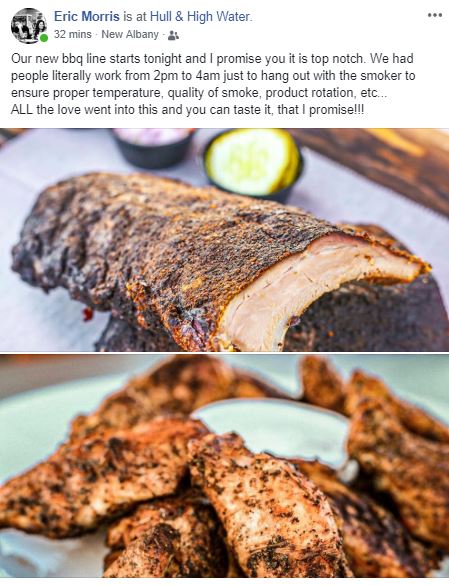
LIVE TO EAT: Southern BBQ comes to Hull & High Water tonight.


Last week Eric Morris revealed an urge to smoke meat at Hull & High Water.

Hull & High Water announcement: "On top of our seafood menu, we have now decided to launch a full Southern BBQ program."


Now he says the time has come to make the BBQ available to the dining public.


"Our new bbq line starts tonight and I promise you it is top notch. We had people literally work from 2pm to 4am just to hang out with the smoker to ensure proper temperature, quality of smoke, product rotation, etc... ALL the love went into this and you can taste it, that I promise!"

Eric also scored some good PR at the website called Only in Your State:

This Nautical Restaurant In Indiana With Riverfront Seating Is A Waterfront Wonder.

LIVE TO EAT: This commentary is a postscript to the Mirin New Albany closing.


Last Friday afternoon (August 9) the Courier-Journal eventually caught up with the Mirin New Albany closing story, which I'd already broken at Food & Dining Magazine. As of today (the 16th), the News and Tribune still hasn't noticed.

But dude, the newspaper is RIGHT ON TOP of what happens within a three-block radius of the newspaper's Jeffersonville digs.

Mirin's location in Louisville remains vibrant, and owner/chef Griffin Paulin was open and up front with the C-J as to the issues he experienced in New Albany.

'Something had to give': Mirin restaurant closes in New Albany after 6 months, by Dahlia Ghabour

 ... What ended up giving, he said, was six months of losing money incrementally — and then losing $5,000 in one day when the restaurant lost power on Aug. 7 and lost all of its food.

Paulin said he didn't blame the New Albany community. He thinks the concept could have worked if he could have held out longer. But multiple closures due to weather damage, a long-pending liquor license and inconsistent traffic added up, and the calculated risk he took fell flat.

As we've discussed numerous times in this space, money almost always is the issue -- whenever someone says it isn't about the money, the opposite is true -- but the precise monetary details invariably are subject to a matrix of numerous reasons, most often connected, although at times truly random.

The heavy metal commentator Eddie Trunk is fond of saying that somewhere around 95% of music-related disputes are about money, and this percentage probably reflects reality in the food and drink sector.

Not enough money = not much of a future.

At the same time, each of these cases is entirely unique. It’s all about location -- except when it isn’t. Prices were too high, or not high enough. Bad service and noisy ambiance, too-hard barstools, unclean bathrooms, filthy smoking areas, awful on-line ratings; the list goes on and on, with enough variables to prompt doctoral dissertations.

I don't know Griffin, who is a colorful figure in a vocation heavily populated with them. I respect him tremendously, just like anyone else who chooses to enter the food and drink business. The pressures and stressors are many, and the rewards often alarmingly few.

Speaking personally, Griffin's social media announcement last week about Mirin New Albany's closing triggered me in an unexpected way, especially his comments about the gut-wrenching task of discharging employees.

Of course, I experienced the same emotional intensity when we closed the kitchen at NABC's Bank Street Brewhouse in 2014. Doing this killed a piece of me, and it's still dead.

There were aspects of social media commentary following the Mirin New Albany closing announcement that strike me as important, but before I document them, allow me to repeat Griffin's words in the C-J, because he clearly gets it.

"Paulin said he didn't blame the New Albany community."

Interestingly, several Mirin fans quite clearly did blame the community. 


By contrast, residents of New Albany (and Southern Indiana) had a completely different view of the situation.


Admittedly I bristled a bit at those negative comments obviously coming from Louisville residents. I'm a fierce critic of New Albany's shortcomings, and I'll maintain that's my prerogative given residency; we may fight like cats and dogs here in town, but don't talk smack about us from similarly dysfunctional burgs located elsewhere.

Besides, the scene is markedly different downtown compared with the recent past -- or else Griffin wouldn't have chanced an outpost of Mirin here in the first place. As far as I'm concerned, it's one metro area even if a state line happens to pass through the middle of it.

I might cock an eyebrow at New Albany residents not knowing about Mirin's presence downtown, and yet (a) it was only six months, and (b) in a car-centric community where walking is still regarded as suspicious to the point of communism, Mirin New Albany was hurt by the lack of a prominent outdoor sign.

Would the advent of the Reisz Mahal have helped pull Mirin New Albany through the doldrums? Maybe, except I'm having trouble imagining the aesthetic assassins who populate Gahan's regime finding comfort in sophisticated Asian noodles. Gahan's more the Bud Light and White Castle ramen sort, and his minions shamelessly pander to his stunted tastes in an effort to avoid 2:00 a.m. phone calls.

Finally, if you're saying to yourself, "nothing works out in that space," then consider how many tenants preceded Adrienne's in their space on Market Street.

Best wishes to Griffin Paulin and his Louisville culinary team. I appreciate your efforts, and I'm sorry it didn't work out here in New Albany. I know what it feels like when the lights go out.

Here's a final thought:


Thursday, July 18, 2019

LIVE TO EAT: Chef Edward Lee's thoughtful essay "Restaurant Reviewing Needs a Revamp."


Marty Rosen points the way in a short post at Food & Dining Magazine, and Chef Lee takes it from there.

Writing for Mark Bittman’s new online food magazine Heated, Chef Lee recently penned an incisive essay that defends the importance of professional criticism but argues that our increasing diverse culinary culture calls for equally diverse journalism.

His tagline is telling: “For those of us who cook from a culture that is outside the European vernacular, we may own our recipes, but we never owned the words that described our foods. And it’s time we did.”

I suppose the future of the genre itself -- restaurant reviews as written by someone who knows something about food -- is up for grabs in a world where Yelp follies proliferate. When everyone knows everything, no one really knows anything, do they?

Restaurant Reviewing Needs a Revamp, by Edward Lee (Heated)

As chefs and diners move away from Eurocentric restaurants, food writing still needs to catch up

... I don’t want to dismantle a system that has documented America’s restaurants, but when the country’s most exciting restaurants are as diverse as the America we live in, how can we possibly rely on the old system? In the past two years, some of the best dishes I have eaten have been from restaurants that serve Sri Lankan food, Laotian food, Uzbek food, and Nigerian food. I am an expert in none of these cuisines. And I am going to make the bold assumption that neither is the food reviewer of the local paper who has been tenured there for the past 20 years. When diners are more interested than ever before in the foods of nations that have been ignored by history, how do we properly and intelligently review these restaurants?

One of the incredible byproducts of the food revolution in America is that we have an army of “foodies” that come in all shapes, colors, sizes, ages, and economic and social backgrounds. We are as discerning about our Michelin-starred meals as we are about our banh mi and our pupusas. In a near future, when Eurocentric restaurants may not be the dominant cuisine, when the new audience is going to demand more from a review than a list of italicized dishes, how do we adjust to this? At a time in the restaurant industry where we are going through a reckoning of what is right and wrong, is there a place where food criticism of “ethnic” cuisines can be more inclusive and respectful?

Edward Lee is the author of “Smoke & Pickles” and of “Buttermilk Graffiti,” winner of the 2019 James Beard Award for Best Book of the Year in Writing; the chef/owner of 610 Magnolia, MilkWood, and Whiskey Dry in Louisville, Kentucky; and culinary director of Succotash in Penn Quarter, Washington D.C. and National Harbor, Maryland.

Sunday, July 14, 2019

LIVE TO EAT: Chef West's cookout at the Pop-A-Top Tavern in Pekin on Saturday, July 20.


I know Jay West solely from social media, where we've had a few nice chats. He's a chef from SoIn who was out of the restaurant game for almost 20 years, and now is working to get back into it.

As such, among other pursuits, he's working in a consultative role with the Pop-A-Top Tavern in Pekin, Indiana (199 E State Road 60 in Pekin). I'm taking this to mean helping them up their food game.

Chef will be doing a few weekend cookout meet & greets at Pop-A-Top with a 35-ft-long open pit fire box, with a light run planned for Saturday, July 20th. If you're in the vicinity, stop by and check it out.

Here's the menu. Beer selection? Can't help you there because I haven't been, so readers, please give us a report if you attend.

LIVE TO EAT: Remembering Bastille Day dinners at Bistro New Albany and Bank Street Brewhouse, 2006-2010.


It's Bastille Day.

The number of New Albany eateries has proliferated in recent years, but few if any of them have been marking the occasion, at least since the Frenchman retired just before Christmas in 2015.

Happy retirement, chef: Louis le Francais has left the building.


There was a time when I was determined to help jump-start a Bastille Day tradition. Bistro New Albany was first, then Bank Street Brewhouse, then finally Louis le Francais, who of course was most authentic of all because he was French.

The most fondly remembered Bastille Day celebration probably was the first, a couple of days late on July 16, 2006.

Recap: Bastille Day Bieres de Garde dinner at Bistro New Albany.


In 2006, Bastille Day came two days late … to New Albany, but a hardy group of 26 revelers beat the heat at the Bistro New Albany yesterday and celebrated French cuisine and fermentation science.

These are legendary photos, and bittersweet.


Bistro New Albany survived to stage a second Bastille Day dinner in 2007, although this time Chef Clancy moved it indoors. The format was much the same, and the evening was well attended.

Photos: Bastille Day Biere de Garde Dinner at Bistro New Albany.


Bank Street Brewhouse picked up the ball on July 14, 2009 with chef Josh Lehman in the kitchen.

Bastille Day recap.


Thanks to those attending last evening's Bastille Day event at the Brewhouse, and to the cast and crew for making it possible. We served more than 30 of the fixed-price, five-course meals, and exhausted the supply of French Bieres de Garde.

BSB did it again in 2010.

On Bastille Day, July 14, a 5-course French Biere de Garde dinner at Bank Street Brewhouse.


On Wednesday, July 14, the Bank Street Brewhouse will honor France’s national holiday, Bastille Day, with an exclusive five-course, fixed-price French menu prepared by Chef Josh Lehman and his intrepid kitchen staff.

As before, this year’s Bastille Day meal comes complete with flavors of French-brewed Bieres de Garde, as well as American craft versions of Northern France’s famous specialty style of malty, food-friendly ale.

I don't mind saying that going back and reliving these events that took place during the years 2006-2010 produces a considerable kick of nostalgia. I'm not sure anyone involved ever really made money from these meals, but it was downtown's "Wild West" period, and anything seemed possible.

We've gained so much in the years since. We've also lost something, and as the French say, "C'est la vie."

Friday, June 21, 2019

LIVE TO EAT: There's nothing quite like German beer with German food, so get over to the Gasthaus and see what I mean.


I've spent the last few evenings looking at 30-year-old slides of Europe; prior to this, last December's photos in Munich and Bamberg were organized. Through it all, periods of thirst have been handled with the help of Wernesgruner, a pilsner brewed in eastern Germany near the Czech border, which we've been keeping around the house.

It occurs to me that even if dinner is pickled herring from the Baltic areas of Germany and not sauerbraten or sausages from Bavaria, German beer remains the default accompaniment to German food. Make the argument for wine if you will. I like my chances of finding the ideal beer.

In turn, this reminded me of a review I once wrote about Louisville's Gasthaus restaurant. I can't believe it's been eight years since I wrote about the Gasthaus; rest assured, we've eaten there numerous times since then, and will be indulging again next week.

Louisvillians are very lucky to have the Gasthaus, and I highly recommend it. Here's a repeat of the September, 2011 review.

---

Friday feast at Louisville's Gasthaus.


You have to love a place that kicks off its menu with a newspaper article on the importance of keeping children under control while dining out.

But Louisville's Gasthaus restaurant is much more than that, and has been bringing great German food to metro residents since 1993. In this second consecutive year of being unable to visit Europe, I've made do with memories, beers and meals in various locales, and as for the latter, Gasthaus ranks above both the Glarner Stube (Swiss/German; New Glarus WI) and Jasper, Indiana's Schnitzelbank in terms of authenticity and a purely Pavlovian ability to transport me to the continent, if only briefly.

The important detail missing from my photo of the Gasthaus's colossal Wiener Schnitzel a la Holstein are the anchovy fillets. Heavens! The sauerkraut was fully cooked, savory and worthy of entree status itself. You can see the strawberry torte. Aventinus Weizen Doppelbock is the star of a short but effective German bottled beer list.

Gasthaus is a splurge, and fully worth it: Two salads, two entrees, a side, two desserts and two drinks came to $125, including gratuity. Hours are short and reservations (for tables as well as desserts) recommended. The location on Brownsboro Road is easy to find, and adjacent to a well-stocked Party Mart package store.