Showing posts with label photography. Show all posts

Saturday, November 09, 2019

Russian photographer Arseniy Kotov and his ode to everyday Soviet architecture.

Volgograd, Russia; from the article.

It's a book to add to the must-have list in 2020. Meanwhile click through to Atlas Obscura and check out the images.

A Photographer’s Ode to Everyday Soviet Architecture, by Winnie Lee (Atlas Obscura)

Arseniy Kotov finds inspiration in urban exploration and concrete cityscapes.


Concrete is a common, humble material—sand, gravel, and cement—but Soviet leader Nikita Khrushchev sang its praises for the better part of a passionate, detailed, two-hour speech he delivered to an industrial conference in 1954. He proposed that concrete should be used for anything and everything, especially prefabricated and standardized buildings that would help accelerate construction and development. It was, he argued, absolutely vital to the Soviet project. The subsequent boom in mass housing was described by The New York Times in 1967 as an “architectural sputnik.” (Though the piece did also state, “There is no real style in Soviet cities yet.”)

Concrete is abundantly present in the contemporary cityscapes of Russian photographer Arseniy Kotov. Images from his upcoming book, Soviet Cities: Labour, Life & Leisure, often depict rows and rows of high-rises, marching endlessly across the horizon. Yet within the cold-looking concrete blocks, he also manages to capture the warm glow of life in apartment windows.

Kotov was born in 1988, so he did not experience much of Soviet life, but he admires the period’s “great civilization” of architectural and cultural heritage. The country is changing fast, but nostalgia for Soviet aesthetics is strong.

Kotov traveled to hundreds of Russian cities over three years, and plans to visit more. “Every new place hides its secrets,” he says via email. “It is normal here (in ex-USSR cities) to feel yourself like an archaeologist, who came to the ruins of great ancient civilization, and didn’t know what you would find!”

The photographer spoke with Atlas Obscura about his enthusiasm for Soviet history, fascination with rockets, and nighttime adventures. His book will be published in 2020 by FUEL Design & Publishing ...

Thursday, September 05, 2019

This Second World War "photo thriller" is a worthwhile documentary from Deutsche Welle.


It's another fine Deutsche Welle documentary, this time with a few uncharacteristic twists. If you're interested in the World War II period, especially the little known Polish side of the story, this one's for you. I enjoyed the film.

A box full of photos from the Second World War serves as the starting point for a historical thriller. It was found by a Polish filmmaker whose grandfather had served in the German army. But what does it mean for Michal Wnuk’s family history?

The photos show prisoners of war in France and Russia - and the Warsaw Uprising of 1944 from a German perspective: Snapshots of the war in black and white. On closer inspection, however, it becomes apparent that Michal Wnuk’s grandfather could not have taken the photos himself, because he never served in those theatres, so Michal sets off to find out where they came from. He discovers that the box belonged to his great uncle, who was in the Polish Home Army. How did he get them? Booty? Evidence? And the films are also puzzling, showing an excursion in the summer of 1939. But who are the people in the pictures? Michal’s search finally takes him to Germany. This German-Polish co-production is a historical thriller, full of riddles and surprising twists, as a hoard of private material turns into a sounding board for great historical events.

Thursday, July 18, 2019

ON THE AVENUES: I'm a citizen of the universe, but I can't take a photo to save my life.


While lounging at Pints&union on a recent Saturday afternoon I found myself chatting with estimable local photographer David Modica. Upon returning home to the lair and glancing at the mound of old travel slides waiting to be scanned and digitized, it occurred to me how much a practiced lensman like David could have achieved in the East Bloc during the late 1980s.

However a second thought arrived quickly on the heels of the first, this being the vague memory of conditions on the ground that rendered an already poor photographer like me even worse at shutter's snap -- this in addition to my prior observation that when you're carrying enough cheap slide film to last through a six-month trip, there does not exist the luxury to squeeze off dozens of shots from which to select the best.

Of course there’s no point denying that my wretchedness as a photographer was exacerbated by a reticence to be intrusive by pointing my camera at people who might conclude this well-heeled foreigner was seeking unflattering angles. Americans tended to be well-received within the communist perimeter at the time (a Polish man once told me the only person more popular in his country than Pope John Paul II was Ronald Reagan), but matters could get complicated if they thought you were laughing at them, as opposed to commiserating with them.

I've forgotten something else during the subsequent three decades of post-communist life. There was a certain measure of self-imposed restraint felt by many visitors based on advice in then-popular travel books to the effect that visiting a “police” state meant risking problems if you photographed taboo objects or potentially embarrassing social conditions.

As an aside, friends always used to ask me if it felt dangerous to holiday in the Eastern European worker’s paradise, and I'd say no, quite the contrary; it felt very safe if the word “safety” were to be defined by the absence of violence directed against us as tourists – as opposed to pervasive bullying by the government against people living there.

In fact while abroad in 1989 I was pickpocketed, drugged and robbed, and also had my credit card stolen -- in France, Spain and Austria, respectively, not Czechoslovakia, East Germany or the Soviet Union. The one time I can recall feeling disconcerted while traveling was in 1985 when soldiers with machine guns were posted on street corners throughout Istanbul, Turkey -- a capitalist country, by the way -- because there’d only recently been a military coup. Too much Midnight Express, I suppose, although it proved to be a delightful stay otherwise.

Being a westerner in a communist country meant that one way or another, we were supplying the regime with much needed hard currency, whether via an official change bureau or by means of the helpful conduit of a black marketer. Either way, like water running downhill, “real” western money was destined to find its way to the government in the end. Acordingly, we were encouraged to spend it.

Still, there were behavioral boundaries. Only the universally adored Australians could get away with rowdiness without apparent consequence. It’s just a gift they seem to have. Addressing photography, I can remember being told not to take pictures of people waiting in line to buy things, a common sight in the USSR (less so elsewhere in the Bloc). Military installations were verboten, too, along with other locales and buildings of strategic significance, with the precise definition being left to the government’s whim.

Much of this was bluff, and yet it could be daunting. Did hospitals count? Sports stadiums? Breweries? There was no way of knowing. Once in Moscow we happened upon a tangled pile of exposed film on the ground. It was very easy to imagine it being yanked from a camera, even if we didn’t witness the policeman in the act.

How would the gatekeepers have reacted to a tourist with a camera documenting the exterior of the central prison in Prague just down the street from where I stayed in 1989 with the family of my friend, where Vaclav Havel had been incarcerated for what proved to be the final time only a couple months before I arrived? I knew what the building represented, but I left it alone. The simple point is that I didn't want to risk it, and we can add a high degree of self-editing in terms of shot selection on top of my other inhibitions.

Besides, I was born to take lousy pictures and to live vicariously through the practiced eye of artists like Modica. Had he been along for the ride, he’d have found a way to capture the essence.

---

There’s a quote I’ve been trying to locate for years.

At this point I’m forced to concede the words I recall may or may not have been spoken, even if I continue to insist they were uttered by the track and field star Edwin Moses during the 1984 Summer Olympics in Los Angeles.

It was a hideous spectacle, the Games of the XXIII Olympiad. Good intentions notwithstanding, the modern Olympics have been politicized from the very start, as I suspect they also were in ancient Greece. Apart from the year 1984 serving as a convenient pretext for rereading of George Orwell’s novel of the same name, it also was an election year and the very pinnacle of the Cold War, Reaganism and Thatcherism.

Not unexpectedly the Hollywood filmmaker David Wolper was enlisted to “produce” the Olympics for global television, with every last movie gimmick trick from the arsenal of the Ben Hur generation in La La Land duly deployed and exaggerated for patriotic effect. Unfortunately for the RayGunners, all this mind-boggling garishness was not witnessed in person by the Warsaw Pact nations; they all boycotted the Olympics except for Nicolae "Conducator" Ceausescu’s Romania, for which the US State Department happily rewarded the dictator with enough slack to oppress his own people for another five years.

At some point amid the propaganda extravaganza Moses won yet another medal and was interviewed by a fawning broadcaster, who was no doubt scandalized to hear the athlete comment that he considered himself a citizen of the universe – or something like that.

I can’t actually prove Moses said it, but no matter. If he did not, someone else did, and either way it was a light bulb moment for me. I’d long been arguing about the impossibility of “proving” irrational religious beliefs, but it suddenly became clear that mankind’s enduring instinct for sectarianism and tribalism, amplified to deafening pitch with the inception of the modern nation state’s industrialized toolmaking, predates religious superstition. Religion is a mere symptom, not the disease.

Consequently, for me this notion of mindless patriotism in the sense of publicly demonstrating one’s “love” of country in knee-jerk, childlike ways is pure nonsense, every bit as much as the blind worship of objects, whether they come in the form of a saint’s toenail, a totem or a flag. Humans have brains, and it might be helpful to use them on occasion. Love might be a many splendored thing, but it’s better directed at other humans and not debatable abstractions that serve primarily to reinforce existing power structures.

That’s because we’re humans first. I was born the same way those guys on the “other” side were, and ultimately I’ll die in precisely the same fashion as someone from Tibet, Chile or South Africa. The rest of it is sheer serendipity, and should be regarded as such. Surely we have better things to do with the brief time we have.

Yes, “go back to where you came from” has returned to the news cycle.

Sentiments like this always have been primeval screams favor an abysmally ignorant point of view, especially as they pertain to “love” of a nation state founded on the basis of welcoming humans from elsewhere to come slaughter and enslave the ones already here.

It’s even less defensible from the perspective of humanity as a whole, although in this as in most all similar circumstances, the eternal imperatives of capital accumulation, and the concurrent preservation of wealth and privilege for the few, depend on the reinforcement of arbitrary divisions.

The disease isn’t limited to Americans, although we seem to be in the process of perfecting it. It’s neither a Republican nor a Democratic affliction, as it flourishes across the political spectrum. When you rant at another human being to conform to your precepts or else get the hell out, the sound you’re hearing off in the distance is the One Percent laughing uproariously all the way to the bank. The fewest with the most simply adore the ease with which you are distracted.

Some readers are red-faced: But what about our brave men and women in the military, fighting to preserve our freedom?

Well, wouldn’t it be great if the deprived weren’t compelled by threat of violence to preserve wealth and power by killing others who are in precisely the same predicament?

Since the dawn of civilization wars have been fought by humans who quite honestly are chosen to die for someone else’s money, property, status and religion, not their own. Violence is an abomination at any level of the human experience, but it doesn’t get much worse than when it is amalgamated and wielded at the nation state’s massive economy of scale.

I respect the soldiers quite a lot -- so much so that I’d like to join with other fellow humans to determine ways of making their sacrifices less predictably common. If this requires a certain redirection of pitchforks, all the better.

Today’s column closes with the thoughts of Jason Williamson, one half of the Sleaford Mods, an English punk band.

“Racism is not the answer to your misery or feelings of alienation. It just isn’t. It never was. It’s just one of the many tools to keep you locked in a small room for the entirety of your life. Thank you. Look after each other. If you can.”

---

Recent columns:

July 11: ON THE AVENUES: Trieste, New Albany and the meaning of nowhere.

July 4: ON THE AVENUES: The 2019 remix, "You want some fries with your redevelopment?"

June 27: ON THE AVENUES: Mourning (and alcohol) in America, circa 1984.

June 18: ON THE AVENUES: Let's lift our voices for another verse of "Talking Seventh Inning Blues."

Friday, October 20, 2017

You see the damnedest sights from the levee on a Friday at lunch.

I went up on the levee around lunchtime today to take some file photos of downtown. It was a gorgeous day for snapping photos, and you never know when you'll need an insert like this -- after all, very soon this view will be changing radically.

The Reisz project begins soon.

Or this.


Dude: that's one big hog of a limo bus.

As it pulled up behind Floyd County Brewing Company, I expected to see either a calisthenics fetishist convention (for the YMCA) or a bachelor party (for the brewery) debark.

Nothing happened. No one got on or off, and later the bus moved around the block to the YMCA's east side.


Hmm. That looks like Xtreme Transportation's XT17 to me. Check out the swanky interior. All things considered, it could cost as much as a couple grand for a day's rental.


A small group of 40-something men eventually boarded. Only one of them looked familiar to me, though all I could make out was a beard. I know I've seen him before.

Maybe they were doctors or lawyers. Who knows? But what struck me is the choice of the YMCA as meeting place. How many times have you seen a limo bus at the Y? How weird is that?

There was something else, too. After ten minutes or so, there was a second group of arrivals boarding the bus.


As I'm sure Lt. Colombo would ask, "Now, if they're the girlfriends or wives with those guys on the bus, why didn't they all get on the bus at the same time, together?"

Surely there are a number of explanations, although when I mentioned it to the Green Mouse, he told me it's a relatively simple matter to hire models for outings, although it's less clear why you'd need them.

I've never been a high roller, and the whole thing baffles me. When I tried googling "full service modeling louisville," New View and Cosmo were at the very top of the search results.


On second thought, I'm sure it was nothing; just another of those inexplicable slices of bizarre in New Gahania.

Never mind. As you were.


But what a lovely day for taking pictures.

Sunday, January 15, 2017

Martin Luther King Jr.: "A Man on the Street."

Photo credit: New York Times.


See the slide show at the New York Times website.

Here's the prologue:

In America’s poorest ghettos, the Rev. Dr. Martin Luther King Jr.’s portrait is one of the most popular subjects of public art. These images, which I have been documenting since 1977, regularly appear on the walls of the liquor stores, auto-repair shops, fast-food restaurants, mom-and-pop stores and public housing projects of Chicago, Detroit, Los Angeles, New York and many other cities across the country. The majority are the work of amateur artists. Though Dr. King is usually front and center, he is often accompanied by other inspirational figures: Nelson Mandela, John Paul II, Malcolm X, Rosa Parks, Mother Teresa, Pancho Villa. He is often accompanied by his famous phrase, “I have a dream” – a reminder that in many of the communities where these murals exist, the gulf between hope and reality remains far too wide.
-- Camilo José Vergara

Monday, December 26, 2016

Photos of Meteora in Greece, 1985, reclaimed from slides via a nifty scanner.


From 1985 through 1994, a period comprising six trips to Europe, some of them quite lengthy, most of the 2,500-plus photos I took while on the road were committed to slide film.

This seemed like a good idea at the time.

The 1970s-vintage slide projector that sufficed for viewing into the 1990s ceased functioning two decades ago, so after all these years of not being able to see these images, I finally purchased a decent quality scanner for Saturnalia.

The process of digitizing these images (and a few thousand more non-slide photos) probably will last the remainder of my life. Short term goals are more modest, as it has come time to write the narrative of the 1987 trip, something currently existing in fragments only. Being able to see the photos will be of tremendous value when it comes to collating memories.

The photos here are of Meteora, monasteries and rock formations.

The first was Kalambaka, itself a nondescript modern town, but the functional gateway to the spectacular, otherworldly monasteries of Meteora, which are man-made complexes of Orthodox holiness and isolation perched like Technicolor mushrooms atop tall shafts of sheer volcanic rock – accessible by local bus thanks to the wonders of 20th-century roadway engineering, but previously reached exclusively by rope and basket conveyances, pulleys and profuse prayers.

I'm a dismal photographer. Here's the lowdown about the up-high.

The Metéora (GreekΜετέωραpronounced [mɛˈtɛoɾɐ], literally "middle of the sky", "suspended in the air" or "in the heavens above" — etymologically related to meteorology) - is a formation of immense monolithic pillars and hills like huge rounded boulders which dominate the local area.
It is also associated with one of the largest and most precipitously built complexes of Eastern Orthodox monasteries in Greece, second in importance only to Mount Athos.[1] The six monasteries are built on natural conglomerate pillars, at the northwestern edge of the Plain of Thessaly near the Pineios river and Pindus Mountains, in central Greece.
Metéora is included on the UNESCO World Heritage List under criteria[2] I, II, IV, V and VII.[3]
The nearest town is Kalambaka.

Thursday, April 21, 2016

Robert Mapplethorpe, the First Amendment, and "a generation of artists ... wiped out by AIDS."

When Robert Mapplethorpe died in 1989, I was tantalizingly close to completing my period of employment at UMI-Data Courier, and getting back to Europe to work for the Commies in East Berlin.

My snazzy job title at Data Courier was "associate editor," or some such. For a year and a half, I read and abstract magazine articles for an emerging CD Rom data base, and although the spirit-crushing corporate mentality chafed, it wasn't a bad gig at all, and my closest experience to grad school.

They paid me to learn. Writing the abstracts could be done in one's sleep, and overall, it was a means to an end.

My introduction to Mapplethorpe's work came less from the actual images than the backlash they produced.

ARTS AND FIRST AMENDMENT: Public funding of controversial art, by Bill Kenworthy (First Amendment Center)

Throughout history artists have produced works which tested society’s standards of decency. Society, or parts of it, may respond to these controversial works with harsh criticism and scorn. In free societies, artists may produce any type of work that their talent, imagination and means can support, whether it is controversial or not. However, the question arises: Do artists have the same freedom when their art is publicly funded by taxpayer dollars?

On one side, Jesse Helms; on the other, Mapplethorpe. It makes it remarkable easy to pick your team. There is a new documentary film about Mapplethorpe, prompting reflections about how far we've come since the 1980s -- and haven't.

A generation of artists were wiped out by Aids and we barely talk about it, by Suzanne Moore (The Guardian)

... I was explaining this to my 25-year-old daughter. She understood what happened, but said, “I just can’t imagine it”. And somehow nor can I, but we lived through it. HIV, we say, is now no longer a death sentence. But, of course, it is in many parts of the world. South Africa has a 19% HIV rate. Russian is only just starting to admit the scale of its problem with an estimate of 1.5 million people with HIV. Neither homosexuality nor addiction can be spoken about in Putin’s Russia.

Mapplethorpe’s work was censored by US senator Jesse Helms who, like many Republicans, saw Aids as a punishment for homosexuality. Nancy and Ronald Reagan pretty much signed up to this line. Republicans banned needle exchanges. The Catholic church banned condoms. Mapplethorpe’s work is shot through the lens of his Catholic upbringing, the black mass and rituals of S&M – his composition, his invocation of the devil not as a metaphor, but as a living presence.

He was but one of a generation of artists, activists and athletes wiped out by Aids. Why don’t we speak about this anymore?

Friday, July 24, 2015

Photos of the Running of the Bulls, 2015.

The Fiesta de San Fermin came to a close on July 14. I've written about it many times, most recently here:

ON THE AVENUES REWOUND: Red scarf, white shirt and San Miguel beer (2012).

 ... As Hemingway undoubtedly would agree, the greatest two minutes in sports do not take place at Churchill Downs each May. Each morning during San Fermin, muscular beasts and eager humans take to the streets of Pamplona to memorialize the death of the festival's namesake patron saint. The ritual is known as the "Running of the Bulls," as the six bulls scheduled to appear in the coming evening's bullfight (along with six heifers) are released into narrow, barricaded streets and driven 900 meters -- a little more than half a mile -- to the bull ring.

My cousin Don, who attends each year, e-mailed me with the following link. The breathtaking photos there vividly capture the spirit of the running. It's a crazy spectacle, and hard to describe. I've no desire to run, but wouldn't mind going back some day to watch from a balcony with a soothing adult libation in hand.

Running of the Bulls 2015: The Fiesta de San Fermin, by Alan Taylor (The Atlantic)

The annual Fiesta de San Fermin began in Spain this week. The festival, including the famous “Running of the Bulls,” attracts thousands of visitors to Pamplona every year. Lasting nine days, the festival kicks off with massive crowds at the Chupinazo in Pamplona town square, followed by a carnival, fireworks, the running of the bulls, and many bullfights. Held since 1591, San Fermin remains a popular, though dangerous and controversial, event—two Americans and a Briton were gored on Tuesday.

Sunday, February 08, 2015

The last Hungarian puszta farmers.

Photo credit: The Guardian

I'm a perennial sucker for the elegiac.

The photos were taken around the same time that I visited Hungary in the late 1980s, during a time that proved to be the dying days of Hungarian communism. The brothers' lives out on the Puszta appear to have been completely removed from the geopolitical realm. Did greasy functionaries ever visit, or were they completely off the grid?

As for the Puszta itself, Hungary's "great plain" is explained here: Hortobágy National Park - the Puszta.

It's a twin thing: the identical brother farmers from Hungary – in pictures (The Guardian)

Miles from the nearest road on the great plains of Hungary, the Papp Lukács brothers lived off the vegetables they grew and the animals they reared. Their way of life was hardly touched by modernity – though they did own a radio, and rode mopeds to market. Over several seasons in the 1980s, photographer János Stekovics made a fascinating record of their rural lives, which is now a book

Tuesday, November 04, 2014

"The Berlin Wall in the cold war and now - interactive."


The Guardian's "Photography then and now" is the perfect vehicle to chronicle the city of Berlin, then and now, as depicted in photos of the Berlin Wall, past and present.

Having visited Berlin 25 years ago, in 1989, just before the Wall's demise, and again in September of 2014, I confess that the anniversary of this pivotal event moves me deeply. The photos tell the story far better.

The Berlin Wall in the cold war and now - interactive

The city of Berlin will commemorate the 25th anniversary of the fall of the Berlin Wall in November. The wall split the city from 1961 to 1989 and became the iconic symbol of the cold war. Sean Gallup has photographed locations around Berlin today to match with archive images of when the city was divided

Saturday, August 23, 2014

Four photographs by David Modica, now at Bank Street Brewhouse.

Last winter, there was a top-notch exhibit at the Carnegie Center.

Of Place at the Carnegie: An "antidote" to the tyranny of our white bread Bicentennial.


Reminder: "Of Place" at the Carnegie, through January 11, 2014.


Subsequently, I purchased four of the black and white photos being shown in the exhibit by David Modica. Yesterday I finally got around to mounting them at Bank Street Brewhouse. The iPhone photos below are fairly horrendous, but at least give you an idea of the appearance. Note how in two of them, reflected colors from the BSB interior lend a certain weirdness. All four are silver gelatin photographs. 

Little Chef at Night, For Edward Hopper 2009


Hugh Bir, Jr., Market Street 2013


Say Cheese! David Thrasher 2013


Primal Scream, Bank Street Brewhouse 2013

Wednesday, January 08, 2014

See how much it's changed (gulp) in a quarter century?


Top, the view in 1987, when my friend Bob joined me in a day of downtown decay photography. Last year I snapped the scene below. If not for the graffiti and a few more panes of broken glass on the Reisz building, it would be hard to tell which year was which. And yet the political perspective remains the same, always, administration through administration: Abject and enduring fear of putting the pedal to the metal, breaking a few eggs, shifting the paradigm, and actually getting something done. In New Albany, caution is defined like this: "Every generation deserves the same deterioration."


Sunday, December 22, 2013

Chevolution.


The documentary tells the story of what might be the world's most famous photograph. A former fashion photographer named Alberto Korda was taking pictures at a public memorial in Havana when Cuban revolutionary leader Ernesto "Che" Guevara suddenly appeared. Korda had barely enough time to squeeze off two exposures, one of which much later became the basis for militancy, art and metaphor all over the word.

Korda received little for it, and the notion of Che's image transmuting into a mainstay of global capitalism transcends mere irony. It prompted roughly two hours of chat in my household alone. Can a photograph of a Communist revolutionary icon be brandished by non-communist money grubbers without all participants straining ideological credulity? To me, the original photograph taken by Korda remains a one-off, wonderful fluke. It's an accident with a life of its own, and the documentary is worth your time.

Saturday, August 17, 2013

N and T: "JEERS ... to the Floyd County Health Department ... "

Jerod Clapp's fine piece in the News and Tribune on Thursday, detailing the Floyd County Health Department's photographic misstep, has drawn several supportive comments.

Battle brewing in New Albany over website photo

In the weekend edition, editor Shea Van Hoy issues a timely Jeer. An excerpt is below, but please follow the link and read it all.

CHEERS AND JEERS — For Aug. 17-18

JEERS

... to the Floyd County Health Department for its petty posting of a photo on its website taken in front of a local business.

It wasn’t just any business, you see, and that’s the major problem. The photo, since removed, was of a health department vehicle in front of New Albanian Brewing Co.’s Bank Street Brewhouse ...

... I can’t say who is in the right in the permit battle. What I can say is the health department — a government-funded agency — was flat wrong when it put NABC in this light.

Harris may not like Baylor or his actions, but he has to remember he is merely the owner. There are other livelihoods at stake here, ones far removed from permits and media coverage.

Wednesday, August 14, 2013

Your Wednesday PourGate Update: Health department spins the web site wheel twice on Tuesday.

Well, THAT was fun ... and there's more to come, so let's review.

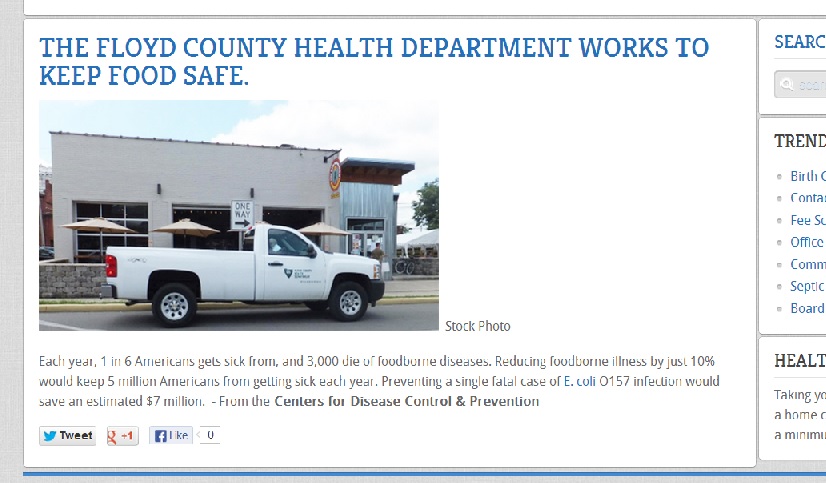
From about July 29, the following image (with banner and text) was displayed at the health department's web site.


At daybreak on Tuesday, it had been a full day since NABC's legal team utilized the usual certified channels to inform Floyd County's commissioners and the county health department of our cease and desist demand and tort claim notice, both pertaining to the infamously staged and defamatory tableau above.

We decided to combat county government's traditionaly stubborn opaqueness by letting the community know exactly what was coming down, as summarized here:

A cease and desist, a tort claim notice, and Dr. Tom at large.

While the record-setting hit count blog turnstile spun, apparently the health department's elephantine gears were beginning to show signs of nudging ever so inefficiently, with the result that by 3:30 p.m., there was a departmental website alteration, which was described here: Floyd County Health Department adds photo of handsome devil to its web site, but retains actionable photo.


The "stock photo" that wasn't remained, as did the banner, but a smaller headline was appended with new text detailing public access news reported here at NAC roughly three weeks ago. Timely they're not. And yet the cleverness wasn't over. Around 10:00 p.m. yesterday, the web site underwent a second change. Now the Floyd County Health Department is working to keep food safe from Roger -- not E coli.


As Typhoid Roger, a veritable human pathogen, my legend as anti-hero now is cemented -- seared into the memory of all those gazing at the health department's web site, and thinking to themselves: Is this REALLY local government at work?

Amid the health department's renewed efforts to make this summer's seminar into something personal, permit me to point out yet again what it's really all about:

The New Albanian Brewing Company’s (NABC) is in a bit of a tiff with the Floyd County Health Department (FCHD). The spat was prompted by the FCHD, and it’s all about Indiana law, and whether the law considers beer to be food.

As much as I'd like to spend the day monitoring the health department's web site to see what sort of Animal House throwbacks are posted next, it's time to drive to Indianapolis for a Brewers of Indiana Guild quarterly meeting, during which there'll be the chance to receive updates as to our progress on the state front.

In the meantime, you are encouraged to let the principle players in this melodrama know what you think. Is character assassination on a govenrment agency's web site really the best use of tax dollars? Is this really the style of county government we need?

Write the commissioners here: commissioners@floydcounty.in.gov ... and write the FCHD’s Dr. Tom Harris here: tharris@floydcounty.in.gov

It's highly doubtful that any of them will reply, but please let them know where you stand.

Tuesday, August 13, 2013

Now the Floyd County Health Department is working to keep food safe from Roger -- not E coli.


Earlier today, I posted this:

A cease and desist, a tort claim notice, and Dr. Tom at large.

It is clocking somewhere around 1,500 unique hits as of 9:45 p.m. Note that this is an all-time, one-day record for this blog.

Then, there was this:

Floyd County Health Department adds photo of handsome devil to its web site, but retains actionable photo. 

It is pushing 800 hits. The total of unique hits scattered among six postings at NAC today and one last evening is in excess of 3,500. Verily, quite a few people are reading.

We now know that at roughly 3:00 p.m. today (Tuesday, August 13), whichever web wizard is deployed by the Floyd County Health Department, and paid with ice cream from Zesto, had altered the approximate surroundings of the photographic image that prompted NABC's cease and desist demand and accompanying tort claim notice. The title and actionable photo remained, only to be removed somewhere around 9:00 p.m. tonight.

Well, that's half the cease and desist demand. We as yet await Dr. Tom's heartfelt apology. The hilarious part about it is that now, my devilishly handsome and beaded mug remains attached to the same old banner headline about food safety.

Dude, how many times does it take to get it right?

Here's how the FCHD's page looked for the past two weeks:


And here's what it is was for about six hours today:


Reminder redux: THIS IS YOUR FLOYD COUNTY GOVERNMENT AT WORK.

I believe I hear pathogens dancing in the streets.

Floyd County Health Department adds photo of handsome devil to its web site, but retains actionable photo.

Earlier today, I posted this: A cease and desist, a tort claim notice, and Dr. Tom at large. As of 3:30 p.m., it has attracted 1,200 unique hits, four times the norm. Thanks for reading, and thanks to A for pointing out a new twist.

As of roughly 3:00 p.m. today (Tuesday, August 13), it would appear that the Floyd County Health Department has altered the surroundings of the photographic image that prompted NABC's cease and desist demand and accompanying tort claim notice.

The title and actionable photo remain.

The leering, junior highscapades reference to E. coli is gone, replaced by a strange press release telling the public what was reported here at NA Confidential several weeks ago: When the FCHD complied at the 11th hour in late July with the terms of NABC's Indiana Public Access records request, the complaint we filed as an inducement to observe legalities was no longer in play.

Duh.

Here's how the FCHD's page looked for the past two weeks:


And here's what it is now:


Hmm. With no photo removal and no apology, me thinks this "change" constitutes a rejection of the cease and desist, although considering the ongoing absence of adults on the FCHD campus premises, it's really hard to say, isn't it?

Given the "juvenile" nature of the FCHD's website hijinks, perhaps it bears reminding readers: This is a government agency at "work."

Really.

Thursday, August 08, 2013

ON THE AVENUES: The fruitless search for adults in county government.

ON THE AVENUES:  The fruitless search for adults in county government.

A weekly web column by Roger A. Baylor. 

The New Albanian Brewing Company’s (NABC) is in a bit of a tiff with the Floyd County Health Department (FCHD). The spat was prompted by the FCHD, and it’s all about Indiana law, and whether the law considers beer to be food.

That’s entirely it, so don’t be confused by a government agency’s lowball tactics.

---

For reasons that remain obscure, on June 14, 2013, the FCHD elected to assert a share of control over beer pouring events, which are already subject to Alcohol & Tobacco Commission (ATC) guidelines. Without advance notice, the FCHD demanded that NABC procure a temporary food serving permit just to pour draft beer. Subsequent explanations were slow in coming from the FCHD, and when they finally did, the word “Orwellian” best describes their tenor.

The FCHD’s move to control beer pouring events constitutes an unprecedented and frankly bizarre break with more than seven decades of regulatory history in Indiana, during which all licensing, control and enforcement of alcoholic beverages comes solely from the ATC. If the FCHD decision stands, Floyd County would become the only county out of 92 in Indiana where the health department is allowed such an egregious expansion of its powers.

NABC has objected strongly to this outrageous usurpation, and while complying under written protest with the unprecedented permit demand, we have followed the appeal process as the rules mandate. We also filed a request with the Indiana Public Access counselor, compelling the FCHD to yield citation documents that severely undercut the department’s own wobbly case.

We then asked for an appeal before the health department board, which issued a contradictory ruling ripe for further judicial review – and rest assured, there’ll be further judicial review.

Perhaps owing to the transparent weakness of the FCHD’s legal justification, or more likely, because NABC has been especially effective at exposing the department’s charades via on-line and social media platforms, this story recent has taken an even uglier twist.

---

On July 24, the day before NABC’s health board appeal, an alert Bank Street Brewhouse employee saw a health department truck come to an illegal stop on Bank Street, just in front of Bank Street Brewhouse. The passenger got out and took a photo, then got back inside, and the truck drove away. On or about July 29, with the hearing concluded, and as we awaited the formal written decision, the photo appeared on the health department’s web site, where it remains.


Ladies and gentlemen, NABC’s current “discussion” with the Floyd County Health Department, which began on June 14 as described above, centers on one topic and one topic alone: Whether the department has any statutory basis to force alcoholic beverage vendors to acquire temporary permits. It is a question of whether alcoholic beverages are food, and subject to regulation as food, in a temporary setting alone.

It has nothing whatever to do with NABC’s two restaurants, both of which are licensed yearly by the FCHD, employ registered food handlers as managers, and are inspected on a regular basis according to health department procedures with which we have had little or no issue in the past, and ones that we’ve never been in violation of, in any apart from minor and immediately correctable ways.

The health department’s photo implies otherwise, and as such, it’s reprehensible. As you think about this, bear in mind that the FCHD is a government agency.

Are you in favor of a government agency using tax dollars for harassment of this fashion?

Are you in favor of Floyd County government taking a hands off approach with respect to such an abuse? Bear in mind that the FCHD answers to the three county commissioners, and while Chuck Freiberger attended the appeals hearing and has expressed a lively interest in this case, Mark Seabrook and Stephen Bush are entirely (and joyfully) AWOL.

Are you in favor of institutional hubris so pervasive that the FCHD denounces protests against its power grab as “juvenile,” while at the same time eagerly deploying a photographic smear that pole vaults past “juvenile,” landing instead in the territory of retributory and intimidating?

If you replied “no” to these three questions, I suggest you get involved. Let the principles know what you think. Is this really the style of county government we need?

Write the commissioners here: commissioners@floydcounty.in.gov

Write the FCHD’s Dr. Tom Harris here: tharris@floydcounty.in.gov

Let me know what they say in reply -- if they do.

Tuesday, July 30, 2013

Dr. Tom plays his Goebbels card. Can Neidermeyer be far behind?


Congratulations to my Facebook friend Rob Y, who accurately "called" the screen shot above last week. It began on Wednesday, July 24, when I noted the following on FB:

At roughly 2:00 p.m. today, a truck marked "Floyd County Health Department" stopped on Bank Street in front of Bank Street Brewhouse. The passenger got out and took a picture of the truck, with BSB in the background, then got back inside, and the truck drove off. What does it mean?

Rob replied:

I believe you'll see that photo again, as 'evidence' of having been onsite for some reason or another.

Bearing in mind that Dr. Tom "Dean Wormer" Harris's photo op was conceived before Otter and me made him aware of Fort Wayne v Kotsopoulos, it would seem that he's fully capable of juvenile (as opposed to Juvenalia) behavior, too.

Welcome to Delta House, Tom.