Showing posts with label street trees. Show all posts

Tuesday, January 07, 2020

Another year in Nawbany, and two more mature, living trees being felled.


The Townshend logging crew was taking a break, and I turned to one and said, "it's a shame, isn't it?"

"Sure is," he relied, "but that's what they wanted."

"They?"

"Yes, (gesturing to the west) the city."

"Were these trees dead?"

"No -- well, one had some bad spots. They're living, though."

(This article took less than ten minutes to write. I'm on sabbatical from involvement in public affairs, insofar as participating takes time I no longer have. But if you want to feed me straight lines, I'll toss off one-liners all day long. That's just FUN, as are short, barbed and factual commentaries like this one).

Saturday, August 24, 2019

Charles Marohn went to Paris and learned a lot of simple things that elude us in America.


"I’m not suggesting it would be easy or straightforward for North American cities to become Paris, but as my friend John Anderson has said many times, we don’t need to be Paris, we just need to be a slightly less crappy version of America."

I've trimmed this down a bit, hoping Marohn doesn't mind that I've left his five central observations intact.

---

The Streets of Paris, by Charles Marohn (Strong Towns)

1. Street Trees
Especially here in my hometown, I’m constantly hearing how we can’t have street trees, largely for maintenance reasons. The leaves drop and mess up the drainage. The roots damage the pipes. They are in the way for people in wheelchairs. Car drivers will hit them. And my favorite: If we ever need to widen the street, they are in the way.

And, of course, there is the persistent criticism of street trees: They won’t grow. My response to all of these criticisms has been to point to amazing places full of street trees and say, “If they can do it, why can’t we?” Paris is full of street trees, and it has been doing it successfully for a lot longer than any modern North American city has existed.

2. Ubiquitous Bollards
In the United States, our civil engineers often insist on a clear zone on each side of the street. You can ‘t place anything in the clear zone because, by the theory of Forgiving Design, if an automobile is driven off the driving surface, the sudden stop from hitting a fixed object will harm the driver and any passengers of the vehicle. This thinking is rightfully applied to highways and areas where we want traffic to move fast without the potential for conflict. When we apply Forgiving Design to local streets, though, we get absurdities like breakaway light poles along sidewalks. There isn’t a clearer statement of the North American engineer’s values than that.

I actually encountered an engineer once that didn’t allow a sandwich board sign because of the hazard it presented to automobiles should they strike it.

Needless to say, Paris has gone far in the opposite direction. Seemingly everywhere a vehicle could operate at speeds that would injure people, they have erected obstacles to keep the errant car from striking a human. Absorbing the kinetic energy of a collision is the responsibility of the car and driver, not the people walking along the street. This is cheap, easy, and really effective.

3. Narrow Streets
In the United States, we use transportation funding as a mechanism to address public safety concerns. Our fire departments often operate on the theory that if you can respond to an emergency quickly, the public is safer. European countries have a much different approach, one that emphasizes prevention over response time. Here in the United States, we require wide lanes, wide shoulders and wide clear zones along our streets so that emergency response vehicles travel unhindered to any emergency. The concept of a clear zone is ridiculous in Paris.

I’ll note that you are far less likely to die in a fire in a European city than an American one. Ditto a traffic collision. Two of our classic Strong Towns memes apply here.

4. Slip Lanes
When a design prioritizes building wealth in a place instead of moving traffic, the basic geometry of the public space shifts. In terms of wealth creation, I really like how this street is designed. There is human space on the edge; wide enough for two people to walk side-by-side and meet a pair doing likewise coming from the opposite direction. They are protected by bollards along the entire stretch. Then there is a one-way slip lane for drivers seeking a place to park a vehicle — these lanes are constrained to ensure slow speeds. Then there is a parking lane, although with a decent amount of that space given over to scooters and bikes. Then a boulevard to provide some vertical framing for the street in the form of street trees and nice lighting. The center has two driving lanes with opposing flow, and then it all repeats along the other side.

For cities that want to make their stroads into wealth-creating streets, this is a great cross section to utilize.

5. Shared Space Intersections

Finally, I’m a huge fan of shared space intersections—intersections that lack traffic markings, including stop signs or traffic signals—and I ran into a great one in Versailles. With tired kids and wife, I didn’t get to linger as long as I would have liked to, but in the short time I was there, I did see the humane mingling of humans and vehicles induced by slow speeds and the more chaotic design.

The idea of a chaotic design is anathema to everything North American engineering practice stands for, yet when drivers are less sure of their own path—let alone the path of others—they do remarkable things like slow down, look people in the eye, and yield. It’s a beautiful thing to watch; it’s just too bad there are so few examples here in the United States.

Saturday, September 15, 2018

Aside from New Albany, "Designing greener streets starts with finding room for bicycles and trees."


The pain of missed opportunities.

Designing greener streets starts with finding room for bicycles and trees, by Anne Lusk (The Conversation)

City streets and sidewalks in the United States have been engineered for decades to keep vehicle occupants and pedestrians safe. If streets include trees at all, they might be planted in small sidewalk pits, where, if constrained and with little water, they live only three to 10 years on average. Until recently, U.S. streets have also lacked cycle tracks – paths exclusively for bicycles between the road and the sidewalk, protected from cars by some type of barrier.

Today there is growing support for bicycling in many U.S. cities for both commuting and recreation. Research is also showing that urban trees provide many benefits, from absorbing air pollutants to cooling neighborhoods. As an academic who has focused on the bicycle for 37 years, I am interested in helping planners integrate cycle tracks and trees into busy streets.

Street design in the United States has been guided for decades by the American Association of State Highway and Transportation Officials, whose guidelines for developing bicycle facilities long excluded cycle tracks. Now the National Association of City Transportation Officials, the Federal Highway Administration and the American Association of State Highway and Transportation Officials have produced guidelines that support cycle tracks. But even these updated references do not specify how and where to plant trees in relation to cycle tracks and sidewalks.

In a study newly published in the journal Cities and spotlighted in a podcast from the Harvard T. H. Chan School of Public Health, I worked with colleagues from the University of Sao Paulo to learn whether pedestrians and bicyclists on five cycle tracks in the Boston area liked having trees, where they preferred the trees to be placed and whether they thought the trees provided any benefits. We found that they liked having trees, preferably between the cycle track and the street. Such additions could greatly improve street environments for all users.

Saturday, September 01, 2018

Yo, progressives -- sidewalks are a social justice issue. But we spend a lot more on paving, don't we?


Don't strain your eyes looking. There were no signs warning of a closed sidewalk throughout the period of work, even though handicapped users could not pass. How much effort can it possibly take to think FIRST about walkers and handicapped users? 

My new work schedule has made it somewhat impractical to attend city council meetings, but I can still read the minutes.

It's budget time, and in the minutes from August 16 there was a casual mention of combining money from two different funds to free as much as $3 million for paving in 2019. Note that this sum addresses paving alone. It does not include various other street expenditures, the bulk of which go toward automotive-enoblement projects.

It would be interesting to arrive at a comparison of car-centric expenditures and those going to improve and enhance non-automotive options. I think it's safe to say that sidewalks (to name just one) receive much less investment on an annual basis. At the risk of error, my guess is that we rely primarily on Community Development Block Grants for the cash for sidewalk improvements. This excerpt is from the 2015 CDBG draft.

Sidewalk Spot Improvements $1,100,000: Funded throughout the Five-Year Plan to provide for improvements where deteriorated sidewalks restrict connections that can benefit pedestrians or to repair spot basis sidewalks where incidental deterioration exists. Sidewalk improvements of approximately 1,795 linear feet are planned each year. Americans with Disabilities Act (ADA) compliant ramps are included.

Um, impressive.


Dear reader, do you think of yourself as a progressive? If so, are you aware that deteriorating or non-existent sidewalks are a social justice problem of escalating dimension?

Read on, if you dare.

Crumbling Sidewalks Become a Legal Battleground, by Adina Solomon (CityLab)

A lawsuit in Atlanta reflects a growing movement that demands accessible, well-maintained sidewalks—and rejects budgetary constraints as an excuse.

I'm shocked -- SHOCKED -- at the possibility of cities not properly budgeting for sidewalks.

For one thing, the ADA became law nearly three decades ago, in 1990. Section 504 of the Rehabilitation Act, which guarantees certain rights to people with disabilities, dates back to 1973.

“At this point, it’s hard to imagine that cities aren’t appropriately accessible,” says James Harrington, an adjunct professor at the University of Texas at Austin and founder of the Texas Civil Rights Project. He has worked on sidewalk-related cases in Texas. “The ultimate defense, of course, is they can’t afford it, but when you’re looking at 30 years of notice, then it’s hard for them to say they can’t afford it had they not structured it into their budget as they were supposed to from the beginning.”

Attorney James Radford, who is representing the plaintiffs in Atlanta, says he spent two to three years on research before filing the lawsuit. He met with people in wheelchairs and looked at sidewalks across the city to gauge whether maintenance was a systemic issue. He also found a 2010 report from Atlanta’s Department of Public Works saying 18 percent of the city’s sidewalk network was categorized as deteriorated.

“If you look at the budgets over time, they just decided not to fix it,” Radford says.

But ... but ... annual paving is the very basis of pay-to-play!

And it’s important to remember that it isn’t just a matter of convenience.

“Cities should invest in sidewalks if they want to increase walkability, often for some of the most vulnerable parts of the population, but [also] for the general population as a whole,” Loukaitou-Sideris says. “Now that we have the back-to-the-city movement, we have more people walking or wanting to walk. As costly as it is, it is not as costly as paving highways.”

Of course, New Albany municipal bureaucrats typically cite their own long-neglected sidewalks as an excuse to mow down street trees accused of buckling walkways, but subsequently they repair only a fraction of the sidewalks thus liberated from the insidious tyranny of shade.

Can old trees and sidewalk repairs co-exist? New Albany's lickspittle clique says no, but surely there's a way, although we probably won't discover a solution for so long as Nanny Barksdale insists on clearcutting anything green (except money).

Seismologists record earthshaking Tree Board orgasms as Schoolmaster Barksdale's chain saw strikes again.


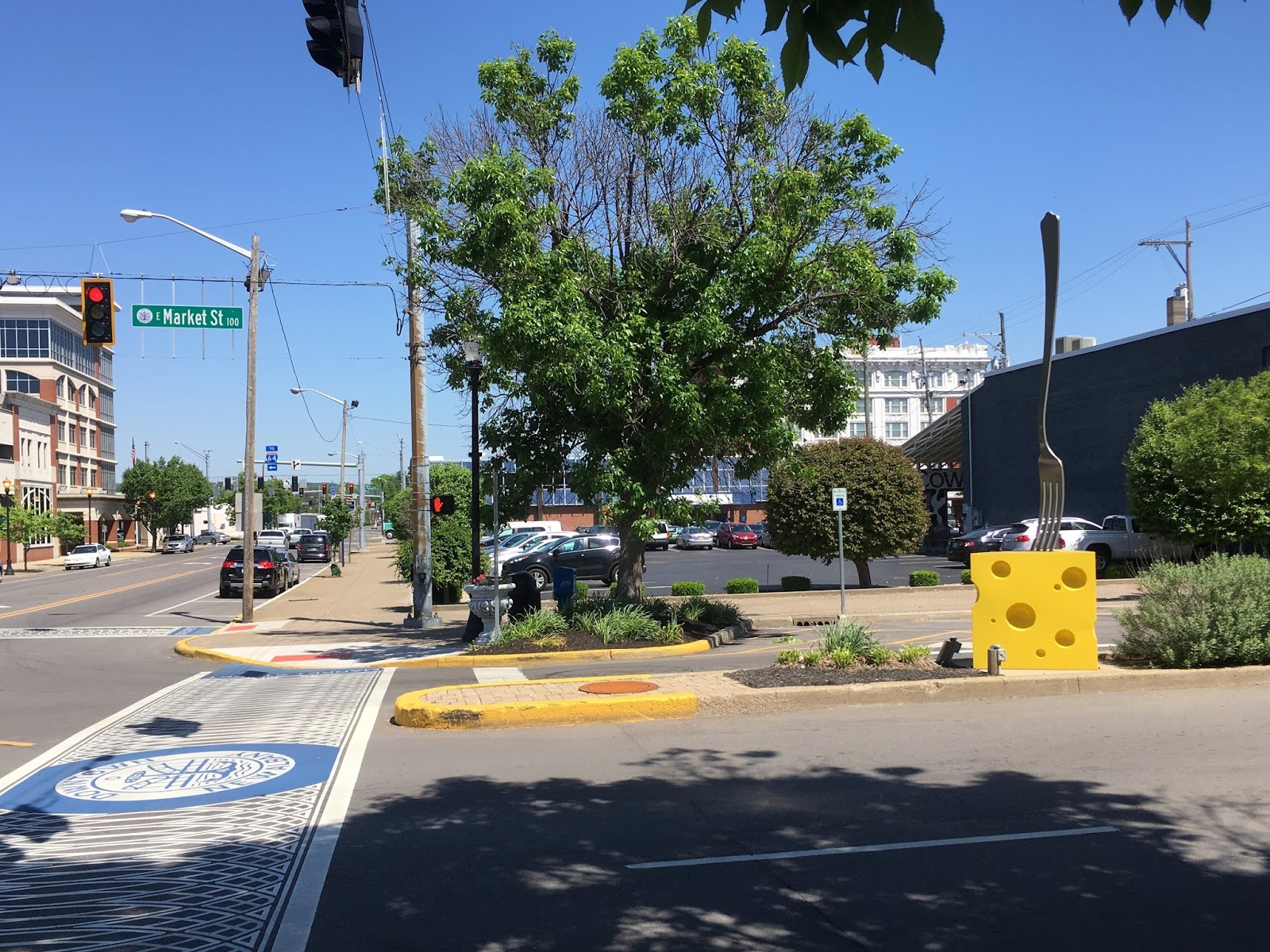
Meanwhile, the newspaper's most recent reporter hire dug a bit and learned that the street tree recently landing atop a car on the south side of the 100 block Market Street -- this being the side of the street slated for zero improvements according to the city's latest sycophant-endorsed plastic Disneyfication plan -- had been reported repeatedly to the city by the business owners nearest it.

Here finally was an obviously rotting tree, one certifiably justifying pre-emptive removal, and of course the city did nothing; however, once the tree fell, all remaining living things on the block were removed and light landscaping followed at a glacial pace, taking something like six days, with parking in front of the salon blocked throughout.

That'll show them for running to the newspaper instead of Big Daddy G. As for Ms. McAfee, she'd best be careful with truth-telling like this. Deaf Gahan might get huffy and cancel his newspaper ads -- and without ads, how can Bill dispatch an editor all the way to Evansville to cover Herr Drumpf?

New Albany business owners frustrated with delays in removing tree, by Brooke McAfee (Tom May[de] in the Shade)

NEW ALBANY—Local business owner Angela Shaughnessy said she wishes the City of New Albany had taken immediate action to remove a hazardous tree before it fell.

On Wednesday, a tree uprooted and fell on top of a car parked downtown on Market Street in New Albany.

The car was damaged, but it was unoccupied at the time. No injuries were reported.

Shaughnessy, co-owner of Downtown Style on Market Street, said she and her business partner have called the City of New Albany multiple times about their concerns with the tree. The tree was located outside of her beauty salon, and she noticed that large portions of the tree's base were visibly hollow.

"I don’t know how it was still standing," she said ...

Friday, August 17, 2018

Seismologists record earthshaking Tree Board orgasms as Schoolmaster Barksdale's chain saw strikes again.


It's been a tough week if you're a downtown New Albany street tree.

When one of your brethren decided to strike a blow against car-centrism, it was inevitable that hostages would be taken, tried, sentenced and quickly dispatched.

No last meals or final requests, just those signature red plastic bands -- and the sound of chortling from Schoolmaster Barksdale as his trademark Husqvarna was lubed and revved for duty.


Early this morning, the latest round of carnage was complete on the orphaned south side of Market, by Hannegan Hall.


Fellow street tree, your appointment with the Robespierres of the Tree Board will soon be processed.

But for now, there goes your brother, off to be rendered into firewood, with the proceeds destined to be deposited into Dear Leader's burgeoning re-election fund.


Earlier in the week, for no apparent reason, this row of street trees on Elm Street by the former St. Mary's school received the condemned terrorist treatment.


Sarcasm aside, if once -- just once -- an elected or appointed city official would mention aloud the issue of urban heat islands (to cite one relevant example), and display a semblance of awareness of the implications, then I'd be more inclined to accept his or her persistent tree removal reasoning.

But when the rationale for removal embraces the crazed notion that trees must be removed so our precious historic buildings can be properly viewed by people in passing cars who are too lazy (or overheated) to get out and walk, then I call bullshit -- and will continue to do so.

Previously:

Earth to Gahan: Street trees increase home prices, shade trees reduce household energy use, and these effects can be measured and expressed in dollars.

Chainsaws are the soundtrack to our anchors: "How Should We Pay for Street Trees?"

#FlushTheClique

Monday, May 28, 2018

Team Gahan's condiments are aligned and measured, and these trees likely are doomed by yet another non-transparent "beautification" plan.


It's another backroom design contract (HWC?), another campaign finance-loaded bid (Allterrain), and another non-transparent Team Gahan "fix."

Summers announces plan to "Walk the Walk" by enhancing car-centrism via the Market Street medians. We advocate nuking them to outer space.


In an e-mail, I asked David Barksdale a few questions.

He's one of three at-large city councilman who have the job of representing us all, even public housing residents, and he also is a member of the redevelopment commission as council appointee.

Lately he's embraced the role of de facto project manager for Jeff Gahan's sanitized suburban overlay for the historic downtown business district.

Which should remind us that there is a tendency among autocratic personality types to harness design and appearance toward the reinforcement of their personally pervasive patterns of grandiosity -- like the time Frank Burns explained to Hawkeye Pierce why he was having the ketchup and condiments measured.


"Well, if you kneel at the end of the tent and get the tabletop at eye level, you will see that each bottle of ketchup lines up behind the other, unless there's only one bottle of ketchup. Now the same is true of your condiments which, if you will note, are arranged according to height and popularity. There's your ketchup, your mustard, your relish, your mayonnaise, your oil and vinegar, your salt and pepper, and your sweet and sour gherkins all in a row."

In short, just like our anchor-laden crosswalks, beautifully doing absolutely nothing to protect walkers from drivers.

Where was I?

Oh yes, my futile e-mail to CM Barksdale.

It has been announced that there'll be changes made to the block of Market Street between State and Pearl, these coming without any chance for the public to see what's planned, or to provide input. Property owners and business people located on or near this stretch might like to be informed of these changes, don't you think? Are there any plans to accept input, or is it another trademark top-down diktat?

He is to be credited for replying, which is more than his favored comrades at Develop New Albany are capable of doing.

Hello Roger,

This is a NARC project and was discussed at the May 9 & 15 meetings..

Larry Summers is the lead person on it.

Dave

Unfortunately it's a lame, bureaucratically evasive reply, kicking the ball to the non-elected city engineer Summers, who I'd have asked in the first place had Summers not already blocked me on social media. What's more, I can't seem to find the city engineer's e-mail address anywhere on the city's web site, so in a return e-mail, I asked Barksdale if he had an e-mail address for Summers.

Pins drop, crickets chirp. To date, only silence. This closing comment recently was overheard during a curbside discussion of Gahanism in New Albany.

"Why do the folks on 'Mansion Row' get to keep their trees (which sport two lights each and underground watering as well) but the plebiscite have to endure Market Street trees cut down to 'improve the appearance’"?

A damned fine question. Good luck convincing the self-appointed community pillars to answer it, as they're busy confusing their own wants for the city's needs.

Tuesday, May 01, 2018

Come to Stump City: Yet another artlessly staged photo purports to show that Deaf Gahan really cares about trees. Problem is, history suggests otherwise.


No single administration in recent memory has felled as many trees as Team Gahan.

No single governing clique in recent memory has failed as often as Gahan's when it comes to making trees a genuine priority during this time of urban heat island awareness.

No single Republican in recent memory has filled as many ground-down stump holes for a Democratic mayor with such enthusiasm as David Barksdale.

No single Tree Board in recent memory has fizzled for so long resisting a legitimate request for meeting minutes (mine dates to May of 2016), although it must be conceded that Bob Caesar holds the record for sheer longevity insofar as refusing to divulge information to taxpayers requesting it.

The following randomly arranged photos depict some of the highlights of Gahan's clear-cutting fetish these past six years. How much more of this strange "love" can the city's tree canopy withstand?


And every now and then, he just pretends.


It doesn't convince anyone.


Previously (August 2017):

Team Gahan has clear-cut virtually the entire city, so it's the perfect time to begin pretending the junta cares about trees.

Wednesday, October 04, 2017

Chainsaws are the soundtrack to our anchors: "How Should We Pay for Street Trees?"

Don’t ask Jeff Gahan about tree canopies or heat islands. He can’t hear you for the pervasive sound of chainsaws.


Yes, I understand that articles like this one speak of matters from the perspective of larger urban entities than New Albany.

And I also understand that an urban canopy cannot be funded as part of a city's public health infrastructure when no such thing even exists. Work with the Floyd County Heath Department? It's one instance where I'd laugh along with Deaf Gahan.

My point: the Tree Board can be funded to do more than it does at present, and what it does at present needs to be open and transparent. Currently it is neither, and that's why until Gahan proves he isn't the most profound serial feller of trees in the city's recent history, I'll keep suggesting he is.

Urban canopy master plan, anyone?

How Should We Pay for Street Trees? by Teresa Mathew (CityLab)

A new report argues that the urban canopy should be considered—and funded—as a part of a city’s public health infrastructure.

Trees have proved to aid mental health, decrease obesity and other health risks, and just generally make people happier. But they are often thought of as a luxury rather than a vital component of healthcare or urban infrastructure. In a new report, The Nature Conservancy, a conservation-focused nonprofit, argues that trees are an important public health asset and should be funded as such.

“Just like the public health sector has gotten used to thinking about walkable cities as something they need to care about, we’re advocating that they need to think about nature and parks as part of that quest,” says Robert McDonald, a lead scientist at The Nature Conservancy and co-author of the report.

McDonald hopes that cities will start to integrate urban forestry into their other health, wellness, and environmental initiatives. Despite the benefits, there are multiple reasons why tree planting falls by the wayside. For one, it’s a process that often requires the coordination of multiple agencies—not just forestry, but other departments like transportation and water. “We’ve set up our cities so there’s one agency to manage trees and parks, and they don’t have a health mandate. Other agencies do care about health, but don’t have a mandate to plant trees,” McDonald explains. Cities often do not see the link between residents’ health and the presence of trees.

Wednesday, September 06, 2017

Earth to Gahan: Street trees increase home prices, shade trees reduce household energy use, and these effects can be measured and expressed in dollars.


Following up on Saturday's post ...

Pusillanimous prioritization? Nickels and dimes later, it remains that we need HUNDREDS of trees planted yearly, not a few dozen.

There it is, in a nutshell. The city needs hundreds of trees planted, not a few dozen, and confronted with this fact, the city council president can think of nothing more relevant to suggest than a bake sale.

Presumably we can hold this nickel-and dime event in July amid the urban heat island. Or, we might fund the Tree Board to succeed -- and if city officials ever stepped outside their air conditioned cars and walked a few blocks, they might grasp the need.

... our friend W found two informative links. First, what it costs to plant trees.

Tree Planting Costs

Tree planting is a special task that can add to property value and increase curb appeal of the property, and may also serve to better separate your property from neighbors.


Average cost of a 4’ - 6’ tree, planted (about $ 106 each)

Then, how to determine what these trees are worth in cold, hard cash value.

Calculating the Green in Green: What's an Urban Tree Worth?

For urban dwellers, trees soften a city’s hard edges and surfaces, shade homes and streets, enhance neighborhood beauty, filter the air, mitigate storm runoff, and absorb carbon dioxide. Trees may even reduce crime and improve human health. However, these benefits have not been well quantified, making it difficult for urban planners and property owners to weigh their costs and benefits or assess tree cover against competing land uses.

New research from the Pacific Northwest (PNW) Research Station demonstrates that street trees increase home prices in Portland, Oregon, that shade trees reduce household energy use in Sacramento, California, and that these effects can be measured and expressed in dollars.

A study led by economist Geoffrey Donovan, research forester with the PNW Research Station, determined that trees planted on the south and west sides of Sacramento houses reduced summertime electricity bills by an average of $25.16. In a second study in Portland, Donovan’s team found that street trees growing in front of or near a house added an average $8,870 to its sale price and reduced its time on the market by nearly 2 days. These economic benefits spilled over to neighboring properties: a neighborhood tree growing along the public right¬of-way added an average of $12,828 to the combined value of all the houses within 100 feet.

Tuesday, July 04, 2017

ASK THE BORED: Years and years later, finally those stumps in the verge have been pulped.

They're literally on the verge of vindication.


Or maybe this swing era song is better. We need change only one word.

Grind me, baby, eight to the bar.


There must have been a leak, and someone was told about my stump stenciling plan.

Ah, but you see, I merely planted the rumor in order to impel them to ridiculously belated action. Devilishly clever of me.


Back in March, the whole story was unspooled.

ASK THE BORED: You can't always get tree stumps zapped when you want, but if you're a V.I.P. -- well, you get what you need.

Contrast this level of prompt, efficient service with the half-block of Spring between my house and 11th Street, where there exist eight stumps of indeterminate vintage (dead trees taken down within the last six or seven years), and perhaps two living replacements.

I believe they got seven of eight stumps on Monday morning. There was a car parked in front of one. The whole process took about an hour. I'm not sure who to thank, but thanks.

Now, about those replacement trees ...

(BOW meets on Wed., July 5 owing to the fireworks holiday)

Sunday, March 19, 2017

Tree-based sexism: "Decades of urban landscaping sexism are partly to blame for high pollen counts."


Yes, of course I have a link to match the meme.

Sniffling and sneezing? Too many male trees are (partly) to blame, by Aimee Custis (Greater Greater Washington)

With February's early warm weather, DC's pollen counts are climbing earlier than usual. What you might not know is that decades of urban landscaping sexism are partly to blame for high pollen counts.

That's tree-based, not people-based, sexism. Some common types of trees used in urban landscaping are dioecious, meaning individual trees are either male or female.

When it comes to dioecious plants, cities tend to prefer planting males to females because females drop fruit or seeds that the city then needs to clean up. The most notorious female offenders are gingko trees, whose undesirable smelly fruit plague residents with "strong notes of unwashed feet and Diaper Genie, with noticeable hints of spoiled butter."

But male dioecious trees don't drop seeds or fruit. Instead, in the spring, they release pollen.

With February's early warm weather, DC's pollen counts are climbing earlier than usual. What you might not know is that decades of urban landscaping sexism are partly to blame for high pollen counts.

That's tree-based, not people-based, sexism. Some common types of trees used in urban landscaping are dioecious, meaning individual trees are either male or female.

When it comes to dioecious plants, cities tend to prefer planting males to females because females drop fruit or seeds that the city then needs to clean up. The most notorious female offenders are gingko trees, whose undesirable smelly fruit plague residents with "strong notes of unwashed feet and Diaper Genie, with noticeable hints of spoiled butter."

But male dioecious trees don't drop seeds or fruit. Instead, in the spring, they release pollen.

Horticultural epidemiologist Tom Ogren traces the modern preference for male trees to around 1950, when the USDA released a book that promoted planting male trees over female trees for easy, litter-free maintenance. The idea caught on with private homeowners, nursery suppliers, and city planners. At the time, Dutch Elm disease was on the uptick, and swaths of trees in US cities were being replaced. Today, DDOT's Design and Engineering Manual (section 47.4.4) confirms that "...trees near walks should be thornless and fruitless to minimize maintenance," though of course there are plenty of fruitless trees that aren't dioecious males.

Favoring male trees isn't a bad idea in itself, and Ogren believes no one had any bad intentions. "But when a city does this on a massive scale, it has a huge impact on the health of the people who live there," he said to Governing. Ogren, who developed the Ogren Plants Allergy Scale (OPALS) used by the USDA and American Lung Association, says planting more female trees will reduce the pollen count in a city.

That makes sense. The job of female trees is to capture pollen, essentially acting as natural air filters. But when they're nearly non-existent, we're left with a ton of pollen in the air with no females to trap it ...

Tuesday, March 07, 2017

ASK THE BORED: You can't always get tree stumps zapped when you want, but if you're a V.I.P. -- well, you get what you need.

As we enter Year Six of the Chronicles of Gallant New Gahania, the perennially moribund Tree Board is showing a faint glimmer of life despite Adam Dickey's presence in a seat.

(see the bibliography at article's end) 

As you read Elizabeth Beilman's February 9 newspaper coverage, bear in mind that even as Jeff Gahan's "parks and recreation" fetish -- which always was more about power than production -- has occupied a disproportionate place in his agenda, hundreds of trees outside the boundaries of his suburban-flavored parks have fallen. Some were dead, others living.

A huge number were brought down for the noble cause of making a Greenway auto-friendly.

During a time of enhanced urban heat island effect, and as the mayor plays his oblivious daily shell game about "walk-ability," which can be translated as "drive-ability," seeing as he hasn't once grasped what it really means, these (shade) trees generally have not been replanted until the cost can be shifted elsewhere, as with grandiose street reconstruction projects financed by the federal government.

In short, under Gahan, the urban tree canopy has received far more contempt than scant attention. Maybe that's changing.

New Albany reenergizes tree protection efforts; Grant to fund tree inventory, management plan, by Elizabeth Beilman (N and T)

NEW ALBANY — The New Albany Tree Board is preparing to take on a larger presence in the community, and it will start by taking stock of city trees.

A $20,000 federal grant from the Indiana Department of Natural Resources will allow the tree board to conduct an inventory of trees planted on city property and then create an urban tree management plan.

"We want to take on a bigger role, because we are losing trees at a fast rate, and we want to make sure that we plant more than we're losing," tree board member and New Albany City Councilman David Barksdale said.

Once the city has a management plan, it will be eligible to receive more grants to buy trees.

"The average person is not going to see this management plan," arborist and tree board adviser Greg Mills said. " ... What you're going to see is the trees that get planted later as a result."

In essence, kudos to anyone who gives a damn, because the upper echelons of Team Gahan clearly do not, and probably won't respond to any tree-related issues -- unless, of course, you're an insider.

Last May, I attended a Tree Board meeting, intent on gathering information (stop me if you've heard THIS one before) which does not exist on-line. By the way, I've never gotten the info -- and curiously, Bob Caesar isn't even on the Tree Board.

The mayor appoints the members of the Board of Works. The mayor appoints the members of the Tree Board.

Whatever work the Tree Board does with respect to cutting, planting and maintaining trees on publicly owned lands and right-of-way is at the behest of the Board of Works, which is given marching orders by the mayor. Shocking, isn't it?

The Tree Board is lamentably understaffed and mostly non-funded. Currently it is short a board member, and to hurriedly arrive at a conclusion for this extremely depressing digression, it comes down to Oz's Whim.

In short, Team Gahan decides whether a tree stays or goes, irrespective of whether the tree is healthy or dying, and quite apart from extraneous considerations of aesthetics, storm water abatement or Urban Heat Islands.

I’ve no reason to believe the Tree Board isn’t well-meaning, or doesn’t try its best. I'm satisfied it does what it can -- and what it can do is highly circumscribed.

Judge Terry Cody also was there at the May meeting. Because there was no quorum, nothing official was decided, but an informal discussion occurred as to Cody's desire to have the trees by his Green House removed. Apparently there was an issue with roots. Heads nodded. The plan was already in its secure pipeline.

As I awaited requested information that never arrived, by November the first three of Cody's city street trees disappeared from the 3rd Street side.


Two months later, the stumps were gone and the sidewalk had been poured without cutouts for replanting. Three down, none to come.


Contrast this level of prompt, efficient service with the half-block of Spring between my house and 11th Street, where there exist eight stumps of indeterminate vintage (dead trees taken down within the last six or seven years), and perhaps two living replacements.


Ironically, my council representative lives as I do within spitting distance of these stumps, but apparently they've escaped his scrutiny. Naturally, this is a scene repeated up and down Spring Street, throughout Greg Phipps' district. Those pesky details.

Yes, we understand that a previous generation of city planners serially botched tree plantings.

It's understood that they planted the wrong trees, perhaps because someone could make a few quid off his brother-in-law's nursery business.

That's right; a monoculture was created, and it's expensive to reverse the process, especially when the mayor insists on funding golden statues of himself rather than eco-friendly aids to urban existence.

We even understand that it's the way of the world when someone like Cody receives preferential treatment -- not so much owing to his position or family history, but as a member of an endangered species, the Floyd County Democratic Party.

And yet ...

Couldn't the city at least remove the effing stumps after a year or two or eight?

I'm told that the city doesn't even own a stump grinder. It rents one when needed. You'd think there'd be chump change left over from the $19 million "green space" TIF bond expenditure for minor considerations like this.

A SELECTION OF PREVIOUS ARTICLES

Unheard of in New Albany: "Going forward, I will be more sensitive to the spectrum of concerns regarding trees."


At least this time Pinocchio felled his OWN tree.


"Eventually there'll be a plan to replant" the clear-cut tree cover, but of course no one can say what or when that might be.


Politics, good judgment, social media, and why I refrained from voting in the Floyd Circuit Judge race.


2016 council budget hearing: Money for the Tree Board to cut trees, or plant them?


Placing a dollar value on the services that street trees perform.


Unlike New Albany, "The people of Somerville, Massachusetts really, really care about trees."


New Albany's Tree Board -- statute, staff and board members.


Whatever happened to the Tree Board, anyway?