New Albany is a state of mind … but whose? Since 2004, we’ve been observing the contemporary scene in this slowly awakening old river town. If it’s true that a pre-digital stopped clock is right twice a day, when will New Albany learn to tell time?
Classism versus classicism? The words have very different meanings.
classism
[klas-iz-uh m] noun
a biased or discriminatory attitude based on distinctions made between social or economic classes.
the viewing of society as being composed of distinct classes.
There was a time when I was knowingly and even joyfully classist pertaining to beer. In fact, it was the basis for my career in beer. In the sense of social classes, my viewpoint held that mass-market beer drinkers were the willfully ignorant lower class, suitable for abuse by those who had grasped higher "better beer" truth.
Recall the Miller Lite advertising tag in the early 1990s: "It's IT and that's THAT."
My rejoinder: "It's SHIT and that's THAT," and the FOSSILS homebrewing club had buttons made as a form of provocation.
It seems a bit silly now, and in my defense the cascading abuse was accompanied by unrelenting efforts to educate about beer for anyone inclined to pay attention.
Then a funny thing happened, because we "won" and the beer world changed, kinda sorta. However, I awoke one morning to find the world hadn't changed quite to my liking; now everyone knew about good beer for so long as the libation in question referred to itself as an IPA. Other styles and traditions had been completely forgotten by the attention-deficit-impelled New Wave.
Being contrarian by nature as well as long practice, this implied a rethink, and I became a proud beer classicist.
classicism
[klas-uh-siz-uh m] noun
the principles or styles characteristic of the literature and art of ancient Greece and Rome.
adherence to such principles.
the classical style in literature and art, or adherence to its principles (contrasted with romanticism).
a Greek or Latin idiom or form, especially one used in some other language.
classical scholarship or learning.
Toward this end and for my present purposes, "classicism" suggests a preponderance of the fifth definition, "classical scholarship or learning." In short, back to beer basics and familiarity with all the styles, not just two or three. Everything I'm trying to do with the beer program at Pints&union is centered on a classicist approach to beer, emphasizing long-held values while not excluding the new, but contextualizing the past 30-odd years within the framework of classicism.
And yes, Pints&union has mass-market beer, too. On that front, it was a case of me getting over myself, and I've succeeded ... most of the time. I've highlighted the closing sentences of this coda.
Many enjoy classical concerts, and for many different reasons. For veteran subscribers, those reasons will often be a combination of social and professional, as well as inspirational. But it is the rarity of the occasion of classical events that give us the feelings of ease, elegance, thoughtful study, even moral purpose and clarity. People dress up, are especially civil, and expect to experience some of humanity’s highest artistic achievements. Some enjoy that we can all feel classy together; enjoying a lifestyle we can’t afford. Symphony Hall and the Opera House will do that, but this has more to do with a classicism that says everyone deserves beauty, and must not be mistaken for classism that says only the cogniscenti deserve beauty. The former can unite us all, while the class warfare of the latter divides us.
I'm writing these words on the 15th of December, imagining that on the morning of the 21st, I'll have consumed too many delicious Rauchbiers at Schlenkerla in Bamberg on Thursday night. Vegas won't touch the action on this particular assumption.
By early afternoon, we'll be taking the train back to Munich after the overnight stay, and pausing only momentarily before heading to the arena for the basketball game (FC Bayern and Braydon Hobbs vs. Real Madrid).
Prior to leaving Bamberg, something I never find it easy to do, let's turn back the pages to a post prompted by our 2009 visit during Christmas.
In the purest of anthropological senses it was a revelation to witness the holiday observed with a manner of dignity and traditional restraint, at least by prevailing and manic American consumer standards.
In 2009, the genuine wintry weather in Bamberg provided ample opportunity to drink beer and eat pork indoors, in proximity to grandly tiled stoves fairly pumping heat, with an inevitable chilly contrast when it came time to use the restrooms. While not about Christmas in any specific sense, these observations now invariably strike me as seasonal.
---
Beer ... and the pissoir.
Any farm boy can tell you what happens in winter, when hot liquid hits frozen ground and steam rises, and so my youthful reveries tending our livestock came back to me after I made my way from the toasty upholstered interior of the beer café, through the entry door, across a corridor, through a second door, and outside to where the restrooms were located just off the snowy, arched passageway leading from the street.
They were unheated, with a predictable temperature differential. I was in and out in a flash, returning to cool smoked lager in a far warmer room.
At least there was plumbing, albeit frigid fixtures.
It hasn't always been the case. In 1999, while drinking draft Baltika in Moscow at a tiny bar located in the concrete bowels of a towering modern concrete housing block, my fumbling water closet query in deficient Russian was met with a shrug. The bar man gestured in the direction of what proved to be a slippery collection of muddy shrubs around the darkened corner.
It may have been Archie Bunker who observed, “You don’t buy beer, you rent it,” and your humble columnist has gleaned a fair amount of experience in such matters in his career as professional beer drinker, especially when imbibing in Europe. Many aspects of the continent’s beer and brewing cultures have changed since 1985, but none more so than a steady escalation in cleanliness and comfort of the facilities at a typical watering hole.
Good, bad or indifferent, my personal theory is that such improvements owe more to the course of the women’s liberation movement than the interest of most males in facets of basic hygiene. In all likelihood, publicans continued pointing to the bushes out back until modernity brought changes in migratory patterns, in the form of female patronage. Only then were modern plumbing solutions contemplated.
Beer and Bamberg (Germany) are gloriously intertwined, which is why I became a regular visitor so long ago. During the 2009 Christmas trip, it suddenly dawned on me that the pleasant modern urinals in the men’s room of Brauerei Spezial (founded in 1536) weren’t there until the late 1990’s. Before that, men urinated into tiled trenches running along the floor. These trenches presumably emptied into the sewer system, although sometimes it’s best to take nothing for granted.
While I hardly can attest to how it was done during the Middle Ages, or even as recently as the 1970’s, my impression is that the process of waste disposal always has differed little from my experience in Moscow, or this one in Albania, circa 1994: A lovely, contemporary wood-lined room with a spotless, modern stainless steel urinal … connected to PVC pipe, which led outside to termination just shy of the town’s riverbank.
Unscientifically speaking, you can look at the many centuries-old brewery taps and public houses in places like Bamberg and see that restrooms weren’t included in the original architectural designs. They were added later, away from the seating areas, often tacked onto the interior courtyards that are a familiar feature of these older buildings.
Modernity has deprived us of the European waste disposal mechanism I miss the least: The fearsome female restroom attendant. Sometimes she was ensconced behind sliding glass windows, but more often she remained seated at a rickety wooden table in front of the battery of stained tiles, guarding her ceramic plate, which was intended for loudly smacking coins into, indicating you’d paid the required tariff and qualified for a square of toilet paper (if really necessary).
In theory, the women were there to keep the area clean, and surprisingly, they often did just that, sometimes while you were otherwise engaged in your business. It made for initial embarrassment, but after all, they were skilled and highly professionals, only doing their jobs.
Male toilet attendants were permitted, but invariably they were less reliable than the elderly ladies, especially as the geography passed eastward from capitalism to communism. When I was teaching English in Slovakia, I was a frequent customer of a venerable drinking establishment where the restrooms were in the basement (not uncommon).
My preferred brand of beer also was the nightly preferred beverage of the subterranean lavatory commandant. Whenever his plate contained the requisite number of coins, he would climb the stairs for another pint of pay package, and by closing time, he could be found unconscious at his post, snoring in the sour, fetid air.
Normally I'm not prone to hyperbole, but I'll make an exception in the case of Pilsner Urquell.
While Joe Phillips and the boys were busting their buns at Pints&union with the Harvest Homecoming crowds, I was lurking behind the scenes, gaining some valuable yardage toward a few of our beer program goals.
Among these are access to a broader range of Fuller's, both on draft and in bottles; Christmas specialty pre-orders; and prospects for the "three pour" Pilsner Urquell draft set-up in the opening video.
As for the latter, all due credit to our Monarch/World Class sales rep Joe Underwood for getting the ball rolling. We both love Pilsner Urquell, and it's a natural fit for the beer program.
From the moment Joe mentioned it, my mind has been fixed on Pilsner Urquell. It remains a core comfort beer for me, and a love affair that stretches all the way back to 1982, when Big Dave Pelham introduced me to the world's original Pilsner.
On the topic of originality -- we know this beer by its German language name, which translates as "coming from the original source in Pilsen" -- it should come as no surprise that Pilsner Urquell's background has been subject to a degree of mythologizing.
Evan Rail, a Californian maintaining long-term residence in Prague, has written extensively about Czech beer in general, and Plzeňský Prazdroj (the beer's trademark name in Czech) in particular.
There’s something bizarre about a beer with a groundbreaking 175-year history that has to go around introducing itself.
“The most difficult thing is that the brand’s awareness is just really low,” says David Schmid, director of high-end imports for Tenth and Blake, about Pilsner Urquell, one of his company’s premier brands. “It’s a great beer. It’s got a great story. But very few people know about the beer and know the story.”
Schmid is talking about the situation in the U.S., of course, far from Pilsner Urquell’s homeland of the Czech Republic, but you’d still think that most Americans wouldn’t need an explainer for a brewery that gave its name both to a type of beer and a kind of malt, not to mention the traditional fluted Pilsner glass. Pilsner Urquell was being imported to the U.S. by 1873, three years before Eberhard Anheuser and Adolphus Busch launched their American Budweiser, and it had become the best-selling imported beer in the U.S. by the time Prohibition darkened our taverns in 1920 ...
Unfortunately, I wasn't aware of Rail's stellar sleuthing last year, when I finally got around to writing about my European travels in 1987.
These wanderings included an abortive attempt to visit the brewery during a day trip from Prague; communism wasn't very conducive to spontaneous decision-making, although I've made it inside on two occasions since the Velvet Revolution.
Following is a reprint of my account of our deterred pilgrimage in 1987. It was an epochal day nonetheless, and is best accompanied by Antonín Dvořák's Slavonic dances, which in my mind always will be synonymous with my passage through the Czech countryside.
For as long we’d been talking about visiting Czechoslovakia, Barrie and I had considered only two firm itinerary prerequisites. Prague obviously landed at the top of the chart. Perhaps less easy to understand at first glance was the city of Plzeň (or Pilsen), 65 miles southwest of Prague, with a present-day population of 178,000.
As a recorded settlement, Plzeň goes back to the year 976. The city remained Catholic during the Hussite wars and became an increasingly important trading center on the route to Germany. In 1869, the founding of the Škoda Works kicked off an era of rapid industrialization, which made Plzeň one of the arsenals of the Austro-Hungarian Empire.
All those Škoda automobiles we saw in Czechoslovakia? They were manufactured in Plzeň, but we weren’t gearheads, and preferred to take the train, not drive, because drunk driving isn’t good, and our plan for Plzeň involved drinking a great deal of Pilsner Urquell beer -- or as it was known in Czechoslovakia, Plzeňský Prazdroj.
The very word “Pilsner,” as it has come to English speakers, is both an adjective and an appellation: Beer from Plzeň. Obviously, beer has been brewed in Plzeň for centuries, though the current Pilsner Urquell brewery dates from 1842.
The story goes something like this: Certain families in Plzeň had been granted brewing rights during medieval times, and this functioned as a monopoly of sorts, with no incentive to improve. Consequently, the quality of beer in the city deteriorated during the early 1800s, ironically at the very same time as modern brewing techniques were being harnessed to the scientific method elsewhere in Europe – significantly, in nearby Vienna and Bavaria.
In Plzeň, it gradually dawned on the diverse stakeholders that the spirit of the age, and the “higher tech” direction being traveled by beer and brewing science, suggested a pooling of resources to achieve better quality and competitiveness. The Pilsner Urquell brewery was capitalized and born from this revelation, at an indisputably ideal juncture.
Modern malting processes now yielded consistent, pale malts. The water in Plzeň was soft, and hops grew in abundance nearby. The notions of selectively standardizing yeast strains and aging ("lagering") beer resulted in a mellow flavor profile. It was clear, not cloudy, and brilliant gold. Glassware was becoming affordable for all, and the color and clarity were accented by glass rather than submerged by dense ceramic or wooden mugs.
The new beer’s body was lighter and less sweet. A generous hopping rate helped make the beer crisp, and renewed the palate. Pilsner Urquell represented modernity, and became the prototype and yardstick. Soon dark, heavy beers were all but obsolete. The world wanted golden lagers brewed more or less (mostly less) like Pilsner Urquell.
Needless to say, we'd come to adore Urq, as Barrie called it.
The red star is no more.
When Barrie and I graduated from high school in 1978, Cut Rate Liquors in Jeffersonville was the only package store in Southern Indiana with a selection of imported beers. What we now categorize as craft barely existed, even in California.
Regular examinations of the wares at Cut Rate revealed the existence of exotic, unexplored modes of thinking and drinking. Most of them were golden lagers from around the world, but there also were dark lagers, British ales and even a few Belgians.
Money was tight, and sampling meant splurging. There was no source of information, apart from bottle labels and six-pack cartons. Still, every now and then we took the risk and tried a new beer. The flavors were different, and hinted at broader horizons.
In 1982, two of my good friends intervened with essential personal testimony. Both of them had "gone away" to college, to study in places less parochial than Floyd County. Larry returned to the fold singing the praises of Guinness Extra Stout, and Dave introduced me to Pilsner Urquell, then sold in four-pack cartons for a lofty $3.99 plus sales tax.
I was intrigued. I’d had Molson, Labatts and Beck’s, but what was the spicy character in Pilsner Urquell, that piquant bitterness cutting through creamy grain flavor? It was something I hadn’t experienced in Blatz. Dave wasn’t sure, but he thought it had something to do with hops. Guinness was black like coffee. It was dry, roasty and daunting in a way that defied categorization, and completely unlike any "dark" beer I’d had before.
Insight: You mean there were different sorts of dark beers, too?
These always had intrigued me, along with pumpernickel, rye and other departures from the Wonder Bread norm. Finally, liberated from the longnecks of our fathers, the notion of beer was starting to make better sense.
All I needed was a lot more money and a plane ticket.
It was left to Michael “The Beer Hunter” Jackson’s original book “World Guide to Beer” (1977), as culled from the remainder table at a mall bookshop, to become the cosmic text that wove all the threads into a coherent whole. An updated “New World Guide to Beer” was published in 1988.
Jackson offered the saga of beer as a long and fascinating one, ranging across all aspects of the human experience.
To him, beer is about science and art, farms and cities, social history, local culture and geography. It's about the places you've gone, and the ones you'd like to go. It's about different textures and flavors to match your mood, the time of day, the season, and the task at hand.
With Jackson’s book as a guide, the obscurities of these imported beer brands gradually became comprehensible. I began working at Scoreboard Liquors, a small store in New Albany, and was allowed to replicate Cut Rate’s import selection just so long as it was kept to one door of the six opening into the walk-in cooler.
Barrie and I drank bad beer often, but when the stars aligned and finances allowed, we drank better ones. My work discount helped, and after returning from my first European excursion in 1985, it became ever more difficult to return to the everyday Bud this, Miller that.
I wasn’t a snob so much as a flavor junkie.
(As an indication of the way one’s memory plays tricks, I was about to add that Jackson’s television series The Beer Hunter was an inspiration for our Ur-Quest in 1987, but it couldn’t have been. The series debuted in the UK in 1989, and in America the following year.)
---
July 15, 1987
We caught a train from Prague to Plzeň, got there well before noon, and reconnoitered. From the station, the Pilsner Urquell brewery was easy to see and smell, although we knew to inquire at the official state-run Čedok travel agency (actually established in 1920, prior to communism), which surely would be located somewhere in the center of the city.
It was. This task was accomplished in due course, and we were summarily rebuffed. No one at Čedok had the slightest interest in helping us score a brewery tour. The lone English speaker we found was exasperated; didn’t everyone on the planet know that Pilsner Urquell brewery tours only took place once a week on, well, any day except today?
It was frustrating, but this was the nature of things during Czechoslovakia’s final years of erosion prior to the Velvet Revolution in 1989. There was no benefit for a travel agency employee to go out of his way to help us; perhaps a bribe might have helped, but our lone English speaker had a very hard face, indeed.
Plan B was commenced. We walked to the Pilsner Urquell brewery and made tepid inquiries at the guard shack. No English was spoken; at least the rejection was friendlier.
For years afterward, Barrie’s version of what happened next remained consistent and only slightly exaggerated:
“We couldn’t get inside the brewery, so I went over, kissed the lock on the gate, and we went to the tavern instead.”
The forbidden city.
Fair enough. To the left of the gate was the brewery’s “official” tavern. It seemed appropriately upscale, at least in contrast to the next closest Pilsner Urquell outlet, located across the street, which was on the ground floor of a 1920s-era structure, smaller and shabbier, and alluring in a counter-intuitive way.
We opted for the well-appointed “official” brewery tap first, probably because the odors of pork and dumplings were leaking through the windows and clinging to our clothes, and we needed to eat immediately. Once inside, we admired the wooden interior and beautiful windows.
Drinking, dining and pervasive deliciousness was the result, and there even was an inadvertent floor show, showcasing the intoxicated antics of a visiting delegation of North Koreans, who were having far too much fun in a communist country that actually had drinkable beer.
It transpired that using the restroom meant passing the Czech restaurant-standard coat check desk. There were few coats to check in high summer, but full employment meant staffing irrespective of the need, and at one point when the two of us walked past, the coat check attendant addressed us and sidled over.
In a low voice, she asked if we were American, and we nodded assent. She beamed, and proceeded to tell us in passable English that she still remembered the liberation of Plzeň by General Patton’s 3rd Army at the close of WWII.
The 40th anniversary had been only two years before our visit, and she cheerfully recounted the appearance of a handful of Patton’s elderly soldiers for the city’s commemorative event.
In late 1945, US troops withdrew from Czechoslovakia, which had been determined to fall within the Soviet sphere of influence, which of course became the Iron Curtain as coined by Winston Churchill.
The coat check woman preferred to remember how nice the American G.I.s had been, helping to rebuild Plzeň in the months before being withdrawn, and frequently gifting her and other children with chocolate bars.
Before we left the premises, she surreptitiously pressed coasters and postcards into our hands, as if to pay back those favors from so long ago.
It was sincerely moving, and I’ve never forgotten her hospitality.
---
It was time for a visit to the dive bar, and as we emerged from the restaurant, things were heating up across the way.
Sadly, when I returned to Plzeň in 1989, the entire building was gone, demolished for a street widening project. Looking closely at the photo from 1987, there seem to be few signs of life in the upper three floors, so perhaps the tavern’s demise was a done deal even as we were drinking there.
At any rate, the pub with no name was a delight, and the regular crowd was shuffling in.
When Frantisek and the lads arrived, the party started. He was a cabbie playing hooky, rejecting an afternoon’s fares so he could drive himself and four of his finest friends from one tavern to the next. As long as his communism-pretend credentials were in order, it probably wouldn’t matter whether he worked or not, and if you’re not working, why not have a few beers on a lovely summer’s day?
They spoke no English and we spoke no Czech. Some German words could be shared. The longer we remained, the easier it got. Seasoned drinkers understand that communication becomes immeasurably simpler once all participants have reached the stage of “universal second beer language,” wherein thoughts and concepts expressed in otherwise indecipherable tongues suddenly make perfect sense.
Eventually Franta reckoned we needed an education in the merits of Czech rum.
Tuzemák, formerly called Tuzemský rum (English: domestic rum), is a term for a traditional Czech distilled beverage. It is a substitute good (ersatz) for true rum which is produced from sugarcane mainly in the Caribbean and Latin America. Since the 19th century, Tuzemák became one of the most popular spirits in the Czech lands.
Tuzemský is produced from potatoes or sugar beets, diluted and flavoured by various rum essences. In the 19th century similar substitutes were produced throughout the crown lands of the Austro-Hungarian monarchy, which had no access to tropical colonies; they were named Inländer-Rum (like Stroh in Austria, today produced from sugarcane molasses and therefore a genuine spiced rum), Domači or Čajni (Croatia) etc.
In 1987, it was simply called rum, and the less said, the better. After a couple belts of it, I undertook a laborious examination of the time, and came to a reckoning of my own: we needed to get back to Prague. As we departed, so did Franta and the gang, motoring toward the next pub on their taxi crawl.
As a final aside, a few architectural details on the brewery's exterior ...
... and the early evening return to our sports club hostel beds in Prague.
Next day, we caught the train to Munich, and a meticulously planned meet 'n' greet with our friend Bob and my cousin Don.
A Creative Prescription: The Optimal Way to Drink Coffee and Beer
Both coffee and beer (in moderation) have shown to be helpful when you’re working on certain types of tasks; however, you shouldn’t drink either when you need to do detail-oriented or analytical projects like your finances. The increase in adrenaline from caffeine and the inhibition of your working memory from alcohol will make you more prone to make mistakes.
Beer For the Idea
The best time to have a beer (or two) would be when you’re searching for an initial idea. Because alcohol helps decrease your working memory (making you feel relaxed and less worried about what’s going on around you), you’ll have more brain power dedicated to making deeper connections.
Neuroscientists have studied the “eureka moment” and found that in order to produce moments of insight, you need to feel relaxed so that front brain thinking (obvious connections) can move to the back of the brain (where unique, lateral connections are made) and activate the anterior superior temporal gyrus, a small spot above your right ear responsible for moments of insight:
Researchers found that about five seconds before you have a "eureka moment" there is a large increase in alpha waves that activates the anterior superior temporal gyrus. These alpha waves are associated with relaxation—which explains why you often get ideas while you’re on a walk, in the shower, or on the toilet.
Alcohol is a substance that relaxes you, so it produces a similar effect on alpha waves and helping us reach creative insights. Coffee doesn’t necessarily help you access more creative parts of your brain like a couple pints of beer.
Coffee For the Execution
If you’ve already got an idea or an outline of where you want to go with your project, a cup of coffee would do wonders compared to having a beer to execute on your idea. The general consensus across caffeine studies is that it can increase quality and performance if the task you are doing seems easy and doesn’t require too much abstract thinking. In other words, after you have an initial idea or a plan laid out, a cup of coffee can help you execute and follow through on your concept faster without compromising quality.
Cousin Don and I had been to Munich previously, but Barrie and Bob had not. On Friday (July 17) we took somewhat of a walking tour through the city center, with Don (a university history professor) holding court about past events. Occasionally we'd pause for refreshment at venues like the Chinese
The beer garden Chinesischer Turm is located in the English Garden (Englischer Garten), Munich's largest park area. With a size of 417 hectares, the English Garden is larger than Hyde Park in London or Central Park in New York. Due to its close distance to the university, the beer garden often attracts a young crowd, mixed with park visitor including many tourists.
It was a warm summer's day. None of us wore shorts (had they been invented yet?), and Don was outfitted in his requisite sports jacket. During our walk through the English Garden, our bundled wintry appearance contrasted jarringly with the perfectly legal full public nudity of sunbathers.
The things you remember ... among them the importance of establishing that the Löwenbräu served in Munich wasn't the same as the Löwenbräu brewed under licence by Miller in the USA.
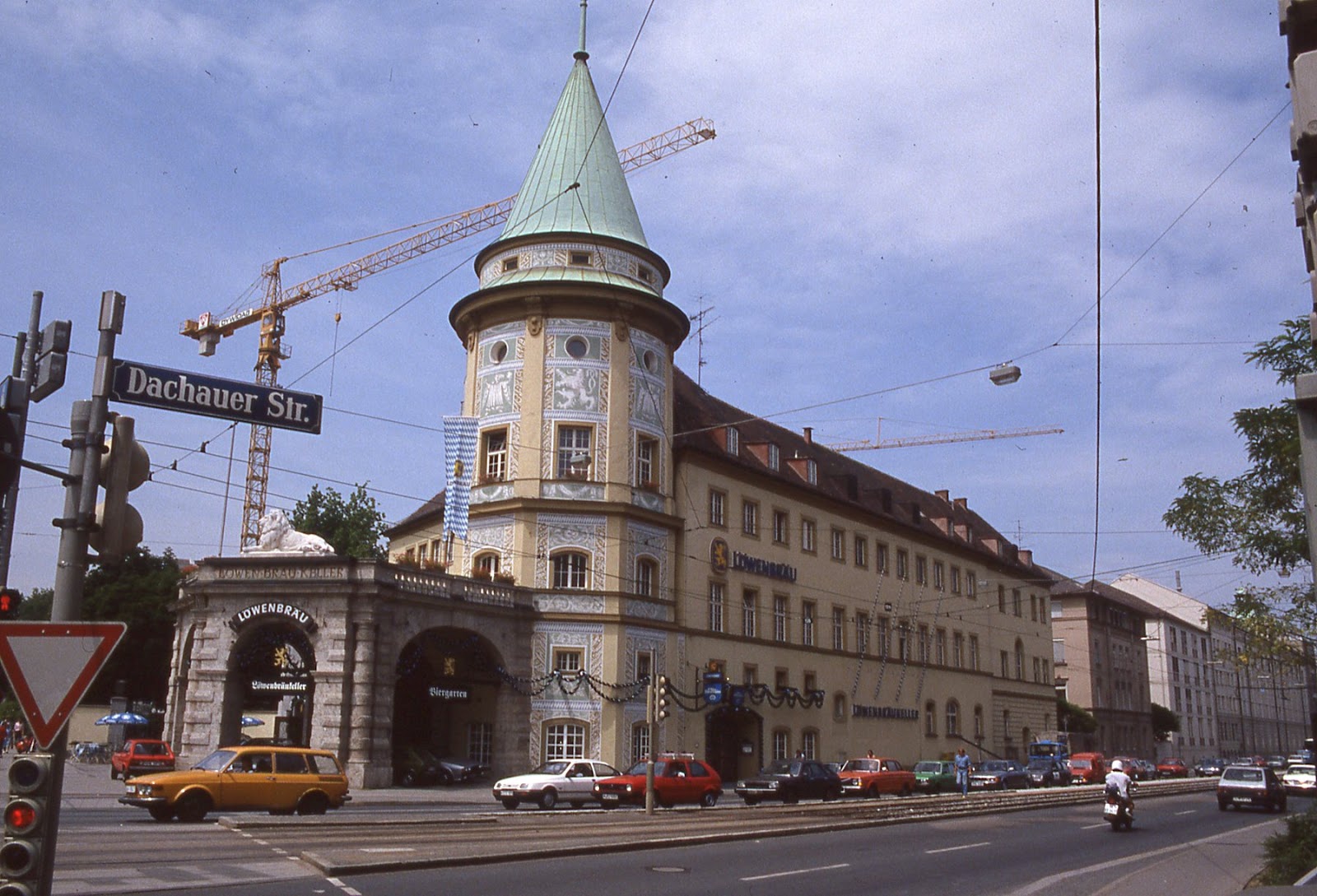
Löwenbräu's own pad, and yes: THAT Dachau.
Löwenbräu was served at Mathäser Bierstadt (beer city), our chosen destination for Friday evening. The remainder of today's look back is a remembrance of this epochal beer hall, which no longer exists.
Therein lies a more contemporary tale.
I first wrote about the Mathäser in 2007 at my Potable Curmudgeon blog. The most rewarding aspect of blogging is feedback, and in this case it took two years for someone on the planet to notice and append their own stories, followed by a few others in subsequent years.
These are uproarious and informative stories, and they stand entirely on their own. Reading them, I find myself strangely moved, almost to tears; complete strangers, all expressing reverence at the memories of this legendary beer hall, and feeling genuine sadness and pain to know it is no more.
This is why I sought a life in beer -- not the fleeting ephemera and narcissism and chest-thumping, but this sense of mystical awe. This is what I'm chasing. The thought crosses my mind that there may need to be a Mathäser Fan Shrine somewhere on the internetz so we all can pay our respects to what once seemed the epitome of Munich-ness.
I summarized all this in 2016, once again at Potable Curmudgeon, and now repeat last year's post in this blogspace, lightly edited and augmented with the few good photos I managed to snap.
---
I: Mathäser, Munich and the summer of '87 with the lads.
These stories about Munich in 1987 have been suitably embellished over the decades, and yet there remains a core of truthfulness to the anecdotes.
There was my episode of disgruntlement at having to leave a beer hall at an hour I considered to be far too early, and a stern worker’s gentle suggestion to take the argument elsewhere.
There was Don rising from the bench to tell us that he’d had enough and was returning to his hotel … except that his lips never moved and no sound was emitted in spite of his subsequent recollections of prime oratory brilliance.
There were liter steins of beer, various and sundry sausages, Deutschmarks and Pfennigs, aspects of unfathomable etiquette that became second nature before the last glass was poured, and a constant flow of conversation, information and education.
Admittedly, had I known then what I know now, we’d have avoided Munich entirely and gone instead to Bamberg, but given our remedial state of beer knowledge, it’s likely that the choice of Munich was all for the best. We might not have fully grasped Rauchbier and Kellerbier. We needed a larger stage, and found it.
The city’s brewery consolidations had already started to diminish historical distinctions, although international corporate investors had yet to appear as they have in recent years. The future could be glimpsed, but at the same time old ways seemed to persist.
These traditions can be pleasing so long as it is remembered that much of what Americans know about Germany actually pertains to Bavaria, and much of what they know about Bavaria actually applies to Munich alone.
For example, “beer halls” in the sense of the Hofbräuhaus generally do not exist in matching scale outside the city of Munich. Moreover, in 1987 a beer hall even larger than the Hofbräuhaus was our home away from home for two glorious evenings: Mathäser Bierstadt, which was tied to Löwenbräu.
It was cavernous, filled with nooks and byways and various banquet rooms and snugs, and decidedly grittier than the Hofbräuhaus – no less attractive for tourists, but rowdy and with an earthier composition of native German barfly.
These many years later, what I’ve taken away from three Munich nights in July isn’t capable of being detailed. That I experienced it with wide eyes and a sense of wonderment cannot be doubted. For a beer- and history-loving Hoosier just shy of his 27th birthday, roaming Europe for the second time, Munich was the epitome. It was Disneyland with ubiquitous mugs of foamy lager and all the sauerkraut and potatoes one cared to eat.
Unfortunately, the Mathäser perished, and the site is now an ultra-modern cinema and entertainment complex. I walked past it in 2004 and bowed in reverence for what used to be. The last time I was there during its actual existence was in 1995, and even then the beer hall seemed exhausted, even if we did our level best to enliven the proceedings.
Dubbed American movies probably are showing now, and outside the cinema, you’ll see imported Miller and Corona throughout the city. The old brands aren’t the same, at least to me. Oktoberfest lagers become ever more golden, and all beer tastes steadily colder on each trip. There even is a Hofbräuhaus franchise in Newport, Kentucky, and more than 20 others throughout the world.
Fond memories, indeed, and now increasingly balanced by melancholy.
II. Now for the comments: R.I.P., Mathäser Bierstadt.
D said ...
Beautifully written, I share your sentiments totally and with equal sadness. In the winter of '62-'63 while working in the banquet hall and night club at the Hotel Bayerischerhof, the Mathäser ( I agree with that spelling too) was THE BEST.
My daughter, Meghan, is about to embark on a trip to Munich ... here is what I wrote her today July 29.09:
Your upcoming trip to Germany is bringing back some pretty strong memories, one of which unleashed a flood of emotion when I just discovered, a few minutes ago, that my all-time favorite Beer Hall in Munich, the Mathaeser (which used to be a stone's throw from the main station, the Hauptbahnhof, and the main traffic circle, Karlsplatz -- colloquially known to us locals as Stachus) has been torn apart and has become a modern, artificial multiplex cinema and urban bar/restaurant center. That is a fucking crime. Meg, this breaks my heart and I'm crying as I write this and knock back a couple of Labatt Blues, saddened that a place which was so central to my experience in Munich has been so abused and all I am left with is my memories of so many wonderful wild nights there with my best friend, Andy Gardiner (who was to die, almost appropriately, a few years later in a late night, post pubbing car crash near Cambridge, UK). The Mathaeser was a HUGE, and I mean massive open beer hall (held 3000+) with a boxing ring type stage in the middle upon which performed various wonderful oompahpah bands with their 'blasmusik' ...I can hear them now ... "Heute blau und morgen blau und oooooooooober morgen wiederrrrr!" ("Sad today and tomorrow sad too and the day after all over again!"). Perfect to sing when you are half wasted on huge steins of frothy beer straight 'vom fass' (from the spring or barrel) interspersed with shots of schnapps dispensed by hefty aproned waitresses with an aluminum bucket full of ice containing a bottle or two of schnapps over their muscled arm. In the same hand they held a tray of shot glasses. They just wandered through the crowd pouring shots which we sometimes just dropped into our steins, glass and all, depth charge style. (A depth charge was a mine dropped on submarines in WW2 … when it reached a certain depth it exploded, hopefully on top of a German submarine. Those schnapps 'charges' were pretty devastating too!) All the while singing lusty (lustiger) German beer drinking songs, arms locked with those of complete strangers and rocking rhythmically back and forth, row-the-boat style, on the benches on which we all sat, twelve to a table. Then, if you were hungry you could retire to one of many satellite rooms off the main hall which served 'eintopf' of wonderfully tasty linzensuppe (lentil soup) served with semmeln (rolls with sesame seeds), soup guaranteed to make you fart for a week. Oh Meg, those were great times. We were so broke but managed to have such memorable times. The Mathaeser's ( pronounced mattayser) rival was the Hofbrauhaus....after which the famous song was sung... In München steht ein Hofbräuhaus (Hofbroyhouse) Eins, zwei, g'suffa ...(pronounced zuffah) Da läuft ( loyft) so manches Fäßchen ( fessschen) aus: Eins, zwei, g'suffa ... translated.... In Munich is the Hofbrau pub-- One, two, drink up!! So many kegs flowed out of it One, two, drink up!!! To us it never rivalled the wildness of the Mathaeser. Hitler spoke here and you could feel, even in 1962/3, an undercurrent of angry, cold, nastiness, as opposed to the Mathaeser's good old German friendly spirit (gemütlichkeit = gemootlichkite) But, today it is all that is left and the service sucks and they steal your change if you aren't careful but it is still a must in Munich. Prost !!!
---
P said ...
Thanks for your reminiscences of the Mathäser Bierstadt, which also left me with a feeling of melancholy for great times gone forever. I caught the overnight train from London to Munich in the summer of ‘75 looking for a holiday job. Having spent all the first day in a fruitless search for work, I was heading along Bayerstrasse back to the Hauptbahnhof to collect my stuff in anticipation of having to sleep in the park for the night when I tried one last time at the hotel right next to the Mathäser, Hotel Stachus. It worked and I got a bellboy/washer-up/night porter/general dogsbody job for the summer. My duties basically consisted of anything that nobody else wanted to do, such as washing up for breakfast. Now, standing over a hot, steaming sink at 7.30 am on a warm summer’s morning washing up for 150 Swedes may not sound like a lot of fun, but the perk of the job was the handily-placed fridge, packed with deliciously cold half-litre bottles of Löwenbräu. I have not drunk beer at that time of day before or since, but never has the golden nectar tasted so sweet or slipped down so effortlessly and however much I drank, I never felt drunk because I was sweating so much from the hot kitchen it just seemed to go straight through the system. This was going to be a great job. The Mathäser was a constant presence. It was so close you could see into it at the back because the kitchen windows of the hotel looked straight down onto it. The oompah bands were generally audible in the background at most times of the day and night, and even during the hours when it was closed there was always activity or movement of some sort going on and the place seemed to be reassuringly alive and breathing even if it was now at rest, like a friendly giant slumbering in the background. As you would expect, the Mathäser had a huge kitchen (or apparently five kitchens: http://de.wikipedia.org/wiki/Mathäser) Whenever a large party arrived at short notice and the hotel was short of food, I would be sent round from the hotel to pick up a few hundred frozen Schnitzel. The head chef knew me and would just add a couple of ticks to the slate as I staggered out under the load, a mere drop in the ocean of the vast quantity of supplies at his disposal. I think they must have brewed beer on site as well, because on warm, slightly damp mornings the streets around the back were always filled with that wonderful smell of brewing hops. There were plenty of other large beer-halls and beer-gardens in Munich, usually displaying the arms of the brewery to which they were attached: Spaten, Paulaner, Franziskaner, Hacker-Pschorr come to mind and I selflessly devoted many hours to a thorough investigation of the particular qualities of each of their different brews: Pils, Export, Export Dunkel (always my favourite but you don’t seem to be able to get it now, not the same stuff anyway) and so on. But none had the all-encompassing warmth and down-to-earth openness of the Mathäser. You walked in and it was always busy and unaffected: all life seemed to be there simply enjoying itself and to have been there enjoying itself for eternity, like a timeless tavern scene painted by one of the Dutch masters. But after a moment’s surprised contemplation, you realised that all you had to do was find a small space in those vast, cavernous rooms, sit down and get the Fräulein to bring you the first Maß, and you became a part of that eternal scene yourself. The Mathäser was not sophisticated, but it was genuine, and it is indeed a tragedy that it has been replaced by a soulless, glass-and-aluminium ‘entertainment’ complex, where the closest you can get to a decent drop is a miniscule amount of beer served in a champagne glass at some frigging café. They don’t know what they’re missing …
---
E said ...
Thank you for your wonderful memories and for stirring my own deeply felt memories of youth. On my nineteenth birthday, a Sunday in June 1968, I found the Mathaeser Bierstadt of Munich by accident. Walking on the street outside with my buddy, a fellow soldier from the 24th Infantry Division, we entered an alcove, drawn by the wonderful smells of cooking sausage. Then, from somewhere, I heard music. We explored further, up a staircase and opened two huge doors--and there it was--beer-drinkers heaven. It was 11AM on a Sunday morning and there were two thousand people in the place! DRINKING BEER! Hallelujah! Hallelujah! We were two dopey kids, but we stumbled upon one of the greatest beer-drinking joints in the world! And I love beer. For the next year, it became my favorite place in Munich, our home away from home. We would take the #6 trolley to Karlsplatz, walk toward the Hauptbahnhof and there we were. It was, at one time, in the Guinness Book of Records. More beer was served in that building, in one year, than anywhere in the world. Everything the previous posters wrote was right-on about the place. I have the warmest of memories the place of how kind the people treated a young soldier. I can't believe it's gone. That makes me very sad. Again - thank you for the memories.
---
J said ...
My partner and I lived and worked in Munich in '78-79. The Mathäser was our favourite watering hole by a country mile and believe me we sampled a few! Saturday nights at the Mathäser were always packed with incident. It was a place that you felt was steeped in history, very down to earth and REAL compared with the tourist traps. We were so happy that on a visit ten years later very little had changed and we naively expected it to be ever thus. I only found out its fate today (April '11) after a search on Google Earth/Streetview. We are devastated that it has gone. I thought that Müncheners of all people were a breed that valued what they had. So sad.
For as long we’d been talking about visiting Czechoslovakia, Barrie and I had considered only two firm itinerary prerequisites. Prague obviously landed at the top of the chart. Perhaps less easy to understand at first glance was the city of Plzeň (or Pilsen), 65 miles southwest of Prague, with a present-day population of 178,000.
As a recorded settlement, Plzeň goes back to the year 976. The city remained Catholic during the Hussite wars and became an increasingly important trading center on the route to Germany. In 1869, the founding of the Škoda Works kicked off an era of rapid industrialization, which made Plzeň one of the arsenals of the Austro-Hungarian Empire.
All those Škoda automobiles we saw in Czechoslovakia? They were manufactured in Plzeň, but we weren’t gearheads, and preferred to take the train, not drive, because drunk driving isn’t good, and our plan for Plzeň involved drinking a great deal of Pilsner Urquell beer -- or as it was known in Czechoslovakia, Plzeňský Prazdroj.
The very word “Pilsner,” as it has come to English speakers, is both an adjective and an appellation: Beer from Plzeň. Obviously, beer has been brewed in Plzeň for centuries, though the current Pilsner Urquell brewery dates from 1842.
The story goes something like this: Certain families in Plzeň had been granted brewing rights during medieval times, and this functioned as a monopoly of sorts, with no incentive to improve. Consequently, the quality of beer in the city deteriorated during the early 1800s, ironically at the very same time as modern brewing techniques were being harnessed to the scientific method elsewhere in Europe – significantly, in nearby Vienna and Bavaria.
In Plzeň, it gradually dawned on the diverse stakeholders that the spirit of the age, and the “higher tech” direction being traveled by beer and brewing science, suggested a pooling of resources to achieve better quality and competitiveness. The Pilsner Urquell brewery was capitalized and born from this revelation, at an indisputably ideal juncture.
Modern malting processes now yielded consistent, pale malts. The water in Plzeň was soft, and hops grew in abundance nearby. The notions of selectively standardizing yeast strains and aging ("lagering") beer resulted in a mellow flavor profile. It was clear, not cloudy, and brilliant gold. Glassware was becoming affordable for all, and the color and clarity were accented by glass rather than submerged by dense ceramic or wooden mugs.
The new beer’s body was lighter and less sweet. A generous hopping rate helped make the beer crisp, and renewed the palate. Pilsner Urquell represented modernity, and became the prototype and yardstick. Soon dark, heavy beers were all but obsolete. The world wanted golden lagers brewed more or less (mostly less) like Pilsner Urquell.
Needless to say, we'd come to adore Urq, as Barrie called it.
The red star is no more.
When Barrie and I graduated from high school in 1978, Cut Rate Liquors in Jeffersonville was the only package store in Southern Indiana with a selection of imported beers. What we now categorize as craft barely existed, even in California.
Regular examinations of the wares at Cut Rate revealed the existence of exotic, unexplored modes of thinking and drinking. Most of them were golden lagers from around the world, but there also were dark lagers, British ales and even a few Belgians.
Money was tight, and sampling meant splurging. There was no source of information, apart from bottle labels and six-pack cartons. Still, every now and then we took the risk and tried a new beer. The flavors were different, and hinted at broader horizons.
In 1982, two of my good friends intervened with essential personal testimony. Both of them had "gone away" to college, to study in places less parochial than Floyd County. Larry returned to the fold singing the praises of Guinness Extra Stout, and Dave introduced me to Pilsner Urquell, then sold in four-pack cartons for a lofty $3.99 plus sales tax.
I was intrigued. I’d had Molson, Labatts and Beck’s, but what was the spicy character in Pilsner Urquell, that piquant bitterness cutting through creamy grain flavor? It was something I hadn’t experienced in Blatz. Dave wasn’t sure, but he thought it had something to do with hops. Guinness was black like coffee. It was dry, roasty and daunting in a way that defied categorization, and completely unlike any "dark" beer I’d had before.
Insight: You mean there were different sorts of dark beers, too?
These always had intrigued me, along with pumpernickel, rye and other departures from the Wonder Bread norm. Finally, liberated from the longnecks of our fathers, the notion of beer was starting to make better sense.
All I needed was a lot more money and a plane ticket.
It was left to Michael “The Beer Hunter” Jackson’s original book “World Guide to Beer” (1977), as culled from the remainder table at a mall bookshop, to become the cosmic text that wove all the threads into a coherent whole. An updated “New World Guide to Beer” was published in 1988.
Jackson offered the saga of beer as a long and fascinating one, ranging across all aspects of the human experience.
To him, beer is about science and art, farms and cities, social history, local culture and geography. It's about the places you've gone, and the ones you'd like to go. It's about different textures and flavors to match your mood, the time of day, the season, and the task at hand.
With Jackson’s book as a guide, the obscurities of these imported beer brands gradually became comprehensible. I began working at Scoreboard Liquors, a small store in New Albany, and was allowed to replicate Cut Rate’s import selection just so long as it was kept to one door of the six opening into the walk-in cooler.
Barrie and I drank bad beer often, but when the stars aligned and finances allowed, we drank better ones. My work discount helped, and after returning from my first European excursion in 1985, it became ever more difficult to return to the everyday Bud this, Miller that.
I wasn’t a snob so much as a flavor junkie.
(As an indication of the way one’s memory plays tricks, I was about to add that Jackson’s television series The Beer Hunter was an inspiration for our Ur-Quest in 1987, but it couldn’t have been. The series debuted in the UK in 1989, and in America the following year.)
---
July 15, 1987
We caught a train from Prague to Plzeň, got there well before noon, and reconnoitered. From the station, the Pilsner Urquell brewery was easy to see and smell, although we knew to inquire at the official state-run Čedok travel agency (actually established in 1920, prior to communism), which surely would be located somewhere in the center of the city.
It was. This task was accomplished in due course, and we were summarily rebuffed. No one at Čedok had the slightest interest in helping us score a brewery tour. The lone English speaker we found was exasperated; didn’t everyone on the planet know that Pilsner Urquell brewery tours only took place once a week on, well, any day except today?
It was frustrating, but this was the nature of things during Czechoslovakia’s final years of erosion prior to the Velvet Revolution in 1989. There was no benefit for a travel agency employee to go out of his way to help us; perhaps a bribe might have helped, but our lone English speaker had a very hard face, indeed.
Plan B was commenced. We walked to the Pilsner Urquell brewery and made tepid inquiries at the guard shack. No English was spoken; at least the rejection was friendlier.
For years afterward, Barrie’s version of what happened next remained consistent and only slightly exaggerated:
“We couldn’t get inside the brewery, so I went over, kissed the lock on the gate, and we went to the tavern instead.”
The forbidden city.
Fair enough. To the left of the gate was the brewery’s “official” tavern. It seemed appropriately upscale, at least in contrast to the next closest Pilsner Urquell outlet, located across the street, which was on the ground floor of a 1920s-era structure, smaller and shabbier, and alluring in a counter-intuitive way.
We opted for the well-appointed “official” brewery tap first, probably because the odors of pork and dumplings were leaking through the windows and clinging to our clothes, and we needed to eat immediately. Once inside, we admired the wooden interior and beautiful windows.
Drinking, dining and pervasive deliciousness was the result, and there even was an inadvertent floor show, showcasing the intoxicated antics of a visiting delegation of North Koreans, who were having far too much fun in a communist country that actually had drinkable beer.
It transpired that using the restroom meant passing the Czech restaurant-standard coat check desk. There were few coats to check in high summer, but full employment meant staffing irrespective of the need, and at one point when the two of us walked past, the coat check attendant addressed us and sidled over.
In a low voice, she asked if we were American, and we nodded assent. She beamed, and proceeded to tell us in passable English that she still remembered the liberation of Plzeň by General Patton’s 3rd Army at the close of WWII.
The 40th anniversary had been only two years before our visit, and she cheerfully recounted the appearance of a handful of Patton’s elderly soldiers for the city’s commemorative event.
In late 1945, US troops withdrew from Czechoslovakia, which had been determined to fall within the Soviet sphere of influence, which of course became the Iron Curtain as coined by Winston Churchill.
The coat check woman preferred to remember how nice the American G.I.s had been, helping to rebuild Plzeň in the months before being withdrawn, and frequently gifting her and other children with chocolate bars.
Before we left the premises, she surreptitiously pressed coasters and postcards into our hands, as if to pay back those favors from so long ago.
It was sincerely moving, and I’ve never forgotten her hospitality.
---
It was time for a visit to the dive bar, and as we emerged from the restaurant, things were heating up across the way.
Sadly, when I returned to Plzeň in 1989, the entire building was gone, demolished for a street widening project. Looking closely at the photo from 1987, there seem to be few signs of life in the upper three floors, so perhaps the tavern’s demise was a done deal even as we were drinking there.
At any rate, the pub with no name was a delight, and the regular crowd was shuffling in.
When Frantisek and the lads arrived, the party started. He was a cabbie playing hooky, rejecting an afternoon’s fares so he could drive himself and four of his finest friends from one tavern to the next. As long as his communism-pretend credentials were in order, it probably wouldn’t matter whether he worked or not, and if you’re not working, why not have a few beers on a lovely summer’s day?
They spoke no English and we spoke no Czech. Some German words could be shared. The longer we remained, the easier it got. Seasoned drinkers understand that communication becomes immeasurably simpler once all participants have reached the stage of “universal second beer language,” wherein thoughts and concepts expressed in otherwise indecipherable tongues suddenly make perfect sense.
Eventually Franta reckoned we needed an education in the merits of Czech rum.
Tuzemák, formerly called Tuzemský rum (English: domestic rum), is a term for a traditional Czech distilled beverage. It is a substitute good (ersatz) for true rum which is produced from sugarcane mainly in the Caribbean and Latin America. Since the 19th century, Tuzemák became one of the most popular spirits in the Czech lands.
Tuzemský is produced from potatoes or sugar beets, diluted and flavoured by various rum essences. In the 19th century similar substitutes were produced throughout the crown lands of the Austro-Hungarian monarchy, which had no access to tropical colonies; they were named Inländer-Rum (like Stroh in Austria, today produced from sugarcane molasses and therefore a genuine spiced rum), Domači or Čajni (Croatia) etc.
In 1987, it was simply called rum, and the less said, the better. After a couple belts of it, I undertook a laborious examination of the time, and came to a reckoning of my own: we needed to get back to Prague. As we departed, so did Franta and the gang, motoring toward the next pub on their taxi crawl.
As a final aside, a few architectural details on the brewery's exterior ...
... and the early evening return to our sports club hostel beds in Prague.
Next day, we caught the train to Munich, and a meticulously planned meet 'n' greet with our friend Bob and my cousin Don.
It has been 30 years since my first visit to Prague and Plzen in 1987, and as I’ve belatedly digitalized my old slide film, I’ve been writing about it.
Unsurprisingly, beer has dominated the Czech narrative. To understand what it was like for a beer drinker to be traveling in a place like Czechoslovakia in 1987, you must begin by forgetting almost everything you’ve learned during our contemporary "craft" beer era.
In 2017, there are at least 5,300 breweries in the Unites States. 30 years ago, there were approximately 150 in all of America. Roughly half of them had come into existence during the preceding decade.
That’s right. When I started college in 1978, there weren’t 100 breweries in the whole country.
In 1987, there were around 70 breweries in Czechoslovakia, a country of a mere 15,000,000 inhabitants, as opposed to 242,000,000 in America. The per capita rate of beer consumption was far higher in Czechoslovakia than in the USA, especially in the Czech lands of Bohemia and Moravia, not as much in Slovakia.
Beer and brewing culture were omnipresent and pervasive in Czechoslovakia, although limiting in terms of stylistic diversity – except that in 1987, we’d yet to be conditioned to expect dozens of styles from which to choose when going out for a pint.
In Belgium, maybe, but in Czechoslovakia, one happily endured numerous hop-accented golden variations on a theme of Pilsner Urquell. Notably, no other Czechoslovak brand referred to itself as "Pilsner" – this honor and appellation was reserved for the Plzen-brewed original – and yet the majority were similar, brewed to varying strengths.
In 1988 many Czech breweries were almost unchanged from the 1930's. While productivity may have been low, there was no argument about the quality of the beers brewed. Open fermenters, long lagering times and absence of pasteurisation produced distinctive and flavoursome beers. No other country came even vaguely close to the general high standard of Czech lager. It was impossible to find bad beer.
The larger regional breweries - Staropramen, Gambrinus, Velké Popovice and, of course, Pilsner Urquell - had national distribution. Even in a town like Prague, where there were several large local breweries, there was a good choice of beer from the whole of Czechoslovakia.
There also were some dark lagers, which tended to be of lower gravity and exhibiting malty sweetness, as well as the occasional “black” lager of better balance and increased potency. Even an old-fashioned bottom-fermented porter might pop up out of nowhere to surprise you.
Still, drinking beer in Czechoslovakia in 1987 meant sampling the same basic style brewed by different breweries. The fun part was roaming cities like Prague in search of the pub on the back street that served one you hadn't seen previously.
---
Barrie and I dropped into several of the more famous Prague taverns during our brief stay in 1987: U Dvou Koček, U Pinkasů and U Fleků among them. The latter was (and remains) a brewery, and in case you were wondering, it helps to know that in Czech, “U” means “at” and is incorporated as a pub name prefix.
Communism was all about investing in selected economic goals, and disinvesting in others. As Pattinson observes, this actually had the curious effect of helping to maintain overall beer quality in Czechoslovakia, in the sense that in the absence of abundant capital for modernization, the older and slower ways persisted. "Old school" wasn't a cliche. It was every day.
As economics pertained to taverns and watering holes, it was a mixed bag. Even the venerable beer shrines reflected the realities of their time, and some were in better repair than others. In most cases, there was lots of wood, plaster and cigarette smoke. The vibe tended to be relaxed and quiet, and inexpensive beer prices were somewhat uniform everywhere you went.
Granted, waiters were prone to padding checks with hidden cover charges, but the prices were so low you seldom noticed – and as noted above, the beer was unfailingly wonderful.
If I’m to be honest about our time in Prague in July, 1987, it’s highly doubtful we dropped into the drinking establishment that subsequently became a great personal favorite of mine, the Automat Koruna. After three weeks in Prague in 1989, the workers probably knew me by sight, if not by name.
In the off chance that Barrie and I enjoyed a beer or two at the Automat Koruna (1931 – 199_?), here is an overview.
---
Prague’s famous Wenceslas Square (Václavské náměstí) was the city’s original horse market, and isn’t a square at all. It’s a boulevard, originating atop a gentle rise in front of the Czech National Museum, then descending to where the Old Town begins. At this intersection (Václavské náměstí 1), just a few feet from the subway stop, is a sizeable Art Nouveau building called the Koruna Palace, which opened in 1914.
Strictly speaking, an “automat” is a vending machine. The first such automat for food and drink was introduced in Berlin in 1895. From what I can tell, the Automat Koruna followed suit from its inception in 1931, though the Koruna Palace was such a large building that there were other food service businesses inside it. It's never been clear to me where originally one of them ended, and the next began.
Whatever the ultimate disposition of the vending machines and the timing of the conversion, by the time I experienced the Automat Koruna (sometimes referred to as the Buffet Koruna), it was a high volume, self-service, cafeteria-style eatery with multiple counters, where customers could buy nibbles, full meals, sweets, coffee and the Koruna’s famous strawberry milkshakes.
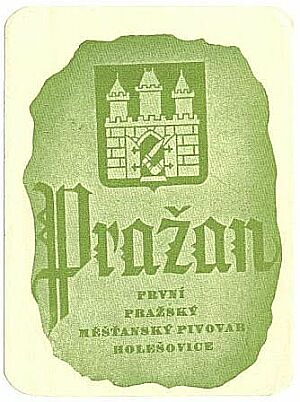
You told the cashier what you wanted and paid, to be given a receipt, then waited in a customarily long line, handing the receipt to one of the white-smocked beer pourers. The reward was a cool half-liter (or more) of golden, pilsner-style Pražan beer, brewed a few miles away in Holešovice district of Prague.
You consumed your Pražan and also ate while standing at a stainless steel table. There may have been chairs at the Automat Koruna, but if so, I can’t remember them, at any rate, I didn’t ever sit. Crowds were a constant, and stand-up space sometimes at a premium.
The ambiance at Automat Koruna was urban, frenetic and often claustrophobic – but I loved it, and what a place to drink beer and people-watch during Prague’s latter communist years! The clientele reflected an indisputably egalitarian ideal, although for communism’s usual litany of wrong reasons.
Military men with medal-filled chests jostled for space with long-haired students. Backpacking tourists and pretty shop clerks stood side by side. Brown-suited functionaries left scraps on their plates, and scruffy street people scooped them up before the busser came to visit. It was ill-advised to step away from your beer, because they’d drain unguarded remnants in milliseconds.
Moreover, it’s worth noting that these perfectly presentable half-liter local draft beers were three to a dollar. Cheap beer hasn't ever been this good.
NA Confidential's mask-free policy on reader comments.
NA Confidential believes in a higher bar than is customary in the blogosphere, and follows a disclosure policy with respect to reader comments.
First, you must be registered with blogger.com according to the procedures specified. This is required not as a means of directing traffic to blogger.com, but to reduce the lamentable instances of flaming and personal attacks on the part of the anonymous.
Second, although pen names are perfectly acceptable, senior editor Roger A. Baylor must be informed of your identity, and according to your preference, it will be kept confidential.
To reiterate, I insist upon this solely to lessen the frequency of malicious anonymity, which unfortunately plagues certain other blogs hereabouts.
You may e-mail Roger at the address given within his profile and explain who you are. Failure to comply means that your comments probably will be deleted -- although the final decision remains ours.
Thanks for reading, and please consider becoming a part of the community here, one that is respectful of the prerequisites of civilized discourse, and that seeks to engage visitors in substantive dialogue.