Showing posts with label my favorite pubs. Show all posts

Saturday, July 15, 2017

30 years today on THE BEER BEAT: The Automat Koruna, one of my favorite pubs (?) in the world.

Previously: 30 years ago today: Prague's Old Town Square, and why we didn't see it in 1987.

It has been 30 years since my first visit to Prague and Plzen in 1987, and as I’ve belatedly digitalized my old slide film, I’ve been writing about it.

Unsurprisingly, beer has dominated the Czech narrative. To understand what it was like for a beer drinker to be traveling in a place like Czechoslovakia in 1987, you must begin by forgetting almost everything you’ve learned during our contemporary "craft" beer era.

In 2017, there are at least 5,300 breweries in the Unites States. 30 years ago, there were approximately 150 in all of America. Roughly half of them had come into existence during the preceding decade.

That’s right. When I started college in 1978, there weren’t 100 breweries in the whole country.

In 1987, there were around 70 breweries in Czechoslovakia, a country of a mere 15,000,000 inhabitants, as opposed to 242,000,000 in America. The per capita rate of beer consumption was far higher in Czechoslovakia than in the USA, especially in the Czech lands of Bohemia and Moravia, not as much in Slovakia.

Beer and brewing culture were omnipresent and pervasive in Czechoslovakia, although limiting in terms of stylistic diversity – except that in 1987, we’d yet to be conditioned to expect dozens of styles from which to choose when going out for a pint.

In Belgium, maybe, but in Czechoslovakia, one happily endured numerous hop-accented golden variations on a theme of Pilsner Urquell. Notably, no other Czechoslovak brand referred to itself as "Pilsner" – this honor and appellation was reserved for the Plzen-brewed original – and yet the majority were similar, brewed to varying strengths.

The British traveler and beer writer Ronald Pattinson explains a key point.

In 1988 many Czech breweries were almost unchanged from the 1930's. While productivity may have been low, there was no argument about the quality of the beers brewed. Open fermenters, long lagering times and absence of pasteurisation produced distinctive and flavoursome beers. No other country came even vaguely close to the general high standard of Czech lager. It was impossible to find bad beer.

The larger regional breweries - Staropramen, Gambrinus, Velké Popovice and, of course, Pilsner Urquell - had national distribution. Even in a town like Prague, where there were several large local breweries, there was a good choice of beer from the whole of Czechoslovakia.

There also were some dark lagers, which tended to be of lower gravity and exhibiting malty sweetness, as well as the occasional “black” lager of better balance and increased potency. Even an old-fashioned bottom-fermented porter might pop up out of nowhere to surprise you.

Still, drinking beer in Czechoslovakia in 1987 meant sampling the same basic style brewed by different breweries. The fun part was roaming cities like Prague in search of the pub on the back street that served one you hadn't seen previously.

---

Barrie and I dropped into several of the more famous Prague taverns during our brief stay in 1987: U Dvou Koček, U Pinkasů and U Fleků among them. The latter was (and remains) a brewery, and in case you were wondering, it helps to know that in Czech, “U” means “at” and is incorporated as a pub name prefix.

Communism was all about investing in selected economic goals, and disinvesting in others. As Pattinson observes, this actually had the curious effect of helping to maintain overall beer quality in Czechoslovakia, in the sense that in the absence of abundant capital for modernization, the older and slower ways persisted. "Old school" wasn't a cliche. It was every day.

As economics pertained to taverns and watering holes, it was a mixed bag. Even the venerable beer shrines reflected the realities of their time, and some were in better repair than others. In most cases, there was lots of wood, plaster and cigarette smoke. The vibe tended to be relaxed and quiet, and inexpensive beer prices were somewhat uniform everywhere you went.

Granted, waiters were prone to padding checks with hidden cover charges, but the prices were so low you seldom noticed – and as noted above, the beer was unfailingly wonderful.

If I’m to be honest about our time in Prague in July, 1987, it’s highly doubtful we dropped into the drinking establishment that subsequently became a great personal favorite of mine, the Automat Koruna. After three weeks in Prague in 1989, the workers probably knew me by sight, if not by name.

In the off chance that Barrie and I enjoyed a beer or two at the Automat Koruna (1931 – 199_?), here is an overview.

---

Prague’s famous Wenceslas Square (Václavské náměstí) was the city’s original horse market, and isn’t a square at all. It’s a boulevard, originating atop a gentle rise in front of the Czech National Museum, then descending to where the Old Town begins. At this intersection (Václavské náměstí 1), just a few feet from the subway stop, is a sizeable Art Nouveau building called the Koruna Palace, which opened in 1914.

Photo credit: Koruna Palace

Strictly speaking, an “automat” is a vending machine. The first such automat for food and drink was introduced in Berlin in 1895. From what I can tell, the Automat Koruna followed suit from its inception in 1931, though the Koruna Palace was such a large building that there were other food service businesses inside it. It's never been clear to me where originally one of them ended, and the next began.

Photo credit.

Whatever the ultimate disposition of the vending machines and the timing of the conversion, by the time I experienced the Automat Koruna (sometimes referred to as the Buffet Koruna), it was a high volume, self-service, cafeteria-style eatery with multiple counters, where customers could buy nibbles, full meals, sweets, coffee and the Koruna’s famous strawberry milkshakes.

I almost forgot: It had beer, too.

Photo credit.

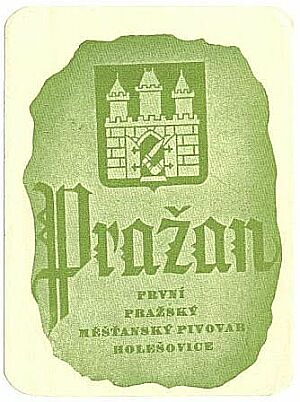
You told the cashier what you wanted and paid, to be given a receipt, then waited in a customarily long line, handing the receipt to one of the white-smocked beer pourers. The reward was a cool half-liter (or more) of golden, pilsner-style Pražan beer, brewed a few miles away in Holešovice district of Prague.

You consumed your Pražan and also ate while standing at a stainless steel table. There may have been chairs at the Automat Koruna, but if so, I can’t remember them, at any rate, I didn’t ever sit. Crowds were a constant, and stand-up space sometimes at a premium.


Photo credit (and preceding).

The ambiance at Automat Koruna was urban, frenetic and often claustrophobic – but I loved it, and what a place to drink beer and people-watch during Prague’s latter communist years! The clientele reflected an indisputably egalitarian ideal, although for communism’s usual litany of wrong reasons.

Military men with medal-filled chests jostled for space with long-haired students. Backpacking tourists and pretty shop clerks stood side by side. Brown-suited functionaries left scraps on their plates, and scruffy street people scooped them up before the busser came to visit. It was ill-advised to step away from your beer, because they’d drain unguarded remnants in milliseconds.

Moreover, it’s worth noting that these perfectly presentable half-liter local draft beers were three to a dollar. Cheap beer hasn't ever been this good.

It's a wonder I lived through it.

Next: The long-awaited Pilsner Urquell pilgrimage

Tuesday, May 16, 2017

THE BEER BEAT: Moss the Boss and his L’ Eblouissant (The Dazzling), one of my favorite pubs in the world.

L’ Eblouissant (The Dazzling); Namur, Belgium

Granted, many of you have read portions of this essay, as published here and there over the years. Any good story worth telling the first time is fair game for retelling -- and so it goes with my remembrance of this greatly influential establishment.

As is my habit, I’ve touched up some of the passages, but have not altered anything of substance.

---

In my view, the “craft” modifier for better beer has outlived its usefulness, at least without an earnest industry-wide bout of introspection as to what the art of “craft” might actually mean when (and if) it is practiced.

Until then, I’ll begin with an anecdote. If my luck holds, I may end with it, too.

In October of 1995, when the Public House was only three years old, I departed the comfortable confines for a ten-day tour of European beer destinations, including Dusseldorf, Cologne and Belgium. There also was a brief two-day side trip by train to Copenhagen to visit my friends there. My friends David Pierce, John Dennis and Ron Downer accompanied me.

Much beer was consumed, though you probably already guessed as much.

Our first great thrill was accidentally stumbling into Dusseldorf on "Sticke" day, when the brewpub Zum Uerige rolls out a special, beefier version of its elegant everyday ale. Sticke happens only at random intervals, and we felt fortunate to experience such goodness by chance, in the primeval absence of social media to guide the proceedings.

These days, everyone would know. Serendipity has been outlawed, and that’s too bad.

The next morning, we set out for Belgium, allowing for a few hours of fast-paced Kölsch consumption in Cologne. A change of trains was necessary at Liege, and so we made for the station buffet to have an inaugural beer. There were 35 choices on the menu, which by Belgian standards was elemental, but they spanned the gamut of the brewer’s art.

At the time, I wrote:

“In America, you also have a choice: Bud or Bud Light. That is, if you can find a train station.”

Namur, located in the Meuse river valley in southeastern Belgium, was the ultimate target. It is a scenic city with an old citadel perched on a hill, and our first move after settling into our lodgings was to consult Tim Webb’s seminal Good Beer Guide to Belgium and Holland (nowadays, just Belgium) for the address of L’ Eblouissant (The Dazzling), a beer café featured in the Namur section, and highly praised by the author.

It was the sole reason we chose Namur in the first place.

Equipped with a sketchy city map and gestures from the desk clerk, we began walking. Upon arrival, it became evident that while a drinking establishment was doing business at this address, it was not The Dazzling.

Because the friendly bartender was kind enough to explain the situation and to give us directions to the café’s new location across town, we ordered a round of Duvel, tipping him handsomely prior to resuming the hike.

Even then, we almost missed The Dazzling. There was no sign apart from a back-lit Murphy’s Stout oval, adorning an accurate facsimile of an Irish pub front. We stepped inside, only to find the pub officially closed to make room for at least two dozen Namur locals gathered there to celebrate their recent return from a tour of Sri Lanka.

At this juncture, our first acquaintance was made with the Belgo-Irish force of nature known as Alain Mossiat, to be forever known as “Moss the Boss.” Moss welcomed us, albeit a bit warily at first. His resistance began to crumble when it became evident that our beer pilgrim credentials were exemplary, and so an impromptu compromise was reached.

He’d be very busy with the group, but we could occupy an improvised table in the rear storage area. He’d serve us when he could, and there was enough Spaghetti Bolognese on hand for us to have some dinner, too.

Moss proceeded to both cook and serve food and beers to the thirty of us, operating from a closet-sized kitchen with an ordinary home stove. His son, perhaps a 7th-grader by American standards, was positioned atop a beer crate behind the bar, pouring nitro Murphy’s all night long for the native revelers.

The stout was Moss’s nod to his Irish side, and besides, no other bar in Namur had such a beer on tap in 1995. However, cash flow aside, Moss’s pride and joy was a comprehensive list of bottled ales from the Wallonia region, which he viewed as poorly represented on famous beer lists elsewhere in Belgium.

After making our first selection ourselves, we asked Moss to choose for us during the remainder of the evening, and one after another, 750 ml bottles of Wallonian ale appeared before us. They were sublime. The pinnacle was an aged, homebrewed mead from his personal (and very literal) cellar, which quite simply was the best I’d ever had, and may yet be.

Perhaps I kept track of what we were drinking, but I doubt it. What I remember is a magical evening in an eclectic setting, seated amid random junk, cases of bottles and various beer placards and advertisements (oddly, not unlike my home base at the time), learning that for all of Belgium’s culinary splendor, the one dish you’re likely to find on the menu at a beer café with “snacks” is spaghetti.

It was an ambiance sans television or music, with our quartet lapsing eventually into an intense philosophical debate. In my 1995 description:

(As we sampled) and finished eating our spaghetti, a spirited argument ensued as to the true nature of craft-brewed beer in America, with Alain interrupting occasionally to explain the next selection. Expatriates abroad. Drinking, talking. Very cool.

My first thought about this scene as recalled 22 years later is this: Damn, we were referring to better beer as “craft” even then? Who'd have guessed?

What exactly was being said about “craft” as we drank ales and mead in Namur?

My recollection is hazy, but one general theme was whether Sam Adams genuinely could be regarded as “craft” when so many other emerging microbreweries produced a fraction of the volume, and without contract brewing accounting for so much of the barrels produced.

How could small and large alike occupy the same boat? As they say, the more things change …

There is much to say about craft, crafty and the sheer grandeur of variable semantics. These can wait for another column.

Thinking back on it, Moss’s strident advocacy of local and regional Wallonian specialties may have planted quite the seed somewhere in my noggin. It would not have been possible to return to the Public House in 1995 and adapt it in such a fashion, but it would be entirely possible now, and an all-Indiana and Kentucky beer format might be quite the marketing corker amid the general in-crowd saturation, appealing to an under-served segment of the better beer crowd for whom localism actually matters.

Moss left the pub business in 1998, relocating with his family to County Mayo in Ireland to operate an organic farm. He’s been back in Belgium for a while, and probably is a grandfather by now. Last year we briefly chatted about the prospects for Moss to go to Spain to open another bar.

To recap: In 1995, we had a discussion about “craft” at The Dazzling, and in 2017, “craft” strikes me as an outtake from The Shining.

I think there needs to be a full-scale reboot.

---

*Postscript*

In January of 2007, I stumbled quite by accident on the website of a band called Ceilí Moss, a folk/rock act from Belgium, where I was stunned to see this explanation:

If you're curious where this name comes from: Ceilí (pronounced as Kylie) is a Gaelic word for a party with music, and Moss was the nickname of Alain Mossiat, boss of the pub "L'Eblouissant", where we did our very first gigs.

As of the summer of 2015, the band had ceased performing.

Also, by April of 2007, when we'd learned that Moss the Boss was back in Namur, David Pierce found a relic of our shared 1990s era of Belgian beer travel. It's Moss the Boss Art.


I was cleaning out some old file drawers this weekend and came upon my old Tim Webb Good Beer Guide to Belgium. Matt Gould and Rick Buckman had borrowed it for their leg of the tour, 1996. The pic was a present for my 40th birthday.

A blast from the past, for sure. Here's to Moss the Boss ... again. His establishment remains an archetype, one ripe for localized reinvention -- don't you think?

Tuesday, April 11, 2017

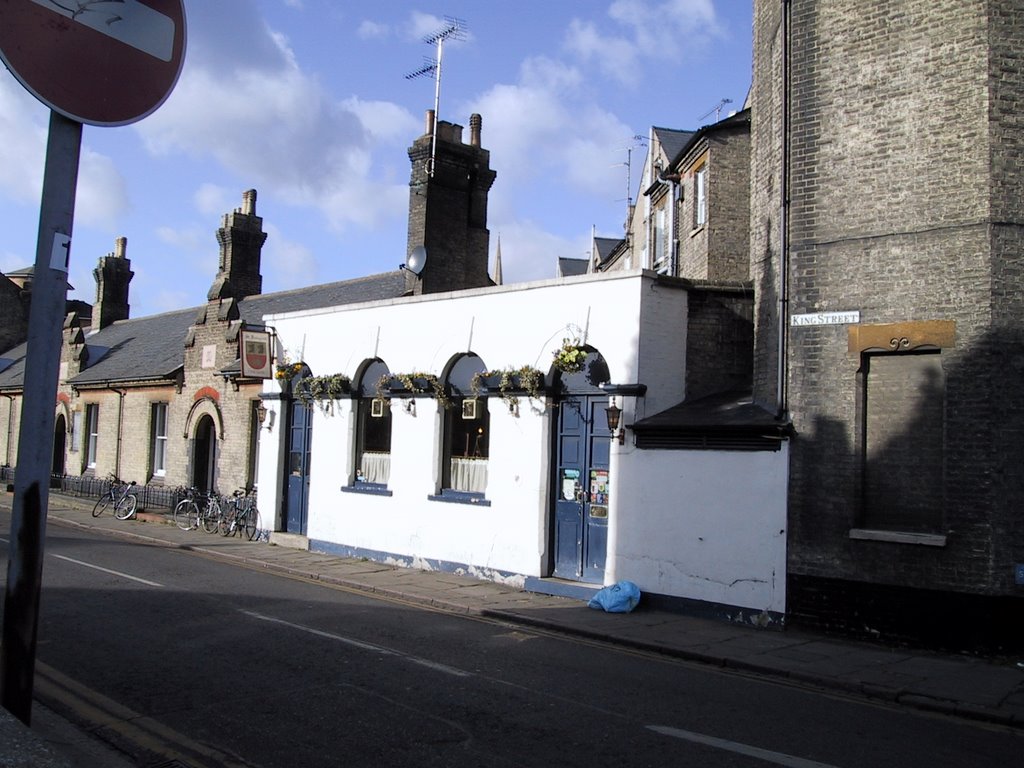
THE BEER BEAT: St. Radegund Free House, one of my favorite pubs in the world.


Regrettably, my paean to St. Radegund Free House in Cambridge, England must begin with the sadly belated report that former landlord Terry "Bunter" Kavanagh died five years ago at the age of 75.


Kavanagh's 17-year stint as landlord of St. Radegund ended in 2009.

The pub is a maelstrom of variety, in no small part courtesy of its patrons. But getting the pub to this point, holding it together, providing the glue, setting the tone, arguing the toss and belligerently ruling the roost has been Terry. He's seen B52s fly over Cambodia. He's done Bali and the Falklands. He's ushered countless students through evenings of unbridled alcoholic vice. And he's pissed in each barrel to make sure it was up to scratch.

Where else but Radegund would you find a cricket ball blessed by the Pope?

Returning years later, I ask barman Timothy Haire who those men (‘Hash House Harriers’) were. “A drinking club with a running problem” is his reply. He tells me of evening runs through Cambridge, following a flour trail which eventually leads to the St Radegund. The pub also boasts a rowing club and a cricket team, both founded by the late, much-loved landlord Terry ‘Bunter’ Kavanagh.

This quote must be rendered in bold.

The reason I look back on the pub with such fondness is not the beer (which was great), nor the spirits (also well chosen), but Terry's presence and the way he forged a community of regulars through sheer force of his personality. This approach is becoming rarer and rarer - and is something I miss from the pub experience.

I first patronized the Radegund during a trip to Cambridge in 1998.


My second and most recent visit came in 2001, as documented in the behind-the-bar photos above. I'm with Terry and my old friend Mark Stewart, who was working near Cambridge in 2001.

In 2006, NABC made a few batches of an English-style ale called St. Radegund. Here is the article, with only slight editing.

---

In 1998, my longtime friends Russell "Roz" Tate and Jason Masingo were in Cambridge, U.K., doing summer program course work. Dr. Donald “Uncle Don” Barry and I joined Roz and Jason for three days of intensive pub crawling and extensive research into the phenomenon of cask-conditioned ales.

My friends already had settled on the ideal venue for “real” ale: The St. Radegund. It’s the sort of pub we’d all like to frequent, with a small but well-selected range of libations and three hand pumps pouring fresh and superbly tended English ale.

The landlord, Terry Kavanagh, turned out to be one of those larger-than-life drinks impresarios glimpsed periodically in literature, but in this instance flesh-and-blood, warm, garrulous and welcoming, yet unwilling to suffer a fool for the sake of a pound. There need to be more like him.

This web comment (see link above) says it all:

“My only concern about the place is that its life expectancy is linked to that of Terry the landlord's liver.”

In 2006, when NABC’s brew crew of Jesse Williams and Jared Williamson announced their intention of making an authentic English bitter designed expressly for the Rich O’s cask cabinet, it seemed like an obvious step to honor the St. Radegund with naming rights for the ale.

But who exactly was St. Radegund?

The pub's name derives from a 12-century Benedictine nunnery in Cambridge that was dedicated both to St. Mary and St. Radegund; Jesus College later was contructed at the site of the nunnery.

For the rest of the story, we turn back to Roz Tate, currently an adjunct lecturer in history at Indiana University Southeast:

The early-medieval line of Frankish kings was the Merovingians. They were rulers of the Franks during the collapse of the Roman Empire and during the beginning of the Dark Ages. It was they who moved the Franks out of Germania and into the area we now call Belgium after the fall of Rome in the west.

Clovis was the most famous of the Merovingians. He ruled the Franks from AD 481 to 511. It was Clovis I who expanded Frankish rule into the lands we now call France. Clovis died in 511 at Paris. His kingdom was divided between his 4 sons. The one you need to know is Clothar I.

Clothar was king of 1/4 of the Frankish kingdom until his brothers one by one died from illnesses or in battle.

Clothar then became King of all the Franks from 568-561, when he died.

(NOTE: You will see the following spellings of his name: Chlothar, Chlotaire, Clotar, Clothar and Lothar. The last, "Lothar," is inaccurate! There is no Frankish King Lothar in the 6th century. In fact, Lothar I does not come along until the 9th century. Clothar is the most accurate and the best choice.)

Clothar had 4 wives, one being Radegunda. Here's how it happened.

Radagunda was born c.520 into the house of a minor Germanic king, who feuded with his brother for power over the German Kingdom of Thuringia. Around 530, the uncle won the feud and killed his brother. This left Radegunda orphaned, but controlled by her uncle, who now ruled Thuringia.

In 531, Clothar crushed the Thüringen army and took control of the kingdom AND Radagunda, whom he eventually married. Clothar had 4 wives, but Radegunda is the only one you need to know.

Clothar felt threatened by Radegunda's brother, so he had him killed. This so hurt Radegunda that she ran away and turned to God for salvation and comfort. She decided to found a nunnery at Poitiers (Christianity was spreading throughout western Europe during this time, so ANY new churches/nunneries were big deals in Rome).

She was successful. Apparently, Clothar felt some remorse over his murder of Radegunda's brother, so he fronted her some cash. The nunnery became famous and the legend of Radegunda began to grow. There are stories of miracles that were performed by her, including the curing of infirmities of all kinds, leprosy and there are also stories of her extreme kindness. There is also a legend of her single-handedly slaying a dragon (a popular story of the time period, symbolic of Christianity's victory over paganism/evil).

In reality, she took the cross herself, but did not become abbess of the nunnery, just a very famous nun. Radegunda died on August 13, 586 (some say 587). Her funeral was three days later, and it was attended by Bishop Gregory of Tours and the priest/poet Fortunatus, who became Bishop of Poitiers in AD 600. Both men left behind historical writings of her life.

Spellings you will see are Radagunda, Radagunde and Radagundis, the first being most common.

She was canonized and is now St. Radegund, patron saint of Poitiers.----

Half the batch of NABC’s commemorative St. Radegund Bitter will be served by hand pump for the next few weeks. The other half will be poured by the usual CO2 dispense.

The recipe used will remind some drinkers of NABC Beak’s Best, but it’s a different ale, with all English malt and a bit sharper hop bite. The abv is in the vicinity of 5.7%, making it milder than most NABC beers but stronger than most cask ales in the U.K.

Remember that by using the cask breather, we’re able to prolong the life of the naturally-conditioned ale, so you’ll have ample opportunity to indulge in the sort of scientific sampling that we undertook back in Cambridge in ’98.

---

St. Radegund may no longer be a "free house" in the strictest terms, as Wikipedia suggests it is tied to the Saffron Brewery, but no matter. The new landlord has refurbished the interior, and the pub lives to pour another day.

In closing, there's a schizophrenic exterior kaleidoscope that should be addressed. First, my photo from 1998.


Then, 2012.


Finally, 2016.


Long live the Radegund ... and cheers to the late Terry Kavanagh.

Friday, April 07, 2017

THE BEER BEAT: The Dolphin, one of my favorite pubs in the world.

Plymouth, England.

The Hoe is an open green space situated atop a promontory facing south to the sea, where Sir Francis Drake is said to have chosen the leisurely consummation of a lawn bowling session prior to sailing out to face the approaching Spanish Armada.

History does not record Drake’s choice of beverage.

The nearby Barbican is a relatively small but atmospheric quarter of older buildings that somehow survived both World War II air raids and a post-war rebuilding effort that seemed to consciously mimic socialist Bucharest’s.

The Barbican tumbles down the eastern slope of the Hoe’s weather-beaten cliffs and meets Plymouth’s old port, now given over to tourism and pleasure craft.

The Royal Navy base and commercial docks, catnip for the Luftwaffe, are located on the west side of the Hoe, along the mouth of the Tamar River. Beyond the Tamar is Cornwall, with the ocean gradually closing in on three sides until land’s end.

These Cornish expanses range far beyond today’s modest destination, the Barbican institution known variously as the Dolphin Hotel, Inn or Pub.

I’ll call it The Dolphin, a “proper” working pub, located mere yards from the spot where the Mayflower departed England for America. Reversing historical travel patterns, we visited Plymouth in 2009, finding The Dolphin suitably equipped with fine ale and delightfully resistant to modern refurbishment.

It was given a minor renovation shortly thereafter, though it seemed little changed when we returned in 2013. A pub regular told me the loos were vastly improved, so there’s that.

The Dolphin’s license holder and publican is Billy Holmes, whose father ran it before him. We haven’t met, but he’s been on duty long enough to become a community fixture.

"We don't do much music, well not more than half a dozen times a year, and we don't do the sports bar thing because that's not us. People come in here because they want a drink and a chat.

"And we don't do food. What would be the point with all the takeaways in the Barbican? People come in here with their fish and chips and have a drink, and that's fine."

Given the chance to complain about the competition from supermarkets selling cut-price booze, he shrugs his shoulders. Young binge drinkers are certainly not Billy's market. Real ale drinkers are; with at least eight on tap, The Dolphin is popular with those who like their beer 'live'.

Few such pubs can boast a semi-official house artist. The late Beryl Cook was a painter who moved to Plymouth after the retirement of her husband. They opened a guest house nearby, and gradually Cook gained fame as an artist. Because The Dolphin was her local, several of her paintings chronicle pub life.


For a visitor, The Dolphin is a fine example of what makes a pub great. The old harbor location is tourist-friendly and the styling traditional, but the landlord hasn’t applied unnecessary gloss and glitz, and he prefers to run the establishment for the sake of its regulars rather than commoditize it.

Imagine that.

Consequently, The Dolphin is comfortable without being pretentious. It isn’t someone’s abstract marketing concept. Rather, it is real – and so is the ale, although it will strike some American beer geeks as unusual to learn that the pub’s main draw, at least for me, was the chance to drink Bass Pale Ale served in a rigorously traditional and characteristically English manner.

The firkin, a keg of unique and purpose-built design, lies slightly tilted on its side in a cradle at room temperature. A wooden peg (spile) faces skyward, filling a hole that had been punched at tapping.

A faucet, tapped into place with a rubber mallet, protrudes horizontally from the firkin. The onrushing ale is borne on a gravity trail, pouring from the opened faucet into a waiting pint glass, cool but not cold, with minimal yet sufficient natural carbonation.

Perhaps the only nod to modernity is the use of stainless steel, rather than wood, to fabricate the firkin. Otherwise, it is likely that Plymouth’s publicans were filling tankards in like fashion almost four hundred years ago as the Pilgrims prepared for their voyage to the New World by loading their own barrels of ale onto the Mayflower.

When they ran out, it was time to find a place to brew more.

The Dolphin decants its Bass at room temperature in this simple, old-fashioned way, unpasteurized, and without the forced-pressure C02 system to which the world has grown accustomed, because the ale itself is naturally carbonated, or cask-conditioned, in the firkin by means of a secondary fermentation.

Although comparatively few English pubs follow the venerable example of the Dolphin’s gravity-pour method, many of them continue to vend one or more cask-conditioned ales with the help of a beer engine, colloquially referred to as a hand pump, or a hand-pull.

Their firkins are stored in the coolness of the cellar, where they are tended and prepped for serving. When ready, the ale is pumped by the barman into eager pint glasses.

At their traditional finest, balance is the watchword for all English real ales, especially those quaffable Bitters, and cask-conditioning is more than a way of drinking. It’s a way of thinking.

Flavors are subtle and even simplistic, yet unmistakably rendered. The malt character is rich and sweetish, with a touch of fruitiness. The classic English hop varieties are elegant, packing less of a bitter punch than their American cousins.

Historically, the alcoholic strength of English ale tends to be lower than one might expect, perhaps averaging around 4% abv. It is this sessionability that one misses most here in America, where we’re usually packing taps with 6% abv beers or higher.

Cask-conditioned “real” ale is thirst quenching or contemplative, depending on one’s mood. It tells the story of slow food, green living and an appreciation of traditional virtues in food and drink.

A place like The Dolphin is real ale’s natural urban habitat. We’ll make it back there some day, hoping the Bass is still pouring.

Tuesday, April 04, 2017

THE BEER BEAT: The Hibernian (Hi-B) Bar, one of my favorite pubs in the world.


It's been 30 years since I climbed the stairs to the first floor (in Europe, that's how they're numbered) and beheld the cramped majesty of the Hi-B. Somewhere up or down another set of stairs was the loo. The publican Brian O'Donnell was a legend even then, and as I write, it is my earnest hope that he's still alive and scowling.

Brian O'Donnell in 2008.

Barrie Ottersbach and I were in Cork, Ireland in 1987. In fact, we were there twice. The first time through town, we stayed at a ramshackle youth hostel and met briefly with a newspaperman named Tommy Barker. He's still at it.

After learning that U2 would be playing at Cork's soccer stadium in a week's time, we decided to wander the countryside and circle back. But first, Tommy directed us to the Hibernian (Hi-B) Bar, a legendary institution recommended to us by my cousin Donald Barry, who knew the Irish newspaperman when he was an exchange student in America.

We might have come back for second pint on another night. I can't remember, such was the merriment of what surely was the better part of an entire day spent drinking with a succession of incredible characters -- not to mention the proprietor Brian himself, with whom Professor Barry had become such good friends that they'd listen to opera together before, during and after hours at the bar.

One of our temporary drinking buddies was a bearded and bedraggled veteran of Ireland's UN peacekeeping force of infantrymen force in Cyprus, circa 1970. When asked if he'd ever witnessed combat in the war between Greeks and Turks, he said no, not exactly; it had been his sensible expedient to turn and run whenever shooting broke out.

Another, better groomed barfly at the Hi-B was a musician who modestly assured us that he'd played with every major pop and rock star of the sixties and seventies. His name didn't strike a chord, but there was an explanation for this, because he'd often appeared uncredited on albums to avoid tax and the prying eyes of ex-wives.

As the bar tab piled up (the two visiting Americans were happy to do the buying), I kept throwing names at the musician. From Van Morrison to David Bowie, and Rory Gallagher to Phil Lynott, he fielded them effortlessly, complete with record dates and concert gigs.

Finally, I thought I'd stumped him: What about Pete Townshend of The Who?

He paused, then admitted he hadn't ever played music with Townshend ... but one time he was driving on the motorway somewhere in England, and stopped to help some poor bloke who was trying to change a tire in the rain ...

That's right. It was Townshend, who offered the helpful good Irish Samaritan one of his guitars in return, but of course he couldn't accept it ...

So it went. We emerged in the wee hours reeking of cigarette smoke and walked back to the hostel, roughly 75 (Irish) Pounds lighter. Following are a collection of links, the most recent of which is from October, 2016.

Cousin Don has kept me posted about Brian over the years, and each update has warned of his friend's imminent retirement. The funny thing? My entire career as a curmudgeonly publican has come and gone since the last time I drank at the Hi-B ... and yet I'm not feeling retired quite yet.

Friends in Hi places lie low when Brian’s on warpath, by Dan Buckley (The Irish Examiner)

Saturday, December 01, 2012

... Yet every few years Brian has managed to attract a new generation to the Hi-B. This is just as well because every now and then he will decide on a mass culling of clientele, and if it wasn’t for the large proportion of young imbibers, there would be nobody left.

So why do people return again and again? Hardly for the decor and certainly not for the dungeon-like gents’. There is only one word for it — craic, beloved of hard drinkers and easy listeners.

And the more cracked you are, the better.

More recently ...

Hi-B, by Julie Daunt (The Culture Trip) 27 October 2016

Situated on Oliver Plunkett Street and up a flight of stairs is the renowned and sometimes notorious Hi-B. Its full name is the Hibernian Bar, but it is known far and wide by its shortened name. The bar is housed in what was once the Hibernian Hotel, and it is perhaps one of the most intimate and eccentric places to have a pint in Cork. What’s more, mobile phones are forbidden, meaning there is always a din of real conversation and laughter. This is enforced by the owner Brian O’Donnell, who is a Cork institution in himself. Fancy frills and sleek decor are left outside the door of this traditional pub. A step back in time, there is always a blazing fire, a cold pint of stout and story to be heard at the Hi-B.
Hi-B, 108 Oliver Plunkett Street, Cork, Ireland, +353 21 427 2758

Finally:

The Hi-B - my favourite bar in Cork City (Ireland), by Daniel M Doyle (Authors Den)

Tuesday, April 12, 2016

The golfer asked Brian to order him a taxi. After a few minutes a rather agitated taxi driver ran up the stairs, stuck his head in the door and announced himself - “taxi!” He was probably double parked on the busy street outside and anxious to get going. Still seated, the golfer slowly turned to address him and eventually said:-

“I’ll be with you ……..in…………..three ………… hours.”

Video credit