Saturday, September 02, 2017

Top Ten posts at NA Confidential for August, 2017.

It was the month's top post, so did Wendy Dant Chesser see this infographic from Money Choice?

Thanks for reading NA Confidential, where we enjoy scanning the neglected periphery for uniquely local perspectives.

I'm delighted at NAC's August numbers, especially your attention to the "Grid Control" series. Overall, August readership testifies to a keen ongoing interest in New Albany stories, perhaps because they're being chronically under-served elsewhere.

The list begins with ten "honorable mention" posts, before concluding with the Top Ten, escalating to No. 1. Stats are derived from Google's internal numbers listings.

AUGUST TEN HONORABLE MENTION

356

Dan Coffey plans his own unity rally, because why should those smarty pants Democrats have all the fun?


---

359

Develop New Albany's Broccoli Walk is August 12. What? Oops, sorry -- it's a Taco Walk.


I still think broccoli is getting the short end of the "signature" event, though tacos are nice, too. Here is the list of participating establishments.

---

364 (tie)

On the errant notion of downtown two-way gridlock: The "I'll huff and puff and boycott a place I rarely go anyway, except to pass through" approach.


There is a word that can't be repeated often enough to those who threaten to boycott downtown because two-way streets will require them to drive a tad more slowly and (heaven forbid) pay attention to the community outside their car windows:

Promise?

---

364 (tie)

GREEN MOUSE SAYS: This new electronic sign at St. Mary's did not receive a COA from the New Albany Historic Preservation Commission (hint: it's illegal).


It's a tad disappointing that as a beneficiary of Super Tuesday's historic preservation largess distribution (and a questionable one, in my estimation), the church didn't follow COA procedures with the new electronic sign. It will be doubly disappointing if City Hall, after these puffy days of publicly celebrating its preservation credentials, doesn't enforce the rules. After all, unequal enforcement is in many respects worse than no enforcement at all.

---

374

Terrified populace braces for 2-way apocalypse, coming later today, only a decade too late.


However, we're told that today at some as yet undefined juncture, Spring Street will revert to two-way traffic after a half-century in captivity.

Pearl and Bank are to follow tomorrow, then Market, and finally Elm. September 30 is the deadline for erasing the city's damaging one-way mentality, albeit it with anchors symbolic of stasis marking every corner.

---

379 (tie)

Newspaper letter writer savages a failing, flailing and floundering Duggins at the NAHA, and follows the bread crumbs back to Deaf Gahan.


The Deputy Executive Director mentioned in Susan Ryan's letter (below) is Tony Toran, a former city official and longtime Democratic Party higher-up. This and other carefully pre-scripted "surprises" occurred at last Monday's New Albany Housing Authority meeting, but numerous reports of David Duggins' escalating managerial incompetence have been coursing through the Green Mouse's grapevine for weeks.

---

379 (tie)

GREEN MOUSE SAYS: Is Denton Floyd acquiring the Reisz building for use by a relocated NA City Hall? We think a deal is imminent.


The Green Mouse since has been told that Team Gahan will soon reveal a deal for the Schmitt family to sell the long moribund Reisz Furniture Warehouse Store to Denton Floyd Real Estate Group, the Louisville developer currently rehabilitating the old M. Fine & Sons factory at the 140 block of East Main.

---

392

Thanks, Gahan: Deaf called it "a blight and eyesore for the area," so he acted swiftly ... to create another one in its place.


Back in March, a scandal-plagued Jeff Gahan explained why he had to demolish buildings at the corner of Market and Vincennes. He didn't say anything about creating a post-industrial wasteland in the aftermath, but maybe the memo got lost when Duggins took all the city's bulldozers over to the New Albany Housing Authority ... with Democratic Party approval.

---

393

Hoard this: Contest concludes as Clint finds the "Entrance to Jeff Gahan's Down Low Bunker."


---

394

Told you so: "New Albany in talks to relocate City Hall to Reisz Furniture building."


Thanks to the News and Tribune's Elizabeth Beilman for confirming what NA Confidential published yesterday.

---

423

James "U of L" Ramsey, sombreros, stereotypes and DNA's institutional legacy of tone deafness.


---

424

ON THE AVENUES SATURDAY SPECIAL: One-ways on the way out, because with downtown at a crossroads, they simply had to be exterminated.


I’ve noticed that as we debate two-way streets in New Albany, or more accurately, as proponents offer ream after ream of statistical evidence even as opponents respond by screaming and threatening to maul someone, those of the one-way persuasion tend to say "I" and "me" a lot, while those interested in more than one path through life use words like "we," "us" and “ours.”

AUGUST TOP TEN

480

Croissants d'BBQ Bologna: Dan Coffey says that restaurants are taking up the sidewalk and his compatriots damn well better do something about it.


Coffey's germ of truth is irrefutable, because disabled users really do face myriad daily challenges attempting to navigate the city of New Albany's sidewalks and streets.

But making this point by attacking the city's food and dining community, which has done more than any other economic sector to make downtown habitable again, misses the larger truth by a Birdseye mile.

---

518

Dear ordinance enforcement: Each of these signs at Breakwater is illegally posted. You'll want to address it, of course.


---

543

"Lost our parking, store closing," says Reeder's Cleaner of Spring Street location in New Albany.


At least I assume Reeder's has closed its Spring Street location; so said the signs, but I haven't walked up that way lately to double check. Speaking personally, while I haven't used dry cleaning services for many years, I was always struck by the sign above the door.

---

561

30 years ago today on THE BEER BEAT: Visiting the Carlsberg brewery just prior to the Altercation in Copenhagen.


Carlsberg would be a return visit for me, and this passage from the 1985 travel narrative sets the scene as well as reiterating what led us to beers of the world in the first place. I've inserted the 1987 photos into 1985 commentary.

---

888

Grid Control, Vol. 23: City's fuddy-duddies losing their minds as the debut for a two-way Spring Street is pegged at August 29.


Thirteen years later, it's the end of the beginning. Speaking personally, I think the Spring Street conversion announcement should have been made at roughly 2:30 p.m. on Monday, when the combination of a solar eclipse and impending two-way-street rationality (finally) would have sent the Luddites streaming panic-stricken toward Birdseye.

---

1,130

Let's all eat at Israel's Delicias de Mexico Gourmet on Saturday, August 12.


If you're not planning on Taco Walking and still need to eat at some point on Saturday, allow me to suggest that while it isn't located in the epicenter of downtown New Albany, Israel's Delicias de Mexico Gourmet (1515 E. Market Street) would be a great place to have a meal.

---
1,156

Grid Control, Vol. 22: City engineer Larry Summers answers our questions about intersection striping errors and the "No Trucks" sign removal.


In Vol. 21, we asked questions about the soon-to-be-repaved intersection at Spring and 10th Street, and the disappearing "No Trucks" sign at the intersection of Spring and Vincennes. Afterward, city engineer Larry Summers swooped into a discussion at the New Albany Indiana page at Facebook and gave these answers.

---

1,324

Grid Control, Vol. 20: As Team Gahan dawdles, another bicyclist is crushed into mincemeat at 10th & Spring's dangerous dogleg.


---

1,334

Grid Control, Vol. 19: In a positive move, HWC begins righting the wrong cross hatching on Spring Street.


It's been roughly six weeks since NAC broke the errant cross hatching story. At the most recent BoW meeting, city engineer Larry Summers said he expected repairs to occur before the debut of two-way traffic, and that doing so would not require the westbound lane of Spring Street to be closed.

---

1,579

Here's one for Wendy: "How Corporate Welfare Is Killing Small Businesses."


Despite being the backbone of the economy, funding from the Small Business Administration is a fraction of that of corporate welfare.

Charlestown's Bob Hall channels his inner Gahan. Are the cattle cars on their way?


We can't demand politicians be honest and transparent without congratulating Bob Hall for his candor.

If we're all being honest (paging Mr. Dickey), there can be little doubt that the conceptual basis of ersatz Democrat Jeff Gahan's public housing putsch in New Albany is perfectly synchronized with the undoubtedly genuine Republican Hall's crusade to erase Pleasant Ridge from the map of Charlestown.

Both seek to make the right kind of space for the better sort of citizen. Think of it as a neatly refashioned "Lebensraum" for River Ridge -- after all, it isn't like those low-rent, anti-social elements work, or anything as useful.

To paraphrase Pete Townshend, "Go to the mirror boys."

Mayor denies Pleasant Ridge accusations, says 'low-rent' neighborhood needs to be removed, by Kirsten Clark (Courier-Journal)

SCOTTSBURG, Indiana — Charlestown Mayor Bob Hall — who is accused of improperly colluding with private developers to wipe out the low-income Pleasant Ridge neighborhood — testified Friday he did nothing wrong in trying to help remove a "low-rent" neighborhood that can attract people "who are not contributing to society."

During a hearing before a judge, Hall maintained that enforcement of the city’s property maintenance code through inspections and fines — which Pleasant Ridge residents allege is part of an “illegal scheme” to force them out — was carried out lawfully and has been effective in addressing issues of crime, garbage and substandard housing in the neighborhood.

“I know it’s not politically correct to say this, but when you have a low-rent district, it invites people who are not contributing to society,” Hall said.

As a closing thought, I fixed Hall's statement:

"I know it’s not politically correct to say this, but when you have One Southern Indiana, it invites people who are not contributing to society."

Friday, September 01, 2017

30 years ago today: (May) Hillsides in Perugia, Gubbio, Assisi -- and the end of Italy '87.


Previously: 30 years ago today: (May) The unique towers of San Gimignano.

---

Day 25 ... Sunday, May 10
Perugia. Met Noah at hostel. Boreass day

Day 26 ... Monday, May 11
Perugia ... Around town with John from Louisville

Day 27 ... Tuesday, May 12
Perugia. With Josh Berger to Assisi, atop mountain, tortellini

Day 28 ... Wednesday, May 13
Perugia. To Gubbio. More tortellini, expatriate argument (Derrick)

Day 29 ... Thursday, May 14
Perugia. Hike, cemetery, new group of Americans

From the start, I’d planned to remain in a relatively confined area of central Italy during my allotted time of 10-12 days. There’d be no wandering through Milan, Rome, Venice or Sicily, at least on this trip.

The tourist destinations of Florence, Siena and San Gimignano all are in Tuscany. For the final act, Italy’s meandering hill country train network brought me to Perugia, in the neighboring region known as Umbria.

It was a fine decision, indeed, and one that I'll always associate with the pop/rock band Crowded House, a connection to be explained shortly.

First, Perugia itself. It's the very definition of an Italian hill town. The train station is located down in the valley, and the city climbs upward from there, with an effect not unlike a terraced vineyard with buildings instead of grapes.

A local bus elevated me to the stolid Piazza IV Novembre, the center of Perugia since Roman times, and so named to commemorate the armistice with Austria-Hungary at the end of World War I.

Just a few narrow blocks away was the Centro Internazionale Accoglienza per Giovani, an inexpensive youth hostel now known as the Ostello di Perugia Centro, and still doing business thirty years later.

At the time, the hostel was said to have been affiliated with a religious order, which didn't overly alarm me. It was inexpensive and perfectly welcoming, if a tad humorless, with a nicely equipped kitchen and handy balconies to hang wet laundry.

There were a good many American college-aged travelers staying there, and while I was older than most at (almost) 27, for a few days we split off in ever-changing small groupings to explore the vicinity.

Having noted this, I remember nothing about Noah, John, Derrick or the new batch of Americans. My notes suggest that one evening, Derrick and I had a heated discussion about something, probably politics. He must have been a right-winger.

Josh Berger is the fellow I remember. If my memory is accurate, Josh was an Ivy Leaguer who had been in Italy for a while, perhaps on a work-study program. He was smart, worldly and in the process of mastering the art of cafe-lounging and girl-watching with requisite aperitifs.

Josh undertook to teach the nuances of Campari to me, and although I couldn't afford many of them, it was much fun. I repaid the favor when the two of us rode the bus to Assisi and had a wonderful discussion about the origins of the Great War, the marriages of the Habsburgs and the work of historian Barbara Tuchman, all the while seated atop the Rocca Maggiore, studying a spectacular view in all directions as we rested for the hike back down the slope.

It made me happy that my IU Southeast education was sufficient to keep pace with a lad from Harvard,

Twice the group convened in the hostel's kitchen and cooked up massive pitch-in meals of pasta, vegetables and fruit with cheap local wine. On the next-to-last evening the communal meal got a bit raucous (in part owing to the debate with Derrick), which brought the night staff down to quiet our exuberance.

At some point very late, I crawled to my bunk bed, made it to the top -- I weighed “only” 200 pounds then -- and donned the miniature/a> radio earphones to make the rounds of the Perugia AM dial.

The very first song I heard was the brand new band Crowded House's "Don't Dream It's Over," and although there was something vaguely familiar about it (namely, Neil Finn's residency in Split Enz), I couldn't place the connection.


The song stuck in my memory for months, until finally back home in the fall of 1987 I made a positive identification. By then the 1987 European dream was in fact over, but a fresh one for 1989 had long since entered the planning stages.

The visuals begin with a few Perugia views in and near Piazza IV Novembre.


I believe this is a view of the back side of the hostel (facing the valley), with some of my clothes drying.


Again, guessing: the valley view from up the hill, probably near Basilica di San Domenico.


A random shot -- might be Perugia, might be Assisi.


The town of St. Francis' birth has become part of his identity: Assisi.


Eventually we walked up to this promontory.


Flying buttresses? Yes, please.


After a bit of belated research, I now believe it's likely that the Josh Berger who snapped this photo of me as we gabbed atop the Rocca Magiore in Assisi in 1987 is the same Josh Berger who currently heads Warner Brothers in the United Kingdom.

If so, this considerably bolsters my "Six Degrees of Kevin Bacon" credentials.


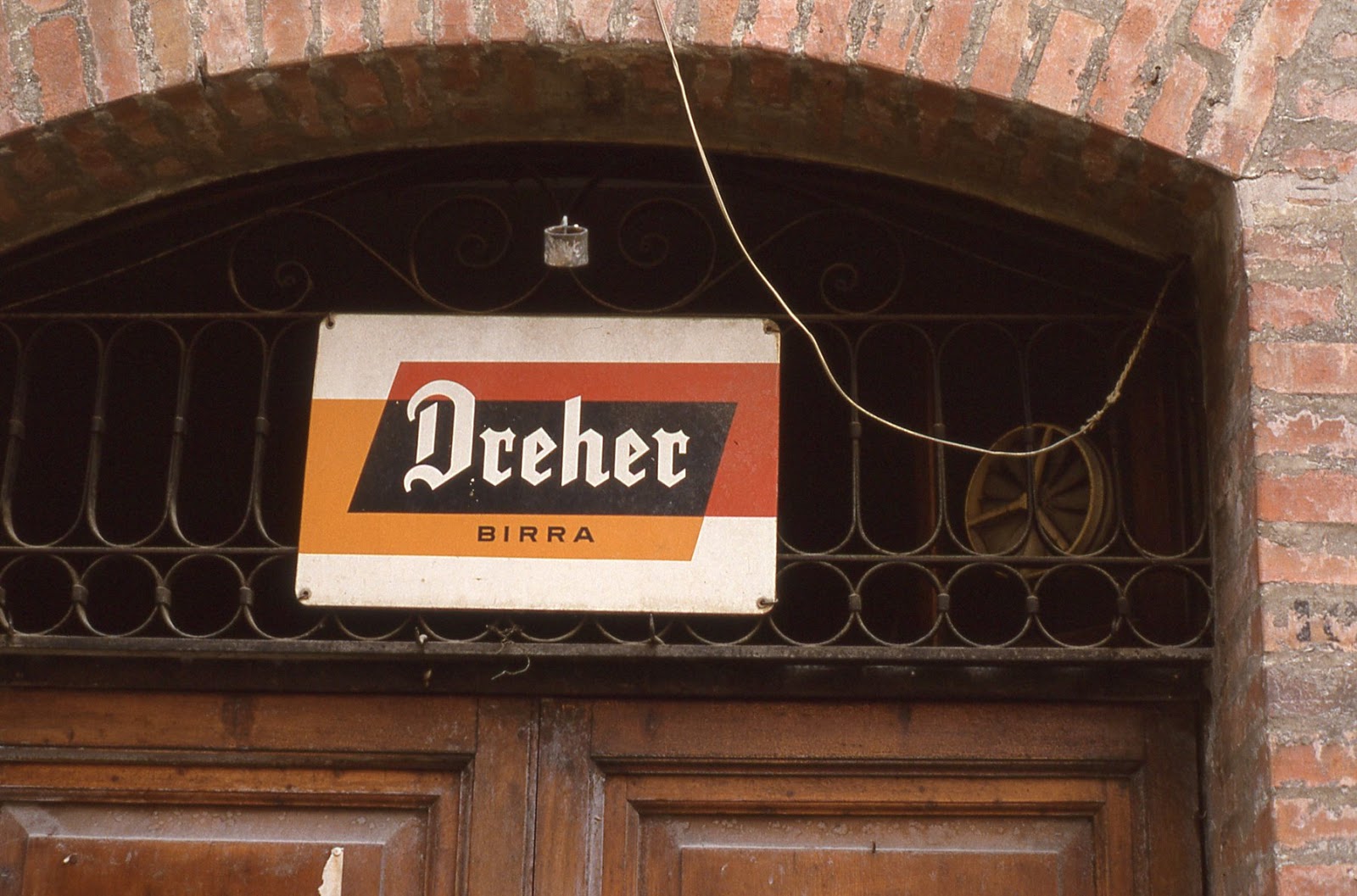
After a walk like that, a cool beer was necessary. The beer is named for Anton Dreher (1810 - 1863), one of the pivotal figures in the development of modern lager brewing.


On Wednesday another bus took me to the medieval hillside town of Gubbio.

Gubbio has been called the"City of Fools" because here one can obtain a "madman's license" and the "citizenship of Gubbio" by making 3 circles around the small fountain in Largo Bargello.

Obviously, one might spend a year in any of these locales and still only scratch the surface.


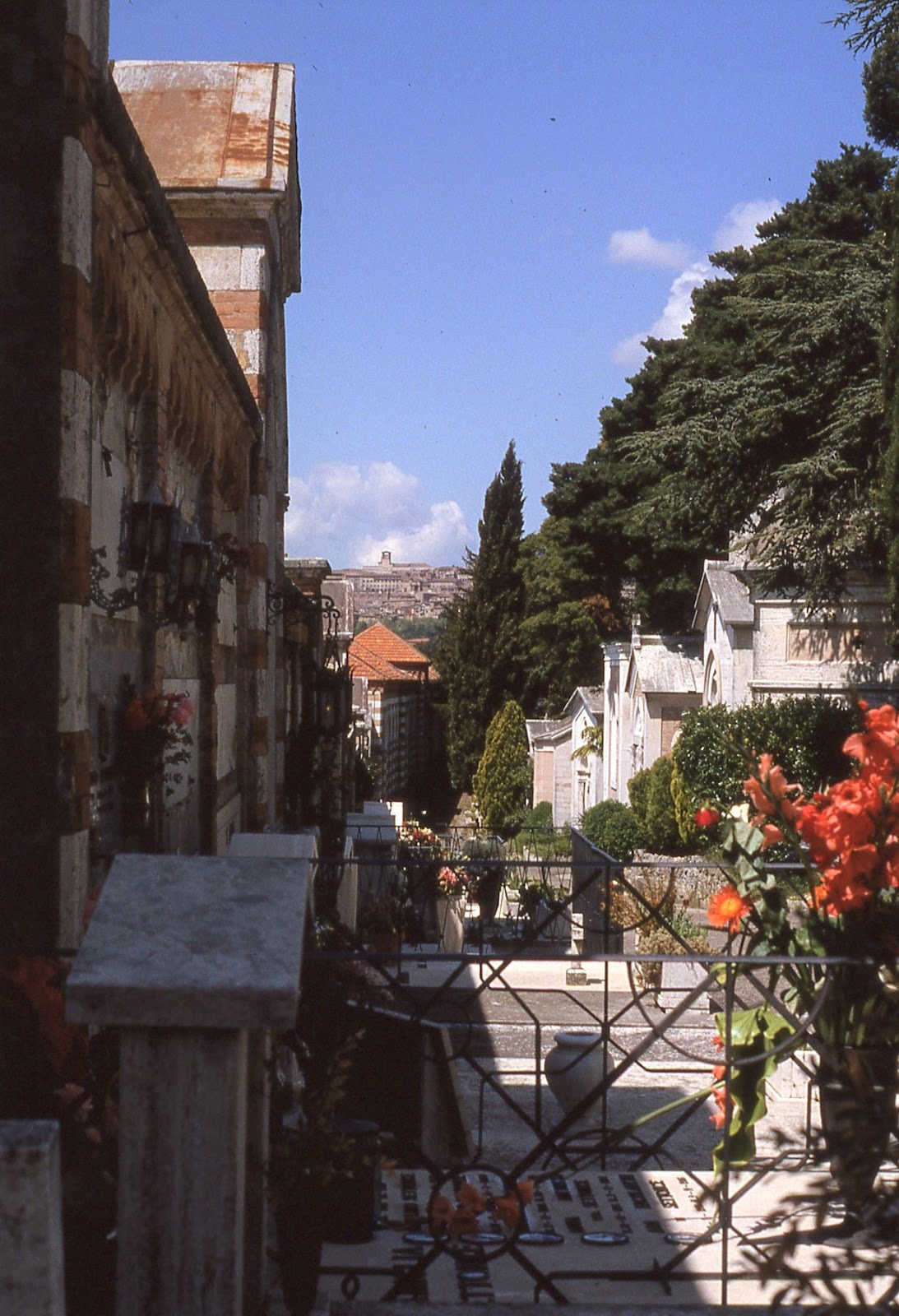
On Thursday, my last full day in Perugia, most of the Americans I'd met shipped out. I rode with them on the bus to the station, then spent the day walking. One destination was this cemetery in the valley. I'd begun to see how much could be learned about a culture by visiting its resting places -- a topic explored at length in an excellent blog entry about cemeteries in Tuscany.

It’s impossible to visit a city in Italy without facing centuries of death. It seems that every town is filled with crypts, catacombs and necropolises. Some of the most compelling sites in this country are the graves of illustrious Italians. We’ve seen the tomb of Michelangelo, Julius Caesar, St Francis of Assisi and Galileo Galilei among many others. Even when the dead aren’t famous, their graves sometimes are. They are everywhere.


It must have been a lengthy hike, indeed. The tall structure in the middle is the Basilica di San Domenico ...


 ... and from near the same church, this photo was taken later the same afternoon.


Yes, there are snow-capped peaks in the Apennines in May -- at least there were in 1987, although in today's warmer world it might no longer be the case.


On Friday, May 15, I took at least three train trips, first from Perugia to Florence, then to Venice, and finally Trieste. Barely pausing to dine, I boarded yet another train to Ljubljana, across the frontier in Yugoslavia.

ON THE AVENUES: Welcome to wherever you are, and come to think of it, Ljubljana will do nicely.

LIVE TO EAT: Stepping outside the General Tso to ask for the “authentic” Chinese menu at Oriental House and Jasmine Chinese Cuisine.


Food & Dining Magazine is a quarterly. For many years, I'd wait until the newest issue came out, then share my previous beer column with blog readers, whether here or at Potable Curmudgeon.

I haven't written a beer column for a while because the magazine's publisher John White has had me doing feature-length articles. However, my format for sharing remains the same, and so here is the complete text of my profile of Oriental House and Jasmine, published in May 2017.

There actually was a blog preview of sorts, a May review of a book I read in preparation to write the profile.

BOOK REVIEW: Chop Suey – or how Chinese food came to be taken for granted in America.


It can suffice to say that between this May feature and the August one currently on the newsstand (a profile of August Moon's owner Mimi Dabbagh), my knowledge of Asian food and history has increased exponentially.

---

Food & Dining Summer 2017 May/June/July

Authentic Chinese Regional Cuisines: Exploring "The Other Menu"

It was a pivotal moment in 20th-century geopolitics.

America’s collective jaw dropped as President Nixon appeared on television wielding chopsticks during a banquet with the Chinese communists in Beijing. Mrs. Nixon was particularly adept with the utensils, having practiced diligently beforehand.

It wasn’t clear whether ideological negotiation or table manners was the major takeaway from the telecast, or the trip. Change was in the air in 1972, but there was no way of foreseeing China’s quantum leap from economic basket case to influential world power.

Nor was there any indication that the legacy of indistinct Chop Suey houses and La Choy Chow Mein in cans (it still exists) would eventually yield to 41,000 Chinese eateries across America.

More than 70 of them do business in Food & Dining’s metro Louisville readership area. Their very ubiquity is key; since significant numbers of Chinese began arriving in California in the mid-19th century, their hot pots have yielded to our melting pot.

A diverse culinary heritage many millennia in the making has proven perennially re-adaptable, and today it’s clear that Chinese buffets, egg rolls and General Tso are as much a part of “real” American eating as burgers, barbecue and fried chicken.

45 years after Premier Zhou Enlai introduced the visiting Nixons to pot stickers, perhaps it’s time for a culinary reboot. Without leaving Louisville, how might we sneak a peek behind the Bamboo Shoot Curtain for a more realistic taste of an ancient land and its varied regional cultures?

A local expedition of rediscovery begins at two restaurants with long and successful tenures in Louisville, each complementing a core lineup of tried and true Chinese dining options with supplemental “authentic” menus filled with regional specialties: Oriental House, emphasizing Cantonese and an all-day array of Dim Sum, and Jasmine Chinese Cuisine, which specializes in classic Szechuan dishes.


At Oriental House, Cantonese and Dim Sum are all in the (Chiu) family.

It was lunchtime at Oriental House, and to my ears it sounded like many of customers were making precisely the same order.

“The usual.”

I chatted with one of these regulars, who was waiting at the counter for his carry-out, gossiping with the help.

“Happy Family is my favorite,” he said, “but I like Mexican food, too. Chicken Fajitas and Happy Family, for sure. One of these days, I’m splurging on a whole Peking Duck.”

Concurrently, Jonathan Chiu has a firm idea about what makes his Oriental House family happy. The secret ingredient can’t be found on spice racks or in cookbooks. It’s togetherness.

“Our family works as a unit.”

Bai He Chiu and his wife Fannie, both natives of China, came to Louisville from San Francisco. They bought Oriental House in 2003, becoming the restaurant’s third owners since its inception in 1964. These days mom Fannie patrols the front of the house with the assistance of his Jonathan’s sister Melissa, who also hires, schedules and runs the company office.

California-born and educated in Louisville (Bellarmine and Spalding), Jonathan has visited China only once. For the past six years, he has been alongside his father in the Oriental House kitchen, gradually absorbing his elder’s life lessons about Cantonese cuisine as a whole, and specifically, the venerable art of Dim Sum.

“Every family has their own flavors and tastes,” Jonathan told me. “My father learned in China and California, over time, from different chefs. His mind created this menu from the best of everything he has learned. It’s what my dad envisioned Louisville wanting.”

It’s what Jonathan wants, too, and he is delighted to be helping the family business cater to heightened demand, because even when the work is hard and you’re lost in the weeds, there’s no better place to be than right in the middle of it, alongside your father.

“These past six years I’ve been in the kitchen, just learning from my dad. When I was growing up, he was always working, and I couldn’t spend much time with him. After college, I decided I was going to learn the family business. This is what I want to do. The work isn’t easy, but I get to hang out with my dad all day, with my family, and at the same time make his workload less.”

The Chiu family’s recipes at Oriental House are variations on the culinary tradition of Cantonese, as referring to the food and dining ethos of Guangdong Province in southeastern China. The famous island cities of Hong Kong and Macau lie adjacent to the province. Taken together, these areas have a staggering population of 116,000,000 persons in an area slightly smaller than Kentucky and Indiana combined.

Two centuries ago, western visitors sailed to China and docked in Guangzhou, formerly Canton, and today the capital of Guangdong Province. Most of them remained in the foreigners-only zone, eating roasts, potatoes, puddings and other meals packed from home. However, a few traders, sailors and missionaries experienced Cantonese dishes for the first time – and some overcame their culture shock to appreciate the differences.

A foodie cultural migration had begun, split into two distinct paths. The more familiar of these routes is documented in Oriental House’s standard everyday menu, with its Americanized offerings on the historic Cantonese model, from the aforementioned Chop Suey, Chow Mein and General Tso’s Chicken, to Moo Goo Gai Pan and Moo Shu Pork.

According to Jonathan, longtime customers who grew up with these choices tend to stick with them, and their patronage is steady and reliable. The second, more exotic face of Oriental House can be found on the “Authentic Chinese” laminated menu card, which Jonathan recently augmented with colorful pictures in a binder, all the better to depict his father’s artistry.

The authentic menu includes more obscure Cantonese renderings of pork, beef and seafood, as well as seldom seen offerings like Tong Choy (water spinach), Hong Su Tofu, and a dish described as “sauteed fish filet rested on its crispy bones,” in which the filet is shaped to hold steamed vegetables, with the bones serving as a base for display.

There was a time when many Chinese restaurants retained just such an authentic special menu, albeit one written in Mandarin only, and usually intended for Chinese customers. This way the contents wouldn’t require explanations in English, and it was unlikely that Americans would glance past the egg rolls, anyway.

By placing a renewed emphasis on its authentic Cantonese options and making them fully intelligible to non-natives, Oriental House is riding a wave of curiosity about food and drink.

In Jonathan’s memorable phrase, the authentic Chinese menu is growing in popularity for a reason: “We have adventurous people who’ll eat chicken feet.”

He’s absolutely right, and I’m one of them. The chicken feet were delicious – fried, braised and steamed to yield buttery skin with plenty of tender meat and cartilage there to vacuum from the bones, just so long as you’re willing to put forth the effort and get messy in the process.

We eat chicken wings and think nothing of it, so why not feet?

One afternoon my wife and I enjoyed a late lunch date at Oriental House, and our friendly server seemed delighted with her order of Singapore-style rice noodles, accompanied by an assortment of Dim Sum: Pan-fried Buns with Pork, Tofu Skin Rolls, Steamed Spare Ribs, Taro Cakes and Turnip Cakes.

Then our server turned to me.

“I’ll have number 14, please – the braised Sea Cucumbers with Shiitake Mushrooms.”

She smiled, albeit a tad quizzically.

“Have you had this dish before?”

“No, but I’m going to have it now.”

“All right, that’s fine. You know, not many people order this!”

The sea cucumber assuredly comes from watery depths, but it is an animal, and not recommended for use in Greek salads. From time immemorial this echinoderm, an otherwise undistinguished ocean-floor bottom feeder, has been craved by status-conscious Chinese diners, along with equally offbeat foodstuffs like bird’s nests and shark fins.

Oriental House prepares its sea cucumber in a subtle oyster sauce with shiitakes, ginger, carrots and pea pods. I found it delectable, with the sea cucumber itself somewhat reminiscent of escargot’s texture.

18th-century American sailors tepidly dipping their toes in Chinese waters were completely flummoxed by these and other mysterious gustatory specialties, although their confusion didn’t prevent them from scouring the Pacific Rim for bizarre (at least to them) foods the Chinese would accept in trade.

Indeed, Cantonese cuisine always has embraced genuine diversity in sourcing, an omnivorous quality for which Guangdong province is celebrated within China itself. It’s a polite way of saying they’ll eat just about anything, although at the same time, a discerning Cantonese chef emphasizes gentle and restrained methods of preparation, as sufficient to showcase the original flavor of the meats and vegetables.

At Jonathan’s suggestion, I ordered a slightly more conventional Oriental House entrée, Sweet and Sour Pork Chops. The brownish-red sauce is as you might imagine, but the sweetness is savory, not cloying. There is a slight balancing tartness from the use of rice wine vinegar, and the pork flavor shines through, undiminished.

One-third of Oriental House’s “Authentic Chinese” menu is taken up by Dim Sum, totaling 27 types in all, and available throughout the day. Dim Sum alone sets the restaurant apart from the Louisville norm, and yet Jonathan stressed to me that these varieties represent a mere sampling compared to the wider selection to be found in China and San Francisco, the American hub of Dim Sum mania.

Dim Sum is a term capable of translation in a bewildering variety of ways, some of them intriguingly abstract. Literally, it means “to touch the heart,” and perhaps can be viewed as widely varied little somethings for nibbling.

After the Gold Rush, Dim Sum gradually evolved from Cantonese origins as a brunch-like morning snack, penetrating American consciousness as both sweet and savory dumplings, pastries and cakes enjoyed during afternoon tea service.

In essence, these were stylish tapas long before small plates became cool, and have evolved into contemporary edible art, with modes of preparation, mutable forms and a detailed lexicon all their own.

The Dim Sum list at Oriental House includes congee, an ancient and foundational form of rice porridge that Jonathan likened to chicken noodle soup in the arsenal of western home health care.

“When someone in China isn’t feeling well, we’re told to go eat some congee, and it will make us feel better.”

Dim Sum is as much a philosophical quest as sustenance, and it’s no exaggeration to suggest that Bai He Chiu, patriarch of Oriental House, someday will conclude his long career as chef, engaged in what by necessity must remain the unfinished study of Dim Sum theory and practice.

Perhaps the safest bet of all is that when dad’s finally ready to retire from the kitchen, his son Jonathan will be waiting at the intersection of culinary art and commerce. It’s something to think about as we await Oriental House’s 100th anniversary in 2064.

Oriental House
4302 Shelbyville Road
Louisville, KY 40207
502-897-1017


The diverse seductiveness of Szechuan food pairs perfectly with Jasmine Chinese Cuisine.

Strictly speaking, Jasmine Chinese Cuisine is separated from Oriental House by ten miles of busy Shelbyville Road asphalt, and while the “regular” Sino-American menus at each of these essential Louisville restaurants are similar, their “authentic” regional bills of fare might be said to lie approximately 975 Chinese miles apart – the distance between Chengdu, Szechuan Province and Guangzhong, Guangdong Province.

It’s almost the exact space between a crock of clam chowder in Portland, Maine and our own bowl of burgoo in Louisville, or paella in Madrid and Bavarian schnitzel.

I’m a devotee of the midday lunch bustle. When I walked into Jasmine for the first time, dozens of carry-out bags were headed out the door for delivery by van, as a table of six crisply dressed professionals dug into identical Sweet & Sour Chicken lunch specials.

Soon I was seated in a nearby corner booth, savoring a plate of Beef Maw and Tendon paired with a steaming bowl of Sour Pickled Fish Soup. They were ordered from the separate “Chinese Menu,” as labeled at Jasmine. It features specialties from Szechuan Province, which lies in south-central China, northwest of Macao, Hong Kong and the huge coastal metropolis.

Home of the giant panda, Szechuan borders Tibet and is a watershed of the Yangtze River. The province is a prime agricultural area long renowned throughout China for honest, spicy, elemental cuisine. Appropriately, in 2011 the capital city of Chengdu was named a World City of Gastronomy by UNESCO.

Lan Zhang and her husband (and chef) Lin Lin own Jasmine Chinese Cuisine. When I met with Lan in early April, Lin was abroad on a trip home to Chengdu. She eagerly unspooled a series of delicious mobile phone photos showing the food he was diligently “researching” while on the road.

“It has been a pretty good experience for us,” said Lan about their decision to include a sizeable component of distinctive Szechuan cooking in the restaurant’s repertoire. She estimates that 35 to 40% of Jasmine’s sales are from the Szechuan menu.

“Our motto is fresh and simple – no MSG, nothing artificial,” she said, adding that in China itself, Szechuan cooking enjoys a widespread reputation.

Hearing this, I was reminded that Kong Qiu – the thinker we know as Confucius – was among history’s first locavores. 2,500 years ago, he was writing about things that remain topical: the superiority of food prepared with fresh, seasonal ingredients; moderation in dining and drinking; and respect of the environment, among other observations.

Confucius is but one in a pantheon of ancient philosophers whose teachings inform Chinese culture to the present day. I’d argue that it makes perfect sense for such doctrines to include deep thoughts about food, and to foster spiritual approaches and respectful rituals. After all, China’s long history is a story of so many mouths to feed, interrupted by periods of too little to eat. Food has not been taken for granted.

Throughout the country, attitudes toward eating often have been shaped by relative scarcity; today, China possesses 40% of the world’s population and only 7% of its arable land. Elderly Chinese remember all too well the ravages of famine, and as you’re reading, farmland is being gobbled up by the sort of unrestrained industrial sprawl that tends to pollute what’s left over.

Perhaps at one time “living to eat” was an indulgence in places where “eating to live” proved a challenge, but as rational responses go, it might also represent a spur to creativity, and the triumph of soulfulness. Surely Szechuan cuisine amply illustrates these qualities. One detects communal peasant origins, notched up but hardly abandoned.

According to tradition, Szechuan cooking marries spicy, sweet, bitter, sour and salty, deploying an arsenal of preferred seasonings, including Szechuan peppercorns, cassia bark, black cardamom, garlic, chili peppers, ginger, star anise and broad bean chili paste.

Their kaleidoscopic use justifies the famous Szechuan saying: “Each dish has its own style, and a hundred dishes have a hundred different flavors.”

Lan agrees. “Our Szechuan food has all the essential character,” she told me. “We’ve cut back only a little bit, and it’s not quite as spicy or strong as in China.”

However, even the natives can find themselves surprised.

“We had a group from China come in, and they asked for authentic Szechuan. My husband said sure.”

Lan made an exaggerated face, as though contorted with shock. Seems the group’s own homeland credentials were tested.

“Maybe it was too much for them,” she laughed.

Irrespective of the accumulation of Scoville heat units, Szechuan meals are selling. “Tastes change,” Lan said, recalling that in the past, eateries like Red Pepper (a restaurant on Brownsboro Road) didn’t survive.

“People come here from the Highlands. We’re creating and changing all the time so they’ll keep coming.”

Lan has the requisite sweat equity, entering the restaurant business since 1995 with a standard Chinese carry-out restaurant in Middletown. In the early 2000s, Lin arrived in Louisville looking for work. They proved to be a perfect mix personally and professionally, founding Jasmine together according to the proven General Tso’s template, but with a small number of Szechuan dishes, gradually expanded. It may not be Chengdu, but the authentic menu is expansive.

During two dining sessions at Jasmine, I was able to put just a small dent in the celestial Szechuan lineup. Two classic dishes that stood out for me were Ma Po Tofu and Dan Dan Noodles.

Ma Po Tofu, known colloquially as “pockmarked granny” (supposedly named for the inventor) is bean curd cooked in a characteristic sauce of red oil, chili peppers and beans, with little bits of Szechuan peppercorn that can leave a tingling, numbing sensation on the tongue.

A similar sauce is the base for Dan Dan Noodles, or “noodles carried on a pole,” referring to their origin as street food – one bucket of sauce and another of noodles, on opposite ends of a pole riding the vendor’s back.

Dan Dan Noodles are served with scallions and minced fried pork on top, reminding us of Szechuan cooking’s rural traditions; accordingly, Jasmine serves pig’s ear, intestines and kidneys prepared the old-fashioned way. It is this rustic element of Szechuan that provides a common link with agricultural communities everywhere, because nothing should be wasted.

Confucius probably wrote a treatise about it.

Accordingly, I enjoyed Twice Cooked Pork Belly; the meat is boiled, then stir-fried, with bean paste and greens. Like the other dishes I tried at Jasmine, its flavors were varied, rich and assertive without being overpowering.

There’s also a small section on Jasmine’s authentic menu called Xiao Chi, which is translated as “little eats.” For a westerner, Xiao Chi is a conceptual mélange. These are dishes too small to be a stand-alone meal, although like tapas and Dim Sum, they might be combined to suffice. Appetizers? That’s close, too.

In cities like Chengdu, little eats might imply a “Fourth Meal,” pinch-hitting for what Louisvillians know as a White Castle run, after revelry, late in the evening – or early in the morning. The intent of Xiao Chi is that of street food in quick bites, not formal dining.

Jasmine’s small selection of Xiao Chi include Szechuan-style Won Tons in a vinegary sauce with garlic and chilis, Chicken Dumplings and Scallion Pancakes.

As for the hundred dishes of Szechuan legend, my tally shows eight down and 92 to go, and I like those odds.

Jasmine Chinese Cuisine and Oriental House have inherited the mixed legacy of the Chinese experience in America. If you think times are troubled now, recall that in 1882, the Chinese Exclusion Act prohibited all Chinese laborers from coming to the United States.

This piece of legislation was the first ever in America to formally ban immigration by a particular ethnic group, and was repealed only in 1943 in the midst of war against Japan, China’s and America’s common enemy.

Lately I’ve been thinking about my grandparents, born a half-century after the Opium War of 1840-42 “opened” China to western dominance, initiating a chain reaction that culminated in the Chinese economic miracle, albeit after considerable suffering.

It is absolutely impossible to imagine them sitting down to a meal of Kung Pau Pork; they’d have preferred the very same meat and potatoes demanded by the sailors in search of sea cucumbers in route to Guangzhang. Nixon’s tricky chopsticks would not have convinced my grandfather, who fancied himself a Yellow Dog Democrat but was no friend of a Commie Red, either.

But here I am, within a 25-minute “virtual” drive of Szechuan and Guangdong, able to get vivid impressions of faraway lands by exercising taste buds alone, thanks to intrepid immigrants.

I thank them profusely.

While tea remains a serviceable beverage, perhaps a bottle or three of Tsingtao beer is better for an afternoon of Dim Sum- or Xiao Chi-fueled reflection – on the souls of Chairman Mao and Henry Kissinger, or more appropriately, about the way that food has been the mutually intelligible basis of Chinese-American relations for 225 years.

Jasmine Chinese Cuisine
13825 English Villa Drive
Louisville, KY 40245
502-244-8896

Budget hearing cue ball personality cult revelation: It's the Redevelopment Commission paying to put Jeff Gahan's face on shopping carts.


At least that's what the highest paid attorney in city government said during recent city council budget hearings.


Mr. Phipps asked if the ads on the shopping carts would come out of that.

Mr. Gibson stated he thinks that comes out of redevelopment because it is with the parks aspect.

Did Shane mean aspect -- or aspic?

What a relief to know that taxpayers are footing the bill to place Jeff Gahan's mug on every inanimate object with or without wheels. I foolishly thought perhaps the mayor would be paying for re-election campaign ads from his campaign war chest. I have so much to learn.

Thanks, Mr. Joshua. The mayor will let you know when he needs a tithe from the New Albany Housing Authority.

Previously:

Scraping rock bottom: Jeff Gahan brings his cult of personality to Kroger shopping carts. But who paid for these political ads?

ON THE AVENUES: Take this cult of personality and shove it (2017 remix).

Grid Control, Vol. 24: Deliver me this.

Courtesy of JP. Who's up for delivery etiquette lessons?

Three downtown streets have been reverted to two-way traffic. Barring a few details, Spring, Pearl and Bank are finished. Market will be next, and then Elm.

All we know for sure is that the whole of the grid modernization project is to be completed by September 30, and until then, any conclusions offered by me or any other observer will be strictly provisional, subject to experience over a period of subsequent months, not hours (whether the viewpoint is ecstatic or embittered).

I'm bullish, though to put it simply, a counter-productive arrangement that took decades to institutionalize cannot be rebooted into sensibility overnight. Our current civic position is the end of the beginning, and we need to be looking ahead to the next steps -- a few short-term tweaks, and a lot more long-haul thoughts and plans.

In the aftermath of two-way traffic reversion on Pearl and Bank, I've heard a few comments about the potential for downtown business deliveries to be disruptive.

Something like this: a truck pausing 25 minutes to unload during the morning on Bank or Pearl when traffic is at its very lightest somehow serves as sufficient panic-stricken reason to abandon the whole notion of 24-hours-per-day grid reform over an area far wider than two or three downtown blocks.

I've heard this fear/annoyance factor mentioned for years, and Jeff Speck covered it in a street study as yet unread by so many sidewalk superintendents.

Trucks sometimes load and unload on these streets—especially Pearl Street—and the removal of the second lane will make this act more difficult. Before a two-way conversion, the City must work with business owners to identify alternative loading zones within a reasonable distance, such as nearby alleys and parking lots. One hopes that merchants will be incited to support this effort by the data surrounding two-way conversion and retail success.

A similar challenge was faced by the City of Lowell, Massachusetts, population 108,000, when the two-way reversion of its downtown streets was proposed four years ago. At that time, it was said that the main retail corridor, Merrimack Street, could not accept eastbound traffic because its second westbound lane was needed for truck deliveries. Eventually, a servicing plan was completed, and just this past summer the full downtown two-way reversion took place—including Merrimack Street. Deliveries now occur in certain designated locations, and the entire transformation came off without a hitch.

The point should be obvious. Indubitably, downtown deliveries are something to be considered and addressed, but they're hardly the sort of destructive phenomenon to justify (even more) apocalyptic arm-waving by the naysayers, primarily because whether the street runs one way or two, a truck parked in the middle of it is an obstacle.

If automobile drivers operate at safe speeds and pay attention, if truck drivers aren't narcissists, and if suppliers work with businesses -- if the obstacles are reduced and systematized as much as possible -- then it stands to be a minor issue, at best.

Naturally, the devil's in the "if," so I looked around a bit and found this article detailing the downtown experience in Columbia Missouri -- not pertaining to a post-reversion situation, as in New Albany, but the everyday problem of deliveries in an urban grid.

City advisory group wants traffic study related to delivery truck parking downtown, by Megan Favignano (Columbia Tribune)

... Earlier this year, the CID’s operations committee and board established a list of recommended or best practices for businesses receiving deliveries downtown.

Those included delivery companies, distributors and merchants complete loading and unloading as quickly as possible, avoiding large deliveries during peak times if possible, paying meters if parked in a meter spot while loading, staying at least 30 feet away from intersections to avoid blocking traffic and larger delivery trucks parking in the middle of the street down the center divider if unloading on Broadway.

The Downtown CID’s board created these guidelines and decided not to establish any policies or recommend the city create an ordinance related to delivery truck parking. Essing said the board felt a policy restricting delivery truck parking could harm businesses.

For instance, she said, if a policy only allowed deliveries during a certain time frame, that may not match up with the hours of operation of all downtown businesses. That means some businesses would need to pay employees to come in to receive shipments during a time the business is not normally open.

Farrar said placing restrictions on delivery truck drivers could have other negative effects on businesses downtown, including delayed delivery of products they need.

The downtown leadership council discussed how prohibiting deliveries during certain hours may affect the businesses downtown, including worsening traffic during a different time of day rather than solving the traffic congestion issue.

“I think everyone wishes there was an easy solution,” Essing said. “If you make one change you need to think about what else is that going to impact.”

Farrar said community awareness could help. She said the trucks have few places to park and citizens should expect occasional delays.

Two jaw-dropping concepts emerge from this article: there's a Downtown Community Improvement District (CID) in Columbia, and a Downtown Leadership Council to tackle downtown issues.

Just imagine. I good place to start would be downtown merchants working together, not separately -- but street direction isn't a direct determinant of this relative failure, is it?

---

Previously:

Grid Control, Vol. 23: City's fuddy-duddies losing their minds as the debut for a two-way Spring Street is pegged at August 29.

Grid Control, Vol. 22: City engineer Larry Summers answers our questions about intersection striping errors and the "No Trucks" sign removal.


Grid Control, Vol. 21: Murderous intersection at Spring & 10th to be repaved and restriped -- and, the hocus-pocus with a disappearing "No Trucks" sign at Spring & Vincennes.


Grid Control, Vol. 20: As Team Gahan dawdles, another bicyclist is crushed into mincemeat at 10th & Spring's dangerous dogleg.


Grid Control, Vol. 19: In a positive move, HWC begins righting the wrong cross hatching on Spring Street.


Grid Control, Vol. 18: Finally a few BoW street grid project answers, almost all of them citing "contractor error."

Grid Control, Vol. 17: Judging by the misdirection of this "CROSS TRAFFIC DOES NOT STOP" sign, we now reside in the British Empire.


Grid Control, Vol. 16: What about HWC's cross hatching correction? Will this be finished before or after Team Gahan declares victory?


Grid Control, Vol. 15: Dooring enhancement perfectly epitomizes Deaf Gahan's "biking last" approach to grid modernization.

Grid Control, Vol. 14: Yes, you can still park on the south side of Spring Street during the stalled two-way grid project.

Grid Control, Vol. 13: "Dear Deaf Gahan and minions: FOR THE LOVE OF PETE, STOP TRYING TO BE COOL AND DESIGNER-ISH. YOU'RE NOT, AND IT'S EMBARRASSING ALL OF US."


Grid Control, Vol. 12: Meet the artistic crosswalk design equivalent of dogs playing poker.

Grid Control, Vol. 11: HWC Engineering meets with St. Marks, city officials nowhere to be found.

Grid Control, Vol. 10: City officials predictably AWOL as HWC Engineering falls on its sword over striping errors.

Grid Control, Vol. 9: "This was supposed to be discussed with us," but Dear Leader doesn't ever discuss, does he?


Grid Control, Vol. 8: City Hall characteristically mum as HWC Engineering at least tries to answer the cross-hatching question.


Grid Control, Vol. 7: What will the Board of Works do to rectify HWC's striping errors on the north side of Spring Street, apart from microwaving another round of sausage biscuits?


Grid Control, Vol. 6: Jeff Speck tweets about NA's grid changes, and those missed bicycling opportunities.


Grid Control, Vol. 5: Egg on HWC Engineering's well-compensated face as it botches Spring Street's westbound bike buffer cross hatching.


Grid Control, Vol. 4: But this actually isn't a bus lane, is it?


Grid Control, Vol. 3: TARC's taking your curbside church parking, says City Hall.


Grid Control, Vol. 2: Southsiders get six more parking inches, but you gotta love those 10-foot traffic lanes on Spring.


Grid Control, Vol. 1: You people drive so freaking horribly that someone's going to die at Spring and 10th.


Toto, we're not on Spring Street any more -- and other 2-pocalypse fallout shelters.


In which a mayor previously unwilling to utter a coherent public statement about street grid modernization stuns the planet with this, referring to the intersection at Spring and Vincennes (my italics):

“There should be some congestion there, When you're coming into a city, you need to slow down.”

Excerpting the Christian Chronicle's coverage, let's focus on Jeff Gahan's uncharacteristically forward and factual comments.

Here's how the first few days of two-way street conversion went in New Albany, by Danielle Grady (Hanson Pew & Proselytize)

Public waiting to make judgement on changes

 ... In Gahan's eyes, most everything has gone smoothly since the roads opened.

“Especially if you're a resident like me, a life-long resident, it's going to feel weird,” he said. But, he continued, once you've driven the streets a few times and you've had the freedom to turn right or left, he believes that you'll find a safer city within the new traffic configuration.

“My take on it is, if you're used to driving very fast in New Albany, you're not going to like it,” he said. “But if you're a business owner in New Albany, if you're a resident of New Albany, if you're a pedestrian or bicyclist in New Albany — New Albany's your home. I think you're really going to like your new combinations and possible routes and the reduction in speed.”

Then, in an interesting preview of Campaign 2019 (kudos to Grady for this juxtaposition), Gahan's probable GOP opponent finds himself prone to exaggeration.

Now, now Mark -- four? You could walk faster than that, and perhaps should.

But slower traffic on New Albany streets means more congestion. That's one thing Mark Seabrook, the owner of Seabrook Dieckmann Naville Funeral Homes on Market St., isn't too happy about. At the intersection of Vincennes and Spring streets, its taken him four light changes to make it through.

Still, he said, "I'm not going to give you a verdict on whether I like it or dislike it until I see what the total piece is. It could either get worse or it could get better.

Stunningly, as though genuinely adept at debating, the mayor scores points against Seabrook, who has not ever showed even a slight grasp of street grid modernity.

Gahan admits that there is some “modest” congestion on the newly converted streets, particularly at Spring and Vincennes, but it's intentional.

“There should be some congestion there,” he said. “When you're coming into a city, you need to slow down.”

Gahan 1, Seabrook 0 ... but it's early yet.