Saturday, November 30, 2019

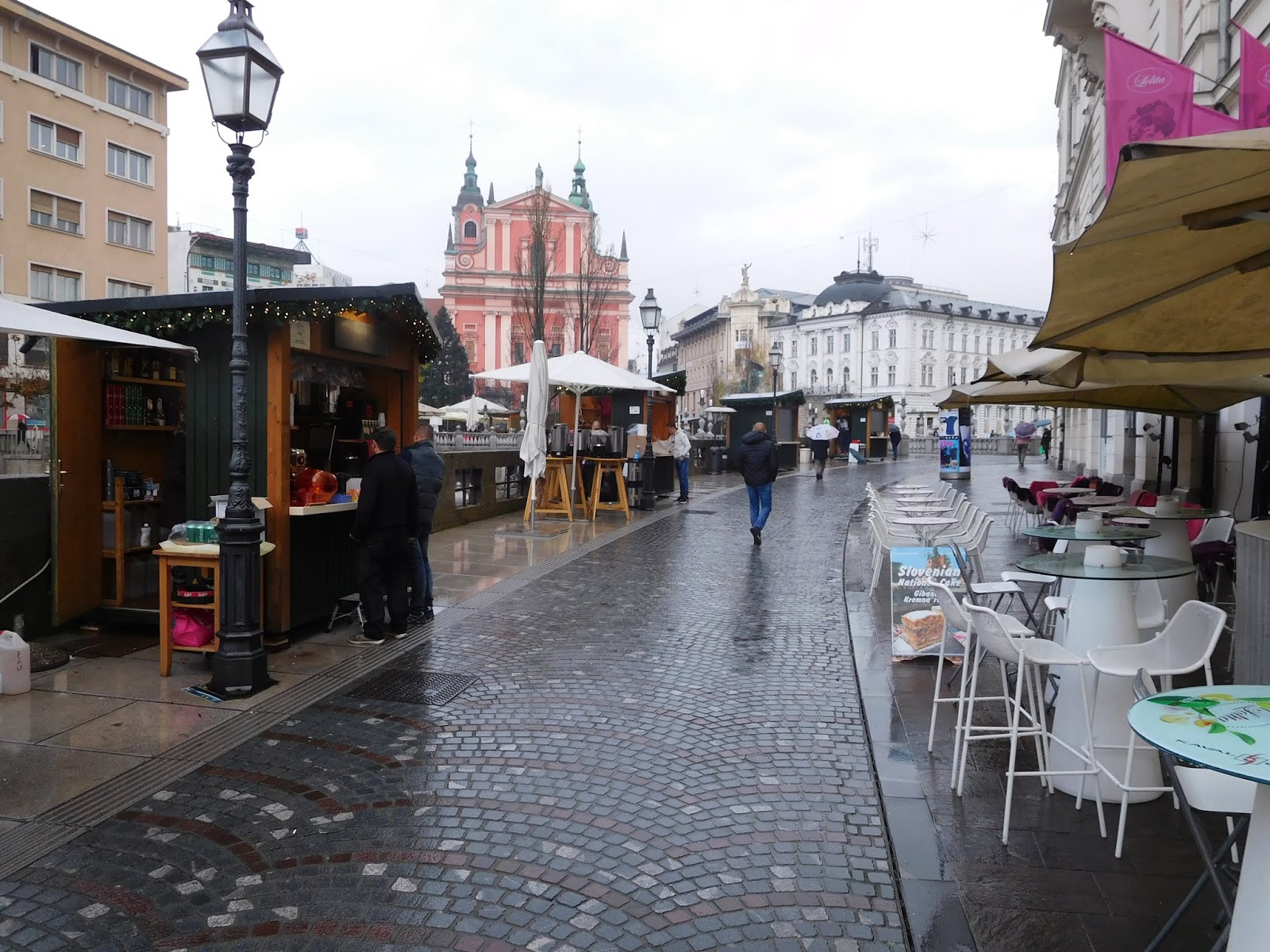
12 Days of Slovenia & Trieste (Part 7): Christmas Market


In 2018 we made a pre-Christmas excursion to Munich. It was memorable.

Munich Tales 2018: Christmas markets are special in Germany, and so it looks like some mulled wine for us.

Bavarian Christmas Interlude 2018, Saturday: English Garden, Chinese Tower, Bavarian Christmas market, more beer, and just a little bit of food.


Christmas markets in Europe are not confined to Germany, and I was pleased to see the Slovene version in Bled opening on the day of our arrival.

Have I become somewhat less Grinch-like? Maybe, maybe not.

Christmas markets in Europe are alright by me, first and foremost because they're ... in Europe, and not America where things get tacky, quickly.

Moreover, these seasonal assemblies embrace a big element of eating and drinking -- always a preferred pastime for a trencherman like me, even if it means bundling up. The locals come out in force.

Why not tourists, too?

Join us by the lake from 29 November 2019 to 5 January 2020! The Winter Fairy tale will be open from Monday to Thursday from 3:00 PM to 7:00 PM and 11:00 AM to 9:00 PM on Fridays, Saturdays, Sundays and holidays.

The stands will offer genuine local dishes and drinks, as well as creative festive gifts.

There will be a music program on weekends (Saturday, Sunday).

St. Nicholas', Santa Claus' and Grandfather Frost' post office will be open every day. Animation programme by Land of Slovenian Folk Tales on saturdays and sundays afternoon (between 15:00 and 18:00).

Do not miss: exhibition of life-size nativity sets, a super-sized Christmas chair under the biggest natural Christmas tree, the power of love on the wheel of romance and Bled ice rink with a view.

Friday, November 29, 2019

Baylor Family Croatia, Slovenia and Trieste 2019, Chapter 11: In praise of kremna rezina, Lake Bled's classic version of cream cake.

At the Christmas market.

We took the train from Ljubljana to Lake Bled, and began eating pastry.

Not exactly, but probably close enough.

As an introduction to Lake Bled, which has been a fairy-tale destination for tourists of all walks of life for several centuries prior to Walt Disney's birth, let's take a close look at kremna rezina.


Lake Bled Cream Cake: A Confection Straight from the Storybooks
, by Emelyn Rude (National Geographic)

Standing placidly in the shadows of the Julian Alps, ringed by thick forests and guarded by a stern medieval castle, is Slovenia’s beloved Lake Bled. At its center is Bled Island, home to one most beautiful churches on the planet and the “wishing bell,” a 16th century chime consecrated by the Pope himself that is believed to grant the wishes of all who ring it.

There’s a reason Lake Bled is Slovenia’s most popular tourist destination: If you’re lucky, a swan might just float by as you watch the flat-bedded boats drift on the lake. Bled offers sweet memories to its millions of visitors, but the hungry ones will have something sweeter—Lake Bled cream cake.

Cream cake, characterized by delicate puff pastry atop layers of light vanilla cream and custard, is a dish that can be dated back to the height of the Austro-Hungarian Empire in the 18th and 19th centuries. Almost all the countries under the Hapsburg’s former reign still have a version of the cake: Bosnians enjoy krempita, Polish love kremówka, and Slovakians dine happily on their krémeš. The Slovenian version of cream cake is kremna rezina and, thanks to a recent granting of protected designation of origin status, it only comes from the patisseries at Lake Bled.

Signs advertising the celebrated cake appear the moment you shake off the short trip to the lake from the tidy Slovenian capital of Ljubljana. Almost every café on its shores serves up decadent slices of kremna rezina. But the staff at each of these eateries will advise you to try one sample it from the original source itself —the Park Hotel. This stately establishment has been serving up Bled cream cake since 1953, shortly after the arrival of celebrated pastry chef Ištvan Lukačević following the Second World War.

Lukačević, an ethnic Hungarian from northern Serbia, was undoubtedly well acquainted with the many variations of krémes and krempita throughout the region. Lukačević, also being a pastry chef, undoubtedly also utilized his skills as a master engineer, as all pastry chefs must be, when creating his celebrated version of the cake. It takes specific temperatures and proportions for chocolate to temper and bread to rise and puff pastry to puff.

Such engineering is evident in the kremna rezina. Everything is prepared under the guidance of the lucky number seven. The puff pastry is folded seven times and then left to rest overnight before baking and cooling again. The egg custard is cooked for seven minutes. Cooled, coated in a delicately sweetened layer of whipped cream, and dusted with powdered sugar, each cake is then cut into a perfect seven-by-seven centimeter square.

The staff at the Park Hotel take their job serving up the world famous cake very seriously. Up to 3,500 slices of it are sold on a given day, and the service team has pre-sliced, pre-plated portions constantly waiting at the pass for the next visitor to order it.

There’s even a Bled cream cake drive-thru at the hotel and an annual festival dedicated to the wondrous confection. Back in the 1970s, when Lake Bled froze over and attracted thousands of merry ice skaters, the hotel sold a record 7,000 cakes in a single day and, still using Lukačević’s original recipe, the hotel has produced more than 12 million cakes in the 62 years since it first graced the dessert menu.

Anyone from this region of Europe takes Bled cream cake very seriously. For anyone willing to look, recipes for Lake Bled cake can be found online to be whipped up in any corner of the globe. But without the Alps and the swans and the mist and the castle, it probably will not taste quite the same.

We had a late lunch on Friday at the Hotel Park, and capped off the meal with -- you guessed it.

Those calories were burned off on Saturday, when we took a walk around Lake Bled.

At Penzion Mlino's restaurant.

Baylor Family Croatia, Slovenia and Trieste 2019, Chapter 10: Ljubljana's grand old train station and the current status of my ghosts.


Previously, Thanksgiving dinner in Ljubljana.

One of the bedrock, greatest-hits-variety stories from my Euro odysseys during the era of the 1980s is the tale of arriving Friday evening by train in Ljubljana and being greeted by scores of drunk young Slovenian army conscripts.

12 Days of Slovenia & Trieste (Part 4): In 1987, Ljubljana was an introduction to Yugoslavia.


Diana is sick and tired of hearing me repeat the saga, so it will suffice to say that 32 years later, I was thrilled to revisit the scene. The station building dates to 1849 when the railroad from Vienna to Trieste was being completed.

I didn't realize that since 2003 there has been a small commemorative plaque at the station honoring a migratory writer's mistake.

On 19 October 1904 (James) Joyce and Nora Barnacle spent the night in Laibach. En route from Zurich to Trieste Joyce and Nora got off the train in Laibach (now Ljubljana in Slovenia), thinking it to be Trieste, and had to spend the night in a park.

These days it's probably difficult getting away with spending the evening in a park. Not that I've ever done that sort of thing traveling ...


And so we were off to Lake Bled.

12 Days of Slovenia & Trieste (Part 6): Of hydropaths and Titoism in Lake Bled, Slovenia.

Tito's image in Sarajevo, 1987.

The overall history of Bled, Slovenia can be perused at In Your Pocket. It's a tourist town in the countryside in the foothills of the Julian Alps ...


 ... with a charming church on an island in the lake that has been pictured on a thousand jigsaw puzzles.

Swiss hydropath Arnold Rikli spent 52 years in Bled, founding the Institute of 'natural healing', and perfecting a rehabilitation program of bathing, taking steam baths, walking, and eating vegetarian; which proved a hit. Indeed, Bled was later recognised as one of the most important tourist sites in the Austrian empire, receiving a gold medal in Vienna in 1903; having got its own train station at Lesce in 1870.

Of more recent topical interest, at least to me, is this specific historical footnote: Vila Bled, hidden pearl of President Tito’s, communist president of Yugoslavia.

The building was completed in 1947 and served as the summer residence of President Tito for many years, where he hosted numerous official state visits. Tito welcomed many eminent dignitaries to the villa, including Ethiopian emperor Haile Selassie, leader of the Soviet Union Nikita Khrushchev, King Hussein of Jordan, Indian Prime Minister Jawaharlal Nehru, his daughter and Indian Prime Minister Indira Ghandi, Egyptian President Gamal Abdel Nasser, Prime Minister of Sri Lanka Sirimavo Bandaranaike, Indonesian President Sukarno, President of Zambia Kenneth Kaunda, Emperor Akihito of Japan, Emperor of the Central African Empire Jean-Bédel Bokassa and even President of North Korea Kim Il Sung.

You can read about Josip Broz (Tito) at Wikipedia; in the meantime, I leave you with this indelible image of Soviet kingpin Leonid Brezhnev (left, with pistol) and Tito (right, seated) on a "hunt" in the Ukraine.

Thursday, November 28, 2019

Baylor Family Croatia, Slovenia and Trieste 2019, Chapter 9: At Gostilna Pri Kolovratu, a lovely traditional Slovenian dinner for Thanksgiving.


We'd been walking around Ljubljana on Thursday.

For the second time in four years we spent Thanksgiving Day abroad. The first instance was in Catania, Sicily in 2016, and now Ljubljana, Slovenia in 2019. In mid-afternoon on Thursday after a day filled with strolling and brief pit stops, we dropped into an eatery called Gostilna Pri Kolovratu, which is located adjacent to the cathedral.

Guesthouse Pri kolovratu (At The Spinning Wheel) is one of the oldest guesthouses of Ljubljana. The first archive record was made in 1836, under the name Zum Spinnradl. In the 19th century, its regular customers included the poet Fran Levstik, opera singer Josip Nolli, the first Slovenian mayor Peter Grasseli, judge Kuralt. However, it was at its most famous between the two world wars, when it was the main gathering point of the "Penati" (the most important people who works in the culture that time).

I knew only that a website recommended it for superlative Prekmurska gibanica, a layered pastry containing poppy seeds, walnuts, apples, raisins and quark (a creamy unripened white cheese). The dessert originally comes from the Prekmurje region in easternmost Slovenia, bordering Hungary. It has become a nationally-known treat. I opted for a sweet štruklji dumpling. Both were wonderful.


The restaurant was empty with the exception of two male staffers struggling to decorate for Christmas; the following day was the debut of the annual Christmas market and it almost surely would be a busy weekend.


We were enamored of Gostilna Pri Kolovratu's picturesque interior and secluded interior courtyard.


We explained Thanksgiving to our server, who graciously gave us a 10% discount card and said he'd be there all evening -- why not come back for the American holiday?

This we did, and it was a memorable meal.

Barley soup with sausage.


Vodnik salad from the 1799 Slovene cookbook (local greens, beets, cauliflower, hard boiled egg)


Lamb knuckle (sun-dried tomato and balsamic reduction).


Ribeye steak.


Slovene merlot and a parting glass of Pelinkovac, a bitter herbal liqueur.


Gostilna Pri Kolovratu wasn't traditional Thanksgiving cuisine in the American-based turkey sense of the occasion, but all the same it was one of my favorite holiday meals in recent memory.


It seemed an indefensible act of gluttony to eat dessert for the second time at the same restaurant, so we departed without sweets.

However the Vigo ice cream shop was just down the street on the way home.


In the next episode we hop a train for Lake Bled.

Baylor Family Croatia, Slovenia and Trieste 2019, Chapter 8: Weird circular Yugoslav garage architecture and an invigorating walk by the river.


Wednesday had ended with a tour at the Pivovarna (brewer) Union.

At sunup on Thursday, something strange happened because the sun actually came out. It did so again several times during the day, although we were destined to glimpse only a few patches of truly blue sky until arriving in Trieste.

Our chosen sleeping spot, the Hotel Park, refers to itself as the "most urban and green hotel in the centre of Ljubljana," and this description seems fairly accurate. We enjoyed it.

View from the hotel
window on Thursday afternoon.

It's an extensively remodeled late 1960s-era Yugoslav high rise in the middle of a regular neighborhood, quiet and well-situated near the epicenter of town, as well as only a short distance from the railroad station. As already noted, the hotel restaurant is quite good. In addition to a menu of Slovenian standards, there's an entire selection of Indian food. It turns out the chef is from the subcontinent.


With the weather finally clearing, we resolved to spend a casual day walking, resting and snacking while deciding where to partake of Thanksgiving dinner. This brought us back to Slovenska hiša, this time for breakfast.

Nice eggs.


We began our stroll in the old town below the castle, by the market, river and downtown shopping streets.


See the knives and forks?


Then had a morning coffee.


The underground bins are one component of a comprehensive municipal commitment to reducing waste. Learn more at The Guardian: From no recycling to zero waste: how Ljubljana rethought its rubbish.

The longer 25-minute walk riverside walk then began.


Now about that strange double circular structure. It is a parking garage, not a place of residence.


It was confusing at first sight, as it's not easy to see actual automobiles without looking closely. Rather, the individual spaces have all manner of stored items stacked near the windows. Consequently the notion of "parking garage" in this sense seems more about replicating one's home garage rather than temporary hourly or even longer term parking.

TGH-48 Car Park
Garažna hiša TGH-48

Architect: Savin Sever
Address: Ambrožev trg 4, Ljubljana, Slovenia
Completion: 1969

Here the problem of parking in the city was solved with the extremely efficient use of space. Sever developed a system whereby the number of car parking spaces could optionally be increased by adding new stories. The only limitation on adding the stories is the height of the stairways and length of the vehicle access. The two-way traffic system, internal communications, and spacious parking spaces allow safe and simple parking.

I was fascinated by these nearby structures under repair, which turn out to a former sugar refinery dating to 1834 called the Cukrarna.


Our original walking destination was a second-hand shop, which offered this old radio among numerous other trinkets.


By the time we found the shop, the scene had turned almost suburban.


Returning to the city center, we ambled past houses, a hospital and an old industrial space subdivided into art studios, performance venues and a skate park.


For my pal Roz.


A late lunch followed, just salads and drinks. LOO-BLAH-NAH is a local craft brewery; I had a pale ale as well as an IPA, both solid. Diana's choice was rum tea.


Passing through the market again to buy souvenirs, we smelled a stall: fresh kraut.


Nearby is the place that sells wine and fish.


And always another castle view.


After a siesta, Thanksgiving dinner in Slovenia.