Thursday, June 23, 2016
Greens, Libertarians -- yeah, and some of that Lesser Evilism, too.
Alternatives to the problem:
Keep the Revolution Going: Jill Stein for President
For takeaways from the Libertarian Party town hall, go here.
As Stein said about Bernie Sanders on morning television yesterday ...
"He was trying to have a revolutionary campaign in a counter-revolutionary party," Stein says. "I'm basically inside a revolutionary party that supports this agenda."
... and she wasn't referring to the GOP, was she?
The Return of Lesser Evilism, by Matt Taibbi (Rolling Stone)
With Trump on the other side, Democrats can be lazier than ever this election
The Democratic Party leaders have trained their followers to perceive everything in terms of one single end-game equation: If you don't support us, you're supporting Bush/Rove/Cheney/Palin/Insert Evil Republican Here.
That the monster of the moment, Donald Trump, is a lot more monstrous than usual will likely make this argument an even bigger part of the Democratic Party platform going forward.
It's a sound formula for making ballot-box decisions, but the people who push it never seem content to just use it to win elections. They're continually trying to make an ethical argument out of it, to prove people who defy The Equation are, whether they know it or not, morally wrong and in league with the other side.
Wednesday, June 22, 2016
And with a donation and naming rights to the little league park's ball fields, finally the Floyd hospital deal makes sense.
As a local journalist observes, "The headline is not something from The Onion."
Just when you though Floyd County government could not possibly stoop any lower, it has enshrined the principle that yea or nay, multi-million dollar public health transactions can be tied to sports.
No wonder Gahan was so steamed about Hammersmith Park. He didn't have a hospital to sell in order to buy what is now Summit Springs.
That ol' crafty Mark Seabrook really got the knuckler past Gahan THIS TIME, didn't he?
Floyd deal gives new hospital name, funds NA little league, by Lexy Gross (C-J)
The contract between non-profit hospital system Baptist Health and Floyd Memorial Medical Group reveals details of the acquisition not formerly made public -- including the new hospital name and an agreement from the Kentucky healthcare group to assist with construction of little league baseball and softball fields in New Albany.
A 67-page contract outlines the details of Baptist Health's acquisition of the county-owned hospital. By law, the contract was required to be made public 10 days before a final hearing and vote by Floyd County elected officials.
Mike Hall, a spokesperson for New Albany Mayor Jeff Gahan's office, said in an email the city received the agreement and "the Mayor will be requesting additional information regarding the pending sale, and will continue to update the media and public with information received."
The best way to slow traffic on Elm at 5th would be to leave the crater alone.
Back in March, NAC glanced at another of Pinocchio Rosenbarger's inadvertent street grid masterworks.
No, we don't have these conversations in New Gahania, but at least this week the city began the latest round of repairs intended to make this intersection smooth as a baby's bottom, so that drivers (they vote, you know) never have to slow down, ever again.
Because we wouldn't want slower traffic, would we?
Speeding down Elm Street to buy Irv Stumler flowers, the Claysburg Chronicle's Chris Morris provides readers with something that has utterly eluded the city's two-way streets campaign finance consultants -- namely, a time line of construction.
A bit of Breakwind work is concurrent with the city's deRosenbargerization.
Rosenbarger retains job by hailing city's invention of revolutionary Speed Dip at Elm and Fifth.
Right there, by the Break Wind Lofts at Duggins Flats ... Elm Street, a drag strip leading from the post office to 10th ... a barber shop, already devalued by the one-way street, now further spat upon by cars constantly weaving lanes to avoid hitting John Rosenbarger's patented Traffic Calming Speed Dip, or bottoming out, or slamming on the brakes at too high a rate of speed, threatening the tailgating Kentuckian behind him ... and do we ever have conversations about the extent of the damage caused by the heavy trucks traveling these arterial streets at high rates of speed, which come to think of it, sounds pretty hazardous for walkers, too?
No, we don't have these conversations in New Gahania, but at least this week the city began the latest round of repairs intended to make this intersection smooth as a baby's bottom, so that drivers (they vote, you know) never have to slow down, ever again.
Because we wouldn't want slower traffic, would we?
Speeding down Elm Street to buy Irv Stumler flowers, the Claysburg Chronicle's Chris Morris provides readers with something that has utterly eluded the city's two-way streets campaign finance consultants -- namely, a time line of construction.
Elm Street and 5th Street will be closed beginning Monday, June 20, for crews to fix the dip in the road at that location. The work is only expected to take two or three days, weather permitting, but may last until Friday, June 24.
A bit of Breakwind work is concurrent with the city's deRosenbargerization.
"How do we solve all those issues if we have a rural mentality where things are static?"
Search this page at City Lab for the word "parks," and you won't find it. Yes, Charlotte is a much larger city than ours, but its mayor obviously has more important things to talk about.
Just try to imagine Jeff Gahan in a discussion with Charlotte's mayor. You simply can't. As proof, just one question and answer is enough.
'Just Let Charlotte Be Charlotte', Ronald Brownstein
Mayor Jennifer Roberts on urban growth, tolerance, poverty, and why rural areas and cities need different rules: America isn’t “one-size-fits-all.”
BROWNSTEIN: Research we’ve done at The Atlantic has looked at big cities across the country: We find an enormous gap in the share of white versus African American versus Hispanic kids who are in schools where most of their classes qualify as poor or low-income. The concentration of economic poverty here in Charlotte is: 23 percent of white kids are in schools where a majority of the students qualify as poor or low-income, 77 percent of African American kids are in such schools, and 80 percent of Hispanic kids are. Can changes inside the four walls of a school overcome that? Or if you have that level of concentrated poverty, are you unlikely to get the results that you want?
ROBERTS: It has to “both and.” And in Charlotte, we have this can-do attitude: We know the odds can be stacked against you, but we believe that if you get the right number of organizations and groups together and focus on a problem and put some real collaborative effort into it, then we can improve it. Statistics are challenging when you have high concentrations of poverty, so what are we doing? We’re looking at our housing policy. We’re constrained by our state in many ways, but we have some tools—for instance, inclusionary housing, trying to get more workforce and subsidized housing in some areas of town. So we want to work with the private sector to help that happen. We’re looking to rewrite our zoning ordinance, which is one tool we have for trying to get that mixed-use development. How do we work incrementally to bring about some of those changes so that we get more of our students in diverse settings?
"If the door is open it isn't theft ... you can't return to where you've never left."
For those who retain an interest in U2 and are familiar with the group's most recent release, this 15-minute podcast details the creative process behind one of the album's key songs. It simply would not sound the same if I were to sing about Baylor-Wisman Road.
Thanks, Jay.
Song Exploder: Cedarwood Road.
10 Cedarwood Road is the address of Bono’s childhood home in Dublin. For the U2 song “Cedarwood Road,” Bono looked back to his life there as a teenager, when skinhead culture seeped into his neighborhood via the Seven Towers housing project …
SHANE'S EXCELLENT NEW WORDS: Midden.
Welcome to another installment of SHANE'S EXCELLENT NEW WORDS, a regular Wednesday feature at NA Confidential.
But why all these new words?
Why not the old, familiar, comforting words, like the ones you're sure to hear at Democrats After Dark, a "social mixer designed just for you"?
It's because a healthy vocabulary isn't about intimidation through erudition. Rather, it's about selecting the right word and using it correctly, whatever one's pay grade or station in life.
Even remuneration-engorged municipal corporate attorneys can benefit from this enlightening expansion of personal horizons, and really, as we contemplate what they knew and when they knew it, all we have left is plenty of time -- and the opportunity to learn something, if we're so inclined.
Our word today is midden, a noun that refers to a dunghill or refuse heap. Synonyms include muckheap, muckhill and dunghill. Middens are especially cherished by archaeologists, who learn about the past by analyzing waste.
A sample sentence:
The city's economic development director, proud as the rooster who is left unchallenged upon the midden, crowed away in a last long burst of quotation and TIFfrontery.
(Thanks to the Free Dictionary for this sentence)
But why all these new words?
Why not the old, familiar, comforting words, like the ones you're sure to hear at Democrats After Dark, a "social mixer designed just for you"?
It's because a healthy vocabulary isn't about intimidation through erudition. Rather, it's about selecting the right word and using it correctly, whatever one's pay grade or station in life.
Even remuneration-engorged municipal corporate attorneys can benefit from this enlightening expansion of personal horizons, and really, as we contemplate what they knew and when they knew it, all we have left is plenty of time -- and the opportunity to learn something, if we're so inclined.
Our word today is midden, a noun that refers to a dunghill or refuse heap. Synonyms include muckheap, muckhill and dunghill. Middens are especially cherished by archaeologists, who learn about the past by analyzing waste.
A midden (also kitchen midden or shell heap; from early Scandinavian; Danish: mødding, Swedish regional: mödding)[1] is an old dump for domestic waste[2] which may consist of animal bone, human excrement, botanical material, vermin, shells, sherds, lithics (especially debitage), and other artifacts and ecofacts associated with past human occupation.
The word is of Scandinavian via Middle English derivation, and is today used by archaeologists worldwide to describe any kind of feature containing waste products relating to day-to-day human life. They may be convenient, single-use pits created by nomadic groups or long-term, designated dumps used by sedentary communities that accumulate over several generations.
A sample sentence:
The city's economic development director, proud as the rooster who is left unchallenged upon the midden, crowed away in a last long burst of quotation and TIFfrontery.
(Thanks to the Free Dictionary for this sentence)
Tuesday, June 21, 2016
Hannegan Roseberry's wonderful column on two-way streets: "What are we waiting for?"
I had a rejoinder ...
Let's ask the old white guys: Revisiting last Saturday's dismal "spotlight" on street reconversion.
... but the accumulated weariness at being compelled to rebut the same tired arguments again and again plainly got to me.
Thanks, Hannegan. Thanks for having the patience to tackle their idiocy point by point. Thanks for standing tall on behalf of the neighborhood.
Just plain thanks. We needed this.
GUEST COLUMN: New Albany deserves two-way streets, by Hannegan Beardsley Roseberry (Morrissongs)
I am writing with regards to the recent story titled “As Cities Convert to One-Way Streets, is New Albany Next?” As a resident of Spring Street who lives in the epicenter of this debate, I am baffled as to how this article was written without talking to a single resident of the neighborhoods affected. To add to my dismay, the article took a negative tone toward two-way street conversion, despite the national research, statistics, and specific experiences of other cities pointing to the contrary. Of the six people quoted in the article — all business owners and/or politicians — four people were opposed to the idea, one was in support, and one was up for “whatever is best.” I feel the voices of the residents affected should have been heard.
Family planning: the unsung human right.
![]() |
| International Planned Parenthood Federation |
Then there is this.
Pro-choice activists have delivered abortion pills to women in Northern Ireland using a drone. The stunt aimed to highlight the strict laws around terminations on both sides of the Irish border.
It is the impetus for an editorial.
EDITORIAL: the Guardian view on family planning: the unsung human right
Millions of women are barred either by cultural taboo, cost or availability from being able to decide for themselves when they have children. Empowering them to take control should be a basic objective of every human health project.
ASK THE BORED: A bicentennial FOIA reanimates a tale of two city seals.
The series introduction is reprinted below. Unfortunately, today I have an unexpected obligation at 10:30, and I won't be able to ask the bored.
However, let's accomplish two tasks at once.
First, though not pertaining directly to BOW, there is an ongoing matter of housekeeping to resolve.
418 days later, it's obvious that Bob Caesar doesn't care for you to know how the Bicentennial money was spent.
It's now 433 days, but yesterday the city's corporate legal counsel confirmed receiving my Freedom Of Information Act (FOIA) request seeking to rectify Caesar's inability (nay, his mulish unwillingness) to share the record of his committee's fiduciary conduct during the late, unlamented Bicentennial celebration.
I've overlaid the envelope, because there is an interesting contrast.
One design of a city seal on the envelope (in snazzy gold leaf), and another on the letterhead. One of them a steamboat, moving forward, and the other, an anchor sinking heavily into the Ohio River mud flats.
Next week, I'll ask the bored if they can help us understand how the city's new anchor design came into being, and now appears seemingly everywhere ... except on this envelope.
They must have purchased a shitload of those steamboat envelopes in bulk -- but surely we're TIF enough to change them, too? It's all about branding, or at the very least, Gahanding.
---
New Albany's Board of Public Works and Safety exists because the State of Indiana says so.
IC 36-4-9-5
Board of public works and safety; establishment Sec. 5.
(a) A board of public works and safety is established in each city.
(b) Notwithstanding subsection (a), the legislative body of a second class city may by ordinance establish as separate boards: (1) a board of public works; and (2) a board of public safety; to perform the functions of the board of public works and safety.
As added by Acts 1980, P.L.212, SEC.3.
As for what the board is supposed to do each Tuesday at 10:00 a.m., you can visit the American Legal Publishing site, search "Board of Public Works and Safety," and sift through various powers accorded the board over the decades by dint of ordinance.
Exactly how much power does our Board of Public Works and Safety possess?
If Jeff Gahan were to stray from the protection of his Down Low Bunker and comment, no doubt he would assert that the board has just the power it needs. He handpicked it, and he's perfectly content to see his program implemented by non-elected boards, as opposed to elected officials.
According to Dan Coffey, the answer surely is "too much." At the city council meeting of June 6, Coffey proposed that our council, as a body made up of elected members, should take back authority ceded to non-elected boards.
Agreed.
The Board of Public Works and Safety may be established by state, not city, and it may be appointed by mayor, not council, but the board's powers appear to derive from the legislative body.
I mention all this as prelude to a new feature at NA Confidential: Ask the Bored.
It has long been NA Confidential's position that given the board's accumulated powers -- justified or otherwise -- and its current function as arbiter of myriad conditions that impact the lives of citizens, for it to hold all its meetings at 10:00 a.m. on a Tuesday meeting is an affront (note that during the Garner Administration, a fledgling but doomed effort to democratize meeting times was made).
However, NAC can attend many, if not all, meetings. Public speaking time is allowed, and on occasion in the past, we've used it for the precise purpose of making comments, raising issues or asking questions, so that these are included in meeting minutes and become part of the public record. This way, it cannot be claimed later that "no one said anything."
Readers, I know you have questions. Many of you cannot attend these meetings, and so when possible, NAC will ask them for you. Generalized questions probably are best, but give us the brief, and we'll do what we can. Submit them at mayorbaylor@gmail.com ... and ask the bored.
Monday, June 20, 2016
Sam's at the Montrose goes, and Rails Craft Brew & Eatery arrives.
![]() |
| Rails on Facebook. |
The second location of Rails Craft Brew & Eatery will take over the Sam's at the Montrose space. Rails is from Seymour, and as with Flat12 Bierwerks before it, I think you'll see more "northern" independent food and drink businesses opening branches hereabouts.
My cherished hope always has been for Three Floyds Brewing Company to be one of them. A boy can dream.
Meanwhile, all the best to Sam Anderson at his Highlander Point shop. This might well be good thinking on the part of all involved.
Sam's at the Montrose closes in Clarksville; Rails Craft Brew & Eatery to take over Clarksville building, by Chris Morris (Forever Clark County)
... Sam Anderson, who owns the building and operated Sam's at the Montrose, said the move makes sense. Sam's at the Montrose was open five days a week since opening 2 1/2 years ago after a fire destroyed Sam's Food & Spirits in New Albany in December 2013. Anderson said his Sam's restaurant at Highlander Point will remain open seven days a week and continue its catering operation. The Highlander Point restaurant has been open since 1991.
"This is a good thing. They will be open seven days a week and this will allow us to focus on one location in Floyds Knobs," Anderson said. "They are turning [Montrose building] into more of a destination. It's time to let someone else drive the boat for a while."
Here's the agenda for Tuesday morning's merchant group meeting (8:30 a.m., Seeds and Greens).
![]() |
| My agenda item. |
Like we said ...
The monthly merchant group meeting is 8:30 a.m., Tuesday, June 21 at Seeds and Greens.
Strictly speaking, these merchant meetings are not "presented" by Develop New Albany, although these past few months, the DNA logo has appeared with correspondence. As such, I've affixed it below. At least it isn't an anchor.
Speaking of DNA, Mayor Gahan lavished some slobbering love on the organization at last week's Pillar Awards:
"DNA does a lot of things to protect our history and our downtown. They also preserve our downtown uniqueness, and we have a lot of people to thank for that," Gahan said. "But at the same time, DNA urges us to move forward. They encourage us to improve and more importantly, they challenge us to grow."
Right. Well, there's no better time than right now to take a nice, long shower, so here's the agenda for tomorrow morning's meeting.
---
New Albany Meeting Agenda
May 21st, 2016 at 8:30 am
Open to all merchants, restaurants & businesses
Seed & Greens Natural Market and Deli
207 W. 1st St., New Albany
Thanks Stacey for hosting our June meeting.
Conducting the meeting: Kim & Teresa
Introductions:
City updates: Courtney/Tonya
Old Business/New Business:
Southeast ISBDC: Presenting “Social Media” Advertising & tips
Ribbon Cuttings:
Adrienne & Co – Wednesday, June 22nd 10 am
Adjorn:
Next meeting is July 19th at 8:30 am location to be determined. If you would like to host a meeting, please let Kim or Teresa know.
Do you have a topic you would like to discuss at these meetings? These meetings are for you and we want you all to be a part of this.
Placing a dollar value on the services that street trees perform.
![]() |
| Has Judge Cody read this article? |
Back in April, I attended a Tree Board meeting.
Unlike New Albany, "The people of Somerville, Massachusetts really, really care about trees."
New Albany's Tree Board -- statute, staff and board members.
Come to think of it, I'm still waiting on the information I requested from the Tree Board, though the duration has yet to approach epic Caesarean standards of non-cooperation.
418 days later, it's obvious that Bob Caesar doesn't care for you to know how the Bicentennial money was spent.
At any rate, consider what our urban trees are actually worth, and thanks to B for the tip.
Trees lining California streets are worth an extra $1 billion a year, by Clayton Aldern (Grist)
It’s not easy to price a tree, but a group of researchers from the U.S. Forest Service and U.C. Davis have tried to do exactly that.
Working with a dataset of about 900,000 trees that line California’s public streets, the group sought to place a dollar value on the services those trees perform, which include “energy savings, carbon storage, air pollutant uptake, and rainfall interception.”
All told, the researchers estimate the trees contribute about $1 billion annually — nearly $111 per tree for each of the state’s 9.1 million street trees.
A contrarian asks: Should there even be "walk" signals for pedestrians?
Here's another way of looking at how best to walk across the street.
In a four-part opinion piece at GreaterGreaterWashington.org, Ben Ross considers signals and crosswalks, and argues on behalf of the principle that "negotiating the use of shared space makes roads safer."
Utopian or practical? You be the judge. Here are links to the four parts, each with a brief teaser.
---
Part 1. Careful jaywalking saves lives
Pedestrians put themselves in danger if they wait for a walk signal instead of crossing the street whenever and wherever it looks safest. There are no definitive studies, but that is what available evidence strongly suggests ...
... Drivers hit pedestrians when turning more often than when they are driving straight ahead. At a red light, drivers who are about to turn wait alongside pedestrians. The changing signal sends both into the intersection at the same time—maximizing the opportunities for collisions.
---
Part 2. Walk signals are bad for walking
Many pedestrians think the walk-don't walk light helps by letting them know when it's safe to cross the street. But its actual effect is to curtail the right to make that crossing.
---
Part 3. Timing signals to work for pedestrians is impossible
It is possible, as New York and a few other cities have shown, for complex signals to make walking easier. Pedestrians get a few seconds to enter a crosswalk before cars can turn. Or turns are banned while people are crossing. But if you try to orchestrate movement on foot in this way at every streetcorner, the traffic engineers' job becomes entirely unmanageable. They cannot possibly find the time to adjust every walk signal for the proper balance between walking and driving.
---
Part 4. To make streets walkable, empower pedestrians to cross anywhere
As the previous posts in this series have shown, these simpler streets would be far safer. They could operate with only limited changes in the rules of the road. Drivers would follow traffic signals as they do today—pedestrians would have the right of way when they cross on green, but yield to drivers when the light is against them. The rule for crosswalks with no signal would not change at all; those on foot would still have the right of way at all times. Elsewhere, foot crossings would be allowed at any location, but pedestrians would have to yield.
The medieval diet: "White wine makes you piss better than any other wine."
It's where the love of history meets the needs of a foodie.
I Tried a Medieval Diet, And I Didn't Even Get That Drunk, by Sarah Laskow (Atlas Obscura)
The Salerno health regimen was based in the humoral theory of medicine, which is focused on keeping balance among the body’s four humours—blood, phlegm, yellow bile and black bile. Foods were thought to possess qualities that could help maintain that balance: each hot or cool, dry or moist. These ideas originated in the ancient Mediterranean world, most prominently with the Greek physician Galen, and were passed to doctors in the Arab world, before returning to Europe.
Way back in the late 1980s, I bought "The Frugal Gourmet Cooks Three Ancient Cuisines: China, Greece and Rome," a cookbook by the late Jeff Smith. From the outset, he cautions readers not to expect rich tomato-based sauces in the Roman recipes.
The selection of vegetables in medieval Europe was relatively small, to begin with. It would not have included plants native to North or South America, which means no potatos, no corn, no tomatoes, no avocados, no peppers, and no beans (with the exception of fava beans). Spinach came from Persia, via Arab conquests of southern Europe, in the 800s, and gradually replaced other greens, like sorrel. Sugar first reached Europe in 1148, when Crusaders brought it back from their war, but it was a luxury product, with limited availability, for centuries. Coffee didn’t come regularly until the 17th century.
She can't do without coffee, but otherwise the author of this post imagines the medieval diet, and actually lives it for a few days.
Sunday, June 19, 2016
Caesar baffled and inconsolable as "anti-establishment" candidate leads the mayoral race in Rome.
Caesar said “establishment politics is different than anti-establishment politics." He said when people have several choices to make, they are just interested in getting to their same old unimaginative ward heeler in a timely manner.
“If you make them think too much, they won’t vote the straight party ticket,” he said. “And people’s attitudes when it comes to pandering will have to change. With two-way pandering, they have to look for solutions in different directions.”
Rome likely to have elected its first female mayor, by Rosie Scammell (The Guardian)
Exit polls suggest that Virginia Raggi, a 37-year-old lawyer, has won the job for the anti-establishment Five Star Movement
An anti-establishment outsider is on track to be elected mayor of Rome, according to exit polls, and become the first woman to run the Italian capital.
Virginia Raggi, the Five Star Movement’s (M5S) candidate, won between 64% and 68% of the vote, according to polls published on Sunday night by the Ansa news agency. The 37-year-old lawyer was well ahead of her rival, the Democratic party’s Roberto Giachetti, who was forecast to win between 32 and 36% of votes.
Northern Renaissance, with Jan Van Eyck, Albrecht Dürer and Hieronymus Bosch.
Any excuse to hoist Albrecht Dürer's image to the marquee is appreciated, but in fact this series is three hours well spent. The link takes you to the YouTube portal for all three episodes.
Northern Renaissance (BBC 4; first broadcast 15 Nov 2007)
Series in which Joseph Leo Koerner argues that the Renaissance in Northern Europe - more so than its Italian counterpart - laid the foundations of modern art.
The Supreme Art
A look at how Jan Van Eyck's oil paintings transformed the art world.
The Birth of the Artist
A look at painter Albrecht Durer, the first world-famous artist.
Image Wars
Joseph Leo Koerner examines the work of Dutch artist Hieronymus Bosch.
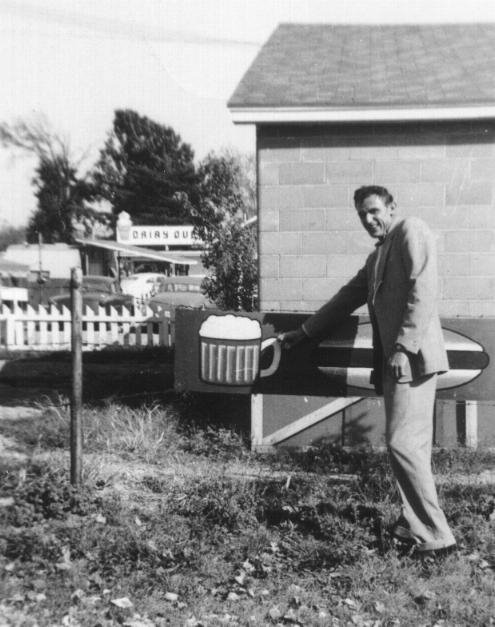
Or, as he was known to my friends, Rog Sr.
![]() |
| Circa 1952. |
Roger George Baylor was born in 1925 and died in 2001, making him 35 years of age when I was born in 1960.
His death predated the inception of this blog by three years, and it occurs to me that I've never written "long form" about him in this venue. I won't today, either. This is because our relationship was complicated, to say the least. It would require a book, so maybe some day I'll write it. It's a bit much for now, and has been for 55 years.
At root, my father was very passionate, but could not express his positive emotions save for sheer physicality, first through sports and then by blunt force hard work in the great outdoors. Music soothed him -- a bit, and then usually only on Sunday.
It was music, not church. If memory serves, his all-time favorite was “Sentimental Journey,” and nothing better describes his customary mood, looking back through the years, than this choice of ditties.
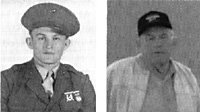
It was as though each morning he awoke (very early, a lifelong dairyman's habit) and confronted the world's existential indifference by coming out swinging, then dropping from exhaustion hours later. But maybe these really were internal struggles, and absent a formula for talking them out, into the open, he chose instead to try battering them into submission, or at least keeping them safely at bay.
Come to think of it, the preceding paragraph might just apply to his son, too, except that my chosen weapons have been words and ideas, not sweat and musculature.
Growing up, our inability to mesh was frustrating. My father and I were just enough alike, and also just enough different, to spend long periods utterly at odds. The word "love" wasn't ever spoken in my house, and I mean this literally. In material terms, life at home was easy for me. Psychologically, it was a challenge at times.
However, in the end, father and son both made concessions. We came to respect each other, and to regard our differing proclivities as complementary.
I'm satisfied with that.
Roger G. Baylor joined the US Marine Corps in 1942 and put in two and a half years as a gun striker and shellman at the 5-inch guns aboard the battleship USS Washington, Pacific Theater. He was called back to service during the Korean War, but remained stateside.
He personally experienced kamikazes, though not all threats to life and limb came from the enemy. During my father's time on the battleship, it collided with another American ship (ironically, the USS Indiana), and once rode out a major typhoon.
World War II interrupted my father's promising career in baseball, though back home after the war, he gave it a belated shot, eventually playing briefly in 1949 for the Kingsport Cherokees of the Appalachian League. At 24 years old, he was over the hill for a Class D league, lowest of the low minors, and yet how many players even make it that far?
In 2011, Ten years after his death, sporting immortality finally came for Roger G. Baylor when his minor league baseball statistics appeared on-line for the very first time.
The batting average was only .213, but more than half his hits went for extra bases, and that's good. Had baseball worked out for him, I probably wouldn't be here.
When Bettye Sue Allen arrived in Georgetown, Indiana to teach at the high school, she was fresh out of the University of Kentucky, and in a strange new place.
She made friends with the late Alda Coakley (later Cecil), who also was good friends with my father, and Alda proved to be the matchmaker who brought my parents together.
My father is seated to the left, with Alda on the right. The venue is the Wonderland in Lanesville, Indiana -- later the Circle Bar, and now the liquor store. The time was the early 1950s, and the fellow dancing has just invented the photo bomb.
Two years ago, I posted this picture on social media, and a comment made by my friend and colleague Jeff Gillenwater comes closest to summarizing the ups and downs of my relationship with my father, though you must speak British to "get" it.
Figures; the old man was a Rocker, you turned out a Mod.
That's all I have for now. My father didn't do Hallmark, and neither do I. He'd be the first to understand exactly why it is impossible for me to produce one of the glowing, feel-good written testimonials to fatherhood on the occasion of Father's Day.
He'd expect no more than facts. It was what it was, and nothing else. It wouldn't bother him.
It doesn't me, and it shouldn't you.
The council's DemoDisneyDixiecrats: Co-option comes right after self-interest, and just before irrelevance.
The American Civil Liberties Union of Indiana lists the rights below under the all-purpose umbrella of "equality." They're merely an opening salvo, not a detailed rendering.
It seems to me that if one must "belong" to one (or more) of these groupings in order to feel solidarity with them, and consequently to take action on their behalf, prospects are daunting indeed for ultimate success in their advocacy.
On Thursday, the only openly gay member of New Albany's city council offered a non-binding resolution expressing solidarity with the city of Orlando in the wake of the horrible massacre there. The resolution noted support of universal LGBT rights and repudiated violence. It was impeccable, and all eight council representatives in attendance concurred.
Yet, there is something nagging about this. While it is perfectly fitting and proper that councilman Greg Phipps represents the conscience of the LGBT community in his job as member of the body, if representation derives only from identity, then the body is not at all representative.
Look at the list below. There are no women, immigrants or racial minorities on the city council. Only one councilman is south of 45 years of age. None are disabled. Our council is composed of nine white males with an average age of around 60.
At Thursday's meeting, Dan Coffey ventured the view that perhaps there should be a council resolution on behalf of all those who've suffered from violence, irrespective of identifier or subheading, and he was right (though probably for the wrong reasons).
However, what is needed even more than another omnibus, non-binding resolution is some coherent notion of how the city's executive body can be part of the solution when it comes to all these human rights issues raised by the ACLU -- and don't even bother mentioning the city's Human Rights Commission, which was built to be moribund.
At the moment, this idea seems more likely to emanate from council's three Republicans and two Independents rather than its remaining four Democrats, who surely find themselves tied to a governing political party script that defines quid pro quo in exacting detail.
I'd suggest that they closely examine the "quid" before accepting the terms of the "pro quo," because co-option comes right after self-interest, and just before irrelevance.
As much as we'd all like to wave a magic wand and produce a society of love, not hate, the chances are slim. All we can do is to keep on keeping on. At the same time, municipal government can help achieve substantive progress in these human rights areas, if only incremental, but the legislative body cannot do so by deferring to the carpenters of stage scenery in the back corridors of City Hall.
---
EQUALITY
"All men are created equal." While it is a simple concept, it is one that can be especially hard to put into practice. The course of American history has been paved by movements for equality — civil rights, women's rights, and most recently, LGBT rights. The ACLU of Indiana has been there to fight for them all.
Disability Rights
The Americans with Disabilities Act of 1990 (ADA) prohibits discrimination and ensures equal opportunity for persons with disabilities in employment, state and local government services, public accommodations, commercial facilities, and transportation.
Immigrants' Rights
Under the Fourth Amendment to the U.S. Constitution, the rights of the people to be secure in their persons, houses, papers and effects, against unreasonable searches and seizures, shall not be violated.
LGBT Rights
Religious freedom is fundamentally important; that's why it's already protected in our state and federal Constitutions. But that doesn't give any of us the right to discriminate against others. We must ensure that hardworking gay and transgender people are not denied a job, evicted from their apartment, or refused service by a business just because of who they are.
Women's Rights
The Fourteenth Amendment to the U.S. Constitution says: "No state shall make or enforce any law which shall ...deny to any person within its jurisdiction the equal protection of the laws."
Youth Rights
The Equal Protection Clause of the Fourteenth Amendment to the U.S. Constitution provides for equal application of the laws, prohibiting states from denying any person the equal protection of its laws.
Racial Justice
The American Civil Liberties Union of Indiana mounts epic struggles to ensure everyone in America gets to enjoy the rights, freedoms and liberties that the Constitution guarantees. Since our formation, we have been involved in all aspects of the struggle for racial justice across the United States.
It seems to me that if one must "belong" to one (or more) of these groupings in order to feel solidarity with them, and consequently to take action on their behalf, prospects are daunting indeed for ultimate success in their advocacy.
On Thursday, the only openly gay member of New Albany's city council offered a non-binding resolution expressing solidarity with the city of Orlando in the wake of the horrible massacre there. The resolution noted support of universal LGBT rights and repudiated violence. It was impeccable, and all eight council representatives in attendance concurred.
Yet, there is something nagging about this. While it is perfectly fitting and proper that councilman Greg Phipps represents the conscience of the LGBT community in his job as member of the body, if representation derives only from identity, then the body is not at all representative.
Look at the list below. There are no women, immigrants or racial minorities on the city council. Only one councilman is south of 45 years of age. None are disabled. Our council is composed of nine white males with an average age of around 60.
At Thursday's meeting, Dan Coffey ventured the view that perhaps there should be a council resolution on behalf of all those who've suffered from violence, irrespective of identifier or subheading, and he was right (though probably for the wrong reasons).
However, what is needed even more than another omnibus, non-binding resolution is some coherent notion of how the city's executive body can be part of the solution when it comes to all these human rights issues raised by the ACLU -- and don't even bother mentioning the city's Human Rights Commission, which was built to be moribund.
At the moment, this idea seems more likely to emanate from council's three Republicans and two Independents rather than its remaining four Democrats, who surely find themselves tied to a governing political party script that defines quid pro quo in exacting detail.
I'd suggest that they closely examine the "quid" before accepting the terms of the "pro quo," because co-option comes right after self-interest, and just before irrelevance.
As much as we'd all like to wave a magic wand and produce a society of love, not hate, the chances are slim. All we can do is to keep on keeping on. At the same time, municipal government can help achieve substantive progress in these human rights areas, if only incremental, but the legislative body cannot do so by deferring to the carpenters of stage scenery in the back corridors of City Hall.
---
EQUALITY
"All men are created equal." While it is a simple concept, it is one that can be especially hard to put into practice. The course of American history has been paved by movements for equality — civil rights, women's rights, and most recently, LGBT rights. The ACLU of Indiana has been there to fight for them all.
Disability Rights
The Americans with Disabilities Act of 1990 (ADA) prohibits discrimination and ensures equal opportunity for persons with disabilities in employment, state and local government services, public accommodations, commercial facilities, and transportation.
Immigrants' Rights
Under the Fourth Amendment to the U.S. Constitution, the rights of the people to be secure in their persons, houses, papers and effects, against unreasonable searches and seizures, shall not be violated.
LGBT Rights
Religious freedom is fundamentally important; that's why it's already protected in our state and federal Constitutions. But that doesn't give any of us the right to discriminate against others. We must ensure that hardworking gay and transgender people are not denied a job, evicted from their apartment, or refused service by a business just because of who they are.
Women's Rights
The Fourteenth Amendment to the U.S. Constitution says: "No state shall make or enforce any law which shall ...deny to any person within its jurisdiction the equal protection of the laws."
Youth Rights
The Equal Protection Clause of the Fourteenth Amendment to the U.S. Constitution provides for equal application of the laws, prohibiting states from denying any person the equal protection of its laws.
Racial Justice
The American Civil Liberties Union of Indiana mounts epic struggles to ensure everyone in America gets to enjoy the rights, freedoms and liberties that the Constitution guarantees. Since our formation, we have been involved in all aspects of the struggle for racial justice across the United States.
Subscribe to:
Posts (Atom)


