Showing posts with label wine. Show all posts

Monday, March 30, 2020

BOOKS OF MY LIFE: "The Botanist and the Vintner," by Christy Campbell.

I'm the beer guy, not the wine guy, but this shouldn't be interpreted to suggest that wine doesn't interest me.

It's just that I keep my wine knowledge casual, the easier to enjoy it without the obligations and annoyances of expertise. Rather, if the wine tastes good to me, then it's good wine.

Disclaimers aside, I've always known a little bit about the European wine blight of the 19th century, when an aphid native to the Americas called phylloxera hitched a ride across the Atlantic to France on those newfangled steamships and began (a) feasting on the roots of grape vines, and (b) multiplying rapidly, coming close to destroying the wine industry on the continent in the process.

I'm almost finished reading The Botanist and the Vintner: How Wine Was Saved for the World, by Christy Campbell, a British writer who tells the gripping story of the phylloxera invasion and chronicles the many years required for scientists to gather sufficient information to devise a strategy for repelling the aphid: rootstock from American vines, which enjoy a degree of evolutionary immunity to the pest. These eventually were grafted with native European vines (programs of hybridization also were pursued), reversing the tide. 

Science hasn't ever been my gig, but I'd like to think that I know how to appreciate good writing on almost any topic, and this certainly is an example. The book reads like military history grafted onto a detective story, with plenty of human foibles as part of the bargain and even a hero or three.
  
This review is from 2008, and it's superb. Thumbing through the blog from whence it comes, it's also fascinating. The whole review is reprinted here, but it seems to me that wine lovers should click through and check out Vinography.

---

Book Review: The Botanist and the Vintner by Christy Campbell, reviewed by Ader (Vinography)

They say those who do not learn from history are doomed to repeat it, but many of the events of the past were so dependent upon the knowledge of the times, that there is simply no way they could ever occur again. Indeed, those of us who are alive today take certain moments in history for granted, precisely because our modern experience blinds us to the extent of the crisis that these events most certainly represented at the time.

Such is the case for the modern wine lover, who enjoys a bottle with the carefree ignorance that there was a period of time when, had things not gone quite right, civilization may have lost wine forever.

The date was 1862, just three years after the publishing of Charles Darwin's The Origin of Species by Means of Natural Selection, and the people of Western Europe were just weaning themselves off of some of their more fanciful suppositions about the way the world worked. Many of the complexities of biology and botany were still shrouded in mystery (thankfully bloodletting had been abandoned by this point), which meant that the unfortunate vignerons of France were completely unprepared to deal with the utter devastation about to be wrought upon them in the form of an unusually diabolical insect that would come to be known as phylloxera vastatrix.

Christy Campbell's The Botanist and the Vintner: How Wine Was Saved for the World, recounts in vivid detail the events that would unfold over the following forty years as France, and soon the rest of the wine regions of Europe, grappled with a foe they could hardly see, let alone understand. These events, and the various personalities that emerged to both explain and do battle with the insect that would eventually kill nearly every single grape vine in continental Europe make for an epic drama that is as fascinating as it is important for our understanding of the wine that we enjoy even today.

A single glance at the bibliography and footnotes of Campbell's impeccably researched book demonstrates the sheer accomplishment this narrative represents. For no other reason than the author's ability to puzzle out the precise sequence of events that began with a parcel of just a few American grapevines planted in the backyard of a French nursery and ends four decades later with a scene of devastation worthy of Hollywood's best, the book would be a triumph of scholarship. But Campbell has managed to do more than simply connect the faded dots of correspondence and news stories across two centuries and several continental wars. The Botanist and the Vintner brings to life the enormity of the struggle, confusion, and desperation of a continent that is forced to watch its treasured wine industry literally wither on the vine, as well as the exhausted relief (or continued denial) of a people who finally find a solution.

With elegant and vivid prose, Campbell does an admirable job of constructing a real narrative out of what were doubtless a quagmire of confused, frantic, and altogether chaotic communications between and among the many players in this turn-of-the-century drama. At times, however, the thread that connects the several botanists and the many vintners gets lost amongst the jumbled events of the times. I emerged from the reverie of the compelling story not knowing exactly which of the several heroes did what, or about when they did it, but that hardly matters. Neither the strength of the story nor the quality of the book hang on a precise reconstruction of the relationships and actions of the characters, as the plot remains inexorably clear, and compelling, from ignorance to devastation to rebirth.

It's the devastation, and the way that so many tried to deal with it that proves to be some of the most fascinating and entertaining stuff of the book. The farmers of France do battle with their adversary as best they can, and it's hard not to feel empathy for a people fighting an enemy that is practically invisible to them, not to mention so utterly complex and sophisticated in its biology that it might as well be an advanced alien race. A member of the aphid family, Phylloxera has a lifecycle so complex it is difficult to understand even today. It manifests in roughly 10 different forms throughout its cycle, including eggs, larvae, winged, non-winged asexual, non-winged sexual, aboveground crawlers, belowground crawlers, and more. Capable of reproducing on the scale of billions within just a few months, it is the ultimate vine killing machine.

Its many forms and sheer ferocity drove French winegrowers (as well as many entrepreneurial souls) to devise the most amazing, and sometimes hilarious, variety of attacks against the insect: hazel-branch crosses gilded with flowers and prayers to ancient gods; roots drenched with white wine; toads should be buried near the blighted vines; strong smelling plants should be planted as cover crops; leaves should be doused with cow's urine, copper sulfate, powdered tobacco or walnut leaves; whale oil and petrol should be applied to the roots; hot sealing wax on the leaves; crushed bone and sulphuric acid on the ground; moles, crayfish, magnetism, "electrical commotions"; and countless other "miracle cures."

In the end, the scientific method and deductions using Darwin's new principles lead to the grafting of traditional French grape varieties onto American rootstocks that have evolved resistance to the insect, and the world's wine industry can breathe a sigh of relief. The happy ending leaves the reader marveling at the perseverance and ingenuity of the many protagonists of the times, but also at the fact that they succeeded at all. This is one of those few books about wine that nearly anyone can enjoy, just as it easily deepens a wine lovers appreciation for the source of their passion.

Wednesday, February 21, 2018

Focus on Portugal, which remains a central player in the world's production of natural cork.


"Portugal produces about half the world output of commercial cork, and its exports over recent years have accounted for around 70 percent of world trade."

Cork - Cortiça

The precious and versatile vegetable tissue known as cork is the outer bark of the cork oak tree (Quercus suber or as the Portuguese call it sobreiro). Cork (cortiça) is most easily stripped off the tree in late spring and summer when the cells are turgid and fragile and tear without being damaged. The tree quickly forms new layers of cork and restores its protective barrier. No tree is cut down. This simple fact makes cork harvesting exceptionally sustainable, leading to a unique balance between people and nature.

Cork has a structure that you can compare with that from a honeycomb. Every cm2 consists of approximately 40 million cells. These cells, as well as the spaces in between, are filled with a kind of gas resembling air, without CO2. Thus the cork cells work as small sound and heat insulators and absorb pressure and shocks. This is what makes cork so remarkable. Up till today there has not been found any other material which combines the same characteristics as cork does.

Given the advent of synthetic cork, is there a future for cork wine stoppers?

... For long aging however, the only closure with an adequately long track record is natural cork. So to be safe, that is the closure to choose. Once we have solid long-term evaluations of synthetics and screw caps, it will be possible to judge their suitability for extended aging, such as more than ten years.

Over centuries, winemakers have consistently taken advantage of new technology to improve their product, from oak barrels to bottles to modern crushing and pressing equipment and micro-oxygenation. While manufactured closures have some key advantages, it is proving difficult to displace natural cork due to its centuries-old tradition, albeit with a few problems, and its connection to the natural environment.

Sunday, December 03, 2017

THE BEER BEAT: What a beer guy like me can learn from Master Sommeliers like Brett Davis and Scott Harper.

The world of wine generally remains mysterious to me, and I aim to keep it that way. Hit or miss, wine remains fun; I know too much about beer to revert to amateur status, so grasping the basics about wine suits me just fine.

The educational opportunities are welcomed whenever they materialize, but I don't always seek them out.

For the past decade and a half, Brett Davis and Scott Harper have represented the other side of this wine appreciation spectrum. They're the Louisville area's Master Sommeliers, which is a very big deal, indeed. The Courier-Journal's Bailey Loosemore explains why.

Master Sommeliers boost city's wine culture

To those chasing it, the Master Sommelier title doesn’t just exemplify the epitome of wine knowledge and service — it’s embodies a way of life, accessible so far to only 250 people worldwide. Candidates who succeed are the chosen ones, skilled at helping their cities’ wine cultures thrive, while cities without Master Sommeliers like Nashville, New Orleans and Indianapolis, stay behind.

Louisville, in the heart of bourbon territory, is now home to two.

After receiving his now-wife’s permission and after six attempts at the master exam, Harper became one of them. The same year he passed, another master candidate who had studied with him, Falls City Hospitality Group partner Brett Davis, passed as well.

Scott worked for many years at the Bristol Bar & Grill, and earlier in 2017 he partnered with the Bristol's ownership group to open Cuvée Wine Table.

Meanwhile, Brett's restaurant management company is perhaps best known for Doc Crow’s Southern Smokehouse & Raw Bar. The company originated Doc's Cantina, which didn't work out, and also owns a restaurant in Nashville, Tennessee.

As someone eternally fascinated by the process of selection -- exactly how does an eatery or bar cull the thousands of possibilities to produce a manageable list of available libations? -- this skull session with Scott and Brett provides numerous opportunities for reflection. Here's an excerpt.

INSIDER INTERVIEWS WITH DAVID FURER: BRETT DAVIS, MS AND SCOTT HARPER, MS

Brett Davis and Scott Harper are Louisville’s two resident Master Sommeliers having both studied and passed the exam together. Introducing myself to them a couple years ago after attending a Bourbon seminar they gave, we became reacquainted last summer barside over draft glasses of Grüner Veltliner at Harper’s Bristol Bar & Grille. Here’s the chatter.

DF: Louisville is growing for reasons other than only whiskey. As both of you are clearly successful in Louisville’s resurging market, and considering market growth in any city, what challenges and what problems might the good wine professional anticipate in planning an effective program?

Scott: Be mindful of where the market is going. New dispensing and preservation systems should be ‘green’ while taking care of your wine. The days of serving oxidized wine that’s been open for 3 days are gone. Coravin, Enomatix, Wine and K are all important to note when building your concept. Retrofitting your operation is expensive, outfitting it right from the beginning—not so much. The same thing from stocking Bourbons to craft beer being ‘on fire’ means making sure you’ve plenty of storage. If you don’t have as much as 50 wines by the glass are you a progressive program? Maybe you can be but you have to be more dynamic.

Brett: You have to read your market. I’m going from fine dining to what I call ‘fun dining’. Even though the economy is coming back people haven’t yet loosened their belts. We’ve begun doing ‘bubba food’ with a good beverage program which is an ‘everyman’s’ wine list, things customers read about and know the varietal they know of if not the brand. The same is true for whiskies and all spirits. I always have Bud Light in my restaurant because I want someone to feel comfortable while also being able to order the most eclectic beer available. It’s not about us, it’s about them.

Scott: Your lists should strike a balance between fun, cutting edge selections that are interesting for the cognoscenti but also have national brands for those people not looking for an intellectual experience in ordering.

Brett: People want to have fun, and are flocking to these middle brow concepts. Markets filled with people with disposable incomes want fine dining, sure, but do they really need white tablecloths? Keep it simple and down-home.

In short, to be a Master Sommelier is like serving as curator of a massive old school library with thousands of volumes, while calibrating selections for restaurants is the process of choosing a couple hundred of these books to be available for reading at any given time -- and to determine ways to make the books entertaining for potential readers.

(Another theme of interest to me in the Furer interview is the relative inferiority of locally-made wines, though a discussion about this can wait for another day. As a novice positioned with two Master Sommeliers, I can't possibly muster an opposing viewpoint ... can I?)

Of course, my central question is about Brett's reference to a Bud Light comfort level for beer: If one is an expert on wine first and foremost, is his or her minimum acceptable level for a dumbing-down point substantively different for the grape than it is for the grain?

Put another way: When it comes to the inevitable descent of offering a comfortable choice, does a Master Sommelier find it easier to do so for a beer than a wine? Is there a place for Gallo ... for Kessler blended whiskey? Or are these impossible, while Bud Light forever probable?

Debating questions like this is why I've had so many enjoyable tasting sessions with both Scott and Brett over the years. As a final example, consider this preview by Bridgett Weaver in Louisville Business First.

FIRST LOOK: Oskar’s Slider Bar shows off Nordic theme

Oskar's also will carry at least four brands of a Scandinavian liquor called aquavit, which Liz said tastes something like gin, but with more specific flavors. It has notes of caraway, juniper and dill. With the liquor, they will offer cocktails with herbs and fruits.

There will be a typical craft beer selection, as at Grind, with 10 tap lines, and a "pretty extensive" can and bottle offering, Jesse said. But the couple wanted to make sure to give the bar and restaurant a neighborhood feel, so all of the go-to domestics will be available, too. And beer will be for sale by the pitcher.

"It was important to us that it was fun but also approachable — both from a food point, but also from a price point," Liz said. "I think we did that."

Expensive imported spirits and Scandinavian foodstuffs inexplicable in the Louisville market? I'm solidly for it, having been blinded by aquavit on several previous occasions. However, kindly note that yet again, when it comes to the reassurance necessary to quell potential squirming, "domestic" beers are the preemptive cure.

As a side note, does anyone care to wager whether the "craft" beer brands from Oskar Blues will be available at Oskar's?

I'm slowly working my way around to a specific point (the gallery erupts in cheers), which is occasioned by this recent article by Caitlin Bowling at (Insider Louisville).

Red Herring ownership, dinner menu change,

Red Herring’s executive chef Jacob Coronado and bar manager Clay Livingston are now part owners of the bar and restaurant — and their first order of business was to change the dinner menu.

The plan was always for the two to build up “sweat equity,” which would later turn into real equity in the business, Livingston told Insider. However, the process was sped up when restaurateur and Red Herring co-owner Brett Davis left to work at a Michigan winery.

Davis is no longer involved with Red Herring. Mo Deljoo, who owns the building and is an entrepreneur, is still a co-owner of the restaurant and bar.

Our mutual friend Kevin had tipped me to the prospect of all sorts of positive changes in the offing for Brett. If it hasn't been made clear already, I think very highly of this man and wish him all the best both personally and professionally.

But when one of only two Master Sommeliers in Louisville goes to Michigan to work in a winery, it strikes me this is a story meriting slightly more coverage than an aside in an article in just one local publication -- no offense intended with regard to Caitlin Bowling, who's a fine reporter.

The only constant is change, or changing of the guard. Many thanks to Brett and Scott for their efforts toward making Louisville such a wonderful food and drink city.

---

As an added bonus, here's a post from Potable Curmudgeon dated August 24, 2005. Both Scott and Brett were in attendance that evening, and I'm very glad Diana was driving.

At the recent L & N beer dinner, a chat with table mates led to the setting of a date for a meal, accompanied by wine and beer, the idea being to compare pairings of both libations with food -- and to give the Curmudgeon something to write about for the next issue of "Food & Dining" magazine.

Deadlines have a way of sneaking up on you.

Last night was the night, and the Bristol Bar & Grille in downtown Louisville was the place. It was a gorgeous, cool summer evening, with a light breeze coming in from the terrace, and a view of "old" Main Street across the way.

We join the party well in progress:


Beer highlights included Lindemans Cuvee Rene Gueuze with fried calamari, Schneider Weisse and a Bibb salad (including Stilton cheese, walnuts and mandarin oranges) and Stone Smoked Porter with the glazed pork chop and baked potato at the bottom of the photo.

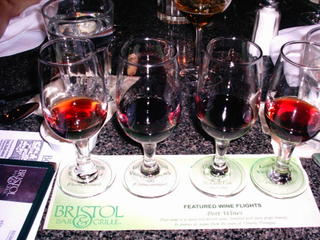
Great wine, mostly reds, and all European, flowed courtesy of the three high ranking area wine gurus in attendance. It's always a treat to receive instruction from the best.


With a closing port flight available, only one dessert beer made it onto the table.

My only regret is that I have but one liver to give for research like this.

Monday, July 24, 2017

30 years ago today: Bayeux and the fabled day on the Mulberry beach at Arromanches.


Previously: 30 years ago today: Exterior memories of the Palace and Park of Versailles.

---

Day 99 ... Thursday, July 23
Paris → Bayeux. Arrive mid-day. Mild evening.

Day 100 ... Friday, July 24
Bayeux. Arromanches, gas (wine) cans on the beach, etc. Sunburn. Drunkenness.

The train for Bayeux departed Paris from Gare St. Lazare. Bob had only two days remaining before peeling away to complete his journey elsewhere. After almost 10 seconds of reflection, I had decided to join Barrie in continuing from France to Ireland via the free Eurailpass sailing from either Cherbourg or Le Havre. My original plan was to resume my solo travels elsewhere, but in truth, we were having too much fun to stop.

We'd spend our last two days as a trio in Normandy.

As in 1985, the Family Home hostel was the choice for accommodations in Bayeux. In contrast with 1985's impromptu mattress dorm in the attic, we were able to get a triple room.

In a Google street view from 2015 or 2016, the by-then defunct hostel's sign still could be viewed on the building. The beds cost a bit more than I'd have liked, but there was a bonus in the form of a nightly communal meal for guests, which was very inexpensive and came with equally affordable wine.

We took advantage of this culinary feature on Thursday evening, though not before foraging first. At a neighborhood mom 'n' pop grocery store, Barrie made an epochal discovery.


Plastic 5-liter gas cans of red table wine were available at this grocery store for an obscenely cheap price, the equivalent of $10 or thereabouts. The wine wasn't local; "Vin de Pays de l'Aude" identifies the wine as from Languedoc, or the region around Carcasonne and Montpellier -- as far south from Normandy as one might go, on the Mediterranean Sea or near it.

A meat counter was spotted in the rear of the store. Barrie pointed at a sizable salami, and when the shopkeeper gestured toward the scale and asked in French how much he wanted, the reply was "un kilo, por favor."

Note that "por favor" is "please" in Spanish, not French.

Note also that now, in addition to baguettes, cheese and tomatoes, we had 10 liters of red wine in two dusty plastic gas cans and 2.2 pounds of salami.

The shopkeeper looked as though he'd hit the lottery.

On Friday morning we awoke to clouds and mist, loaded our day packs with wine and salami, and caught a bus a few miles to Arromanches-les-Bains, situated in the geographical center of the invasion tableau on Gold beach, site of the first Mulberry artificial harbor installation.

From this point forward, the photos are presented chronologically.


I've previously written about my visit to the vicinity in 1985, and it applies equally to 1987.

---

Knowing that that the Normandy landings on June 6, 1944 comprised the biggest amphibious invasion in military history proved to be inadequate preparation for viewing the ocean from the high ground, then trading places at water’s edge to look back inland, and being overwhelmed by what it must have felt like waist-deep in salt water, having nowhere to go except forward.

Most of the invading force came from the United States, the United Kingdom, and Canada, assigned landing beaches code-named Utah, Omaha, Gold, Juno and Sword (from west to east). However, troops also were present from Australia and New Zealand, as well as in small numbers from occupied European countries: Belgium, Czechoslovakia, Denmark, France, Greece, Netherlands, Norway and Poland.

There had been a great disinformation campaign on the part of the Allies, one designed to confuse the Germans as to the landing site. It worked to a significant degree, but perhaps the single biggest hindrance to an effective coastal defense stemmed from the larger strategic picture, because German wartime strength was waning.

Guns and ammo were less of an issue. Contrary to popular belief, Germany was able to keep up its war production in material terms in spite of relentless bombing, which Hermann Goering’s Luftwaffe was unable to impede. War production went underground, literally and figuratively, but Allied control of the skies proved vital as the Normandy invasion unfolded.

More importantly, Germany’s two-sided war was in the process of bleeding manpower to the breaking point. By 1944, the Germans were in retreat across the entirety of the Eastern Front, where the Red Army’s seemingly limitless numbers and escalating tactical abilities gained traction in proportion with the increasing exhaustion of the Germans.

Indeed, then as now, Americans need to understand that the outcome of the Great Patriotic War – as WWII was called in the Soviet Union – hinged on horrifically costly combat in the East. Tens of millions died there. US forces bore the brunt in the Pacific, while in Europe, the Soviets punished Adolf Hitler.

Consequently, Germany was weakened, and France’s coastal defenses were only partially completed and inadequately manned. Hitler’s constant military meddling added a further level of dysfunction; the perfectly capable general Erwin Rommel was on the job, and yet the dictator insisted on moving chess pieces from Berlin.

In spite of these many advantages, Operation Overlord was far from a sure thing. The Allies aimed to shift 150,000 soldiers across an unpredictable ocean, albeit over a relatively short distance from England. Even a slight shift in the weather might have wreaked havoc.

Not only were fighting men in route on small transports. Big naval ships had to be positioned for shelling, and parachutists had to be dropped behind enemy lines. There were supplies to be landed, too, primarily by means of an improvisational device called the Mulberry, which was a floating harbor to be assembled where natural contours were lacking.

As almost always is the case in war, it came down to the heroism and tenacity of the foot soldiers. On the Allied side, casualties during the first day alone exceeded 10,000, one of whom was my old friend Barrie’s father, who received a Purple Heart. More than 4,000 of his comrades died.

June 6 ended with five contested, bumpy bridgeheads for the Allies, and yet these lines held and were expanded during the remainder of June. By the end of the month, close to 900,000 troops had poured into this continental foothold.

You know the rest of the story.

---

For the remainder of the day, we didn't get far from the starting block. The mist burned off, the sun came out, and the wine was being consumed at exactly the prodigious pace you'd fully expect from the likes of us. We started the day almost alone at the historic sites. My early afternoon, the remainder of France had come out to the beach.


Yet again, as the day grew hotter, we found ourselves in the unenviable position of being horribly over-dressed for the beach scene. Wine helped with this, though it did not prevent considerable sunburn.


The scenery had become steadily more fabulous in concert with our intoxication, but it was unavoidable; we'd have to go back to Bayeux and sleep.

Don't ask me how we found the bus stop at this stage. There were two elderly invasion veterans aboard (from Scotland, I think), and Barrie had an animated conversation with them.


At last, Bayeux. Apparently Barrie had tired of me taking photos of him, and I can't say I blame him.


The evening concluded back at the Family Home hostel, at another communal meal. Bob and I are of the opinion that something strange happened while we were dining -- some spillage or a breakage, perhaps. We've no idea what form this might have taken.

The following morning, Bob departed. Barrie and I were down to a liter or two of jug wine. At least half the salami remained, as well as a final tiring day.

Next: Omaha Beach, Pointe du Hoc and a chance meeting with Leon Bourse.

Tuesday, March 14, 2017

THE BEER BEAT: Airline pricing for movie theater drinks, although we've little idea which ones.

If I were an editor at Business First -- well, that's unlikely, given that business-oriented publications contain far too many numbers for a humanities major like me, and anyway, it's my habit to refrain from fetishizing grubby capitalists -- I'd ask the contributing writer why some of the following beers are tagged by brand name, but the wines are identified by style.

What's on tap at Baxter Avenue Theatres' new bar, by Marty Finley (Louisville Business First)

... The bar has been in the works for months and carries several domestic and imported beer selections on tap — priced between $7 and $9 — alongside red and white wine selections for $10, according to Apex.

The theater's beer selection includes Budweiser, Bud Light, Miller Lite, Rolling Rock, Cumberland Brew, Dos Equis, BBC Pale Ale and Rhinegeist. Wine selections include merlot, pinot noir, cabernet sauvignon, white zinfandel, chardonnay and moscato.

Maybe the printing on the mass-market wine box was too small, or the press release incomplete.

Furthermore: Miller Lite is a specific beer brand, but Rhinegeist and Cumberland Brew (forgot an "s" there) are not. Which beers from these two breweries are they?

Then there's the reference to BBC Pale Ale. To my knowledge, BBC (currently down a brewery since the St. Matthews location closed earlier this year) isn't packaging at present. Is this draft, and if so, might it be BBC American Pale Ale (APA), which has been the name since the mid-1990s?

To summarize, seeing as I attend movies in theaters like this about as often as I read business-oriented publications ...

Sunday, May 05, 2013

Sunday, December 27, 2009

Moss profiles Harper.

I'm happy that Dale Moss caught this one. Scott Harper is a master sommelier, of which there are just over one hundred in the entire country, and he works in Jeffersonville. That's good news, any way you look at it.

Expert reveals the simple truths of savoring wines

Friday, July 17, 2009

Windsor's "Farmers Market" beer and wine dinner coming on Monday, July 27.

Here’s the lowdown on the Windsor Restaurant and Garden's forthcoming event, called "The Windsor Beer and Wine Dinner: Farmers Market."

The idea is to use as much food as possible from the Farmers Market just across Bank Street from the restaurant. I’ve reprinted the dinner menu below. Wine and beer pairings have yet to be made, but each course comes with a pairing of wine and beer, according to the information I've received.

This dinner will be served on Monday, July 27, and begins at 6:30 p.m. The price per person is $60, not including tax or gratuity. The Windsor’s phone number is (812) 944-9688, and the dinner is available by reservation only. The Windsor Restaurant and Garden is located at 148 East Market St. in downtown New Albany.

Wine will be provided by Louis Meyer of Crossroad Vintners, beer by Tisha Dean of World Class Beverages, and a closing beer will come from the New Albanian Brewing Company.

Chefs are Justin McMillen and Cory A. Cuff. Cory says: "The Windsor staff would like to thank Susan Kaempfer of Develop New Albany, as well as the local farmers who’re making this possible. A full list of farmers is to come, and a full list of pairings, too.

MENU

Soup
Duo of chilled melon soup shooters with champagne "caviar" and lime granite

Salad
Pork Roulade Terrine with mixed Asian baby greens and a B&B pickle vinaigrette with assorted pickled vegetables

Fish
Seared Sea Bass escabache with smoked zucchini, squash, and carrot "spaghetti" garnished with a micro green salad and a parsley and meyer lemon vinaigrette

Red Meat
Seared Ostrich medallions with a honey lavender marinated grilled asparagus, and deconstructed twice baked fingerling potatoes with a Pennywise Petit Sirah Marchand Du Vin

Dessert
Peach two ways, a peach and blackberry cobbler and a Lindemann's Peche float with a goat cheese and lemon verbena ice cream

Sunday, July 05, 2009

Appetizers now available Wed. - Sat. at the River City Winery.

Gourmet pizza is coming soon, but not quite yet. There's a short appetizer menu (crab cakes, cheese plate, shrimp, Caesar salad) being served evenings from Wednesday through Saturday. I think the winery's open every day now, and of course, wine is pouring by the glass (bottles sold to go, too).


The winery's located at 321 Pearl Street in downtown New Albany. The phone number is (812) 945-9463, and in addition to wine and nibbles, you'll be awed by the interior and exterior remodeling work that was done in preparation for business.

Wednesday, May 06, 2009

Yesterday's "First Tuesday" event and a chance to visit the River City Winery.

Yesterday was the monthly "First Tuesday" mixer, co-hosted by Develop New Albany and the River City Winery. The photo above was taken by Ted Fulmore, and to view more, click here. I was busy dodging paparazzi determined to catch me in the act of drinking something other than beer, which turned out to be a dryish Cabernet/Merlot blend.

The building renovation is nothing short of amazing, and the winery crew was busy bottling and applying labels downstairs as the event took place at ground level. I gleaned that there will be limited evening hours for wine tastings only beginning immediately, with food to follow later this summer (late July or August).

River City Winery website