Showing posts with label Woody Guthrie. Show all posts

Thursday, June 25, 2020

Woody Guthrie is back; Tulsa Athletic to play “This Land is Your Land” at home matches instead of the national anthem.

The Pearl in Germantown.

It's the soccer club in Tulsa, but first, allow me to express delight with the mural in Germantown. It wouldn't be allowed in Nawbany. I'm very happy that Woody Guthrie is being so honored.


Tulsa Athletic Making Bold Moves
(Protagonist)

There’s bold and then there’s Tulsa bold.

Tulsa Athletic announced today that the club would no longer play the National Anthem before matches, and instead play Woody Guthrie’s “This Land is Your Land” at all home matches. In a press release put out by the club this morning, co-owner Sonny Dalesandro explained their decision. “We developed a culture of inclusion and acceptance at Tulsa Athletic. We live in a country that allows us to freely speak our voice. We utilize this right as a club to continually try and improve our team and community. We believe ‘This Land Is Your Land’ not only captures a powerful patriotic sentiment, but this it does so in a far more inclusive way. The song speaks to this country being built and shared by every person of every race, ethnicity, religion and sexual orientation. It represents a future Tulsa Athletic is committed to striving for.”

Sonny, flanked by representatives from the club, made the announcement in front of a Woody Guthrie mural, painted on the side of the Woody Guthrie Center in Tulsa.


As for the song selection, I'm also feeling vindicated. I've been making this argument for so damn long ...

ON THE AVENUES: Let's lift our voices for another verse of "Talking Seventh Inning Blues."

... Conversely, if we simply must have a 7th-inning tune other than the historically correct one ("Take Me out to the Ballgame"), why not sing “This Land Is Your Land,” Woody Guthrie’s far superior response to Irving Berlin's "God Bless America"?

Why not sing it instead of the national anthem?

“This Land Is Your Land” is sublimely ecumenical, addressing the natural and human wonders of America without resorting to the divisiveness of those many supernatural elements.

I suppose the drawback is that when it comes to the imperative of emotional manipulation required by engorged corporate capitalists, Guthrie’s work isn’t as simplistic as Berlin’s schmaltzy paean to blind obedience.

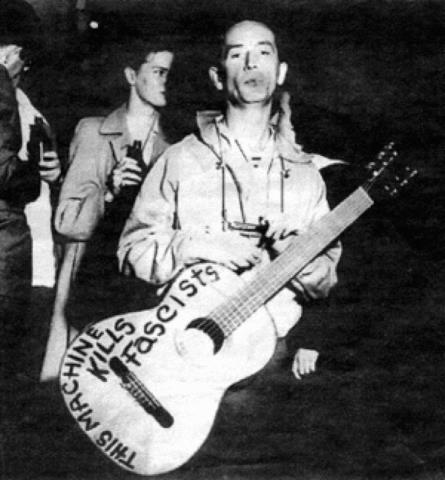
Better yet, we might all wear “This Machine Kills Fascists” t-shirts whilst happily harmonizing from the third base side. It is through Guthrie’s legacy that this phrase has become immortalized. For many years my former brewing company used “These Machines Kill Fascists” as our motto, alongside a graphic of brewing vessels, and even today, with me being long gone from NABC, I never tire of telling the story of its origin.

Tuesday, June 18, 2019

ON THE AVENUES: Let's lift our voices for another verse of "Talking Seventh Inning Blues."


On the Avenues will move back to Thursdays, beginning next week.

World Cup soccer star Megan Repinoe's principled decision to refrain from singing the "The Star Spangled Banner" prompts one of those questions we ask the friendly 800-lb gorilla in the corner.

In short, why do we play the national anthem before a sporting event, but not prior to opening the doors at a frilly boutique, muffler shop or dive bar?

Imagine the plight of the 24-hour mini-mart, forever unable to to find an opportunity to play the national anthem, and settling instead on an endless loop of Lee Greenwood songs.

The 800-lb gorilla isn't finished.

Why do we insist on patriotic rituals attendant to the airing of the anthem alongside overt displays of nationalism merely to sanction throwing a football and shooting hoops, not to mention taking slap shots?

(As an aside, these questions were of relevance long before Repinoe chose silence and football’s Colin Kaepernick took a knee.)

According to writer Richard C. Crepeau in an essay from the mid-200s, the answer is that rote patriotism featuring "The Star Spangled Banner" became a feature of baseball games during World War II.

In 1940, with the fighting underway in earnest and America becoming more conscious of the possibility of war, there was increased talk of the need to hear the national anthem before all baseball games. This was suggested by The Sporting News in June, while at the same time the president of the International League called for the anthem to be played in U.S. league cities, as was already being done in Canadian cities. By 1941, the practice of playing the anthem before sporting events had achieved nearly universal status. At some games the pledge of allegiance was added, and, by 1941, "I Am an American Day" became a feature at major league parks.

It would be nice to say that all of this was due to pure patriotic expression, but of course much of it was created by PR-conscious owners who wanted to make sure that no one would question the patriotism of athletes who played games during World War II while others went off to serve their country. Four years of war, followed by the Cold War and the emergence of the American Empire, solidified the practice and made it into a national ritual.

Since September 11, 2001, another ritual has come into fashion in baseball. Nowadays the seventh inning stretch often is devoted to a commemorative performance of “God Bless America,” for which I’ll soon be suggesting an alternative with less proselytizing. As a long-ago Internet analyst once wrote:

“‘God Bless America’ rings a false note now, as it did when the song was first written (by Irving Berlin, 1939). Woody Guthrie, wrote the song ‘This Land is Your Land’ in 1940 after hearing Kate Smith sing ‘God Bless America’ one too many times.”

But first, since I’m perfectly willing to be the iconoclast in this particular hometown locker room, another question: Is it really necessary to bring religious devotion into the seventh inning stretch?

Or: Where is the imperative for a deity to “bless” America in the first place, quite apart from sports?

Perhaps a better question is this: If we deploy societal peer pressure to encourage a conditioned response by requiring people to participate in a ritual intended to remind them of a noteworthy event, aren’t we trivializing the event?

Shouldn't folks remember on their own?

To be sure, the events of September 11 are an indelible memory for current generations. Furthermore, and on a far less savory note, the invasive logic of the security state arising in America since 2001 has affected our lives more deeply than we realize.

Still, active memories of 9-11 will fade, just as recollections of human slavery's toll, the efficacy of vaccination and a merits of a living wage have disappeared into the mists of rear-view mirrors.

In my world, instead of mandating participation in sing-alongs during sporting events, a better way of understanding history’s lessons is to take an interest in historical facts. Some sweet day we all may rise as one from the bleachers, precariously cradling ours beers and brats, and listen as local actors and television luminaries read relevant passages from Howard Zinn.

Too few of us can sing well, anyway.

---

At this point the hackles of some readers surely are popping to life: “What -- don’t you love your country?”

Well, this depends on what the meaning of “love” is.

Speaking only for myself, I cannot regard the word “love” as a concept applicable to one among many nation-states into which I was serendipitously deposited by the fickle finger of fate. Rather, during my adult life the extent of my personal attachment to the concept of the United States of America has been conducted in a cerebral way, not in terms of blind allegiance.

(I do love my wife, but each year at tax time my feelings take a back seat to hard mathematics and fluency in bureaucratese; lacking both, I immediately hand the dossier to my accountant to be assured it's done right.)

Somewhat amazingly my teachers succeeded in convincing me that to be an American bears an intimate connection with an intellectual process, not an emotional one. I accept that a philosophy of governance came first, this being a rational undertaking incorporating thoughts, ideals and the historical record, not misty eyes, the fevered thumping of a chest or identification with a piece of cloth.

At the same time, my acknowledgment of this political construct does not imply acceptance of its imperfections. As Tina Turner might have asked, “what’s love got to do with it?” The Constitution as a document is a starting point, and it is to be regarded as a work in progress, not another gilded icon to be revered sans examination with a critical lens.

Because how could the nation's founders have devised perfection when Walt Disney had yet to be born?

All of these considerations matter owing to one’s personal conscience, and the minute we seek to align the conscience of the many individuals into the potential blunt instrument of the one, it’s time to be vigilant.

A brief survey of history reveals that soldiers on all sides have consistently marched off to war in the patriotic belief that God is on their side, and when one considers the catastrophic results of war, it should be obvious that this equation is irreparably skewed, as is any other pertaining to the abstract entity of nationhood -- especially as such abstractions come from hearts and not heads.

My views in this context understandably aren’t mainstream. I think love for other persons can be crazy, blind, binding and inexplicable. Beyond that, brains are there to be used, not lobotomized.

There weren't any weapons of mass destruction in Iraq, were there?

---

Returning to what it means to be a baseball fan, "Take Me Out to the Ballgame" is the only patriotic song we've ever needed. For decades a staple of the seventh-inning stretch at ballparks large and small, from California to the New York island, this music was most delightfully defined by the late Harry Caray’s boisterous press box version.

Baseball possesses its own sort of quasi-religious faith; if not, why would Baltimore Orioles fans buy a single ticket in 2019?

For me the substitution of “God Bless America” for “Take Me Out to the Ballgame” is like inserting an advertisement for organized religion where it doesn't belong, whatever the variety.

Of course I’ve nothing whatever against the old-school songwriter Israel Beilin (Irving Berlin), who died a famous, feted American in 1989 at the age of 101, this wonderful and welcoming country having provided a beacon to his family of immigrants escaping nasty pograms in Tsarist Russia.

Among Berlin’s hit songs I prefer “Cheek to Cheek” or even “Alexander’s Ragtime Band” to “God Bless America,” in which Berlin appealed directly to a simple love of country with groundless theism, prideful chest-thumping and a mawkish sentimentality, neither of which suits my cosmopolitan (read: cynical) internationalism.

---

Conversely, if we simply must have a 7th-inning tune other than the historically correct one, why not sing “This Land Is Your Land,” Woody Guthrie’s far superior response to Berlin?

Why not sing it instead of the national anthem?

“This Land Is Your Land” is sublimely ecumenical, addressing the natural and human wonders of America without resorting to the divisiveness of those many supernatural elements.

I suppose the drawback is that when it comes to the imperative of emotional manipulation required by engorged corporate capitalists, Guthrie’s work isn’t as simplistic as Berlin’s schmaltzy paean to blind obedience.

Better yet, we might all wear “This Machine Kills Fascists” t-shirts whilst happily harmonizing from the third base side. It is through Guthrie’s legacy that this phrase has become immortalized. For many years my former brewing company used “These Machines Kill Fascists” as our motto, alongside a graphic of brewing vessels, and even today, with me being long gone from NABC, I never tire of telling the story of its origin.

Woodrow Wilson Guthrie (1912-1967) was an iconic American folksinger. He was born in Oklahoma and came of age during the twin pre-WWII crises of national economic collapse (the Great Depression) and regional environmental catastrophe (the Dust Bowl).

Musically inclined from childhood, Guthrie followed the westward drift in pursuit of work, eventually landing in California alongside numerous other Okies. In doing so, he played a living, breathing part in novelist John Steinbeck’s “Grapes of Wrath,” and as a direct result of what Guthrie experienced during these troubled times in America, his political views evolved in progressive, leftist directions.

Many of Guthrie’s subsequent songs -- he wrote thousands -- chronicled the hardships of ordinary people, expressing empathy for their lot and support for what he saw as curatives: Worker rights, unionizing, and racial and gender equality.

Guthrie eschewed the feel-good and the flag-waving, both so often deployed to mask deprivation and trivialize injustice. His annoyance with “God Bless America” spoke to this feeling.

For all of Guthrie’s leftist tendencies, he remained a staunch patriot as well as a firm, committed believer in the potential of America, albeit a more idealistic and hopeful vision of the American experiment, one not defined entirely by wealth and privilege. The Second World War put his beliefs to the test, and he responded admirably.

It is instructive to remember that during World War II, the United States (a democracy -- of sorts) aligned with a hereditary monarchy (Great Britain) and the USSR’s Communist gulag against the military aggression of Germany, Italy and Japan. Such was the greater threat posed by fascism.

Guthrie viewed his music as an integral part of the war effort, and so he scrawled “This Machine Kills Fascists” on his acoustic guitar, meaning that music and ideas were as much weapons against fascism as guns and bullets. Guthrie enlisted in the Merchant Marine, and whenever performing, he used his own machine, one that he considered vital in killing fascists.

The same phrase was written on machinery in factories throughout the United States, as those millions of people in America’s industrial work force made a similar point: The person operating the machine that makes the supplies used to defeat fascism are helping to kill fascists, too.

Co-opting religious imagery to further the imperatives of a war machine driven by wealthy elites, or returning to the egg and reminding us that “we the people” might yet resemble universalism and in self-governance?

I appreciate Irving, but I vote for Woody -- now and always.

---

As a postscript, the lyrics.

This land is your land This land is my land
From California to the New York island;
From the red wood forest to the Gulf Stream waters
This land was made for you and Me.

As I was walking that ribbon of highway,
I saw above me that endless skyway:
I saw below me that golden valley:
This land was made for you and me.

I've roamed and rambled and I followed my footsteps
To the sparkling sands of her diamond deserts;
And all around me a voice was sounding:
This land was made for you and me.

When the sun came shining, and I was strolling,
And the wheat fields waving and the dust clouds rolling,
As the fog was lifting a voice was chanting:
This land was made for you and me.

As I went walking I saw a sign there
And on the sign it said "No Trespassing."
But on the other side it didn't say nothing,
That side was made for you and me.

In the shadow of the steeple I saw my people,
By the relief office I seen my people;
As they stood there hungry, I stood there asking
Is this land made for you and me?

Nobody living can ever stop me,
As I go walking that freedom highway;
Nobody living can ever make me turn back
This land was made for you and me.

---

Recent columns:

May 28: ON THE AVENUES: Challenges are forever, but downtown New Albany's food and drink purveyors keep on keeping on.

May 21: ON THE AVENUES: "Pints&union, where the classic beer hits keep right on pouring."

May 14: ON THE AVENUES: Where do we go from here?

May 6: ON THE AVENUES REWOUND: Ghosts within these stones, defiance in these bones (2018).

Sunday, October 02, 2016

Big cheer for the Orioles: "Baltimore is the only major league franchise to regularly play 'This Land Is Your Land,' which it does at Friday home games."


I've been here before, most recently in 2013.

ON THE AVENUES REWOUND: Talking Seventh Inning Blues (2010)

For a baseball fan, the only patriotic song that really matters is “Take Me Out to the Ballgame,” for decades a staple of the seventh-inning stretch at ballparks large and small, from California to the New York island.

Unfortunately, the purloining of this sacred tradition commenced shortly after 9-11, reaching a predictable nadir during the annual playoffs and World Series, which prompted an exciting, new activity in my heretical household: Scrambling to be first to thumb the mute button, thus sparing us yet another performance of “God Bless America.”

Delightfully, the Orioles "get it" -- not often enough, but we must start somewhere.

Orioles Deliver a Seventh-Inning Message: This Song Is Their Song, by Ben Strauss (New York Times)

BALTIMORE — In the middle of the seventh inning of the Baltimore Orioles’ game against the Arizona Diamondbacks two Friday nights ago, the public-address announcer asked the crowd at Camden Yards to stand and celebrate America’s diversity. Three singers then stood on the first-base dugout and did a rendition of “This Land Is Your Land,” the famous folk song written by Woody Guthrie.

By the time the end of the third verse arrived — “All around me a voice was sounding, this land was made for you and me” — fans had joined in.

In a tradition that dates to the aftermath of the Sept. 11 terror attacks in 2001, “God Bless America” is played in major league ballparks around the country, including in Baltimore, during the seventh-inning stretch of Sunday games. The song can also be heard during assorted holiday games, and the Yankees play the song during the seventh inning of every home game.

But Baltimore is the only major league franchise to regularly play “This Land Is Your Land,” which it does at Friday home games. And the song, long considered an anthem of the left because of its populist themes, is meant to be more than a Camden Yards singalong. It is a subtle, yet intentional, message from the Orioles’ management that at the intersection of sports and patriotism, one size does not have to fit all.

Thursday, January 16, 2014

To fascist or not to fascist: Another fine day in the comments section.


NABC's web site garners few comments, with most discussions occurring elsewhere in Facebook, at Twitter, or on unguarded masonry walls.

Of course, what makes the Internetz so much fun is that enlightenment is only a click away, as was the case overnight with this observation from Ron:

Too bad you don’t know what fascism actually means. Too bad that Woody Guthrie was a self-righteous useful idiot who didn’t know what fascism was either.

His comment was appended to our explanation of These Machines Kill Fascists, and my reply is as follows:

The word fascism came to us from Italy (Mussolini), which was an ally of Germany (Nazism, Hitler); both declared war on the United States after Pearl Harbor, and Woody Guthrie supported the war effort against them. It would seem that Guthrie connected the dots quite effectively. But enough about beer.

Saturday, August 17, 2013

These machines kill fascists, pathogens and bureaucrats.


As of Friday, the Floyd County Health Department's web site has been purged of references to NABC and me, and there are no artlessly staged "stock photo" ops ("eco-lies", we call them), and no images of me purloined from my web site absent my permission. Seems they can take dictation, after all.


Meanwhile, last evening's Bicentennial Park concert gig was the occasion for another cursory inspection by the department, whose representative took little time in offering me the clipboard for signing, along with these words: "There isn't much to see here."

Yep. The foot soldiers keep getting it, while their superiors ...

Thursday, July 04, 2013

ON THE AVENUES REWOUND: Talking Seventh Inning Blues (2010).

ON THE AVENUES REWOUND: Talking Seventh Inning Blues.

A weekly web column by Roger A. Baylor. Today's July 4 rewind was originally published in November, 2010, and is dedicated to the Floyd County Health Department.

“‘God Bless America’ rings a false note now, as it did when the song was first written (by Irving Berlin, 1939). Woody Guthrie, wrote the song ‘This Land is Your Land’ in 1940 after hearing Kate Smith sing ‘God Bless America’ one too many times.” -- Democratic Wings

---

For a baseball fan, the only patriotic song that really matters is “Take Me Out to the Ballgame,” for decades a staple of the seventh-inning stretch at ballparks large and small, from California to the New York island.

Unfortunately, the purloining of this sacred tradition commenced shortly after 9-11, reaching a predictable nadir during the annual playoffs and World Series, which prompted an exciting, new activity in my heretical household: Scrambling to be first to thumb the mute button, thus sparing us yet another performance of “God Bless America.”

I’ve nothing against the songwriter Irving Berlin, whose family escaped pogroms in Tsarist Russia by immigrating to America. It’s just that in appealing to what Berlin perceived as the common American’s simple love of country, he was prone to overt chest-thumping and mawkish sentimentality, neither of which suits my cosmopolitan internationalism.

Why can’t we sing “Take Me Out to the Ballgame” at the game, and save the Pat Robertson Bible College advertisement for his cable empire, where it belongs?

---

Conversely, if we must have a 7th-inning tune other than the historically correct one, why not sing Woody Guthrie’s far superior response, “This Land Is Your Land”?

It is sublimely ecumenical, addressing the natural and human wonders of America without resorting to the divisiveness of those many supernaturals. I suppose the drawback is that when it comes to the imperative of emotional manipulation required by moneyed corporate capitalists, Guthrie’s work isn’t as misty-eyed as Berlin’s schmaltzy paean to blind acceptance.

Better yet, we might all wear “This Machine Kills Fascists” t-shirts whilst happily harmonizing from the bleacher seats.

It is through Guthrie’s legacy that the phrase has become immortalized. For what seems like years, my company has used “These Machines Kill Fascists” as our motto, alongside a graphic of brewing vessels, and I never tire of telling the story of its origin.

Guthrie (1912-1967), the iconic American folksinger, was born in Oklahoma and came of age during the twin pre-WWII crises of national economic collapse (the Great Depression) and regional environmental catastrophe (the Dust Bowl).

Musically inclined from childhood, Guthrie followed the westward drift in pursuit of work, eventually landing in California alongside numerous other Okies. In doing so, he played a living, breathing part in novelist John Steinbeck’s “Grapes of Wrath,” and as a direct result of what Guthrie experienced during these troubled times in America, his political views evolved in progressive, leftist directions.

Many of Guthrie’s subsequent songs – he wrote thousands – chronicled the hardships of ordinary people, expressing empathy for their lot and support for what he saw as curatives: Worker rights, unionizing, and racial and gender equality. Guthrie eschewed the feel-good and the flag-waving, both so often deployed to mask deprivation and trivialize injustice. His annoyance with “God Bless America” spoke to this feeling.

For all of Guthrie’s leftist tendencies, and in stark contrast with the way that today’s right-wingers typically malign them, Guthrie remained a staunch patriot as well as a firm, committed believer in the potential of America, albeit a more idealistic and hopeful vision of the American experiment, one not defined entirely by wealth and privilege. The Second World War put his beliefs to the test, and he responded admirably.

---

It is instructive to remember that during World War II, the United States (a democracy -- of sorts) aligned with a hereditary monarchy (Great Britain) and the USSR’s Communist gulag against the military aggression of Germany, Italy and Japan. Such was the greater threat perceived in fascism.

Guthrie viewed his music as an integral part of the war effort, and so he scrawled “This Machine Kills Fascists” on his acoustic guitar, meaning that music and ideas were as much weapons against fascism as guns and bullets. Guthrie enlisted in the Merchant Marine, and whenever performing, he used a machine that he considered vital in killing fascists.

The same phrase was written on machinery in factories throughout the United States, as those millions of people in America’s industrial work force made a similar point: The person operating the machine that makes the supplies used to defeat fascism are helping to kill fascists, too.

With “These Machines Kill Fascists,” my company honors Guthrie. As machines, the brew kettles, mash tuns and fermenters we use to make craft beer are our weapons against fascism in the beer world, where there are aggressive multi-national industrial brewers such as AB-InBev (as when shopping at Wal-Mart, your Bud money goes overseas, folks), and smaller, local, anti-fascist entities like us.

One of them better symbolizes Guthrie’s view of the American Dream.

If one cares to read more into it, interpretation surely is a privilege whenever listening to song lyrics. Speaking personally, my leftist proclivities are well documented, although at the same time, while historical accuracy demands that we use the phrase as originally rendered, I’d probably prefer killing “fascism” rather than “fascists.” Beyond that, I remain convinced that daily craft beer production indeed kills fascists.

Drinking some of it never hurts, either.

“Nobody living can ever stop me,
As I go walking that freedom highway;
Nobody living can ever make me turn back
This land was made for you and me.”

Friday, March 29, 2013

Woody Guthrie and the Eastern Front: "Miss Pavlichenko."


During the course of his research for the label of NABC Eastern Front (see excerpt below), graphics maestro Tony Beard stumbled across Woody Guthrie's ode to Lyudmila Pavlichenko. Guthrie performed the song with the help of a machine that kills fascists.

Lyudmila Pavlichenko

Lyudmila Mikhailivna Pavlichenko (Ukrainian: Людмила Михайлівна Павліченко; Russian: Людмила Михайловна Павличенко; Lyudmila Mikhailovna Pavlichenko; July 12, 1916 – October 10, 1974) was a Soviet sniper during World War II. Credited with 309 kills, she is regarded as the most successful female sniper in history.


For additional beer release news, go here.

There’s a whole new identity for an old favorite: Eastern Front, formerly known as Elsa von Horizon.

Eastern Front remains true to the same idea of an Imperial Pilsner, as brewed seasonally during recent year, and as originally formulated by former NABC pub brewer Jared Williamson as part of the since-retired Brewers Best Friend series.

In recent years, David Pierce (NABC’s director of brewing operations), has honed our Imperial Pilsner into even more of an awesome seasonal release than it was before. Unfortunately, and perhaps curiously, Elsa has not resonated as well off-premise as when poured in our own two establishments, prompting a rethink.

Trust me: I didn’t make this decision lightly. Changing Elsa’s name and imagery is hard, primarily because of my respect and esteem for Jared and his long tenure at NABC. At the same time, we really want the idea to succeed, and not just in our own smaller marketplace. It has clearly been the case that the Elsa name and previous label design did not click with the wider pool of customers, especially in the bottled version. So, a plan for adaptive reuse was in order. The beer’s just too damned good to leave behind, and so we move forward with Eastern Front.

The name Eastern Front is layered, and it reflects my own interests.

Eastern Front recognizes that throughout history, German and Slavic lands have overlapped, hence this strong, hoppy lager’s stylistic re-augmentation as a “Russian” Imperial Pilsner. It’s also a nod to graphics wunderkind Tony Beard’s artistic label inspiration: Female sniper teams posted to the Red Army during the Great Patriotic War (in the West, we still call it World War II).

Tony’s presently working on the label for Eastern Front, and as soon as it’s ready, you’ll see it here. This year’s batch will be draft only, with a limited allocation for outside draft sales in Indiana and Kentucky. In 2014, we hope to include a bottling run.

Wednesday, July 18, 2012

Woody Guthrie and Dust Bowl adobe.


Previously we've covered Woody Guthrie's allergic reaction to Irving Berlin, and the singer's anti-fascist angle, which my company has embraced as a timeless badge of sorts.

"Talking seventh inning blues.”

Now there's even more: A novel about much more than adobe.

This Land Was His Land; Woody Guthrie’s Dust Bowl Novel, by Douglas Brinkley and Johnny Depp

The legend of Woody Guthrie as folk singer is firmly etched in America’s collective consciousness. Compositions like “Deportee,” “Pastures of Plenty” and “Pretty Boy Floyd” have become national treasures akin to Benjamin Franklin’s “Poor Richard’s Almanack” and Mark Twain’s “Adventures of Huckleberry Finn.” But Guthrie, who would have been 100 years old on July 14, was also a brilliant and distinctive prose stylist, whose writing is distinguished by a homespun authenticity, deep-seated purpose and remarkable ear for dialect. These attributes are on vivid display in Guthrie’s long-lost “House of Earth,” his only fully realized, but yet unpublished, novel. (His other books, “Bound for Glory” and “Seeds of Man,” are quasi-fictional memoirs.)


Thursday, November 11, 2010

Today's Tribune column: "Talking seventh inning blues.”

Beats me, but maybe Elton John's "Texan Love Song" should have been the seventh inning choice for World Series games played in the Lone Star State.

I heard from a friend you'd been messing around
With a cute little thing I'd been dating uptown
Well I don't know if I like that idea much
Well you'd better stay clear I might start acting rough


You out of town guys sure think you're real keen
Think all of us boys here are homespun and green
But that's wrong my friend so get this through your head
We're tough and we're Texan with necks good and red


So it's Ki yi yippie yi yi
You long hairs are sure gonna die
Our American home was clean till you came
And kids still respected the president's name


And the eagle still flew in the sky
Hearts filled with national pride
Then you came along with your drug-crazy songs
Goddamit you're all gonna die


How dare you sit there and drink all our beer
Oh it's made for us workers who sweat spit and swear
The minds of our daughters are poisoned by you
With your communistic politics and them negro blues


Well I'm gonna quit talking and take action now
Run all of you fairies clean out of this town
Oh I'm dog tired of watching you mess up our lives
Spending the summertime naturally high


It ain't Irving Berlin, and it ain't even Woody Guthrie, and yet for a couple of Englishmen, it aptly summarizes the problem. Here's today's column.

BAYLOR: Talking seventh inning blues

... It is instructive to remember that during World War II, the United States (a democracy — of sorts) aligned with a hereditary monarchy (Great Britain) and the USSR’s Communist gulag against the military aggression of Germany, Italy and Japan. Such was the greater threat perceived in fascism.