Showing posts with label Phipps in captivity. Show all posts

Sunday, June 07, 2020

Do Black Lives Matter? Team Gahan won't answer, but thankfully others aren't afraid to lead.


Say Their Names: Chalk the Sidewalks is coming to New Albany on June 13.

SoIN is taking a stand by saying the names of those violently killed by systemic oppression and racism. We will be meeting in the downtown areas of both New Albany and Jeffersonville to write the names of those killed as a reminder that we must not be silent and we must say their names. If you are unable to join us for the group event, please participate at your own home as you can. Chalk your sidewalks or driveways with their names.

We will not and must not be silent any longer.

For the New Albany location, we will meet at the corner of Spring and Pearl near the Bicentennial Park.

For the Jeffersonville location, we will meet at the base of the Big Four Bridge.

Good. It's about time for an awakening.

I think it's impressive and commendable that four of the five members of New Albany's Human Rights Commission (HRC)* are displaying admirable social conscience during these potentially transformational times.

Calle Janson (an organizer of Say Their Names), Paul Kiger, Jennifer Ortiz and Ken Brooks all can be viewed on their Facebook pages referencing Black Lives Matter and advocating ... well, for HUMAN RIGHTS. After all, it's why the commission is there, right?

The fifth member of the HRC is Warren Nash, whose public utterances recently have been confined to the usual semi-comprehensible partisan political sycophancy -- for the Democratic Party as well as the municipal administration for which he specializes in backroom fixes, envelope shuttling and the occasion snarl directed against modernity.

Sadly, it's easy to imagine Nash bringing the sidewalk chalking to the Board of Works and Safety for approval and deep editing.

Louisville's ever-shrinking Greg Fischer needs to resign. Nash desperately needs to retire. He is Miss Trixie to Jeff Gahan's Gus Levy (look it up).

The party itself has had almost nothing to say about events in America for the past two weeks. Neither has Gahan, nor any of the mayor's team. I cannot locate an example of an elected Democratic Party office holder in New Albany making a public utterance about social justice, BLM or any other topic that has dominated the national discourse recently.

They just dig deeper and deeper into the Down Low Bunker.

You'd think maybe councilman Greg Phipps would show signs of a pulse, given that he fancies himself the enabler of the HRC -- which has been crippled and hamstrung since its inception (and two re-inceptions) by the very same Democratic Party that enjoys taking credit for the commission just as long as it isn't visible.

To repeat: The Democratic Party controls New Albany. It is a profoundly propaganda-tainted conservative institution -- as I refer to it without a shred of satiric exaggeration as the DemoDisneyDixiecratic Party -- albeit with a good number of progressive-leaning individuals residing inside the party's ideological tent, who for whatever reason constantly defer to the Gahan/Nash elder regressive faction that amply keeps the pay-to-play wheels greased, but possess all the social conscience of a lump of clay.

Consequently, Black Lives Matter probably will come to Birdseye before it arrives at Hauss Square. Local Democrats are absolutely terrified of BLM -- not because of what IT is, but who THEY are ... and aren't.

---

The HRC's last available minutes are dated July 16, 2019

Monday, June 01, 2020

Councilman Phipps' future council meeting emergency reduction resolution is another Team Gahan mess. Can it be tossed out with the rubbish?

It's bad enough that Jeff Gahan has used the occasion of a pandemic to concentrate his powers even further, but the DemoDisneyDixiecratic Party's new scheme to set out provisional guidelines for minimal public appearances just in case things get bad again in the fall is muddled and laced with nonsense.

It's a strange resolution, anyway. The bulk of it sets out to define how public input can be made in the era of Zoom, then a brief paragraph almost incidentally allows for the council president (currently the awful partisan sycophant Bob Caesar) to take the council underground if Gahan's own state of electoral emergency so ordains, with COVID as pretext.

Our local DDD officials lie almost as artlessly as Louisville police. The only surprise is that Warren Nash hasn't found a way to blame Floyd County government for his own purportedly faultless party's enduring contempt for transparency.

Following are the minutes from the most recent council meeting. This resolution belongs in the landfill, but with five council votes coming from Gahan's shameless bootlickers ...


Saturday, December 07, 2019

More than three weeks ago I put the fallen leaves exactly where the city asked, and they're still there, untouched. There oughta be an ordinance.

Good thing I have a councilman living two doors down.


On September 27, NA Confidential performed an invaluable public service by reminding you of the proper way of dealing with fallen leaves: Don't say I didn't remind you of the leaf sucking protocol for 2019.


Short version: If you want your leaves sucked, keep them out of the curbs, gutters and streets, or else ... absolutely nothing will happen to you.


Now, can I get the leaves sucked in front of my house, or did we sacrifice availability to street department services by pointing out that the mayor is a loser no matter how often he wins?

Tuesday, November 19, 2019

House fire in the 3rd district turns the spotlight to the importance of corner buildings, and how few city officials understand it.


It's unlikely the owner will be stepping forward to save the house, given that his serial neglect over a period of years surely contributed to its demise, but maybe miracles still happen.

TIF-buffing, anyone? Duggins' personal "Lots-R-Us" housing authority might be able to take it over for voucher housing.

Meanwhile David Barksdale's right about those idiotically vacant corner lots scattered throughout town where buildings ought to be, with perhaps a dozen in Councilman Phipps' 3rd district alone.

So of course everyone involved happily agreed to build parks at the corner of 11th and Spring, and the corner of Pearl and Spring -- and of course the corner of State and Spring remains a superfluous parking lot, and there's the biggest waste of what should be prime real estate in the entire city where the Farmers Market was built ...

Yep, those corner lots.

True, the city can't control what happens with all of them, but it's too bad we can't get it right for the ones we do.

Fire crews battle blaze at historic New Albany home, by Aprile Rickert (Hanson's Chain Folly)

Building was vacant, chief says

NEW ALBANY — Fire crews continue to attack hot spots after a historic home in downtown New Albany caught fire early Friday morning ...

... The corner-lot house falls within New Albany's historic Mansion Row, adjacent to St. Paul's Episcopal Church on the west and Naville & Seabrook Funeral Home on the north. It was built in 1910 by Edward and Mary Hackett, a family that was in the furniture manufacturing business. Edward died in 1922 and the home was subdivided into apartments in 1926, years before the bulk of larger building were cut into multi-family units during World War I and II.

Mary remained in control of the property until around 1940, when it was purchased by Vincent Knabel.

Floyd County Historian Dave Barksdale said that first and foremost, he's glad no one was seriously injured or killed in the fire. But he's concerned about whether the 109-year-old building will survive the damage.

"Corner buildings are very important to a street and when you lose a corner building, it's a shame because you're losing the anchor of that block," he said. "Depending on what the owner is intending on doing, there could be a good infill project go in there. It would be great if it could be saved, but just from my vantage point, I think it would be awfully hard to save."

Greg Sekula, director of Indiana Landmarks Southern regional office, said he has hope it can be restored.

"It certainly kind of makes your heart sink, particularly when the building is in a historic district and it is a contributing property within the district," Sekula said.

He said the house is a good example of framed colonial style and was one of the more prominent homes on the street when it was built. As an income-producing property, he said there are federal grants available to help with restoration.

"You don't want to see a gaping hole there," Sekula said. "I'm hoping that either the owner or someone else would step forward and try to save the building and rebuild the structure...hopefully the structural integrity is still intact which would make rebuilding feasible."

The Floyd County Assessor's Office confirmed that the property was last sold to Timothy Hollins in 1993. Hollins was unable to be immediately contacted for comment.

Monday, October 28, 2019

Particularly in Nawbany: "Why We Need to Dream Bigger Than Bike Lanes."

"We can’t let car companies again shape the vision for our future; if we don’t dream big now, we may never get the chance again. Let’s let’s elevate a different kind of transportation infrastructure that recognizes universal basic mobility as a human right and brings it to every man, woman, and child. If we don’t think of micromobility as the serious solution to a whole host of societal and environmental problems, then who will?"

I'll never forget, back when we were asking only that City Hall implement the entirety of Jeff Speck's street grid network proposals -- which in addition to calling for a reversion to two-way traffic prioritized a state-of-the-art downtown bicycle network -- these potentially transformative improvements were blithely characterized as outlandish by Greg Phipps (councilman) and Greg Roberts (ESNA). Modernity was cackled out of the room as going way too far for primeval New Gahanians, not just by these two, but by other "progressives" who seldom are.

By their unwillingness to do the homework, to try to understand exactly what Speck was aiming at, and to do battle ... with their abject eagerness to stroke Dear Leader's ego ... community "leaders" like these abetted Jeff Gahan's whopper of a bait 'n' switch on the street grid. Promises abandoned, Gahan commissioned HWC Engineering to gut a wonderful walkability and biking enhancement program, recasting it into yet another re-election omnibus paving project, retaining the basic two-way reversion but rendering it almost useless through timidity and incomprehension.

Then again, when's the last time you've seen Gahan or any of his sycophants walking or biking?

Yes, Dear Leader gifted us with two-way streets, and they've been mildly effective, albeit neutered by constraints into insensibility. Perhaps that's why the drivers are still treating downtown streets like race tracks.

But that's fine. Just push that button and the drivers from elsewhere will let you cross the street, just so long as it doesn't add seconds to their cross-town commute. 

Why We Need to Dream Bigger Than Bike Lanes, by Terenig Topjian (CityLab)

In the 1930s big auto dreamed up freeways and demanded massive car infrastructure. Micromobility needs its own Futurama—one where cars are marginalized.

There’s a quote that’s stuck with me for some time from Aaron Sorkin’s The Newsroom: “You know why people don't like liberals? Because they lose. If liberals are so f***ing smart, how come they lose so goddamn always?”

American urbanists and bike advocates are smart, or at least well informed. We know how important cycling is. We are educated about cycling cities in other parts of the world and how they are so much better for health, well-being, economics, traffic, pollution, climate, equity, personal freedom, and on and on.

But if we’re so smart how come we lose so goddamn always?

Why is the best we seem to be able to accomplish just a few miles of striped asphalt bike “lanes,” or if we’re lucky, a few blocks of plastic pylons—“protected” bike lanes?

Our current model is to beg for twigs
More often than not, bike infrastructure is created reactively. Typically in response to a collision or near collision with a car, an individual or advocacy group identifies a single route that needs better infrastructure. We gather community support and lobby local officials for the desired change, trying as hard as we can to ask for the cheapest, smallest changes so that our requests will be seen as realistic.

What’s the problem with this model?

It’s like imagining a bridge and asking for twigs—useless, unable to bear any meaningful weight, easily broken. And it’s treating bike infrastructure like a hopeless charity case.

This makes bike infrastructure seem like a small, special-interest demand that produces no real results in terms of shifting to sustainable transportation, and it makes those giving up road space and tax dollars feel as though they are supporting a hopeless charity.

But when roads, highways, and bridges are designed and built, they aren’t done one neighborhood at a time, one city-council approval at a time. We don’t build a few miles of track, or lay down some asphalt wherever there is “local support” and then leave 10-mile gaps in between.

And yet this is exactly how we “plan” bike infrastructure.

Bike lanes are intermittent at best in most North American cities, and since they are usually paint jobs that put cyclists between fast-moving traffic and parked cars with doors that capriciously swing open, only experienced riders brave them. The lanes are easily blocked anyway, by police, delivery trucks, and film crews, if not random cars banking on the low likelihood of being ticketed.

This kind of bike “infrastructure” doesn’t actually do very much to protect existing cyclists, let alone encourage and inspire the general population to start cycling.

Why are we settling for easily broken twigs? The total number of people on bikes and other micromobility modes like scooters and skateboards is large and growing. An enormous force has been divided and conquered, splintered among thousands of neighborhoods ...

Divided is the way we're kept by the country's Gahans. It is purposeful. If you intend to insist on being characterized as a "progressive," maybe a good place to start is to progress past the insipid lies and self-aggrandizing campaign finance schemes of the local C-minus students, and start standing up for grassroots solutions calculated to improve the place where you live.

Friday, October 25, 2019

The curious question of 3rd district candidate Alex Bilbrey's yard signs.

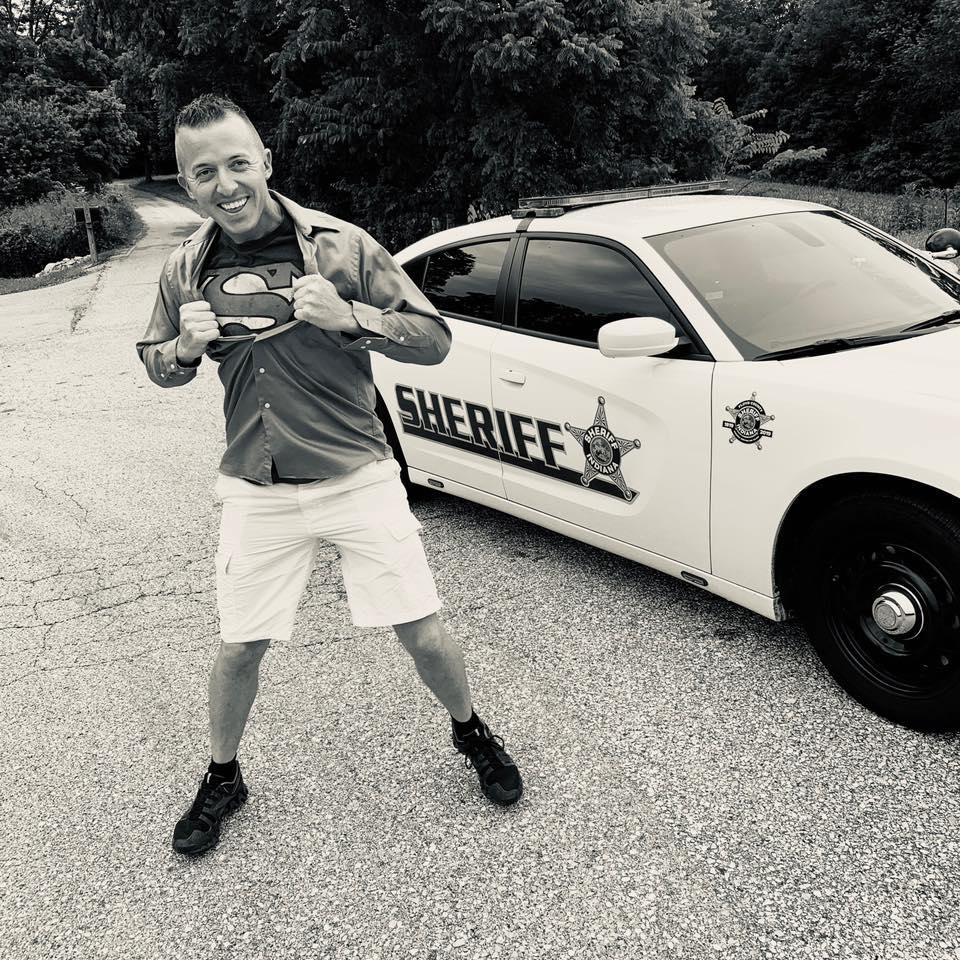
No joke: Alex Bilbrey will need to be Superman to beat Greg Phipps.

It's hard to imagine Bilbrey (R) breaking 40% of the vote in the 3rd council district against two-term incumbent Phipps (D); after all, the 3rd district is to pretend-progressive Kool Aid as Porto is to vintage port wine, and Bilbrey -- who registered to run at the last possible minute without the knowledge of his party's chairman -- has been all but invisible for the entirety of 2019.

Except for yard signs.


I've seen several, including one of the big honking signs behind my house at the auto repair shop, and this makes Bilbrey's CFA-4 campaign finance disclosures very curious.


Bilbrey reports that he has neither raised nor spent a dime.

How then did he pay for the signs?

No matter; never mind -- you know, like Gahan's platform.

Yes, conscience precludes a vote for either Bilbrey or Phipps, and this is why I'm supporting Thunder Over the 3rd.

Vote for Thunder the Wonder Ferret as a write-in for New Albany City Council District 3.

 ... Phipps does a fair to middling job of performing the duties of a purely average council representative. However, in political terms Phipps is profoundly weak, and he has done so very little on his own initiative that it comes down to a single consideration.

Phipps has supported Mayor Jeff Gahan roughly 95% of the time, and I've opposed Gahan by an equal percentage. The taint is real.

Consequently, I cannot vote for Phipps, who has been utterly non-intellectual in his persistent sycophancy. That's a shame. He could have been so much more.

But no.

He wasn't ... and isn't likely to be.

---

Roger's Endorsement Compendium:

Friday, September 20, 2019

Vote for Thunder the Wonder Ferret as a write-in for New Albany City Council District 3.

Thunder's campaign web site.

Call it an endorsement if you will, or think of it as my personal support, backing, seal of approval, recommendation or advocacy.

In making these 2019 election endorsements, I'm trying my best to focus on the positives, but the 3rd council district is my own, and positives are few and far between.

The incumbent is Greg Phipps (D), and the challenger is Alex Bilbrey (R). Phipps does a fair to middling job of performing the duties of a purely average council representative. However, in political terms Phipps is profoundly weak, and he has done so very little on his own initiative that it comes down to a single consideration.

Phipps has supported Mayor Jeff Gahan roughly 95% of the time, and I've opposed Gahan by an equal percentage. The taint is real. 

Consequently, I cannot vote for Phipps, who has been utterly non-intellectual in his persistent sycophancy. That's a shame. He could have been so much more.

Conversely Bilbrey's bizarre vanity/stealth candidacy is so problematic that it's hard to know where to begin dissecting it.

He's been almost completely invisible, and he has made no public indication whatever of core positions or policy preferences apart from platitudes about "service." Bilbrey has not attended events like the League of Women Voters' chat at the Silver Street Pleasure Dome. He doesn't seem to be taking his own candidacy seriously, so why should anyone else?

However, my biggest problem with Bilbrey is that he works for the sheriff's department, as does Scott Evans, the Republican candidate in 6th district -- who by contrast is a quality candidate and a campaigning dynamo worthy of consideration in that district.

True, it is not illegal for men and women with badges to occupy elected office; Jack Messer (city councilman) and Steve Bush (county commissioner) both did, and they are good people.

It's just a personal thing with me, and it's not about being anti-police. Rather, it has to do with worrisome accumulations of power. I believe being a cop and a councilman simultaneously is a concentration of too much power in one individual.

You're free to disagree, and my ears are open to your arguments against my position. I'd love to find a loophole in my conscience to include Evans, but so far it's elusive.

Conscience dictates that my only option in the 3rd district is to cast a write-in ballot. I'm open to suggestions in this regard.

John Smith, are you ready?

Steve Price?

Thunder the Wonder Ferret?

---

Compendium:


Saturday, May 11, 2019

Cars FAST, speed testing slooooow as Deaf Gahan looks forward to the year 2026 for traffic calming measures downtown.


The bookseller filed a report midday on Friday.

As many of us had expected the speed test on Spring Street has ended 3 days after the primary.

It took six months for HWC Engineering's deliberate abacus to register sufficient "results" which may or may not correspond with what we see with our own two eyes each day.

These "results" now will be compared to precinct vote totals to ensure Jeff Gahan's dwindling support isn't compromised by drivers infuriated at a two-minute delay to cross town.

But even as we speak, the speed pandering test has being shifted to Market and Elm Streets.


Came a follow-up over the wires yesterday.

I asked 'is the test over' and the contractor smirkingly said 'on THIS street.' It was as if he was counting his gold and shopping for a new bass boat.

But wait a minute. HWC Engineering surely is synonymous with gold in the mind of our wheeler-dealer Bunker Elvis.

The Jeff Gahan Money Machine, Part 1: Mysterious CRS Marketing and the inevitable HWC Engineering tie-in.


So, if a speed test is to be run simultaneously on both Market and Elm, that's another six months, which coincidentally takes us past the fall mayoral contest and into a presidential election year, when nothing further will happen because everyone's busy arming for the culture war.

Add on six month increments for another dozen streets, and we're far into Veneer King's fourth term -- he'll be drawing social security, we'll still be testing streets, the cars won't be moving any slower but every HWC Engineering employee, sub-contractor and their grandchildren will have copped a new bass boat.

Don't look at me, 3rd district "progressive."

I sure as hell didn't vote for him; you did -- and now you're getting exactly what you deserve, good and hard. Stick around until 2023, just before the primary, and 3rd district councilman Greg Phipps might be allowed by his handler to produce another miracle just like this one.

The four-way stop at Elm & 13th, and why openness and transparency matter.


Previously, back at the beginning of December, 2018, we took a closer look at how unreal this simple process can be in Anchor City.

Speed Thought Control: Board of Works, city engineer still unable to grasp reality when it comes to speedway street grid dangers, so they spout meaningless drivel.


Shouldn't they be fighting to implement safety measures, rather than making the sort of "we can't do nuthin' at all" excuses, just like this oldie but still goodie:

Summers said he does not think a stop sign or signal can be installed at Fourth and Spring because a traffic count would not warrant one. He said there is not enough traffic on any of the side streets, off of Spring, that would require a stop sign.

Jeeebus, Larry: then conduct the fucking traffic count as a prelude, and if the state's cars-first standards aren't serving the cause of walkable street grid safety, can't we fight against THEM, to do what's right for US, rather than dismissing safety because enhancing safety is too much trouble?

The verdict is fairly clear. Jeff Gahan has no intention of slowing cars downtown if doing so inconveniences drivers.

He's a dull-witted, car-centric suburbanite, and that's that.

Wednesday, April 10, 2019

There's a 4-way stop at Elm and 13th. The only question is whether it came with a ribbon.


Does this mean the forever variably apolitical Develop New Albany is endorsing candidate Phipps? Let's follow the Facebook sharing protocol of the presumed non-profits. First, from DNA back to ESNA.


Then ESNA to the source.


It's an election year, and candidate Phipps says he has been "working with the city for several months," as back-room and non-transparently as always, to get a 4-way stop at Elm and 13th.

Fair enough; it's been needed not for months, but for YEARS. After almost eight years of rubber-stamping City Hall expenditures, it's always good to achieve something.

So, ignoring the pertinent question of why Phipps took so long to work behind the scenes, and why his cherished overlord the mayor took so long to give his "superstar" BOW mentor Warren the okay to release this intersection just in time to become a nice pre-primary poll-boost, there’s an absolutely positive aspect to all this electioneering.

That's because the same Democrats who dragged their feet for months before making this needed change so a Democrat could take re-election campaign credit for it can no longer be the same Democrats resisting similar proposals (hint: 4-ways for Spring and 10th; for Main and Bank; rinse, repeat) because the statute of limitations has expired for the same Democrats who oft times before used the completely spurious excuse of a need for traffic studies and INDOT indulgences to avoid mustering the simple one-two cojones to do what's right.

All of which Phipps never questioned until his passive acquiescence to Gahan's hack job on Speck's plan produced tepid two-way street grid results.

But hear me out; this 4-way at Elm and 13th is genuinely important.

Finally a 4-way precedent has been set, so let’s hope future action to #slowthecars might someday occur when it ISN’T an election year.

Dude; that'd almost be PROGRESSIVE, wouldn't it?

Wednesday, July 25, 2018

Councilman Phipps meets the enemy -- and finds that they are him.

Several times in the recent past we've cast a flabbergasted glance at these duplicitous machines of sheer uselessness.


The "distracted pedestrian" is a myth, but distracted engineers and planners are another topic.


Neither City Hall nor HWC Engineering sees a problem with this mishap-plagued intersection. Maybe we should appeal to Floyd County government for help.


This means you: "STOP FUCKING DRIVING YOUR CAR AT PEOPLE."


At Strong Towns: "4 Reasons We Must Build Our Streets for People (Not Just Cars).


3rd district councilman Greg Phipps' first mistake was to accept Jeff Gahan's watered-down two-way street grid paving project without a substantive murmur, insisting all the while that to question mayoral authority was even more treasonous than breaking bread with Vladimir Putin.

A neighbor's social media post yesterday about those idiotic solar-powered pedestrian danger crossings puts it all into perspective.

Just throwing it out there: there needs to be a highly visible driver education campaign to teach drivers what this sign and signaled light actually mean. I pushed this button to turn on the light to signal drivers I wanted to cross the street, and had I proceeded, I would’ve been mowed down by nothing short of 10 to 12 cars. Drivers did not even hit the brakes. I think these are a great safety move and I am glad they were installed, but they will not be effective in actually protecting pedestrians until drivers are educated.

A respondent tagged the councilman.

Greg Phipps....any ideas? Or any changes that the city is planning on implementing?

Phipps:
I have mentioned this at least 5-6 times at council and board of works. They are unwilling to add signs in the middle of the street like at the high school :(

Citizen:
What about a public education campaign? It’s seriously a tragedy waiting to happen. I shudder to think if someone made the assumption the traffic would slow and stop. Or children growing up and learning to cross the street. Scary stuff. The street was actually safer without these lights installed. These provide a dangerous false sense of security.

Phipps:
There has been an article in the tribune, but very few read it.

---

Let's go back to this: They are unwilling.

Who are they, anyway?

Isn't Greg Phipps "they"?

Phipps is a Democrat. BOW is populated by Democratic Party appointees, and party appointees trashed Jeff Speck's street grid plan and installed these pathetic, non-functional pedestrian crossing sitting duck mechanisms. 

Phipps passively notes that no one reads the newspaper, and laments being ignored at Board of Public Works meetings?

Seriously?

They and them ARE he and him, one and the same. Phipps was elected to office with C-minus junta support, and has voted with the governing clique roughly 95% of the time. He's one of only nine councilmen (not a single woman) in the entire city, and yet he cannot determine a way to make his voice heard.

Instead, he merely whines in response, not unlike a lashed cur.

But he has the means at his disposal to make "them" listen, doesn't he? After all, he's one of them. Phipps' council vote has immense significance should he ever decide to wield it tactically.

Just imagine if Phipps' vote in favor of the Reisz city hall relocation boondoggle had been made conditional on his fellow Democrats actually DOING something about the pedestrian safety problem, rather than ducking, covering and kicking sand in his face.

A "no" vote on the Reisz Mahal's first reading in May, accompanied by some genuine spinefulness, might well have resulted in both of Phipps' desired outcomes: real-world safety measures on streets AND relief for the oppressed, inhumanely housed city workers. 

The election's next year.

Isn't it time for a change in the 3rd district? 

#EightIsEnough

Saturday, July 07, 2018

Psst, willfully snoozing DemoDisneyDixiecrats -- "We should be building cities for people, not cars."

Political captivity ribbon-cutting ceremony.

Zuegel's essay is uncommonly clear and well-written. Let's begin with the conclusion.

Walkability leads to better health outcomes, more affordable housing, and greater economic vitality. The best part is that easy, low-cost changes can go a long way in improving the options for how people move around their communities. Cities all around the country have begun to appreciate and capitalize on alternative modes of transportation, especially walking.

We still have decades of auto-dependent land use trends to offset, but small shifts in the way our received infrastructure is designed can go a long way to making our neighborhoods more walkable — and in turn healthier, more affordable, and more vibrant.

You can't espouse walkability if you're busy fluffing drivers.

In 2017, the city of New Albany unveiled a ballyhooed street grid improvement program, the major component of which was two-way street reversions. NA Confidential naturally supported two-way streets, but significantly, from the moment consultant Jeff Speck showed us what was possible in a city of this size, we opted for the Full Monty rather than dribs and drabs of incremental caution.

The expected benefits of two-way traffic have materialized largely as expected, but it should be obvious that by stripping away the majority of Speck's proposals pertaining to pedestrians and bicycling -- by focusing on the needs of drivers and their cars, and not humans pursuing other means of mobility -- Team Gahan stupidly negated vast portions of the potential good in favor of a glorified paving project.

The political ramifications of Gahan's car-centric failure are personified by 3rd district councilman Greg Phipps, who is too intelligent not to understand the truth, but so firmly caught up in the Gahan patronage web that he's reduced to weakly flailing during council meetings amid protests of the sad restraints posed by political impotence -- this position of powerlessness being willingly chosen by Phipps from the beginning in exchange for occasional (and unprincipled) lip service from Gahan toward an imaginary municipal social policy.

The political flaccidity of city council's inexorably shrinking DemoDisneyDixiecratic rump is a topic for 2019, when we'll roll up our sleeves and make badly needed change. For now, let's return to Zuegel's excellent statement of planning principle.

WE SHOULD BE BUILDING CITIES FOR PEOPLE, NOT CARS, by Devon Marisa Zuegel (Strong Towns)

The way we live is shaped by our infrastructure — the public spaces, building codes, and utilities that serve a city or region. It can act as the foundation for thriving communities, but it can also establish unhealthy patterns when designed poorly.

Zuegel opens with the example of San Francisco's Embarcadero Freeway, destroyed by the Loma Prieta earthquake in 1989. Nature did what humans said they could not possibly do: remove the freeway, to be transformed into an urban boulevard and street car line. Comparisons to Louisville 86-64 are purely intentional.

Thus, the central point.

Unfortunately, America’s inherited infrastructure is more like the old Embarcadero Highway than the boulevard that replaced it. Urban planners spent the 20th century building cities for cars, not people, and alternatives to driving have been systemically undervalued. This legacy has resulted in substandard health outcomes, missed economic opportunities, and a shortage of affordable housing.

The article is too extensive to adequately recap in this space, so I'll emphasize this section and strongly encourage you to click through and absorb the whole.

OUR INFRASTRUCTURE IS MAKING US SICK
The American health care crisis is, at its heart, an urban design crisis. To get a sense for the toll our car-centric infrastructure has taken on our physical and mental well-being:

  • Car fatalities have killed far more Americans than all of our wars combined.
  • Commuting by car ranks as people’s least favorite regular activity.
  • A 23 minute driving commute has the same effect on happiness as a 19% reduction in income.
  • For every extra 5 minutes Atlanta residents drive each day, they are 3% more likely to be obese.

“Doctors focus on remote disease risks, but what really kills us is our built environment," explained Dr. Richard Jackson, a physician who served for 9 years as the CDC’s Director for Environmental Health. People who walk, bike, or take some form of mass transit to work weigh less, live longer, and have lower divorce rates than commuters who drive. They also have lower rates of depression, more free time, and a more robust social life.

Despite its costs, driving remains the most common mode of travel in the US, at around 85 percent of commuting trips. One out of six workers commutes more than 45 minutes each way, and private vehicles account for 60% of trips a mile or shorter. But it’s not drivers’ fault; rather, our infrastructure encourages — and in many cases forces — us to depend on cars. Our communities are built at the scale of highways rather than humans. Expressways slice through neighborhoods, and widened streets prioritize the flow of cars over making it worth traveling to their destinations. In the 1950s and 60s, large scale demolitions were commonplace in order to make way for fast moving motorized traffic, and communities from New York to Los Angeles have never fully recovered.

People choose to drive despite its costs because they lack reasonable alternatives. Unfortunately, this isn’t an accident of history. Our transportation system has been overly focused on automobile traffic flow as its metric of success. This single-minded focus has come at the cost of infrastructure that supports alternative ways to travel. Traffic flow should, instead, be one goal out of many. Communities would be far healthier if our infrastructure actively encouraged walking, cycling, and other forms of transportation rather than subsidizing driving and ignoring alternatives.