Sunday, February 25, 2018

LIVE TO EAT: Read my stories about Chef Space and Tito's Handmade Vodka, and grab the latest issue of Food & Dining Magazine, out now.


The Spring 2018 (February/March/April) issue of Food & Dining Magazine is out, and once again, I have two articles in this edition. You can read them at issuu.

"Chef Space: A Kitchen Incubator (and a community venture)" is a featured profile.

What exactly is Chef Space?

“We’re Louisville’s only non-profit kitchen incubator, dedicated to helping early stage entrepreneurs launch their food-based businesses,” explains Andrew Held, vice president of operations.

Christopher Lavenson is the president of Chef Space, and he proceeds to a bigger picture.

“We’re part of a larger revitalization project, and this basically is an engine to create jobs through food entrepreneurship.”

Regular readers will recall this post, which was one of the blog's most-read in January.


A kitchen incubator is the sort of idea that might work in that big building at 336 Pearl Street.


In a little over two years since opening, 13 members have "graduated" from the Chef Space incubator to their own bricks and mortar. Another is about to do so, and I took a look at V-Grits just last week: THE BEER BEAT: V-Grits, False Idol Independent Brewers, their bricks 'n' mortar vegan brewery in development.

Food for thought, indeed.


My second contribution to the current issue is an e-mail interview with Bert Beveridge, founder of Tito's Handmade Vodka.

In recent years vodka has exploded past all former limitations of national origin and price point to become as diverse and specialized as any other type of tipple, but aside from waffle-flavored vodkas distilled according to ancient Druid techniques, exactly how did a regular guy from Texas create a craft vodka that recently toppled the perennial powerhouse Smirnoff as America’s number one spirits brand, hurdling other famous names like Bacardi, Jack Daniels and Jose Cuervo, and in the process completely reordering the American vodka hierarchy?

I’m speaking of Bert “Tito” Beveridge and his creation, Tito’s Handmade Vodka, which dates to humble beginnings two decades ago in Austin, Texas.


I hope readers enjoy these profiles, which will be reprinted at NA Confidential in text format once the next issue of Food & Dining (Summer 2018) is released in May.

Later this week I'll get around to doing this for the previous two profiles I wrote: Waylon's Feed & Firewater and Akasha Brewing Company, both from Winter 2017.

As a side note, diligent readers will recall my work on a feature-length exploration of the exploding restaurant and bar scene in Jeffersonville. For various reasons this piece has been delayed, but I'm hoping it will resurface some time in 2018.

As always, thank you for reading.

The late Billy Graham: "Lying to the young for a living."


At the 1:21 mark of this video clip from 2007, Christopher Hitchens observes that any American president, however deserving of condemnation or impeachment, always could rely on Billy Graham to run to his side as a defender, toady and crony.

Son Franklin has filled those shoes capably with regard to Donald Trump, hasn't he?

Long-time FFRF foe and state-church opponent Billy Graham dies (Freedom from Religion Foundation)

... Anti-Semitism was not Graham’s only vice. He also worked to destroy our secular government. Graham helped corrupt America’s secular foundations by riding the wave of religious fervor in the 1950s, which brought with it “under God” into the Pledge of Allegiance, the Capitol prayer room, and “In God We Trust” as a national motto.

The National Day of Prayer is set by federal statute, Public Law 82-324, which was passed in 1952 at the direct suggestion of Graham to help bring “the Lord Jesus Christ” to the nation. “What a thrilling, glorious thing it would be to see the leaders of our country kneeling before almighty God in prayer,” Graham proclaimed. FFRF’s major challenge to the National Day of Prayer uncovered the forgotten history of Graham’s role in this troubling, theocratic act by Congress.

Several years ago, Graham passed the reins of his religio-economic empire to his son, Franklin, who has turned out to be even worse than his father. Graham leaves behind a legacy that has severely damaged our Constitution and the wall of separation between state and church. FFRF will continue to work to undo this legacy.

You can count me out of any paeans of praise for Graham.


Billy Graham: An Old Soldier Fades Away
, by Cecil Bothwell (Common Dreams)

An Obituary

... Based on that Biblical mandate for all governments, Graham stood in solid opposition to the work of Dr. Martin Luther King, Jr. In his Letter from Birmingham Jail, all but addressed to Graham, King noted, "We should never forget that everything Adolf Hitler did in Germany was 'legal' and everything the Hungarian freedom fighters did in Hungary was 'illegal.' ... If today I lived in a Communist country where certain principles dear to the Christian faith are suppressed, I would openly advocate disobeying that country's antireligious laws. "

Fear is the stock in trade of most evangelists, of course, comprising the necessary setup before the pitch. As historian William Martin explained in his 1991 account of Graham’s early sermons, “... even those whose personal lives seemed rich and fulfilling must live in a world filled with terror and threat. As a direct result of sinful humanity’s rebellion against God, our streets have become jungles of terror, mugging, rape, and death. Confusion reigns on campuses as never before. Political leaders live in constant fear of the assassin’s bullet. Racial tension seems certain to unleash titanic forces of hatred and violence. Communism threatens to eradicate freedom from the face of the earth. Small nations are getting the bomb, so that global war seems inevitable. High-speed objects, apparently guided by an unknown intelligence, are coming into our atmosphere for reasons no one understands. Clearly, all signs point to the end of the present world order.

“... Graham’s basic mode of preaching in these early years was assault. ... Then, when he had his listeners mentally crouching in terror, aware that all the attractively labeled escape routes—alcohol, sexual indulgence, riches, psychiatry, education, social-welfare programs, increased military might, the United Nations—led ultimately to dead ends, he held out the only compass that pointed reliably to the straight and narrow path that leads to personal happiness and lasting peace.”

Saturday, February 24, 2018

Rest in peace, Hugo (2002 - 2018).

No tolls ... circa 2011.

ACT I, by Diana


The early days ... circa 2003.

Stories can seem too personal to tell, but I find myself moved to expose a rare moment of vulnerability, and to share a deeply personal story of my first maternal relationship.

As some of you know, I passionately work with folks who cope with serious symptoms of mental illness, and I cannot express how much my life has been touched all the more for it. A case in point came on a very rainy September day in 2002, only three months after my mother passed.

As typical, I arrived early to work, second only to the receptionist (and my neighbor) Creighton. I immediately was greeted by one of my clients, who was obviously very distressed; he was holding a soaked backpack and seeking urgently to see me. I proceeded to let him inside, out of the rain, and guided him to my office to offer some support.

He unleashed a torrent of information about how a woman from his apartment complex had been evicted, taking with her the cat which had just given birth to kittens, but leaving behind the newborns.

The other tenants, trying to be conscientious, had attempted to care for these feral souls through the warm months, but only one kitten from the litter had survived. Now he was five months old.

This brave little beast had been brought inside my client’s home during the previous night because of the first cold rain of the season, only now the kitten was deemed by the client to be possessed by demons -- and needed disposing of.

My client knew the command was a symptom of his illness, and he wanted the kitten to be removed from his existence right away. So it was that a malnourished, flea-infested, dirty, scrawny, timid, buff tabby landed on my desk, and my client quickly exited the premises with much relief.

In keeping with my personality, this turn of events wasn’t a problem. There’d be a solution, and I would find it. I began making community calls to shelters, vets, animal activists, etc. I sent e- mails to cat lover co-workers and friends.

By lunch … nothing.

It is noteworthy that Creighton was a friend as well as a co-worker, and she’d been keeping a close watch on me since my mother passed away. Throughout the morning, Creighton gently suggested that the male kitten’s chances were slim, repeating a mother’s words: “things happen for a reason.”

They do. It took until afternoon, and this placid being sitting on my desk never moved, watching in peace and solitude, waiting, until I accepted his offer of life companionship.

On that day in 2002, the drive home cost me close to $500 to get the kitten cleared to enter my apartment safely. At the time, $500 seemed like a million dollars, and yet it taught me that the return can be vastly greater than the initial investment.

On Thursday night we lost Hugo, the abused and disheveled kitten -- my little gay opera singer. I am devastated but so grateful to have been witness to most of his life’s entirety. It’s such a gift having pets.

---

ACT II, by Roger


The lion in winter ... February, 2018.

We returned from our wonderful trip to Portugal to discover that our beloved cat Hugo had left us. At some point on Thursday evening, he curled up on the floor and passed away at 16 years of age. That’s 80 in human years.

Diana already has related the story of how Hugo originally found his way to her as a kitten. Shortly thereafter, when I came onto the scene, her new companion cat wasn’t always sure about the suitability of a freshly arrived boyfriend.

This undersized, emotive, though ultimately gentle creature immediately fashioned himself as Diana’s protector. In Hugo’s mind, he was a mighty lion, not a tiny tabby. Granted, I had him by at least 250 pounds, but the truth is he had me -- by the heartstrings.

Diana and I would be in bed, and at some point I’d look up to see Hugo perched vigilantly on the dresser, bearing the famous cold glare later deployed to such great effect in his best known role, the No Tolls Kitty. I knew I’d have to work to win Hugo over, and eventually he relented, except one thing never changed: he remained Diana’s right-hand feline, from start to finish.

One way I endeared myself to Hugo was by diligently curating his litter box, where he spent as much quality contemplation time as any American male, albeit without magazines, a cell phone or an ashtray.

The litter box was Hugo’s refuge and sanctuary, and perhaps the springboard for his eccentricity … and boy, did Hugo have an outsized personality far out of proportion to his diminutive stature.

For one, no cat ever was more proud to display his immaculately groomed butt.

Often at night we’d hear Hugo shoveling industriously in the litter box, followed by what we imagined were conversations with ghosts of cats past in this century-old house, or maybe the performance of uncommonly tuneful arias from his previous life as a stage cat in the opera.

Hugo made regular, watchful patrols of the upper floors, and having learned early on to push nearby human buttons at every opportunity, he delighted in repositioning his water dish to trip us nocturnally.

Never a lap cat strictly speaking, Hugo nonetheless functioned as Diana’s personal space heater during the cold weather months. Once she was settled, he’d find a sweet spot on her side, and as long as she didn’t move, neither would he.

As Hugo transitioned into his dotage, the elemental quirks became even more delightfully crotchety. The pale fluffy fur that attached to every surface like Velcro got thinner. He slept much more, and he hung closer than ever to Diana. We commented about how he seemed needier.

I grew up in the country, and I’m still convinced that animals know the cosmic score the way humans did once, before we became sophisticated enough to imagine we might stave off mortality. With the approach of spring, I think Hugo sensed the bell beginning to toll.

We’re sad, and we’re grieving, but we also know that once those first few challenging months passed, Hugo enjoyed as loving and rewarding a life as any cat ever has on this planet. His own stay here ended where it should, right at home, amid comforting and familiar surroundings.

Goodbye, Hugo.

Not really a caption contest as Gahan and Duggins bond over light beers.


Social media has delivered a clear verdict: That Kid for Mayor 2019.

"In a high chair, texting, and throwing back."

And this:

"At least the child has the proper glassware for his water."

The hits keep coming.

"Tastes great!"

"Less filling!"

Or maybe it's better this way:

Beer: no taste

Drinkers: no filling

Topically speaking ...

"I just bought 5 new tasers. You can get 'em cheap online."

But the best comment of all comes to us from Michael Wimmer, whose WE Studio preceded Hull & High Water at 324 E. Main Street.

I guess all I had to do was sell the studio to someone selling lite beer to have Gahan stop by.

Damn. The truth hurts, doesn't it? Thanks, BM, for a gift that will keep giving far into the 2019 campaign season.

Public art: Is it Funchal (Madeira) or New Albany (Indiana)?


Duh -- of course it's Madeira; there ain't no palm trees in Nawbany, but apparently when David Duggins became enamored with the imagery of Anchors, he didn't bother with a trademark.

Note this shop in Porto.


Back in Funchal, we found no shortage of public art in Zona Velha. It's the city's "old town," with some buildings dating to the 1500s. These days Zona Velha is Funchal's restaurant district.

As you look at these photos, just think about the possibilities when art bubbles up from the grassroots, rather than being dictated by higher-ups.


A reminder: Funchal is the capital city of Madeira, which is an archipelago in the Atlantic Ocean west of Morocco. Since 1976, Madeira has been an autonomous region of Portugal.

Banned at 312 Bank Street? Or, "Courage: The Greatest of Virtues."


While I'm an unapologetic creature of the left, whenever my friend Ken thinks a column by Jonah Goldberg might interest me, he forwards the link.

Obviously I tend not to agree with every point made by the National Review's senior editor, and sometimes with none of them, but usually there are ample thought-provoking nuggets.

So it is with this installment, which includes ruminations about empathy and cowardice, and words and dictionaries ...

The truth is that I don’t object to new words or even new meanings being breathed into them. I know that will happen. What bothers me is that no one seems to appreciate that the new meanings destroy the old ones for all time, and sometimes those meanings are worth keeping.

... as well as a central observation about honesty.

The only real litmus test for me is whether you take a position because you think it will advance conservative ends and that you are making your argument for it in good faith — i.e., that you’re not lying. Telling the truth is a form of courage, arguably the first form, and courage is the greatest of virtues.

Goldberg quotes Kevin Williamson, who also is speaking about conservatism.

And we should be ashamed of ourselves if we come to accept this kind of dishonesty in the service of political expediency. If conservative ideas cannot prevail in the marketplace of ideas without lies, they do not deserve to prevail at all.

This applies on my side, too.

Here in New Albany, local Democrats fancy themselves as somehow "left," though seldom willing to explore the actual perimeter. As I await their decision to display some/any merchandise at the party's vending stall in the marketplace of ideas, it strikes me as ironic that Jeff Gillenwater made mention of all this just the other day.

I’ve lived in New Albany, Floyd County, Indiana for more than a decade now. Throughout that entire tenure, the local Democratic Party has staunchly refused to take any position on any local issue. Save the occasional jab at a local or state Republican, they have focused almost entirely on federal issues. To the extent that any locals have raised concerns about that, they’ve been derided as unreasonable malcontents and radicals. Now that the party has a federal candidate who’s been asked about local issues, though, a lot of the very same people insist that strict jurisdictional guidelines must be followed; locals should only respond to local issues, federal responds only to federal, etc.. If these people get any more hyper-hypocritical about all this, we’re going to have to find a new way to measure such things just to try to keep up.

Fewer lies, more courage. Not exactly earthshaking, and not to mention probably impossible for so long as Adam "The Muzzler" Dickey's calling the party's neutered shots, but it would be pleasant for a change to read about ideas from Gahanites.

Do they have any?

The link: Courage: The Greatest of Virtues, by Jonah Goldberg (National Review)

Friday, February 23, 2018

THE BEER BEAT: The twentieth Gravity Head begets a Pints & Union update.

The beginnings of a bar. 

The siding begins.

It wasn't until a few days prior to our recent departure for Portugal that I remembered February 23 was the beginning of Gravity Head.

Ladies and gentlemen, the inimitable Tony Beard.

It's the 20th such celebration, and during the first 17 of them, I usually was busy tending to the birth, right up until the curtain parted.

There is background in this column from 2016.

ON THE AVENUES: Gravity Head again, because times change, and possessive pronouns change with them.

For so many years, I’d do the ordering and stashing; write, rewrite and publish the program; disseminate the propaganda; rig tap handles; produce signage; and count glassware … and by the time all of it was ready, it felt like I knew each one of those kegs personally. Farmers must feel that way when they take their piggies to market.

I am compelled to make this link because it turns out that the managing editor of Indiana on Tap didn't even know about Gravity Head until this year, and in three articles (1, 2, 3), my name doesn't come up even once.

That's just fine by me.

Mark Lasbury does an excellent job of describing what Gravity Head looks like to the uninitiated (bizarre insanity), so take it to the bank: what makes me mildly  churlish isn't the absence of personal recognition, but the fact that beer history is routinely neglected these days -- and there's a lot of history to Gravity Head.

In point of fact, while I may be a Session Head these days, I'm damned proud of it.

The verdict: maybe I've been away long enough, and it's time for a comeback. In this vein, here's an update about the emerging Pints & Union project.

First, a few links.

ON THE AVENUES: Golden oldie classic comfort beers at an old school pub? Sounds like Pints & Union to me.

SHANE'S EXCELLENT NEW WORDS: On taverns, pubs, Gaststätten and Bung -- with a Mencken chaser.

THE BEER BEAT: "Pints & Union to open in New Albany, will be inspired by classic European pubs."

The News and Tribune piece appeared as we arrived in Porto. I toasted it with an ice-cold Super Bock, about which there'll be more to say as the jet lag dissipates.

Future New Albany pub about the classics and conversation, by Danielle Grady (N & T)

NEW ALBANY — Joe Phillips and Roger Baylor both have experienced the thrill of being on the cutting edge.

Phillips, a 27-year veteran of the service industry, has helped set up trendy Louisville favorites, such as Copper & Kings and The Butchertown Social. Baylor was an original founder of the New Albanian Brewing Co., which effectively introduced craft beer to Southern Indiana.

The latest brew they’re whipping up for the Louisville area is about going back to the comfortable basics: a United Kingdom-inspired pub with classic drinks and no televisions, planned for the former Vickie’s Good Times Bar & Grill at 114 E. Market St. in downtown New Albany. The building's interior and exterior are being completely renovated.

Pints & Union will likely feature eight taps, curated by Baylor, with five that he plans to keep the same all the time. So far, he knows of three beers that the bar will definitely provide: a Guinness stout, a Pilsner Urquell and a Fuller’s London Pride — all fairly standard, historically speaking. The beers won’t possess crazy high alcohol contents, either, with most staying around 5 percent.

It’s a little different than the constantly rotating taps and beer choices embittered by hops that Baylor’s focused on in the past ...

You CAN go home again -- and Taco Steve is moving in mid-March to NABC Bank Street Brewhouse.

Last week's sneak preview.

In case you missed it, there was a big announcement last week, and as previously revealed, there already was a reshuffle under way amid the downtown New Albany restaurant and bar scene.

Before linking to media accounts of Taco Steve's "coming full circle" relocation, let's recap.

Stacie Bale, late of NABC, reveals new project: Roadrunner Kitchen, coming soon to 145 E. Main Street in downtown New Albany.

Bale, late of Earth Friends Café, had operated the NABC downtown front-of-the-house since early 2015, just after I announced my impending departure from the business.

As a side note, there'll be more to say about my buyout status next week, when I finally should have positive news to report.

With Taco Steve moving to the (once again) Bank Street Brewhouse, there's a vacancy at the Destinations Booksellers incubator. I'm told we'll be seeing action on that front very soon.

Dragon King's Daughter has an impending ATC permit date, and should be moving soon to its new location on the corner of W. 1st and Market.

Also being readied for a spring launch is Longboard's Taco & Tiki, from Ian Hall and his Brand Hospitality Group (302 Pearl Street).

Finally, Joe Phillips and I continue work toward the establishment of Pints & Union at 114 E. Market Street.

Now, read about the homecoming of Stephen Powell.

Bank Street Brewhouse will soon have Mexican food as Taco Steve moves in, by Danielle Grady (News and Tribune)

NEW ALBANY — After two years of steady growth at Destinations Booksellers in downtown New Albany, Taco Steve is making a move to a different kitchen.

“It’s just a matter of I feel like I’ve kind of outgrown the kitchen where I’m at in the bookstore,” said Stephen Powell, the owner of the popular Mexican-inspired lunch spot. “I love it here, don’t get me wrong. I really enjoy this environment, but we’ve kind of got to move up and on.”

Powell’s destination is the New Albanian Brewing Company’s Bank Street Brewhouse — less than a mile down the road from his current spot. Powell, who worked for the New Albanian on and off from 1989 until he opened Taco Steve, will be replacing the brewhouse’s current in-house menu of burgers and “bar bites” with his own food ...

And:

Boomerang effect: Taco Steve to relocate to Bank Street Brewhouse, by Kevin Gibson (Insider Louisville)

... Powell said he will roll out new menu items slowly, and that the popular tacos mexicanos deal of two tacos and a side for $7.50 will continue.

When Taco Steve reopens, he said, it will probably four days a week — Tuesday and Thursday through Saturday, 11 a.m.-10 p.m. Eventually, days will be added, along with a planned Sunday brunch.

Coffee break's over, so let's begin by commending Team Gahan for modernizing the city's pumping plants.


"As often as I criticize the current administration, when the rains come like this I do remember that Mayor Gahan had the flood pumps rebuilt and/or replaced. That was a good thing because those pumps were old."

Every day not every now and then.

From afar, we've been following the rising waters, and what Mark wrote yesterday at Facebook is true without qualification. An amphitheater enveloped by flood waters is exactly why we have a levee and flood wall, and making sure the city's part of the deal is up-to-date and functional is the job of any mayor. Previous occupants didn't see the need, so let's give credit where it's due.

There is much more to report; all in due time. It's good to be home.

Photo credit: Joey Ward.

Thursday, February 22, 2018

ON THE AVENUES REWOUND: Money is the ultimate bully (2015).

ON THE AVENUES REWOUND: Money is the ultimate bully (2015). 

A weekly column by Roger A. Baylor.

I'm on vacation, so this is a rerun from August 7, 2015, when I was waging an ultimately unsuccessful bid for mayor of New Albany as an independent candidate.  Two and a half years later, I'm finding that much of my material has worn quite well, hence the encores. 

Don't forget: #FireGahan2019

---

New Albany is a city of 37,000 residents. Not even 1% of them bicycle to work. The poverty rate is 23%, and incumbent mayor Jeff Gahan came into the year 2015 with almost $100,000 in his re-election fund.

He’d have spent some of it during the primary season, and surely raised more since then.

That’s a lot of money, isn’t it?

Do you ever wonder where it all comes from?

For $100,000 to have come entirely from New Albany, every voter opting for Gahan in 2011 already would have donated at least $22 to his 2015 campaign. One needn’t be a card-carrying cynic (like me) to know this has not been the case, and I’d wager that less than 20% of the mayor’s total take has come from “just plain folks” locally.

Speaking in broader terms, we needn’t bother examining Gahan’s financial filings with a magnifying glass in order to make educated guesses about the sources of the lucre.

$50,000 or more probably has come from elsewhere, whether Indianapolis, the Magic Kingdom or the Canary Islands, by way of various PACs and Democratic Party funding sources. In addition, there are certain to be significant chunks from those engineering, contracting and construction firms commissioned to erect Gahan’s many gleaming palaces by means of taxpayer money.

Did I say gleaming palaces?

I meant TIF-bonded, plaque-ready building projects. They’re pictured on the flash cards Gahan holds aloft at every opportunity, although where I grew up, things can’t be classified as “gifts” when the giver used your credit card to pay for them.

Since 2012, the good times have rolled and many beaks have gotten nice and wet. Randomly adding together Bicentennial Park, the farmers market buildout, Main Street beautification, parks and aquatic center bonds, Coyle site sewer fee waivers and the accompanying corporate TIF welfare handouts, special event equipment rentals, overtime and an expense account luncheon here and there, Gahan has spent well north of $30 million since January 1, 2012, on wants, as opposed to needs.

It’s probably closer to $40 million … and I forgot the drive-to-only dog park.

$40-odd million.

That’s a lot of money, isn’t it, and it helps to explain the familiar cycle of campaign funding, doesn’t it, and as a longtime blogger, independent mayoral candidate and fairly well-read fellow who also enjoys sitting at the bar and nursing a beer, is it somehow my fault that I possess the ability to bring all this to your attention in an educational and entertaining way?

Am I forcibly seizing the bully pulpit? Using the tools at my disposal? Deploying guerrilla tactics against a well-heeled, unscrupulous opponent?

Of course, all the while hoping there still exists a modicum of free speech, allowing any of us to mount that soap box and let it rip – and to toss a hat onto the ring, file petitions, do paperwork, amass a scant pittance of campaign contributions, mount an insurgency against a man who has held elective office for twelve years, who has $100,000 burning a hole in his pocket, and what’s more, possesses a slick publicly-financed social media stream disseminating shameless re-election materials daily under the shabby guise of civic news -- and lest we forget, flaunts a local Democratic machine faithfully at his side, one ready to transition the incumbent as an Indiana Senate hopeful at the drop of a few hundred thousand bucks.

Let's try to be adults. Even this heretic knows that Goliath was the big bad bully, and not the dude with the spot-on slingshot, and accordingly, I’ll continue to speak and write openly about the way things are in New Albany, because when it comes to underdogs, sleepers, dark horses and the man in Tiananmen Square blocking a column of tanks with his briefcase, you won’t find any of them in the $100,000 mayoral suite overlooking one-way Spring Street.

And that’s exactly the way I like it.

Like sands through the hourglass, so are the hundreds of thousands of millions of dollars comprising New Albany’s debt, but what the hey -- it’s the way American politics work, all disgusting and horrible when Republicans do it, which is why Democrats do it, too. Meanwhile, 44% of African-Americans in New Albany live below the poverty line … and 100% of Gahan’s out-of-town sugar daddies remain unaware of this fact.

---

Four years ago, Jeff Gahan and I got together. He held a grudge over my participation in an abortive lawsuit intended to compel unwilling city council members to redistrict fairly, a reform Gahan helped shoot down, but heeding advice to be a good soldier and work within the Democratic Party system, I parleyed.

Over coffee, we spoke about what we viewed as important for the city’s future. On my list were topics familiar to anyone who’s been reading this blog since 2004, including two-way streets, rental property registration, slumlord abatement, ordinance enforcement, economic localism and historic preservation. He seemed to be in agreement, and I supported his candidacy as a result.

Obviously, Jeff Gahan won the election.

Obviously, Gahan hasn’t followed through on his promises to my satisfaction – and I’m not the only one who feels this way.

Obviously, I believe he has turned out to be an absolutely lousy mayor. If I believed otherwise, would I be running against him as an independent?

Hence, my point: When I say Jeff Gahan is a lousy mayor, either aloud or in written form, and at times with pictures, some of them artistically altered so as to be funny, it’s hardly character assassination. Rather, it is an ongoing dialogue, and an argument constructed with concepts, ideas and evidence in addition to the wit and snark. In 2015, it’s also a political campaign, and as such, it is a milieu that each candidate has accepted as part of the game.

Of course, several of us have gone to great lengths, fairly often and for a very long time, to explain in excruciating detail why Gahan’s decision-making process is faulty, how we’d have done it differently, and what we might yet do to reverse the mistakes and make things better.

Here is one recent example.

Gahan’s corporate welfare bursar is David Duggins, although his official title is the increasingly improbable “economic development director.”

Duggins is fond of using words like “ripple effect” to describe Reaganite-style “trickle down” Hail Mary plays in cases like the Coyle site upscale luxury apartment development, in which the city of New Albany will pay one-third the price of a private company’s $15 million investment, devoting taxpayer dollars to mitigating the private company’s risks, these being magnanimous guarantees unavailable to dozens of homegrown entrepreneurs and investors.

One “ripple effect” of the Coyle site deal, which Duggins himself has referred to as mere “boilerplate,” is that it neatly closes the circle of campaign finance (see above).

But to me, these unfortunate “ripple effect” references better describe the many negative ramifications of Gahan’s bad Coyle site decision, above and beyond “just” losing the $5 million in corporate welfare handouts being thrown at Flaherty Collins.

For one, it sends a dreadful message to stakeholders in perennially neglected neighborhoods a mere stone’s throw away, which can be read in the smirk on Duggins’s face:

“Relax, folks. Trendy bocce ball access is on the veranda, with Mojitos and the best internet service in town, and these amenities matter far more than taking the time to curb the slumlord or revert the one-way street, actions that would increase your property values, reduce crime and enhance your quality of your life. Just be patient and wait for the ripple effect, because we’re sure the high rollers won’t forget the gratuity when you’re finished picking up after them. After all, they’re the right kind of people.”

The underemployed single mother in a shotgun house?

She must have forgotten to make a campaign donation.

Furthermore, the Coyle site subsidy represents five of 40-odd million questionable decisions, each one representing opportunity costs, lost chances and squandered potential. The money might have been spent on projects and programs designed to address genuine fundamentals of the sort calculated to spread the risks, spread the rewards, nurture the grassroots, and help lift the many rather than stroke the few.

However, far too often Gahan’s “investments” have not been directed toward these goals, and this isn’t my idea of what quality municipal government does. Perhaps it is yours, in which case I’d recommend voting for the mayor’s re-election, because in the end, that’s how elections are supposed to work.

They’re not enthronements. Ideally, they represent choices, and that's precisely what I aim to provide in 2015. If Jeff Gahan cannot keep up, it isn't my problem.

So, let’s be crystal clear: We rage against the current mayoral machine because the machine is the bully in this equation. To think otherwise is to practice the sort of enduring self-deception and intellectual debasement that have characterized Democratic machine politics in New Albany for so very long, and which prevent this city from reaching its potential.

I believe there are alternatives to the same tired civic rituals, practiced by the usual underachieving political suspects, and which come down to these three priorities:

Infrastructure
Empowerment
Transparency


Broken down a bit further, I’ll close the column today with these ten bullet point Baylor for Mayor platform planks.

Infrastructure upgrades and management
Quality of life by two-way design and ordinance enforcement
A sane and sustainable budget
Historic preservation and greening
New Albany’s economy comes first
Equal governance and level playing fields
A deep personnel cleaning of City Hall
Internet connectivity as infrastructure
Transparency and governmental communication
Human rights as non-negotiable mandate

Next week, I’ll elaborate on these points.

---

Recent columns:

February 15: ON THE AVENUES REWOUND: No more fear, Jeff (2015).

February 8: ON THE AVENUES: Golden oldie classic comfort beers at an old school pub? Sounds like Pints & Union to me.

February 1: ON THE AVENUES: Did you hear the one about Duggins' deep TASER regrets? I laughed until I cried -- and so did the folks in Keokuk.

January 25: ON THE AVENUES: David Duggins’ violent “jokes” will continue until the New Albany Housing Authority’s morale improves – or Duggins is fired. We advocate the latter.

Focus on Portugal: The characterful and historic azulejo tiles of Portugal.


I don't remember much about my first trip to Portugal in 2000, but the country's ubiquitous azulejo tile murals and decor have always stuck with me -- like the reaction I had upon arrival at the Pinhão Railway Station.

Pinhão Railway Station is a beautiful train station along the Douro Line, one of the most iconic rail journeys in Portugal. The station is a major tourist destination in the Alto Douro Wine Region. The first train arrived at the Pinhão Railway Station on 1 June, 1880, and for nearly one hundred years the station served as the primary transport site of people and goods into and out of the Douro Region. It was particularly important in the production process of the Douro Valley’s Port wine.


That's right; as incredible as it seems, the beautiful tile work is at a train station.

A Brief History of Portugal's Beautiful Azulejo Tiles, by Nina Santos (Culture Trip)

Azulejos date as far back as the 13th century, when the Moors invaded the land that now belongs to Spain and Portugal, but they secured their foothold in Portuguese culture between the 16th and 17th centuries. The word azulejo stems from Arabic roots, meaning ‘small polished stone’. Originally they were fairly simple structures cut into geometric shapes in neutral tones.

It wasn’t until Portugal’s King Manuel I visited Seville and brought the idea back, that Portugal truly adopted this artwork into its culture. The tiles were used to cover up the large areas of blank wall that were common inside buildings during the Gothic period.

Antique azulejos were decorated in a simple color palate, dominated by blues and whites. It is believed that these colors were influenced by the Age of Discoveries (15th – 18th centuries) and considered fashionable at the time. The other colors that appeared were yellow (sometimes looking gold) and green ...

Wednesday, February 21, 2018

Portugal Trip 2018 (9): History, sandwiches, sunsets and craft beer on the final day in Porto.


I've prefaced the travel narrative of our visit to Portugal (which has been backdated) with a series called Focus on Portugal, which provides background on a European destination that's scandalously little known to Americans. Previously: "Portugal Trip 2018 (8): Beach, park and cemetery, with a few Spanish beers and tapas."

It was Wednesday, February 21, the ninth and final day of our visit to Porto, and it dawned with the promise of being sunny and warm. There were several items on the sightseeing agenda, and we were determined to bind these loose ends.

For the second morning in a row, breakfast was taken at Sabores da Invicta, a family-owned and operated cafe located where Rua Flores merges with the square called Praça de Almeida Garrett. The cafe faces Sao Bento train station right across the street, but there weren't many tourists amid the morning crowd either day.


There are dozens -- nay hundreds -- of cafes in this approximate model scattered throughout urban Porto. They serve varied baked goods and sweets with coffee in the morning; light sandwiches in midday; a beer or glass of wine; and more coffee or tea throughout the day. These cafes are civilizing institutions.

Duly fortified with sugar and caffeine, we trundled downhill to the Douro. To this point, we had failed to experience the view from the hilltop vantage point of the plaza between the Sé do Porto (Porto Cathedral) and Paço Episcopal (Bishops' palace), which together dominate the skyline in widely distributed views of city.

The reason for hurrying downhill to gain the hilltop is the existence of a funicular (cable railway for steep inclines) at the foot of the Dom Luis I bridge. Arriving at the entrance, our enthusiasm abruptly ebbed, because the funicular was closed for no stated reason, requiring us to walk back up the hill by seemingly endless stairs in order to reach a spot we might have accessed from Sabores da Invicta via a brief, relaxing grade from the train station.

Once on top, the vistas were worth the strain.


The panorama of Vila Nova de Gaia across the river included a close-up of Quinta do Noval, our favorite of the Port wine lodges.


Awaiting investment.


The ubiquitous azuelos tile and iron railings.


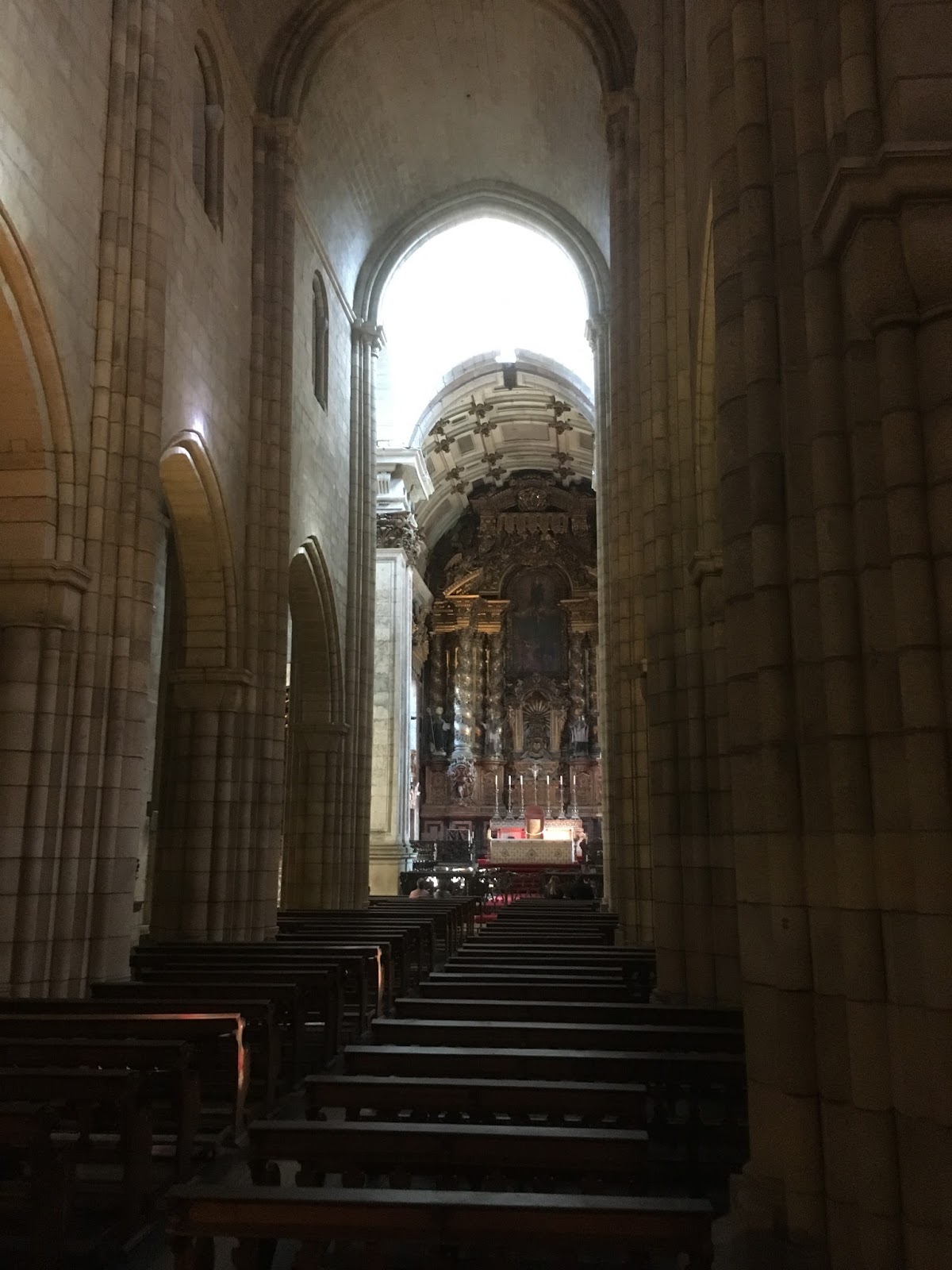
And, finally, a glance inside the cathedral.


For lunch, I was determined to devour one last Francesinha sandwich. Numerous times we'd passed ELoi'os Cafe & Snack (Rua dos Caldeireiros 13), and each time I was struck by the tiny size, unobtrusive presence and suggestive signage.


Simply stated, the specialty of the house is suckling pig -- but as noted, my objective was a Francesinha, and it was my favorite one overall.


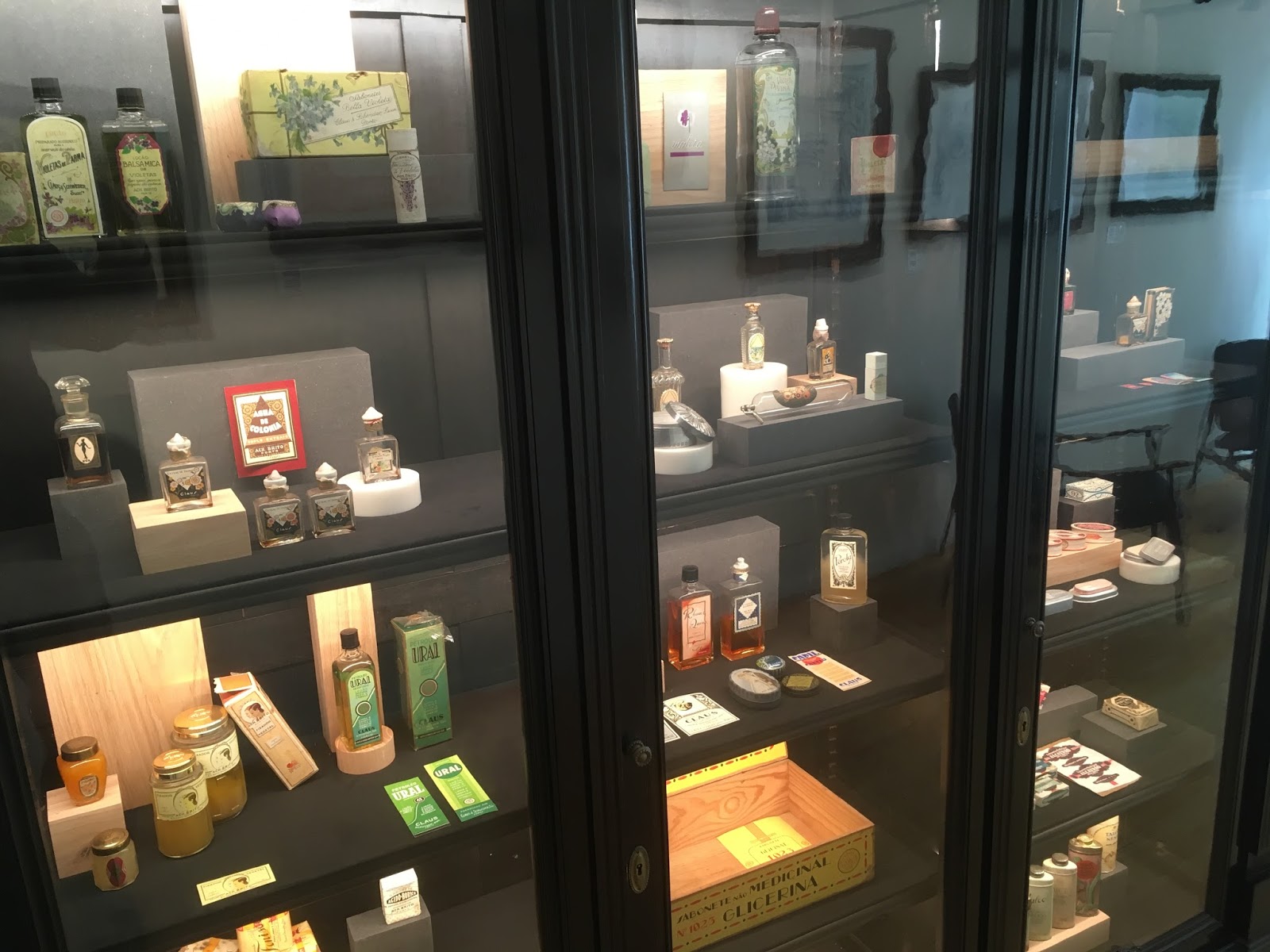
Diana wanted to duck into Claus Porto, a shop located on Rua Flores. It specializes in bath soaps and body care products, and while I'd usually avoid such a venue owing to the bad effects on my allergies, the latter have been somewhat alleviated with medication, so inside I went.

It turns out that Claus Porto is a world-famous corporate son of Porto, founded by Germans in the 1880s, and Portuguese-owned since the aftermath of World War I, when the Germans were booted out and the company nationalized -- which is to say that in addition to being a swanky sales outlet, there's also a museum of sorts upstairs, and when there's a museum to visit I can (almost) forget about the hefty price tags on the merchandise.


With public transportation passes still fully charged, the evening plan was set. First we'd hop the bus back to the Foz do Douro and the city's Atlantic coastline north of the Douro's mouth (where we had roamed the previous day), find a place to have a drink, and watch the sun set.


Ya gotta love it when a plan comes together. Next, we rode the bus back to the starting line and walked to As 7 Maravilhas, the craft beer bar and eatery we'd enjoyed so much on Sunday night.


On Thursday morning we were able to take our time, walk to the Sao Bento light rail stop, and make it all the way to the airport using our transport passes.

As I finish this final installment, it is March 25, more than a month after our return from Porto.

As regular readers know, our beloved elderly cat Hugo died just hours before we made it home, circa 1:00 a.m. on the 23rd; four days later, the final documents were exchanged in the NABC settlement; Joe and I had announced Pints and Union (the pub project) just before we left for Porto; and the first anniversary of my mother's passing came on March 12.

Talk about a swirl of emotions. The usual gentle post-travel glow was not to be found, and there for a while, I was wondering if the roller-coaster of the return might forever dim the legacy of the marvelous journey to Porto and Madeira.

But ... now it's been a bit more than a month. In fact, I've been profoundly moved by just about everything that has occurred in my life since late January -- it's been exhausting, but exhilarating, even Hugo's passage across the proverbial bridge.

He was old, and we knew he was winding down. We also knew that our feral reclamation cat, Mila, probably wouldn't delve into self-domestication until the way was cleared and the hierarchy altered, and it has been -- and so has she. It's been almost like witnessing a birth, even though she's six years old.

Porto was a blast: Francesinhas and Port, sights and sounds, rain or shine, with basketball, pork ribs in the fishing village and the advent of craft beer. I hope we make it back to Madeira for a week. The island was truly enchanting. Through it all, whether on the mainland or on a speck of volcanic rock in the ocean, the people were uniformly incredible.

I leave you with the photo in the front entryway of the Hotel da Bolsa. I've known about Porto because of Port, but as usual, there's quite a lot more to it.