|
| Not a quilt, but azulejo tiling patterns (Diana's photos). |
I've prefaced the travel narrative of our visit to Portugal (which has been backdated) with a series called Focus on Portugal, which provides background on a European destination that's scandalously little known to Americans. Previously: "Portugal Trip 2018 (6): "Sunday at the beach, then some fine eating (Taberna Stº. António) and a solid craft beer bar (As 7 Maravilhas)."
On Monday morning (February 19), we made the short stroll from the hotel to the tourist office in order to buy a three-day transit pass. With it, we'd be able to make unlimited rides until late Thursday morning, giving us enough time to use the passes for the journey to the airport via light rail.
With the weather becoming sunny and warm, it was time for serious roaming. Along the way was Liberdade Square (and Avenida dos Aliados), a rectangular expanse of open space that reminded me a lot of Wenceslas Square in Prague.
With the transit passed secured, our walk continued to the light rail station by the Mercado do Bolhão, Porto's biggest public market, where we had a second look on a day much nicer than the
drenched Wednesday previous. Diagonally across the street from the market lies the
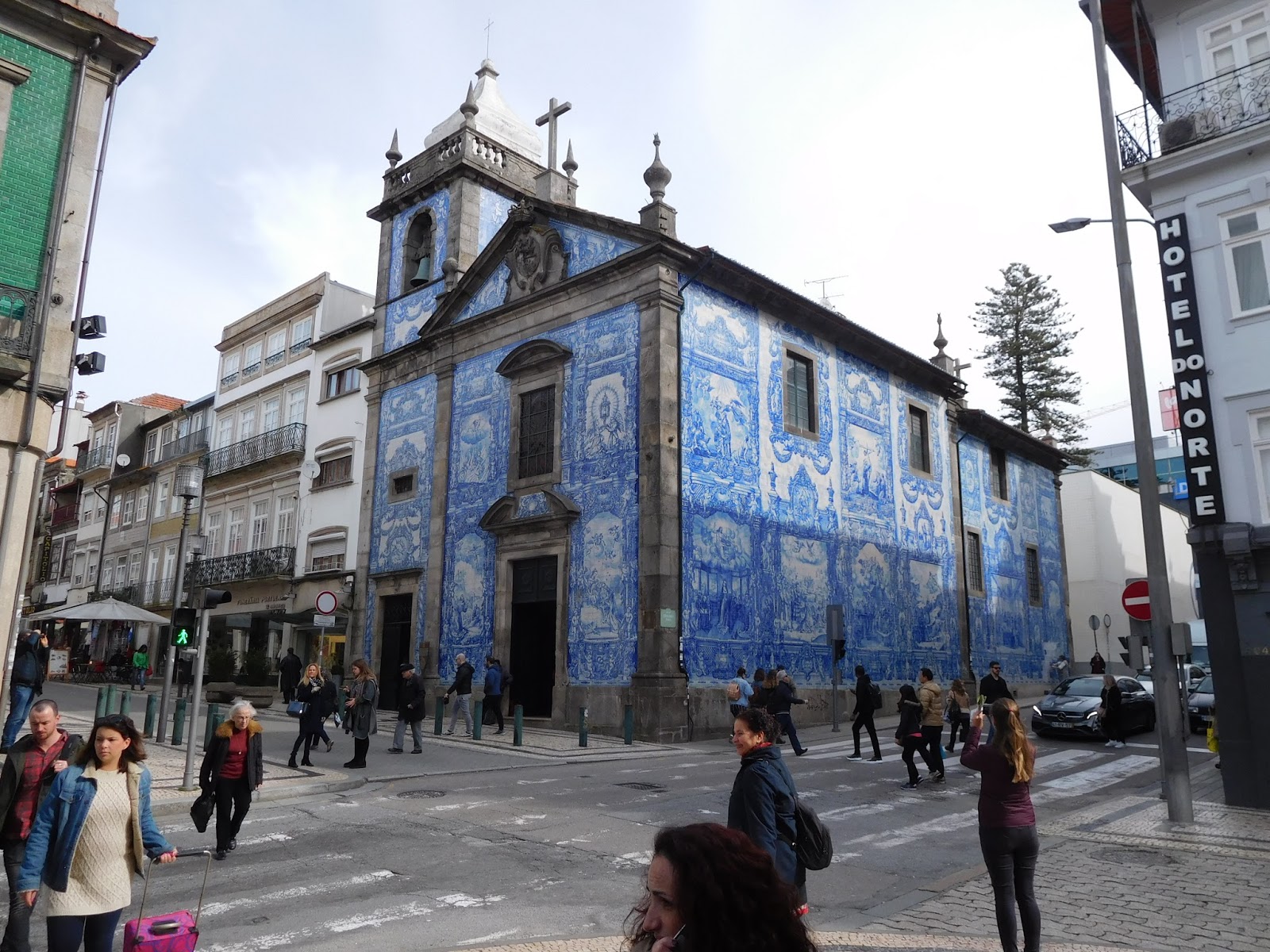
Capela das Almas.
On Rua Santa Catarina stands the strikingly ornate, azulejo-clad Capela das Almas. Magnificent panels here depict scenes from the lives of various saints, including the death of St Francis and the martyrdom of St Catherine. Interestingly, Eduardo Leite painted the tiles in a classic 18th-century style, though they actually date back only to the early 20th century.
A brief hop southward aboard the "D" line brought us to the first stop on the Nova Vila de Gaia side of the Douro River, where we debarked by the upper level of the Pont Luis I bridge.
Above us was the former monastery called Mosteiro da Serra do Pilar ...
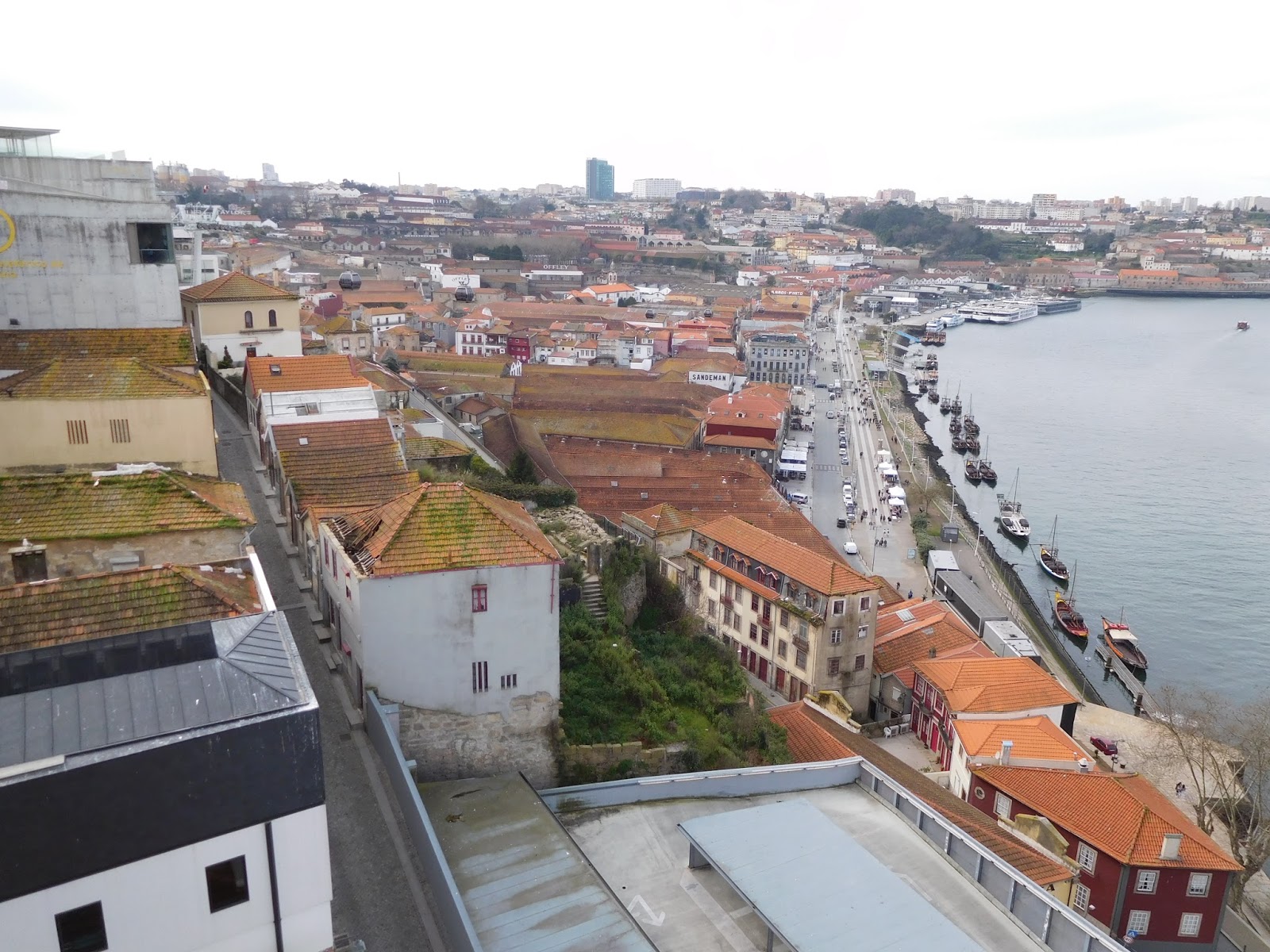
... and below a pleasing expanse of Port wine lodges.
This is the view looking up the Douro -- to the east toward the vineyards, not west to the ocean.
Rather than walk from the heights down to river's edge, we opted to float. Since 2011 there is the handy Teleférico de Gaia, or cable car. My fear of heights has improved but not entirely dissipated, and I was far too terrified to take photos. Diana refrained, too; she was too busy rolling her eyes at my exaggerated outbursts.
Our objective was an hour's hike (3.5 miles) along the left bank of the Douro, from the epicenter of Gaia to the village of São Pedro da Afurada, which is nestled beneath bluffs and a huge modern highway bridge just before the land yields to the Atlantic.
Still in Gaia, we passed a
Rabelo boat refurbishment yard.
Looking back, with the Pont Luis I bridge in the center.
Both sides of the river are lined with old warehouses in varied states of disrepair. Some have been gentrified and others demolished to make room for modern housing blocks.
The riverside path dipped under the highway bridge, and this brought us to São Pedro da Afurada, an urban parish of 3,500 in the city of Gaia. The curious thing is that the comprehensive public transportation network misses São Pedro da Afurada, a village surrounded by 400,000 people but still retaining an isolated feel.
On the eastern edge of the fishing village called São Pedro da Afurada, the Casa Machado ("traditional food") faces the river. We were seated amid the lunch crowd and made aware of eatery's "menu of the day," with entree, potatoes, salad, bread and wine ("green" Vinho Verde) for six Euros, or a bit more than $7.
And not fish, but pork ribs -- ribs being eaten by every regular customer in the joint, and ribs being grilled by the owner out front.
Perhaps the folks in the fishing village know best when the catch is more valuable for selling and not eating, and besides, it was one of the best meals we had on the whole trip.
Actually there is a bus connection to the village, but first one must take the water taxi across the Douro to the right (north) bank.
At Rua do Ouro, the grid resumes, including one of the old trolley lines still operated primarily for tourists.
Dilapidated buildings fascinate me. Hours can be wasted imagining stories about their past.
Not to neglect the kiosk by the river, where the (mostly male) pensioners go to smoke, drink and play cards, in a scene repeated in ports and harbors all across the planet.
We rode the bus all the way back to the Pont Luis I bridge, then walked back to Gaia by way of the lower level, completing the day's long circle where the cable cars of sure death hummed merrily above us.
Late afternoon was to be devoted to another round of Port tasting, beginning at Kopke.
Followed by a round at Ramos Pinto.
We also returned to our favorite of the lodges, Noval. By this time the sun was setting on Gaia, but the road rebuilders were still at it, patiently assembling jigsaw cobblestones.
We walked back to the Ribeira and had a snack at the same restaurant where we'd eaten on opening night, sat outside, and looked at the lights in Gaia.
Addendum: Last, but not least: Real Indiana.
It's always interesting to contemplate the many ways that different languages yield occasionally strange translations.
Shouldn't it be "Real Hoosier"?
Next: Back to the (northerly) ocean, with a walk through Parque da Cidade do Porto and lunch by the cemetery gates.