Sunday, December 11, 2005

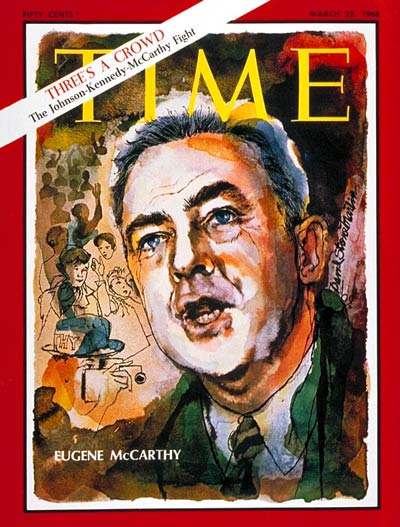
Eugene McCarthy (1916-2005).

There are numerous and compelling reasons to note the passing of Richard Pryor, whose often hilarious artistic expression nonetheless spoke movingly and deeply about the national condition in America.

And yet ... given the primacy of Iraq in the national conscience, and the inescapable parallels with an earlier period in the nation's history, a remembrance of Gene McCarthy seems in order.

Eugene McCarthy, who galvanized a generation of war opponents, dies, by Tim Pugmire, Minnesota Public Radio (December 10, 2005).

Certainly they taught that in journalism school?

While tiptoeing carefully through the thickets of the Tribune’s evolving new website, I was reminded that one feature of its revamped format is a weekly on-line reader poll.

As a profoundly unscientific exercise, one that implies far more empty calories than brain-conscious readers should ingest, such a feature is almost entirely devoid of meaning ... and if we want meaninglessness, there's always FOX-TV News.

Consider this week’s thinly veiled, populist ringer of a rigged question:

Should public entities remove religious references to the holidays?

a. Yes, separate church and state.
b. No, political correctness has gone too far.
c. I don’t care.


With 304 votes cast (as of 8:00 p.m. on Saturday, December 10), the Tribune’s latest poll showed 89% of respondents opting for the “no” response.

Duh. These days, it’s politically incorrect to be politically correct, so must we be reminded that poll results like these are largely dependent on the way the question is phrased – or is this too advanced a concept for New Albania to grasp during the avarice season?

I’d prefer the same question be asked this way:

Should public entities enforce adherence to the holiday traditions of one religion over another?

a. Yes, the state should be allowed to choose my beliefs for me.
b. No, this sounds too much like the thought police for my tastes.
c. I don’t care.


The results? Well, they might be different, eh?

The ‘Bune’s making progress, but doltishness like this is a step backward.

Saturday, December 10, 2005

One eyesore down.

Prior to the most recent Kroger-sponsored non-blizzard, we noticed that demolition finally was under way at the tanning salon on Charlestown Road that burned on Labor Day weekend.

We're told that such delays are not unusual, given insurance company procedure, and yet ... if a hazardous hulk remains (partially) standing while an insurance company's Byzantine process unfolds, and a child from the school down the street wanders onto the property and is injured, can the insurance company sue itself for damages?

"Fellatiogate" revisited: Talk dirty to us.

A cynic is a man who, when he smells flowers,
looks around for a coffin.
-- H.L. Mencken


Earlier, NA Confidential considered the “only in Indiana, laughing stock of the nation” saga of Fellatiogate:

Straight up from the AP: Student paper's oral-sex article creates uproar.

Libertarian activist and former gubernatorial candidate Kenn Gividen, who was quoted by the Associated Press in the referenced article, subsequently posted the following clarification to NA Confidential:

The quotes in the AP story were derived from a story in The Republic (Columbus' daily), a publication that is notorious for misquoting and manipulation.

The "dirty" quote was in response to a question, "Teens are already talking about it, so why not publish it?"

My response: "And teens engage in a lot of dirty talk. They did when I was in high school. If everything teenagers talk about is published, the publication will be wholly pornographic."

Typically, The Republic failed to publish the context of my comments. And typical of most news consumers, the words of the media are believed as gospel truth.

My opinion: Along with liberty comes responsibility. Having a right to publish doesn't make it right to publish.

The North HS faculty had the opportunity to teach the kids the importance of appropriate content. They failed.

To be misquoted is to be wronged by the media; all can agree on that point.

But to what appreciable degree does Gividen’s duly corrected words alter his fundamental position in the matter, other than to mildly differentiate his interpretation from territory normally occupied by the O’Reilly Factor?

Does Gividen's correction appreciably alter the thrust of amplification spun by fellow Libertarians like the party’s state chairman, Mark Rutherford, who was quick to note, “Being a Libertarian is not the same as being a libertine?”

How does any of this prove that the Columbus North faculty "failed" to "teach the kids the importance of appropriate content?"

Is there a difference between pornographic chatter and the explication of issues pertaining to legitimate public health concerns?

Is providing such legitimate public health information another in a long line of abuses and usurpations of the institution government?

If so, and adults are held responsible for collecting their own health information, then what about the children? Can they be expected to do the same without supervision and assistance?

Isn't that the entire purpose of education, whether public, private or home-schooled?

Friday, December 09, 2005

The council member's Rumpke bid lie: It is an ethical lapse, and it does matter.

Considering that Monday’s city council meeting was deemed so unimportant that the Courier-Journal didn’t even bother sending a reporter to cover it, numerous nuggets of community-wide relevance have emerged in the meeting’s aftermath, and there has been ample debate in the local blogosphere this week -- much of it uncharacteristically even-tempered.

Arguably the most significant development has been given short shrift, relatively speaking, lost beneath the fallout from CM Steve Price’s perpetually dopey hostility toward worthwhile economic development and CM Dan Coffey’s ever more obvious physical and thematic resemblance to Joe McCarthy.

Namely, which city council member (or members) openly lied to blogger Laura Oates, implying the possession of non-existent insider information about Rumpke’s sanitation bid?

Here’s what we know about this sordid tale (for a more exact chronology, see Say it ain't so, (Dan, Bill, Steve, Larry) ... you've given Trog Sham(an) a pain in the Rumpke, previously on NAC).

A full two days prior to the opening of sealed sanitation bids by the Board of Public Works and Safety, Laura Oates reported at her Speak Out Loud NA blog that “the contract for privatizing sanitation services has been awarded to Rumpke,” using as her primary source the legal notices in the New Albany Tribune.

When challenged, Oates modified her stance the following day, writing: “I must make a correction regarding information that I posted here about Rumpke and the Sanitation privatization contract. This info was actually disseminated verbally by Council members.”

She has not chosen to clarify this statement to indicate whether the information passed directly to her from the "Council members," or whether it passed through the copperative conduit of a spouse.

As Volunteer Hoosier’s Randy Smith proceeded to point out, her amended revelation – far from making the issue disappear – effectively transformed the initial assertion from an innocent misreading of the classifieds on the part of a citizen into a case of potentially felonious behavior on the part of a councilman or councilmen, whose leak might well be construed as an attempt to interfere with the bidding process.

And that’s serious, indeed.

As it turned out, the Rumpke bid was not submitted until minutes before the deadline, so Oates’s source quite obviously lied to her, but the fact that the insider leak was a blatant falsehood does not lessen its gravity, or its intended effect when uttered in such a context.

During Monday night’s council meeting, Citizen Smith aimed to devote his five minutes of public speaking time to exploring what was at stake pertaining to the integrity of the council, and intended to ask a simple “yes or no” question of council members as to the perpetrator of the sanitation bid misinformation, but his efforts were disallowed by the council president (and probably correctly, given protocol).

Twenty-five minutes later, when it was Mayor James Garner’s turn to speak, CM Bev Crump pointedly asked him what he knew about the Rumpke disinformation, and he replied that he “knew nothing about it” until being told it was somewhere on a blog.

Somewhat oddly, the previously stoic CM Larry Kochert chose this precise moment to leap feet-first into the discussion, noting for the record that all of New Albany should know that he had been so concerned about the Rumpke blog rumor that he took the unprecedented step of calling City Clerk Marcey Wisman on Monday, a day before the sanitation bids were opened, for clarification and to be reassured of the bid’s sanctity.

Odd, given that CM Kochert wasn't, and isn't, being accused, and that in the past, he has given the impression that he remains mostly unaware of Wisman's professional existence.

Some council members looked surprised during CM Kochert's comments, while others issued immediate, albeit mumbled, statements of disinterest in the topic of council integrity; CM Price lamented that “rumors are rampant” on blogs, while CM Coffey reminded listeners yet again that he hadn’t read a blog for months, although he thankfully did not choose the occasion to denounce reading and the insidious book learning that derives from it, as he has during past digressions.

Does the story end there?

NA Confidential believes that while discussion of the potentially felonious Rumpke bid lie may have dissipated on the blogs, especially on SOLNA, where it’s a potato far too hot to handle for a proprietor who genuinely believes she is protecting a “source” by not divulging the truth about the lie’s origin, the topic and its implications remain near the top of the charts among those who are closest to it, i.e., the CM or CMs who originally told Oates something that wasn’t true, and may have done so for ignoble reasons.

Make no mistake: NA Confidential believes that Oates is the victim in this case. She was manipulated, and she, her readers and the public at large are owed an explanation.

The easiest way for this issue to be put to rest would be for the responsible CM or CMs to step forward and acknowledge an error in judgment; as an insider points out, there is no shortage of politicians here or anywhere who cherish opportunities to stroke gullible constituents (and gain competitive advantage) by portraying themselves as all-knowing.

Just admit that it was a mistake ... a silly kid mistake ... and move on.

Barring such an unlikely confession, we feel that those members of the current city council who truly care for the body’s future ethical reliability should choose the next council meeting to offer a motion unequivocally condemning the Rumpke insider deception, recognizing the potential harm of such harmful acts, and reaffirming that it and similar lapses of judgment are not in keeping with the council’s job description.

Our local reporters? Unfortunately, they completely missed the story … but we don’t intend to let this one die.

Life is what happens to you/While you're busy making other plans.

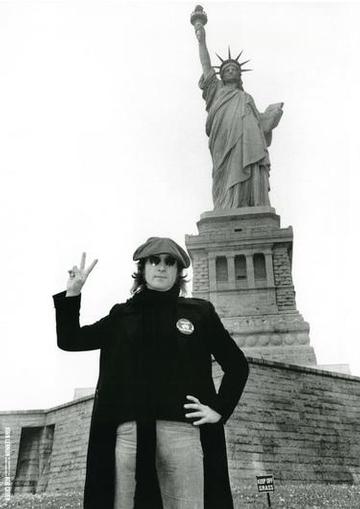
On the morning of December 9, 1980, I learned that John Lennon had been shot to death the previous night.

Groggy and entirely unaware, I shuffled into the kitchen and looked down at the Louisville Courier-Journal lying atop the breakfast kitchen table.

The headline was very clear. My reaction was anything but.

My mother was listening to the AM radio, as was her morning habit before going off to teach school, and as I listened to the news reports, my enthusiasm for attending morning classes at Indiana University Southeast quickly disappeared.

However, I wanted to be with friends, so I drove from our home in Georgetown to the Grant Line Road campus in a daze, thoughts swirling, FM radio tuned to the inevitable all-day tributes, chronologically at the age of twenty, but on this day still far too painfully adolescent.

Apparently there had been too little of death in my upbringing, too few opportunities to learn how to handle grief. What was it about pop culture that made it easier to display emotion at the murder of an icon far, far away, even as it remained impossible to discuss feelings in my own family?

My father and his schoolmates could easily remember where they were and what they were doing when Pearl Harbor was bombed, and in the 1960’s, a different generation reacted in similar fashion to the assassinations of President Kennedy, his brother Robert, and Martin Luther King.

When John Lennon was killed, I was quite certain something had come to an end, although it was unclear to me that morning exactly what it was. It was an emotion that I was not to experience again until September 11, 2001.

On December 9, 1980, walking through the corridors at school, I met a friend named Sean, who had moved to Louisville from the East Coast a short time before. Sean was Irish, and a drinker, and as we shared our feelings about John Lennon’s death, I was reminded that Sean’s father was an executive in the bourbon industry, something that loomed large considering our mutual desire to get drunk and the fact that neither of us was 21.

I don’t recommend driving while drinking, but we did, listening to the music of John and the Beatles, watching the Ohio River, and wishing we had girlfriends. After Sean returned to campus to meet other friends, it was safe for me to sit alone in the parking lot and have a good cry when one of the FM deejays played “Beautiful Boy” from the Double Fantasy album.

Two or three days later, I saw a letter in one of the local newspapers, in which a fundamentalist Christian took offense at the widespread depth of feeling for John Lennon, preferring to view the slain musician as an immoral agent of Satan, out to subvert Christianity and promote sinful lifestyles. Incensed, I wrote a rebuttal, which was published … and I began to reflect on the hatred and spite that so often preface religious fanaticism.

Suddenly, I understood what had changed. On December 9, 1980, I abandoned the notion – admittedly, a tenuous one even then – that a world in which artists are violently struck down before their time and the upwardly devout respond by piously sneering at the blood of the victim has anything whatsoever to do with deities and the supernatural.

John Lennon’s brutal death wasn’t the only impetus for this conclusion. It was 1980, and the ascendancy of Jerry Falwell. Ronald Reagan was in the White House. There were many reasons for a young man to be angry before the morning when the music died.

A quarter century later, there still are … even though I’m no longer young.

In recording these thoughts, honesty is my first aim. It would be much less jolting and far more pleasing to concentrate on remembrances of the good times when the music of John Lennon and the Beatles filled my life – and indeed, there were many such times.

There will be more. I cherish them.

But the image of the newspaper headline won’t go away, and neither will the conclusions that the tragedy of John Lennon’s death produced for me, in my life.

I miss his creativity.

And my innocence.

Thursday, December 08, 2005

Malicious and cowardly anonymity rebutted (again), version 8.1 ...

Today, NA Confidential offers a brief refresher course on an important topic that bears reconsideration from time to time, both for the benefit of longtime visitors and those who are new to the neighborhood.

Malicious and cowardly anonymity rebutted, version 8.1

Apparently refreshed and reinvigorated by her startling petulance in storming from the room during Monday’s city council meeting, the proprietor of New Albany’s spitwad blogyard has set out today to inspire her dozen or so disgruntled readers to even greater heights of anti-social abusiveness by “reiterating our purpose, and restating our goals.”

Unsurprisingly, anonymity remains a vital component of a platform that the administrator insists contains no political content.

Everyone also has the right to NOT put themselves, their jobs, or their families, in any kind of harms way, due to their viewpoint or opinions on issues discussed.

We will continue to allow anonymity, with all its inherent difficulties, because we are dedicated to giving EVERYONE a voice. We have made this policy clear from the get-go, and we will maintain this policy despite the hostility and frustration it generates from other bloggers. Names don't matter, opinions do.

As was the case when this issue first arose in May, NA Confidential chooses to rebut SOLNA’s abhorrent “anonymity clause” with the words of an American soldier, which appeared in the letters section of Stars and Stripes (Pacific edition; July 22-28, 2001).

----

Anonymity is cowardly

In reply to the July 18 letter “Benefits of anonymity,” I must strongly disagree with the characterization of Stars and Stripes’ policy on anonymous letters as cowardly.

Anonymity, on the other hand, is essentially a cowardly way to get one’s point across without having to actually put anything at risk. Honor and courage dictate that any just cause is worthy of risking something of value.

How effective would the “95 Theses” have been if Martin Luther had nailed them up signed “Anonymous?” And how about an anonymous “Declaration of Independence?” Abraham Lincoln could have written an anonymous “Emancipation Proclamation,” and maybe spared his own life at the hands of bigots.

When you truly feel that you are right, even about small matters, don’t be too cowardly to put your name on it.

Anonymity is too often a shield for lies and exaggerations, and is widely recognized as such. As an American and a Marine, I am happy to have a forum that will print the voice of dissent, as long as it is not skulking in the shadows.

The letter writer has sadly mistaken “freedom of speech” for “freedom from accountability.” The Stars and Stripes policy only censors those who are looking to whine without repercussion or who have no stomach for defending what they believe is right. People who will not identify themselves, censor themselves. They can pity themselves anonymously too, I don’t want to hear it.

Please don’t complain “out of respect … for those who serve today.” That’s me. I can complain for myself, and I’ll sign my name to it when I do.

Jerry M. Milton … Camp Foster, Okinawa

---

In short, if you continue to feel it’s fair and proper to wear a hood while savaging your political enemies, don’t complain to NA Confidential.

Tell it to the MARINES.

While we're on the subject, here is NA Confidential's comments policy.

NA Confidential welcomes reader comments, but we do not sanction anonymity in the comments section.

Pen names are acceptable, but the primary blog administrator must know your identity. It will be kept confidential if you so desire.

We insist upon this solely to lessen the frequency of malicious and cowardly anonymity, both of which plague certain other blogs hereabouts, and have risen to a fever pitch of irresponsibility in the past few months. Here we have rules, and intend to enforce them; anonymity will result in deletion.

You may e-mail the New Albanian at the address given in the profile section.

Thanks for reading, and please consider becoming a part of the community here.

---

Here, in no particular order, are several previous NA Confidential articles that pertain to the cowardice of anonymity.

"Cowardice coupled with ignorance, topped off with a threatening tone" -- Ms. Ali, we know exactly what you mean.

"Sending someone an e-mail message where you accuse them of whatever and then not sign the e-mail – well, that seems a bit cowardly … cowardice is a characteristic that is particularly annoying to me. Cowardice coupled with ignorance, topped off with a threatening tone is more than I’m willing to tolerate."

Porcine opinion polls, or revisiting the silk purse -- and identifying its likely source.

Such uneasiness is the ideal breeding ground for opinion, which mutates into dark rumor and dire conspiracy with unfathomable speed, especially when abetted by the pandering of the politician seeking a vote, or the philandering of a mock academic in search of an audience, or even the good intentions of a neighbor with an axe to grind that might date back to before you were born.

Roger and Laura discuss free speech and accountability

Thus, given that I am a small business owner, as is Randy Smith and Rick Carmickle (among others), and dependent on the good will of customers for my livelihood, exactly how is it that I’m not risking something or putting something at stake when I venture an opinion and attach my name to it?

---

Mock academic?

How interesting ...

NAC responds to a Tribune letter to the editor ... in more than two hundred words.

New Albany Tribune reader Joe Tanksley performed a valuable public service yesterday when he demonstrated that far too many New Albany residents – not only those with high school educations, but from all educational backgrounds – remain acutely vulnerable to rumors, innuendo and misinformation.

Mr. Tanksley’s letter to the editor ran atop the redesigned editorial page, and readers were invited to respond in 200 words or less. As that’s a mere two or three painfully abbreviated paragraphs in NA Confidential’s realm, we decided to respond here.

If and when it becomes possible to link to Mr. Tanskley’s letter, it will be done, but in essence, he wrote to express dissatisfaction with the current city administration.

It’s not Joe’s fault that conspiratorial hucksters prey on him … although it is to their shame, and the community’s detriment, that they persist in doing so.
Of course, everyone’s entitled to their own opinions, but not their own facts, and some times it is awfully difficult to tell the difference when some folks are determined to mislead you.

In point of fact, New Albany’s first priority for the future is to become smarter – and not just by support for education. We must keep more of our …

(Note: 200 words would have ended here.)

… best and brightest, and attract a new generation of homeowners and jobholders whose lifestyles and professional skills blend together into a phenomenon now referred to by economic analysts like Richard Florida as the "creative class."

Obviously, some aspects of "business as usual" have to be changed, and far from "not having it," the current administration fully recognizes the need for New Albany to break with the city’s well-documented civic dysfunction. It has coped admirably under stress, faced by a series of crises not of its own making, while at the same time attempting to address the issues of a smarter New Albany, without which revitalization efforts may well come to nothing.

Unfortunately, the Scribner Place project continues to be the whipping boy preferred by those among us, like 1st District Councilman Dan Coffey and his Siamese Councilman, 3rd District CM Steve Price, who are innately suspicious of an evolving world that seems foreign and incomprehensible to them, one populated by odd people with strange preferences like exercise, reading, sushi and espresso, and who, to them, symbolize detached affluence and practiced disdain for the working classes and the underprivileged.

Nothing could be further from the truth, and both Mr. Coffey and Mr. Price probably know it, but grandstanding and ward heeling become second nature when you’ve been at it for so long.

These people represent hope for a new economy, and New Albany desperately needs to get smarter so all of the city’s residents can reap a share of the benefits from such a new economy. The good news is that many, if not all, of the factors necessary to get us headed in the right direction are already here. They just need help.

Scribner Place, while hardly a panacea, is precisely the sort of cost-effective partnership between government and the private sector that stands to bring people – including non-residents -- downtown. In conjunction with the Ohio River Greenway, the Cannon sports park, Main Street and Spring Street area plans, Al Goodman’s plans for the Moser Tannery, existing downtown businesses and new ones that are coming soon (trust me, I know), Scribner Place is a major step in the right direction.

I know it doesn’t seem this way to those for whom envy and spite are the dominant personal and political modes of expression, and it’s a genuine pity that they’ll be missing out on the good times ahead out of sheer stubbornness, but as they say so often, it’s just their opinions – which aren’t necessarily facts, and which definitely aren’t valid reasons to dismiss progress in New Albany.

----

Here are random links from May and June, 2005, to NA Confidential pieces on this and similar topics.

Price rocks S. Ellen Jones: The last person to leave New Albany, please douse the candles and drop off your keys at the Brambleberry residence

The Coffey/Price dumbumvirate's rear-guard action against progress

An evening on the brink: Tragicomic opera courtesy of NA's Siamese councilmen

Councilman Cappuccino declares city administration null and void, invites YMCA to form provisional government with himself as regent

Coffey to Redevelopment Commission: I'm clueless, and you should be, too

Price to citizenry: I'm scared, and you should be, too

Wednesday, December 07, 2005

(FELLATIOGATE UPDATED) Straight up from the AP: Student paper's oral-sex article creates uproar.

We fully expect our friend Healthblogger to be all over this one, but until then, here’s the scoop from the AP wire:

Student paper's oral-sex article creates uproar (Associated Press).

COLUMBUS, Ind. -- High school students were trying to protect fellow teens' well-being with a four-page report in the school newspaper on the risks of oral sex, school officials said.

The report in last week's Columbus North Triangle emerged after a student brainstorming session, said Kim Green, adviser to the school's publications. The report, titled "That Other Sex," discussed oral sex and its medical and psychological risks, and included student interviews on how widespread the practice has become.

All in all, routine “tempest in a teapot” content here; students are taught to prepare for adulthood, then take the advice literally, outraging prim and proper bystanders who’ve forgotten their teen years and insist that abstinence is the cure for everything except the war in Iraq.

The part of this story that NA Confidential finds confusing is here:

Kenn Gividen of Columbus, who has run unsuccessfully for the Bartholomew County school board and was the 2004 Libertarian candidate for governor, said the student newspaper is not the proper place for such a frank sexual discussion.

"I'm sure this is something kids are talking about. Kids talked about a lot of dirty things when I was in school," he said. "But it's something completely separate for the school to endorse it, which is obviously what they did by publishing it."

Knowing that NAC has at least two known Libertarian readers, might one or both of them enlighten our blog’s regulars as to the significance of the word “Libertarian” in the wire service story?

Is Kenn Gividen’s Libertarian affiliation a simple matter of editorial courtesy, so as to identify a former gubernatorial candidate in a more precise matter than mere “private citizen,” or is his Libertarian philosophy contextually relevant to his stated viewpoint?

If the latter, what is the Libertarian position on the Columbus North case?

NAC does not know the answer. Deb? Kirk?

----

7:00 p.m. update:

Since posting, we remembered adding the blog of Mark W. Rutherford, chairman of the Libertarian Party of Indiana, to NAC's bookmarks, and upon checking, found that Rutherford indeed has taken note of the public relations mileage being gotten out of the Columbus North's Fellatiogate by Gividen:

Former Libertarian Gubernatorial Candidate Kenn Gividen Getting a Lot of Media Attention

Here are brief excerpts:

Being a Libertarian is not the same as being a libertine …

… Some Libertarians are going to find that there was no problem with Columbus North High School publishing the article. Other Libertarians are going to find that publishing the Columbus North High School article was a poor judgment call. But all will agree that the growing trend for government to make decisions in the place of parents is very, very bad policy. They will also agree that free speech is about Kenn questioning the wisdom of Columbus North High School publishing the article. Libertarians wish more people would question government operations such as Columbus North High School.

Ahhh ... public education as government's improper reach. Finally it's starting to make sense.

Kenn Gividen has his own blog: Hillary's Village, and there you can find his views and opinions in detail.

Netpointe's street spam: We do not like it here or there ... we do not like it anywhere.

Isn’t it ironic that one of the most egregious generators of street spam hereabouts is an Internet service provider?

NA Confidential has nothing "against" Netpointe ("we buy houses" is another matter entirely), but simply stated, spam is spam, and it's disappointing that a local business that undoubtedly devotes so much of its work time fighting against one variety of spam chooses to contribute to the litter problem by printing dozens of another and littering the city with them.

We'll forward this posting to the folks at Netpointe, and let you know when they respond.

If you're just tuning in, you may be asking: What is street spam?

It is the term for illegal signs along roadways, at intersections, on traffic signs or utility poles, and even on private property. Illegal street signs are also called vertical litter, bandit signs, snipe signs, utility pole advertising and stuff on a stick (SOS). The signs may advertise local businesses, multilevel marketing schemes selling weight loss products, health insurance, sample sales, landscaping services and even pet waste removal services.

The preceding definition comes from the FAQ section of the Citizens Against Ugly Street Spam web site.

See also Street spam, sign sharks and the sheer joy of litter removal, a recent article in NA Confidential.

Tuesday, December 06, 2005

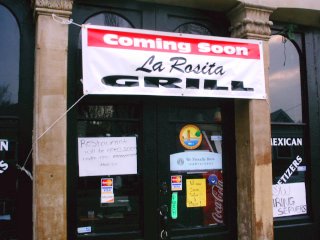
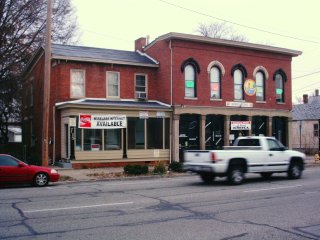
California's, we hardly knew ye; next up at 1515 E. Market: La Rosita Grill.

Boy, you sure could see this coming.

Information is scant, but it's certain that the California's experiment has ended at 1515 E. Market Street. Here's the encouraging banner across the storefront:

Seldom in our experience have we encountered a business quite like the now defunct California's, which began life as a coffee house last spring before frenetically mutating into so many different concepts in consecutive, short-lived order that even those of us desperately wanting to like it could find nothing to hold on to from visit to visit.

We're told that the new operators are the same people who are running La Rosita, the much acclaimed taqueria (and adjoining Mexican grocery) on Charlestown Road, and will be expanding their culinary offerings at the Market Street location.

The weekend tripe special within walking distance? We're for it.

An empty chair's better than an empty suit -- or why Frankfort Avenue is bad for an Uncouncilman's stunted imagination.

In 1976, baseball commissioner Bowie Kuhn voided three player sales made by Oakland Athletics owner Charles O. Finley, who lambasted Kuhn as the “village idiot.”

Later, Finley sincerely apologized to America’s many villages, and amended his assessment of Kuhn to that of the “nation’s idiot.”

---

Meanwhile, in his clearest and most unambiguous statement to date on the topic of New Albany’s revitalization, 3rd District Uncouncilman Steve Price said last night that we should not “pack people in like sardines,” as is the case over at Louisville’s Frankfort Avenue, where presumably the numerous niche shoppers, gallery viewers, satisfied diners, all-hours coffee drinkers, job holders, taxpayers and residents of highly valued properties would pose a conspiratorial threat if they were to be somehow transported to New Albany and permitted to spend money here.

Price, a rental property owner, spent the evening enthusiastically playing to the obstructionist Luddites in attendance by joining fellow Siamese Councilman Dan Coffey in affectionately stroking the sizeable, green-tinted chip that rests at all times on Coffey’s shoulder -- the one that manifests itself in unbridled and self-destructive disdain for any human being in a position of authority who has made the mistake of being educated ... as Coffey has not.

Consequently, not content merely to oppose efforts to amend a new sewer tap-in fee ordinance to allow community housing organizations like Habitat for Humanity to receive waivers, or at the very least discounts, so as to assist these organizations in keeping the price of starter and low-income housing low, and encouraging in-fill development in blighted areas, both Coffey and Price seized every opportunity to smirk and to scoff at any and all progress in human affairs, leading inevitably to the single most preposterous utterance of Price’s bumbling, embarrassment-filled tenure in the 3rd District council chair.

We learned last night that of all the dreadful bogeymen invading Li’l Stevie’s restless dreams, none is as terrifying as the one in which New Albany actually succeeds at something more than barely maintaining the lowest common denominator used by the Prices and Coffeys of the world to measure underachievement (and determine rents).

And the whipping boy chosen by Steve Price?

Frankfort Avenue.

To tens of thousands of people, it’s a weekly and perhaps even daily destination, a vibrant and diverse place to eat, drink, shop, spend, walk, love and enjoy some of the best that the Louisville metro area has to offer.

There isn’t a community in the United States of America that would not do whatever is necessary to have such a three-mile long corridor, one that attracts natives and outlanders alike, enhances the city’s image in tourist commentaries, pours tax revenue into the coffers, employs hundred of people – one that makes its residents and the city of Louisville proud.

And yet, to Steve Price and those of his utterly clueless ilk, Frankfort Avenue is somehow the enemy, an inexplicable collection of strange people and alien concepts to be feared and loathed owing to the incomprehensible differences, and a revitalization equation that simply does not compute -- at least when reckoned by the slumlord’s shopworn abacus.

Undisguised contempt for education – more accurately, hatred for human reason itself -- is the only way to explain why a hectoring bully like Dan Coffey continues to publicly and petulantly slur the Scribner Place project, the best hope in a generation to bring change to his perpetually degraded district.

Undisguised contempt for education – more accurately, hatred for human reason itself -- is the only way to explain Steve Price’s ongoing, spiteful jihad against every rational proposal to improve the neighborhoods that he was (mistakenly) elected to represent.

Collectively, New Albany improves only as it gets “smarter,” and there are numerous ways for the city to become “smarter.”

Ever heard of addition by subtraction?

You will, as the 2007 elections draw ever closer.

Monday, December 05, 2005

The Tribune pulls it together, and the City Council prepares to meet.

Tribune changes are coming fast and furious, and in yesterday’s edition, recently arrived executive editor Steve Kozarovich outlined the strategies that lie behind the newspaper's revamping.

In short, staffers have been shuffled, reporters hustled out onto their beats for a greater volume of local stories, new and more ideologically varied syndicated columnists inserted into the opinion page rotation, and a open call made for local writers to author columns.

Here’s one potentially valuable new addition to the newspaper:

Floyd County Meetings preview, by Amany Ali (News-Tribune), in which the week’s governmental gatherings are noted and discussed.

Yes, it’s time again for the City Council to meet, and there are hot-button issues aplenty to occupy the body’s Monday evening session tonight, including sewer tap-in rates and the ultimate fate of New Albany’s sanitation department.

Visit Volunteer Hoosier for a succinct explanation of why a simplistic regimen of higher tap-in fees would act to "discourage infill development and redevelopment":

Tonight, as the council considers the imposition of an increased sewer connection fee, I urge them to create within the ordinance the mechanism for expressing a public policy preference for “infill” development.

This council can effect that preference by authorizing a slightly higher sewer connection fee, while directing the Sewer Board to declare a moratorium for one year, or a waiver, for all residential sewer connection fees for properties within the areas currently designated as “blighted.”

As for the Great Sanitation Debate ... with Christmas right around the corner, you can expect tirades of self-righteousness and multi-hankie theatrics from the peanut gallery, as in this Priceful snippet of troglobyte graffiti scrawled above the urinals at the Luddite Bar & Grill, reprinted in its original screaming capital letters:

IF OUR "MAYOR", MR. GARNER, WANTS TO REDEEM HIMSELF, EVEN A LITTLE BIT, HE WILL LISTEN, AND GIVE SERIOUS CONSIDERATION TO SAVING OUR SANITATION DEPARTMENT, AND THE WORKERS JOBS, ESPECIALLY AS WE APPROACH WHAT IS SUPPOSED TO BE THE GIVING TIME OF YEAR. MERRY CHRISTMAS' DON'T COME WITH A PINK SLIP.

Of course, such appeals to emotion won't help unravel the riddle of determining the best sanitation solution for the city as a whole, but they are quite likely to be answered by the predictably Pavlovian yelps of the Gang of Four … which reminds NAC of an interesting idea that was forwarded to us after the publication of Paint and public art as progressive ideals -- why not in New Albany? last week.

My friend Bayard writes:

Using the blank wall of the city-county building as ‘progressive’ public art is fine, but why not use it like a big anti-smoking billboard and show how ‘not’ to do it?

He suggests something like this:

Thanks, but no thanks, Bayard.

The sublety would escape folks like Concern Taxpayer who lack the "satire" gene, and our crazed Luddites might start frequenting the spot, bringing flowers, singing off-key, drinking cheap wine and smoking weed the way the rock 'n' roll pilgrims do at Jim Morrison's grave in Paris -- and some people just shouldn't wear spandex (or leather) past the age of 50.

Long ago and far away in Slovakia: Kraut, carp and carols.

Ann Streckfus offers a wonderful piece on today's Diggin' in the Dirt blog: St. Nicholas Eve.

When I was a kid, we always hung our stockings on St. Nick's Eve. My dad was from a German family who still kept many of its traditions despite immigrating to the US in the mid 1800s, and they always celebrated St. Nicholas Day on December 6th.

Although my family also traces its roots to Germany, we never acknowledged St. Nicholas Day in this manner, but Ann's mention of it dislodged memories of my Christmas season fourteen years ago in the city of Kosice, Slovakia, where I was temporarily living and working as an English teacher.

The Slovak holidays were observed with considerably more taste and restraint than has become our habit in America, and although much time has passed and the country has moved beyond the transtional post-Communist period of my brief residency, I’d like to think that the old-fashioned, festive mood hasn’t completely been subordinated to consumerism.

Here’s something I wrote at the time.

A Christmas Dispatch from Slovakia ‑ December, 1991.

There's a good chance of a White Christmas in Slovakia.

The winter's first snow has come and gone, and although we didn't get very much, it was enough to add a cheerful hazard for pedestrians in the forms of sleds, multitudes of them, some of old‑fashioned wood construction, others of molded plastic. More sleds than I've ever seen have appeared as if by magic from closets and storage rooms, to be pulled by their brightly outfitted young owners and steered at breakneck speed down any and all available slopes, inhabited or otherwise.

They had been charging down the wide sidewalk that leads from Festival Square and ascends the low ridge to the hospital complex where I teach, and the snow on the walkway had been firmly packed into an icy surface that defied sure footing, and the reason I know this is because I was trying to walk up the hill – and failing miserably.

You can't blame the children for failing to understand (or to care about) the consequences of their fun. After all, children don't have as far to fall.

It was a good day for a walk. The snow was fresh and powdery, and it crunched loudly beneath my boots. The white dusting on the cupolas and steeples of the old city brightened the sooty, aging facades. Even the look-alike gray rows of block housing were softened by the white.

The sunshine was bright and surface temperatures no lower than freezing, but a sharp, gusting wind from the north kicked up miniature/a> snow squalls and blew the clothes on the ubiquitous clotheslines into frozen, horizontal positions.

The chill made me think of Russia. The Soviet Union used to be close to Kosice, but now the line on the obsolete map is the border of the infant Ukrainian republic, and who knows the procedure for crossing that border? Probably a bottle of Scotch and a smile.

The cold flowing into Kosice from Siberia will be as close as I get to Russia this trip, yet I can still see our fur‑clad, vodka‑wielding, erstwhile enemies waiting in line for brown bread.

It makes me think of the cruel toll of forty years of Cold War: hunger, homelessness, environmental degradation, social upheaval, rampant violence, the decay of the family, impending economic catastrophe ‑‑ and these are America's spoils of "victory."

In the former U.S.S.R., the situation is even worse.

But Christmas is coming, and somewhere in a valley near Kosice, in the backyard of a quaint farm, a goose is getting fat. Barrels are being inspected to gauge the progress of the cured cabbage that will form the base of the traditional holiday soup. A trip to a nearby town is being planned. There will be shopping for gifts and a visit to the fish market for carp, another holiday staple ‑‑ or perhaps the fish will be vended from oversized plastic tubs, to be weighed and wrapped right on the street.

For an American, there's an eerie quality to the Christmas season in Slovakia. For starters, decorations didn't begin to appear until the first week of December; then again, what can you expect of such an unenlightened country where there's no contrived holiday like Halloween to mark the beginning of the shopping season?

Only a few tasteful, understated window displays are to be seen in the stores, and high ­pressure, guilt‑laced sales tactics aren't in evidence at all. Slovakia obviously has much to learn about economics before its people can begin to see the wisdom of centering all hopes on wild overspending at Christmas to keep the economy afloat. It's almost as if Christmas has a meaning beyond retail sales ‑‑ a meaning that was nurtured and kept alive through the many years of anti‑religious repression.

Nah, that's too far‑fetched.

In Slovakia, Santa Claus makes his rounds on the eve of St. Nicholas Day (December 6). Children scrub and polish their shoes and place them on the windowsill to be filled with candy and chocolate, but only if they've been good. If not, they're supposed to receive a bundle of twigs bound together and intended for use to swat their you‑know‑what. On Christmas Eve, rumor has it that gifts are not delivered by Santa, but by Jesus himself.

In Communist times the regime attempted to persuade the populace that a chap named Grandfather Frost brought the goodies, presumably on behalf of the benevolent leadership.

There are Christmas trees and caroling in the streets by children, one of whom might carry a representation of the manger, and maybe the singers will be rewarded for their efforts with fruit and cookies.

In short, despite tight economic times and a full list of daunting problems to be solved, the holiday season in Slovakia is proceeding according to schedule and tradition. I've been given a bottle of homemade peach brandy for St. Nicholas Day; the doctor who gave it to me instructed me to make a Christmas Eve toast to peace, health and a good harvest. On a cold day, with steaming sauerkraut soup just around the comer, the toast strikes me as a true and noble thought.

Sunday, December 04, 2005

"My shoes are filled with Volga mud ... "

Expanded reading for a chilly Sunday morning ... from 1999.
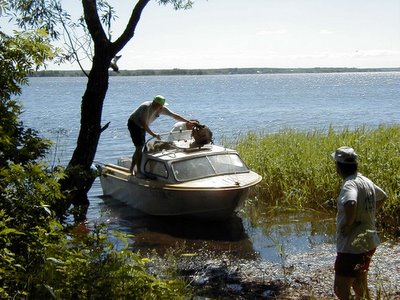
I knew we were in trouble when I saw the weather-beaten boat that had been hired by Allan Gamborg to take us out into the expanse of water that he swore was a river, but looked to me like a vast inland ocean.

A handful of pasty white male natives in flowery swimming trunks eyed us with curiosity from behind reeking cigarette stubs. There was an odor of gasoline in the air … or was it vodka?

It had taken more than three hours just to reach the village. We began the day in central Moscow on the inner ring road, with Allan pointing the car north through seemingly limitless, shabby cement towers, until at some point approaching sheer urban claustrophobia, we reached the open countryside.

A couple of reform-proof collective farms were bisected, and we probably passed through a time zone or two before arriving eventually at the Russian equivalent of Kentucky’s Land Between the Lakes, a big piece of land wedged between the confluence of three rivers, terrain dotted with venerable rural homes made of peeling painted wood, weekend houses (dachas) of the high-rolling city folk, and numerous indications that the short-term visitor would be utterly removed from the fast pace of urban life.

Allan’s dacha, a nicely built house of recent vintage, was being tended in his absence by a neighbor. Among her advance instructions were to garner and prepare food in anticipation of the arrival of the vacationing foreigners: The two oversized Americans (myself and Barrie Ottersbach), as well as Allan’s fellow Dane, the ever-energetic Kim Wiesener.

Scouting opportunities for profit, a stereotypically scarfed, elderly woman met us at the rickety gate of the compound, displaying a rather large and odiferous fish that she excitedly explained might well be the highlight of our visit to all of Russia. Allan bought it for mere kopecks, and with only slight trepidation it was slated for the outdoor grilling of meat and vegetables set to follow the boat trip to Sand Island.

Settling into our evening accommodations, we secured the perimeter of the kitchen against horse flies and bees, then examined the afternoon’s provisions. Bottles of expensive imported Budvar beer (each costing the equivalent of 50 cents, American), peppercorn-encrusted salami (already road gnawed), hunks of regional cheese and crusty bread were thrown into a bag. I slammed a clip into my camera and reached for Bulgakov’s "The Master and Margarita," some sunscreen and a vial of insect repellant.

The four of us strolled down a gentle slope to the marina, which proved to be a rectangular patch of murky river water enclosed by a roughly reinforced concrete wall, all gray and rust, perhaps a suitable home for pocket submarines during the late, lamented Cold War. It isn’t known whether our small boat was named the Minnow, but its tiny, coughing outboard motor sputtered like a leftover Trabant. The grizzled captain welcomed us aboard, his metal teeth shining, and our Volga cruise began.
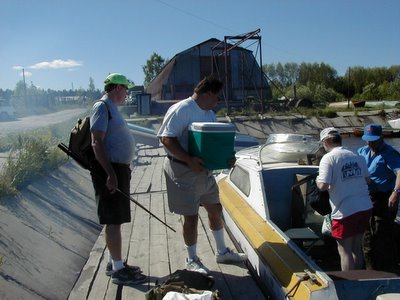
The motor died more than once, but the captain expertly revived it when necessary, and the boat was steered into the middle of a huge open lake -- an impoundment, to be sure; even Russians don’t make rivers that big. It was a brilliant, sunny summer’s day with enough wind to create choppy waves that our small craft struggled valiantly to conquer. After twenty-five minutes, we slowed and began chugging toward a long, low island carpeted with pine trees.

When we closed to within a hundred yards, I noticed something peculiar about the shoreline ahead: There was no dock jutting out from it. In fact, there appeared to be no structure of any kind of the sort that would calm the nerves of an inveterate non-swimmer. Actually, being neither a swimmer nor a naturalist of any remote sort, I asked Allan: "Uh, well, exactly where’s the dock?"

"There is no dock," he said cheerfully.

We’d have to wade in like so many Douglas MacArthurs, except we’d be bearing beers and sausages, not guns, and we’d be wading right back out whenever Captain Ahabski returned for us – assuming, of course, that his long-suffering outboard didn’t go the way of Dzerzhinsky’s toppled statue in front of the Lubyanka prison back in Moscow.

It was later that Allan made the offhand comment that proved to be the mantra of the trip: "My shoes are filled with Volga mud." I could accept that, just so long as my lungs weren’t filled with Volga water. In the meantime, I held my Budvar close to my heart and stuck a naked toe over the side.

The Future Is the Past?

From the beginning of the trip, it seemed a strange sensation to be finally returning to a land that had captivated me so intensely earlier in my life.

In particular, it seemed quite wrong to be entering Russia by plane. Before, back in the dark ages of the 1980’s, I’d arrived after long journeys by bus or train, the latter taking me eastward through ever more mysterious and primitive circles of east central Europe. Being able to effortlessly glide into an airport in the belly of a Swissair jet seemed corrupt and decadent by comparison.

Sprawling, brooding Moscow remains the imperial capital of Communism, at least in physical appearance. Seventy years of urban methodology has been loosely draped with the familiar veneer of the capitalist west’s victory in the long running Cold War saga. Garish neons, intrusive billboards, cellular phones, even the occasional coat of paint -- all conspire to trick the unthinking visitor into believing that Moscow has become somehow Western.

Don’t believe it.

Perhaps it will never be possible for me to fathom Moscow with the precise clarity of an objective, unbiased eye. I first visited the Soviet Union when I was young and impressionable, during a time of geopolitical ubiquity, when hardly a press conference passed without Ronald Reagan making one reference or another to the evil empire centered in a city neither Napoleon nor Hitler could capture and hold.
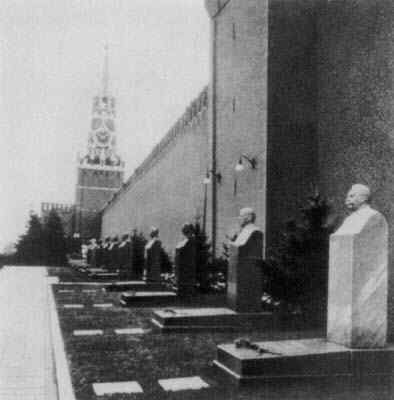
In 1987, people queued around the block to glance for fleeting, rushed seconds at the mummified remains of Lenin, the founder’s fist clenched beneath the eerie glass. Exiting Lenin’s mausoleum in the shadow of the massive red brick Kremlin Wall, the pilgrim walked past idealized busts and burial places of the Soviet Union’s friends and luminaries ("there … that’s John Reed’s slot … "), then spilled out onto Red Square and girded for the inevitable bargaining for jeans and shirts and shoes.

Perhaps the hushed conversation was taken off the crowded street and into a dirt-cheap and dirty stand-up eatery, with the deal being sealed later over a shared bottle of vodka while seated on a park bench, watching the dignified old folks shuffle past, the ones who worked so hard for so little building the nation, their grandchildren circling them like tiny ice cream smeared Sputniks.

In 1999, with the long and fevered century coming to a close, my days in Moscow were spent thinking and drinking, a bit part from a Dostoevsky screenplay, flashing backward and forward from the eighties to the present, haunted by the past, confused by the present, but glad that it no longer was necessary to buy beer from the trunk of a cabdriver’s car or the hard currency shop.

Contemporary capitalism was user-friendly: Merely find the nearest kiosk, spend the ruble equivalent of $5.00, and walk away with more bottles of beer than could be comfortably carried.

Our Friends Share Their Knowledge.

In 1999, both Allan and Kim were living and working in Moscow, where they had first met in the 1980’s while studying at Moscow State University. Better hosts could not be imagined.

Barrie and I were taken for a tour of the KGB museum. We were hustled to the affluent northwestern outskirts for a meal in a theme restaurant where servers in peasant blouses ladled out ridiculously overpriced game dishes to mafia bosses, who were seated astride an artificial, babbling brook.

We viewed thousands of bootleg compact discs that were being hawked at the huge weekend open-air music mart somewhere west of the center, bought a few, and enjoyed the marvelous Kvass (a lightly fermented, carbonated beverage made from bread and malt) being dispensed from one of the old streetside tanks.

We visited a brewpub that could be reached only after passing through a metal detector, where the beer was mediocre, but the selection of pro-am prostitutes was diverse and entertaining, providing us with many new ideas for marketing like-sized American brewing establishments.

We walked along the Moscow River, viewed the city from the Lenin Hills, found the Patriarch’s Ponds, seemingly straight from Bulgakov’s novel, and drank good draft beer on a hot summer’s night while seated on a cement wall at the foot of Kim’s apartment complex, laughing heartily about the proximity of public toilets – out that way, behind the untrimmed shrubbery, where the light bulbs all had been broken.
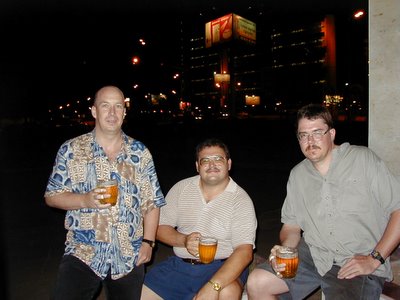
Still, the excursion into the Russian countryside was the best part of the itinerary.

Beer Hunters Lurking.

I awoke groggy and disoriented. We had retreated indoors quite early the previous evening, aiming to avoid mosquitoes of Biblical proportions, and sat inside talking and drinking Baltika Porter from St. Petersburg in the odd glow of a never quite black summer’s night.

Allan’s local helper had been commissioned to prepare fish soup for a midday meal to be consumed just prior to making the drive back to Moscow, and this left us with several hours to explore. Allan proposed a drive to a nearby town.

Armed with bootlegged Jackson Browne and Bad Company CD’s that had been procured for next to nothing at the thriving music market back in Moscow, we set out for the trek to Kolyazin, a dusty and isolated provincial town that has the eternal good fortune to be dusty and isolated less than four hours away from Moscow – this being “good” because a brief look at any reputable map of Russia will reveal there to be hundreds of Kolyazins, most of them located in places that are so lost in the middle of nowhere that they might as well be on another planet.

The open road led through another unreconstructed Soviet-era plantation, then into the "city" limits. A right turn, a rutted dirt street sloping downhill, cracked and peeling pre-revolutionary houses … and at the bottom the street abruptly stopped at the water’s lazy edge. Ahead of us, one hundred yards from dry land, completely surrounded by water, was the steeple of an Orthodox church, which had been converted into an island by the river’s impoundment some years before, no doubt pleasing numerous atheistic bureaucrats at the time of construction.
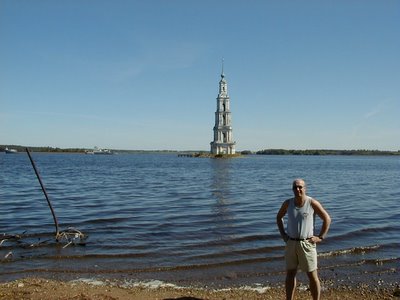
Kolyazin’s bleak main square still was being overseen by V. I. Lenin, his statue no more weed-encrusted and neglected than the remainder of town. The market showed a few more signs of life. Accompanied by children who had sold their services as "protection" for a few cents – they were supposed to be guarding the car, but kept wandering off to invest their newfound wealth in ice cream cones -- Barrie and I bought a few bottles of beer and surveyed the trinkets.

Allan had determined that beer was available in one or all of three places: The market itself, a nightclub, and on draft in a genuine tavern, which was rare in the countryside. The market had bottles of Baltika (a good sign), and the nightclub was closed (also good, judging from the appearance). The tavern was located in a relatively new addition to an older building and appeared positively upscale compared to the surroundings, but once inside, the ambience was late Spartan: A few wooden tables, plastic chairs, and a window to order and collect the beers.

A young, engaging woman served us from behind the counter, noting to the ever-solicitous Allan that the beer was brewed locally and giving him vague directions to the site. As he relayed this information, I saw Barrie’s eyes following something at the base of the wall. It was an adapted garden hose, now serving as the line carrying the beer from the cellar to the tap. Nonetheless, it wasn’t bad golden lager, a bit yeasty and perhaps on the green side, but fresh tasting and refreshing. We resolved to find the brewery.

Back on the main highway in the outskirts of Kolyazin, we followed the barmaid’s ambiguous directions. Eventually Allan pulled over to the shoulder to ask a pair of slack-jawed pedestrians if they knew the location of the brewery, and in opportunistic fashion, they offered us this critical information in exchange for a small fee: A ride.

Moments later the car came to rest in front of what appeared to be a collective farm storage building, more gray concrete with rusty port wine stains down the sides, and no discernable activity on the premises. Our sweaty passengers swore to the authenticity of the site, and suggested that we ask for the proprietor in a cluster of houses at the end of a muddy lane that was sufficiently booby-trapped with potholes that Allan correctly feared for the life of the car. It was midday, and there were few signs of people to ask directions, so we elected to abandon the brewery chase.

Allan drove back down the dirt road to the highway, and as we pulled out I happened to see a hand-lettered, cardboard sign with an arrow pointing to the left and a single word in Russian, one announcing the site of the Grail: Pivo.

That’s “beer” in the Russian tongue.

It was a roadside beer stand, the mysterious local brewery’s de facto open-air tap room, nestled under the welcomed shade of trees in a farmyard littered with puddles, chicken droppings and fish bones, where a lady poured beer from a rigged faucet attached to a single keg, minus the needless expense of extras like refrigeration or television advertising.

At her disposal were six mugs, a basin of well water for rinsing them, and a bowl of rubles for making change. A half-liter of draft beer cost 25 cents, and the origin of the bones was revealed when I offered her a 20-ruble banknote for two beers, and in lieu of coins, she offered two small, leathery smoked fish in return.

Barrie and I chewed on the pungent freshwater fish jerky as Allan conversed with the proprietor, learning that the building we had found indeed was the brewery, that is was operated by a Moscow man who’d moved to the countryside, and that the business was growing.

The beer itself was the same fresh, golden, unfiltered lager that we’d sampled back in the Kolyazin pub. How good was it? I feel that it would be wise to subordinate any critique to the uniqueness of the setting, in this case sitting on a wooden bench, washing away the dust and midday heat with a cool (not cold) beer, and watching two hilariously drunk local farm workers in action.

Their extended liquid lunch break apparently having come to an end, along with the bulk of their money, the two staggered to their feet. One of them pressed coins into the hand of an old man seated nearby, who nodded and disappeared around the corner. Within minutes the old man reappeared, bearing a washtub filled with water, which he proceeded to dump over the heads of the delighted drunks. Soon their ancient Lada sputtered out onto the highway, and when we also left soon after, we were careful to drive the opposite direction.

Mother Russia & Sand Island.

The boat drifted toward shore, the engine was cut, and we were as close as we were going to get to Sand Island. If I intended to make the picnic and enjoy my salami and Budvar, I’d have to get my feet wet. To the surprise of none, Barrie had no doubts: "I’m going in," he announced, and commenced swaggering through the knee-deep water.

As so often before, I was quite happy to let Barrie do the blocking, and after my initial hesitation, I found the layers of black mud and decomposing leaves to be reassuringly soft between my toes.

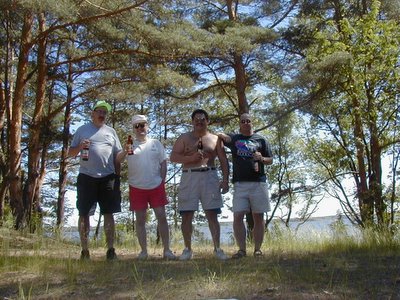
Clambering up the wooded hillside, we established camp in a sandy clearing and watched through the gently swaying branches as the boat disappeared over the horizon. It was as peaceful an idyll as I’d ever known. The salami was greasy, the Budvar beer outstanding, the company of my good friends valued, and the mud – the timeless Volga mud clinging to my feet – unexpectedly reassuring.

Photos by Allan Gamborg, except for the Kremlin wall, which was borrowed from the Lenin Mausoleum website. Here we are (l to r): Roger, Kim, Barrie and Allan.
Saturday, December 03, 2005

Silver Grove’s in the news!

Although precious few New Albanians know about it ...

Once, Silver Grove had its own history, by Dale Moss (Courier-Journal).

It’s a great piece about New Albany’s Silver Grove neighborhood, with a contemporay photo of resident historian Jim Munford, and two old-time views of the area.

The U.S. Constitution: It's why I remain seated.

Daniels: Prayer ruling 'regrettable'; House GOP might announce appeal, by Ashley M. Heher (Associated Press – published in the Courier-Journal).

Their Man Mitch, a.k.a. “Hoosier Vanguard?,” took a quick Friday break from composing his most recent thank-you note to syndicated columnist George Will, and expressed righteous outrage over the ACLU’s refusal to back away from taunting the Christian Right with passages from the US Constitution.

Gov. Mitch Daniels said yesterday that he disagrees with a federal court ruling restricting prayers in the state House of Representatives.

"I just think it's regrettable," he said in his weekly meeting with reporters. "It's in a long line of confusing and sometimes clumsy attempts by courts to insert themselves into this issue."

Confusing and clumsy? Not at all, given that the fundamental question pertaining to this issue simply isn’t being asked.

Why must there be a prayer at all in such a setting?

After all, it’s hardly a church.

U.S. District Judge David Hamilton offers a welcomed nod in this direction:

"All are free to pray as they wish in their own houses of worship or in other settings," Hamilton wrote in his opinion. "The individuals do not have a First Amendment right, however, to use an official platform like the Speaker's podium at the opening of a House session to express their own religious faiths."

Imagine that ... freedom to pray as one wished without state sanction? Perhaps it's something we can at least try here in America.

Rather than debate the semantic merits of neutral theological utterances, simply eliminate the prayer, and people of genuine faith can pursue this avenue in their own way and on their own time without it being commandeered as a backdoor effort to publicly proselytize.

Friday, December 02, 2005

Paint and public art as progressive ideals -- why not in New Albany?

In the interest of reconciliation and progress, it is understood that we can’t have what we want most of all: Fully staged show trials in which previous generations of New Albany civic “leadership” would be compelled to listen to the recitation of their aesthetic crimes against the municipality and be sentenced to penance.

We’re speaking primarily of the era of the 1960’s and early 1970’s, when classic components of New Albany’s architectural legacy, i.e., the post office and the courthouse, were blithely sacrificed for barren parking lots, formulaic banks festooned with Formica, and sterile socialist-inspired structures that continue to blight the cityscape long after the perpetrators have retired to Florida to escape the eyesores of their making.

However, all is not lost. In other parts of the outside world, creative thinkers rush in where fear-mongering troglodytes fear to tread.

We believe that when it comes to correcting the deficiencies of modern architecture, simple solutions like paint and art are capable of transforming this smudgy river town into a brighter, warmer place.

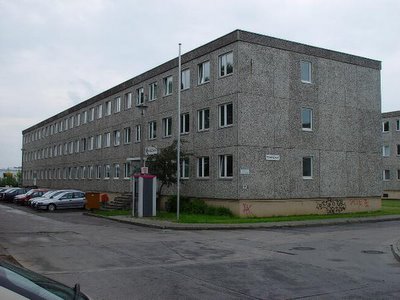
Consider the monumental task faced by those European countries breaking with Communism, where most cities are ringed with gray blocks of flats erected cheaply and rapidly in the post-war era, many similar in appearance (but varying in size) to this one in Greifswald, located on the Baltic coast in the former GDR:

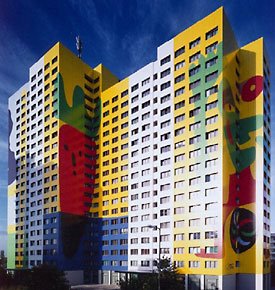
At the risk of oversimplifying the complexities involved with the process of privatizing state-owned apartment blocks, improving the amenities within, and revitalizing neighborhoods outside, it would seem that the most common solution to the simple problem of gray murk has been a coat of paint:
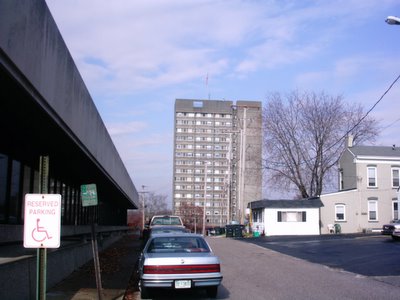
Consider the looming bulk of our Riverview Tower retirement home, a building that would not be out of place in Bucharest or Tirana:
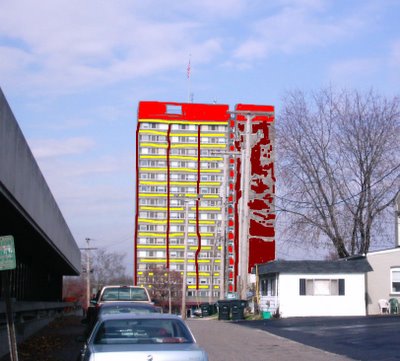
And try to visualize the impact of color, as in this hastily sketched revision:
Local residents Dave and Bonnie Thrasher have been leading proponents of public art as a valued pillar of revitalization, and we’ll leave the details to them and so many others who’ve studied the utility of art in this context.
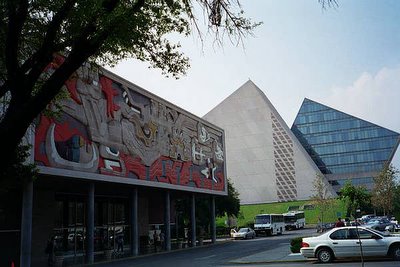
At the same time, while walking to the library yesterday morning, it struck NA Confidential quite forcefully that wall murals and similarly styled artistic renderings are a marvelous way to humanize the windowless walls of public buildings, as in this view from Mexico:

A prominent example of a contemporary structure with a wasted, blank gray wall is the City-County Building:
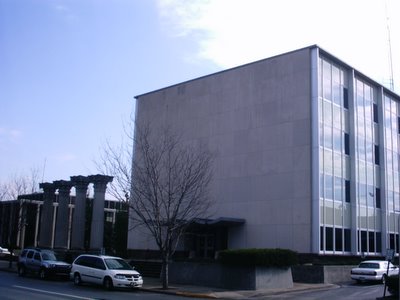
Here’s how it might appear if used as the canvas for a mural:
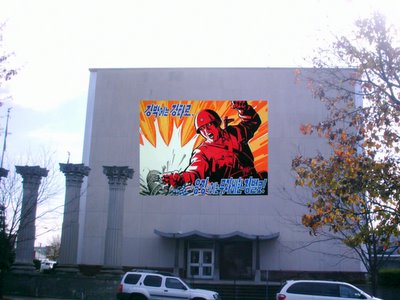
Granted, the scene above is a North Korean anti-imperialist propaganda poster, but you get the drift. I’m seeing an historical scene from New Albany’s past, one that might be realized by a local artist and financed by private fund-raising efforts.

Consider public art a viable plank in the progressive platform … and there’s absolutely no reason why a five-year plan to achieve such a goal cannot be commenced right now.

Addendum: Read about Jeffersonville's flood wall art in an Evening News article by John Gilkey.

Smoking ban addendum: Jeff's new law "at a glance."

As provided by the Courier-Journal:

SMOKING BAN AT A GLANCE

Forbids smoking in buses, taxicabs, retail stores, public places, restaurants, bowling centers and places of employment.

Allows it in outdoor spaces, private residences, retail tobacco stores, private clubs, businesses with no more than four employees and up to 20 percent of the rooms in a motel or hotel.

Imposes a $50 fine on violators, including smokers, business owners and managers.

Takes effect 180 days after being published in a local newspaper.

Smoking ban in Jeff signed by Mayor Waiz as NA's non-smokers eye CM Kochert as their champion.

For the record …

Jeffersonville mayor signs smoking ban, by Alex Davis (short shelf life for Courier-Journal links).

After nine days of deliberating, Jeffersonville Mayor Rob Waiz signed the city's first ban on smoking in public places (on Thursday).

In conversations around town, many people have asked whether such a debate, much less an actual legislative proposal, might emanate from New Albany’s city council -- at least in our brief lifetimes.

In a previous article by the C-J’s Davis, it was written:

Larry Kochert, a member of the New Albany City Council, said he is encouraged by Jeffersonville's move to limit smoking.

He said he considered a similar ban for New Albany about five years ago but dropped it after realizing that support wasn't there.

Kochert said public opinion about smoking has changed, though, and he predicts that the momentum from bans in Louisville and possibly Jeffersonville might be enough to turn the tide in New Albany.

"People who smoke infringe upon my rights," Kochert said. "If I walk into a restaurant, I should be able to breathe clean air."

Sorry, but we’re having trouble envisioning CM Kochert swimming against the tide of ignorance upon which he generally relies for succor, and assuming the progressive leadership role in advancing such a proposal, which if nothing else would require energy, commitment and an appreciation for the realm of ideas.

Like they say, three strikes and you're OUT.

It’s even harder to imagine support for a smoking ban amongst the Gang of Four’s other three card-carrying obstructionists, and even if there were such miraculous interest on the right side of the council table, the continuing absence of any coherent principle of leadership within their ranks surely would doom any effort to stumbling irrelevance, if not incestuous malevolence.

And while it is conceivable that one of the council’s four remaining Democrats might make the issue his or her own, it is less likely that the body’s lone Republican would agree, and it is virtually guaranteed that the Gang of Four would oppose any proposal made from the left side of the council table … which means that almost any way the deck is cut, chances look slim that the current city council will consider a smoking ban any time before 2008.

But two years hence? When mandated redistricting causes the Gang of Four to become the Gang of Two, or even one? When Councilman Cappuccino takes his well-earned retirement to a thatched-roof hovel in the south extremity of Westendia?

If a smoking ban were offered early in 2008 by a city council with a reformist majority, it would be accepted by the voting public and largely forgotten by the following election in 2011, and consequently quite cheap in terms of political fallout.

If we’re still around then, or even if we're not, just remember: You heard it here first.

Thursday, December 01, 2005

Street spam, sign sharks and the sheer joy of litter removal.

Here’s a far too common scene around town.

No doubt you've grimaced at the many "Buys Houses" signs, both on utility poles and in medians or along city streets. The circus posters were put up in September, and many still can be seen, rotting, where they were stapled.

These are examples of "street spam."

Q: What is Street Spam?

A: Street Spam is the term for illegal signs along roadways, at intersections, on traffic signs or utility poles, and even on private property. Illegal street signs are also called vertical litter, bandit signs, snipe signs, utility pole advertising and stuff on a stick (SOS). The signs may advertise local businesses, multilevel marketing schemes selling weight loss products, health insurance, sample sales, landscaping services and even pet waste removal services. Some of the most common spam signs have the come-on Work at Home, Work From Home, I Lost 30 Pounds in 30 Days, Have a PC, We Buy Houses, Affordable Health Insurance, Budget Health Plans, and Going Out of Business.

The preceding definition comes from the FAQ section of the Citizens Against Ugly Street Spam web site.

Until reading the CAUSS FAQ, I wasn't aware that I'm a "sign shark." During city walks, "street spam" has a way of coming off in my hands. As noted by CAUSS, illegal signage (exceptions being legitimate realtor's signs and the like) is nothing more than litter -- and who doesn't believe in picking up litter?

For a similar perspective, and abundant photographic evidence of the targets as identified by these and various other like-minded campaigns, visit Atlanta Street Spam Eradication Campaign.

Anyone for a "sign shark" roaming walk some afternoon?

The Roman winter solstice festival, Saturnalia, inspires a draft beer festival at NABC (beginning Dec. 16).

Following is the press release (of sorts) for our next event at Rich O's Public House and Sportstime Pizza, the on-premise faces of the New Albanian Brewing Company.

If you will, kindly pardon a digression.

Recently, this was said about me by a competitor for the hearts and minds of thinking New Albanians:

We acknowledge, of course, that his (Roger's) skewed sense of self is most likely the result of the continuous consumption of his beverage of trade.

Lovers of 20th-century history will recall Winston Churchill's famous response to Lady Astor, who leveled a somewhat similar accusation at the British PM:

But I shall be sober in the morning and you, madam, will still be ugly.

Churchill also once said:

I take a lot more out of drink that it takes out of me.

Imperfect as all such commercial endeavors remain, I take a great deal of pride at what NABC has accomplished in becoming a nationally recognized "best beer" business, and derive considerable enjoyment from the fact that we somehow manage to do it in New Albany, where so many of the city's own residents continue to insist in the impossibility of such feats.

New Albany's ingrained, ages-old defeatism is entirely unmerited. It can be done here.

If this is the expression of a raging, uncontrolled ego ... so be it. The world brims over with people who mistake their own feelings of inadequacy and discomfort for universal conditions, and expect those with sense of self to apologize for possessing talent and the confidence to exercise it.

Any person with a conscience feels empathy for others who suffer, whether that suffering comes from within or without, and I'm no exception. If there were a foolproof salve for anger and resentment, the first round truly would be on me. But until such a time, there will be no apologies forthcoming from me with respect to the things I do well ... and I'm sorry that some feel differently.

Needless to say, selective sampling for quality control purposes will continue when appropriate.

Now, about Saturnalia ...

THE NEW ALBANIAN BREWING COMPANY PUTS THE PAGAN BACK INTO CHRISTMAS WITH “SATURNALIA MMV,” A DRAFT BEER FESTIVAL BEGINNING DECEMBER 16 … AT RICH O’S PUBLIC HOUSE AND SPORTSTIME PIZZA IN NEW ALBANY.

In pre-Christian Rome, Saturnalia was the annual winter solstice celebration that originally coincided with the feast days for Saturn (god of sowing and the harvest), Consus (god of the storage bin) and Opa (goddess of plenty).

Many of our contemporary winter holiday traditions derive from Saturnalia’s pagan roots, including the hanging of wreaths and garlands, donations to the needy, prayers for peace on earth, time away from work to be enjoyed with family, and of course eating, drinking and merriment.

On Friday, December 16, Rich O’s Public House and Sportstime Pizza pays tribute to these ancient pagan origins with the kick-off of Saturnalia, a draft beer festival scheduled to last past Christmas and New Year’s into January of 2006.

For NABC’s second Saturnalia celebration, I’ve gathered 31 special kegs of beer – some rare, some seasonal and others just innately festive – from America and around the world (see complete list below).

Some of these hard-to-find beers will be appearing in draft form for the first time ever in metropolitan Louisville, as is the case annually during two other renowned draft festivals at Rich O’s and Sportstime:

Gravity Head (strong ales and lagers; begins February 24, 2006).
Lupulin Land (harvest hops; begins October 13, 2006).

When the doors open at 1:00 p.m. on Friday, Dec. 16, the first 15 sacrificial Saturnalia selections for MMV will be revealed, tapped in a ritualistic manner … and the hedonistic pleasure will begin. The 16 remaining kegs will be tapped as needed when the first wave depletes.

Contact: Roger A. Baylor, Co-owner and Publican
812-949-2804
potable@richos.com

THE BEERS.

Pricing and portion sizes vary according to alcohol content and style. Selections marked with an asterisk * are appearing on draft for the first time at Rich O’s Public House and Sportstime Pizza. There will be 31 draft beers in all, with 15 to be tapped on December 16, and the remaining 16 following in due course as openings occur. This will take several weeks. During the festival’s run, information and updates will appear on these web sites:

Potable Curmudgeon
Publicanista!
NABC
Rich O’s Public House

Note: Gale’s Christmas Ale (2003) is a cask-conditioned ale and will be served from the hand-pump beginning on Friday, December 16.

BEER DESCRIPTIONS, BY COUNTRY OF ORIGIN.

BELGIUM

Corsendonk Christmas Ale
Spices likely are used, but precise information is lacking. The effect is subtle and polished, complementing a typically rich, malty, seasonal Belgian Abbey-style ale.
8.5% abv

*De Dolle Special Extra Export Stout
Dolle’s first-ever Stout is brewed with roasted, chocolate, pale and caramel malts; Nugget hops; house yeast; and candy sugar. Combining chocolate, coffee and espresso flavors with Dolle’s characteristically singular funk yields an individualistic Belgian Export-style Stout.
9% abv

De Dolle Stille Nacht
Stille Nacht means “Silent Night” and is Dolle’s winter seasonal, a high-gravity treat brewed with pale malts and white candy sugar, full and sweet in a complex way, with judicious additions of Nugget hops for balance. 9% abv

De Ranke Pere Noel
An amber winter Belgian seasonal that offers traditional elements like spiciness, but builds to a dry, hoppy finish, eschewing the near-universal sweetness of many such Belgian ales.
7% abv

Delirium Noel
The venerable, family-run Huyghe brewery near Ghent created this holiday beer in 2000 to complete their “Delirium trilogy,” and appropriately, Noel blends the clean flavor profiles of Delirium Tremens and Delirium Nocturnum into a unique third way, albeit slightly stronger at 10% abv, prompting the brewery to remind us that it “requires a responsible consumption.”
10% abv

*La Rulles Cuvee Meilleurs Veoux “Best Holiday Wishes”Unpreviewed Wallonian Christmas ale, brewed with multiple malts, three different hop varieties, and fermented with Orval’s unique Trappist yeast strain.
7.3% abv

N’Ice Chouffe
Thyme, vanilla, orange peel and candi sugar are among the spices used to accent a dark and brawny winter seasonal, brewed in the hills of the Ardennes.
10% abv

St. Feuillien Cuvee de Noel
Reddish-brown Abbey-style elixir with secret herbs and spices evident in the aroma, but much less so in the palate, which suggests the quintessential Belgian body and flavor.
9 % abv

GERMANY

Mahr’s Christmas Bock
In the tradition of Yuletide lagers, this is a tweaked version of the classic Bamberg brewery’s springtime Bock – a shade tawnier, and with more assertive noble hop character.
6% abv

JAPAN

Kiuchi Hitachino Nest New Year Celebration Ale 2005
We’ve given last year’s release of this hybrid spiced Japanese micro Eisbock another nine months to age in the keg, and are expecting a smooth, complex character with a punch.
Circa 7.6 to 9% abv

UNITED KINGDOM

Gale’s Christmas Ale 2003
Cross your fingers, folks. Normally two-year old cask ale would be impossible to serve, but this is a special stronger Christmas brew. If it’s right, it could be a Saturnalia high point.
8.5% (cask-conditioned)

JW Lees Moonraker
The name comes from the purported habit of soused local farm workers to try and “rake” the moon’s glow on a placid pond near the Lees brewery. We’ll take some of what they were drinking, bartender.
7.5% abv

*Ridgeway Seriously Bad Elf
This Bad Elf keep getting more obstreperous as the years pass. He’s already been in trouble this year (http://www.sheltonbrothers.com/home.htm) in Connecticut, with Indiana misbehavior still yet to come.
9% abv

Ridgeway Santa’s Butt
A higher-gravity nod to Salopian Brewing’s Entire Butt, itself a revival of the classic English tradition of mixing certain ales to achieve the flavor profile for what eventually came to be known and brewed as Porter.
6% abv

Young's Winter Warmer
Textbook example of a maltier, slightly stronger winter version of an English ale, brewed by one of the world’s most famous breweries (located in London).
5% abv

UNITED STATES OF AMERICA

Anchor Christmas Ale (“Merry Christmas & Happy New Year”)
The recipe has differed each year since the holiday ale’s inception in 1975, but the conceptual links with trees (on the label) and the winter solstice have remained consistent.
5.5% abv.

*Arrogant (Oaked) Bastard
According to Stone Brewing Company, the addition of oak chips to its flagship, “angry” Arrogant Bastard Ale transforms it into something more “sophisticated.” Indeed, the hints of oak complement this rare Bastard’s trademark hoppiness in a worthy and memorable way.
7.2% abv

*Avery Old Jubilation
Previewed in November to rave reviews, Avery’s “winter warmer” ale is mahogany in color, with a malty, nutty and slightly English flavor (sans spices) deriving from the use of five malts and Bullion hops for balance. Rich, elegant, and almost restrained by Avery’s evolving standards of gravity brewing.
8% abv

*Dark Horse Tres Blueberry Stout
This unpreviewed, fruit-laced Stout comes from one of many innovative Michigan breweries.
4.5% abv

Great Lakes Christmas Ale
In general terms, the brewing of holiday specialties breaks down to one of two paths, irrespective of national origins. One is the tradition of adding spices or flavorings to a stronger-than-usual beer. The other is a stronger-than-usual beer, without spices. Upland Winter Warmer represents the latter, and Great Lakes Christmas Ale the former. Four malts, wheat, honey, cinnamon, ginger and grapefruit-like Cascades hops combine to produce a dictionary definition of spiced holiday microbrew, American-style.
7.5% abv

Left Hand Milk Stout
The addition of lactose (milk sugar) to stout is an English practice, with the calories added helping to bolster claims of nutritive qualities that probably would not withstand the scrutiny of modern science. This is a decidedly sweet stout not to be mistaken for Guinness or stronger Imperial Stouts. Pleasant notes of chocolate and oats, low gravity.
5.2% abv

New Holland Phi
Another Michigan innovator, one that offers annual, wildly differing interpretations of a proportional recipe formula as part of its high gravity series. The 2005 Phi is golden and strong. What is it? If you have an opinion, let me know.
9% abv

*Oaken Barrel Epiphany
Brewer Ken Price uses Westmalle Trappist yeast to fashion this tasty Tripel, which nudges toward the sweet side of the range without sacrificing a velvety elegance.
Circa 9% abv

Rogue Chocolate Stout
Brewed with a staggering 10 ingredients, including chocolate malt, chocolate flavoring and rolled oats, and rich in every conceivable respect. Draft is made available very selectively, so we’re fortunate to have one.
Circa 6% abv

Rogue HazelNut Brown Nectar
First concocted in honor of a creative, homebrewing friend of Rogue’s head brewer, HazelNut Brown Nectar is brewed with hazelnut extract, a half-dozen malts, Perle and Saaz hops, and Rogue’s trademark yeast strain.6.2% abv

Rogue Santa’s Private Reserve
After a year’s absence, Santa’s Private Reserve is back on draft as part of Rogue’s “John’s Locker Stock” series. Imagine a slightly bigger St. Rogue Red with double the hops, and you’re almost there.
Circa 6.5% abv

*Schmaltz He’Brew Jewbelation 5766
What can be said about a contract brewing company that says it is “celebrating nine years of delicious beer and delicious shtick”? Jewbelation has 9,000 lbs of 9 different malts and 9 different hop additions.
9% abv

Sierra Nevada Celebration Ale
Speaking from the perspective of a dozen years’ experience at Rich O’s, it is indeed difficult to imagine another seasonal ale that symbolizes the holidays better than Celebration Ale. Desert island beer for many, recurring seasonal favorite, with generous doses of Chinook (for bittering), Cascades and Centennial hops, dry-hopped with all three, but not neglecting a delicious malt underpinning.
6.8% abv

*Summit Winter Ale
Unpreviewed, but on the dark side, inspired by English winter ales, and almost surely malty rather than hoppy.
5.9% abv

Three Floyds Alpha Klaus Xmas Porter
Only Three Floyds Brewing Company would devise a robust porter with English chocolate and Mexican sugar (or vice versa, depending on the source) that reeks of piney hop essence and is built on a broad, malty foundation. We’re quite happy they did. Highly recommended by anyone who’s sampled it previously, including the Publican.
7.5% abv

Upland Winter Warmer
Upland’s winter specialty is perhaps best described as a cross between an Old Ale and an English-style Barley Wine, falling a bit shy of the strong American microbrewed interpretations of both styles. Compare to the Young’s Winter Warmer.
9% abv