Listening.
That's why he's here, you know.
Just one question: When has Slick Jeffie ever heard what's being said?


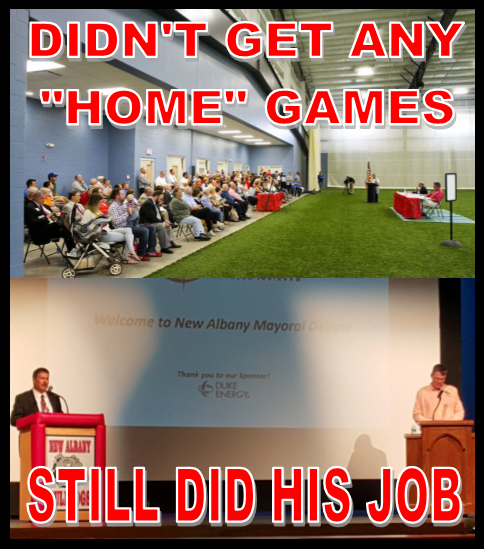
Gahan is far more energetic in ducking debates than keeping campaign promises from 2011.
... In the assumption that Kevin Zurschmiede would be out of town for his son's wedding, Jeff Gahan carefully planned his mayoral debate schedule to avoid any unmanageable situation requiring the three of us to appear together, accepting invitations to events staged by the New Albany Housing Authority (Sept. 22) and the League of Women Voters (24th), and declining to participate in what obviously stood to be the most substantive and challenging, debate, as organized by Leadership Southern Indiana on the 29th.
Gahan already has refused to attend the Southern Indiana Realtors Association question and answer luncheon. Another such mayoral chat, put together by the Builders & Development Association, was cancelled. Had it been held, Gahan would not have been there.
(Zurschmiede was unable to alter his travel plans and couldn't) come to Silver Street Park (Gahan's de facto "home" field) for the League's debate, which will feature questions provided in advance from LWV organizers like Linda Moeller, who also is Gahan's appointee as controller and openly acknowledges her position as high-ranking Gahan campaign worker.
Thus far, the League has managed to misspell Zurschmiede's name twice (differently each time) on promotional materials, which incorporate an 8-year-old photo of me, when literally dozens of more recent photos can be found merely by Googling my name and clicking on Images.
In short, the only debate at which all three candidates will appear is a softball toss orchestrated by Democrats supporting Gahan, who conveniently wave the League's "impartial" banner. It's a farce, and needs to be recognized as such, but I wouldn't think of missing.
Kevin (Zurschmiede) actually voted against the expenditure for the park and many others questioned it, including Roger. Gahan, in turn, has been continually using it as a prop for campaign purposes. The League declaring it something beautiful of which to be proud, a very pro-park and, in context, pro-Gahan stance, isn't exactly impartial so it's not difficult to see why many people are questioning venue choice. I think the brewery that Roger helped build is great and an asset to the community but I wouldn't suggest that holding a mayoral debate there would be impartial. The same could be said of Kevin's properties. The park is technically public but the association is plain. Given the low number of New Albany forums involving all the mayoral candidates, it doesn't seem unreasonable that a single alternative date and/or location could be explored without conflicting with another event. Besides the LSI debate, what other neutral events involving all the mayoral candidates are scheduled between now and the November election that would make it difficult to find another date or location? The library, the Carnegie Center, IUS, or any of the public schools would be neutral. Is there really not an alternative date available at any of them over the next couple of months? At best, this is an honest mistake but it's not too late to correct it.
OUR OPINION: Candidate forums offer direct Q&A
... But how do we know what any of (the candidates) are thinking, what their ideas are, their priorities, and if they match ours?
We can’t rely on glossy fliers or scripted political ads to tell us what we need to know. We need face time.
Fortunately, the South Central Indiana League of Women Voters is making it easy for us to connect with candidates who want our votes.
Beginning Thursday, the League of Women Voters is hosting a series of candidate forums — in our own back yards. Charlestown, New Albany / Georgetown, Jeffersonville and Clarksville voters can hear directly from candidates in their communities.
The best part is that candidates get the chance to speak directly to us, and we can ask them questions about issues that are important to us. No filter. Just us, and them ...
— The News and Tribune Editorial Board members are Publisher Bill Hanson, Editor Susan Duncan, and Assistant Editors Chris Morris and Jason Thomas.
Editorial: Why political debates still matter LA Times Editorial Board
... Nothing beats the potential of old-school debates to reveal and humanize the men and women behind the glossy ads and focus-group-approved slogans.
Admittedly, debates can often seem like well-rehearsed exercises in reciting talking points and staying on message. Still, it can be tremendously informative when two candidates vying for the same important job stand (or sit) next to each other in front of an audience to answer questions, describe their policy differences and, well, debate. Unscripted forums offer a rare glimpse into candidates’ foundational character traits and temperament. They can also indicate how well a person might handle the unexpected challenges that arise once he or she is in office.
Political forums kick off in Charlestown ahead of election, by Tara Schmelz
CHARLESTOWN — About 75 Charlestown residents filled the downtown square Thursday night to hear from candidates seeking local office, as part of the first of a series of forums hosted by the South Central Indiana League of Women Voters.
However, something was missing.
The Republicans.

 |
| Gahan ducked primary opponent David White --twice. |

New Albany needs grassroots empowerment, not top-down cliques. David White gets it. Maybe that's why Jeff Gahan won't debate him.
I'd love to see David have the chance to debateGoliathGahan. I actually believe at some level Gahan himself might want to do so, given his outrage at the temerity of anyone daring to challenge his reign.
Regrettably, the odds are that Gahan's handlers won't allow it. They know he can't do improv, and they fear the emergence of the nocturnal Mr. Hyde. But a boy can dream.


Stalin was so paranoid he suspected his pet parrot of deviant tendencies when it imitated his crude spitting; he purged it with a death blow from his pipe.
New Albany mayor, redevelopment official debate benefits of Rails to Trails project, by Chris Morris (Tom May Biblical Odyssey)
NEW ALBANY — Scott Stewart said the Rails to Trails proposal sounds intriguing, and admits the idea looks good on paper.
However, as a member of the New Albany Redevelopment Commission, Stewart voted no on hiring Indianapolis law firm Faegre Baker Daniels (FBD) to assist with advancing the Rails to Trails project. The measure passed 4-1 recently with FBD being paid $125,000 for its services.
The Rails to Trails initiative would replace abandoned CSX train tracks that run 63 miles — starting just north of the new Sazerac facility (at the former Pillsbury Plant) in New Albany and ending near Bedford.
Stewart said there are only so many redevelopment dollars available, and he would like to see the money used to benefit New Albany residents. He said connecting neighborhoods and making them more walkable is something he supports.
"When you look at New Albany, we have wonderful neighborhoods and downtown, there is the Greenway .... there is a lot to build on," he said. "I would like to see safe pathways for cyclists and walkers."
Stewart said developing Rails to Trails would cost millions and while FBD may help secure some state funding, those dollars will be capped leaving the city and other communities along the trail responsible to foot the bill.
"It faces immeasurable challenges. The financial commitment is significant," Stewart said of the idea. "It just didn't makes sense to me.
"Where does it go from here? There is a much bigger potential to distract scarce resources from our neighborhoods and business districts. I am interested in taking care of New Albany first. This is a discussion of a difference in priorities."

Mills' opponent continues to dodge debate ...
The lengthy process of trying to secure a debate for the benefit of the voters in Floyd County now continues. Mills was originally disappointed when he learned that Leadership Southern Indiana (LSI) was not going to sponsor a Sheriff debate this election cycle, as has been the case in previous elections. This was especially disappointing since both candidates for Floyd County Sheriff are graduates of the LSI program.
The Mills campaign was also concerned when it learned that a relative of the current Sheriff is a member of the LSI Advisory Board where they also serve on the organization’s community relations committee. This committee has been previously charged with running the logistics of LSI debates. The LSI Board of Directors issued a statement in late August stating that the organization will not host debates this year. Conversations between LSI and the Mills campaign reveal that the organization will likely continue to host debates again in the future, but for “capacity reasons” they are just taking a break from debates during this election cycle.
Based on his comments to the News and Tribune on August 28th, Sheriff Loop seemed open to a debate, but only with the two community groups who had already stated they were not interested in hosting a Sheriff debate this year. Loop said he would "absolutely" debate Mills. "I would be glad to entertain the possibility," Loop said. "I think somebody like a 1si (One Southern Indiana) or LSI (Leadership Southern Indiana) ought to put it together to make sure it is fair, but I would be glad to participate."
The fire this time – the legacy of James Baldwin, by Lanre Bakare (The Guardian)
His work fell foul of civil-rights-era binary racial and sexual politics but, as a new film shows, now Baldwin’s ideas are used to explain everything from Trump to Black Lives Matter
... For Baldwin scholar, professor of English at Yale and author Caryl Phillips, the return of Baldwin to mainstream thinking isn’t surprising at all. For him the big issues concerning American life now – the rise of crude, racially charged politics, killings of unarmed black men by the police, an apathetic public – repeat a history from which Baldwin’s critiques still offer some solace. “People are looking for someone who can articulate these issues,” says Phillips. “I think the person who has probably articulated what it means to be an American and what it means to be black, with more eloquence than anybody else in the last century, is Baldwin.”
You might see a film about William F. Buckley and Gore Vidal’s ten televised debates during the 1968 presidential conventions as an opportunity to bask in eloquent, pointed repartee. You might also enjoy the spectacle of two of the foremost intellectuals of their time coming very close to physically beating the crap out of each other. You might not expect, however, to find yourself weeping — for the state of the republic and the poisoned media landscape, for the decay of the American social contract. Yet here we are. Robert Gordon and Morgan Neville’s masterful Best of Enemies leaves you with an overwhelming sense of despair. It’s not just a great documentary, it’s a vital one ...
... Best of Enemies’ true aim is to lament a bygone political discourse. Vidal and Buckley may have started off as representatives of an old-fashioned school of debate, learned and articulate and polite, but by the end of the conventions they wound up unwittingly inventing a new media landscape: one of constant conflict, sustained anger, and barely contained violence. Gordon and Neville find in these two men’s infamous clash a turning point, the moment in time when the networks, the press, the pundits, and even average Americans first realized their taste for political bloodsport. A terrible beauty had been born, as they say. This might be the saddest film of the year.
It is fascinating, not for any supposed lost standard of excellence in argument – the drawling debates look like a squabble between two snippy and indistinguishable twins – but for showing us two examples of that exquisite, extinct breed: the literate “political classes” willing to exchange high-flown badinage on television. The contest was always about who would lose their cool first and it was Buckley, furious at being called a “crypto-Nazi” and threatening to sock the “queer” Vidal in the face, live on camera. Buckley had, therefore, humiliatingly lost, but Vidal endured the ignominy of irrelevance as Buckley became the height of political fashion in the Reaganite years. They both then entered the wilderness as incorrect patrician wordsmiths who no one cared about any more.
In 1968, as the summer political-convention season approached, ABC News decided to take a gamble. The network seemed permanently stuck in third place, and its news division in particular suffered from the lack of a brand-name on-air authority figure to compete with Chet Huntley and David Brinkley at NBC or Walter Cronkite at CBS. Back in those days, the two leading networks covered the conventions live from beginning to end. (Can you imagine?) Instead of comprehensiveness, ABC went for provocation and at least the illusion of intellectual heft, hiring Gore Vidal and William F. Buckley Jr. to conduct a series of debates during the Republican circus in Miami and the subsequent Democratic debacle in Chicago. “Best of Enemies,” Robert Gordon and Morgan Neville’s lively new documentary, an accessible assemblage of archival footage and talking-head analysis, mines the Buckley-Vidal skirmishes for nuggets of historical insight.
And also — not quite the same thing — for zingers and gotchas and other flashes of that mysterious, you-know-it-when-you-see-it phenomenon called “great television.” The most memorable such moment occurred late in the battle, as the Chicago Police Department rampaged in Grant Park. What looked like law and order to Mayor Richard J. Daley and like “Gestapo tactics” to Senator Abraham A. Ribicoff of Connecticut set off a series of especially nasty personal volleys between ABC’s designated intellectuals. Vidal needled Buckley, calling him a “crypto-Nazi” until Buckley lost his patrician cool and snapped back: “Now listen, you queer. Stop calling me a crypto-Nazi or I’ll sock you in your goddamn face and you’ll stay plastered.” Ratings gold.
 |
| Our corporate class. |
No, Hillary Clinton Should Not Go Business Class When She Gets into Office, by Charles P. Pierce (Esquire)
... On Tuesday night, because I could not sleep and do not have a life, I checked in on a replay of a recent debate between the candidates for the U.S. Senate seat from Indiana. The Democratic candidate is Evan Bayh, a classic Simpson-Bowlesite who left the Senate once before because the political climate had gotten too hot and the Senate too wild for his delicate constitution. He then became a lobbyist. Now he wants to get back to the Senate because…oh, hell, who cares. I tuned in just in time to hear Bayh brag that he was opposed to the estate tax and that he would vote for its repeal.
Except he didn't call it that.
He called it "the death tax."
The death tax.
I'm amazed that he isn't telling people he's running for the Senate as the candidate of the Democrat party.
Evan Bayh is half an anachronism and I suspect he doesn't know it. The country has changed. So has the Democratic party. I remain cautiously optimistic that its presidential candidate realizes that as well.
WITHIN CITY LIMITS: Episode IV, The Saga Continues: My Trump Soap Box.
With the recent news of Donald Trump missing the next debate (which will have happened by the time you read this) I felt that now was the time to dust off my anti-Trump rhetoric and bless you all with an article filled with my anger, because this is a blog after all.
Trump Plays It Smart, While the Rest of the GOP Field Rips Itself Apart, by John Nichols (The Nation)
... Trump skipped Thursday night’s Fox News debate in Des Moines, a move that at the start of the 2016 Republican race would, indeed, have been considered unacceptable, unimaginable, and unexplainable.
But anyone who watched the debate without Trump quickly understood why he decided that he was better off across town.

Fact or fiction? Weighing the truth in Jeffersonville's mayoral debates ... Weighing the truth in Jeffersonville's mayoral debates, by Elizabeth Beilman (News and Tribune)
JEFFERSONVILLE — Throughout all three debates this election season, Jeffersonville mayoral candidates Mike Moore and Dennis Julius challenged the accuracy of some of each others' statements, asking audience members to look it up for themselves.
Here are the facts.
New Albany candidates hit issues, criticize Gahan, by Lexy Gross (C-J)
Independent candidate Roger Baylor and Republican Kevin Zurschmiede answered questions from a four-person panel at New Albany High School. Incumbent Mayor Jeff Gahan was invited to the debate hosted by Leadership Southern Indiana, but his campaign chose not to participate.
Gahan's campaign committed to two debates during election season, but all three mayoral candidates won't debate on the same stage before Nov. 3.
In one of the final questions of the night, the candidates explained their vision for New Albany.
"As mayor, I want to create a city where people want to live," Zurschmiede said.
Echoing previous notes about attracting millennials to New Albany, Baylor said he considers himself a "bridge to the next generation."
 |
| Courtesy of the Floyd County GOP page at Fb. |
New Albany mayor's debate focuses on who wasn't there, by Jerod Clapp (News and Tribune)
NEW ALBANY — Several issues were brought to the stage, but Tuesday’s New Albany mayoral debate was bookended by who was missing from the discussion.
Two of the three candidates running for the seat — Kevin Zurschmiede, a Republican, and Roger Baylor, an independent — participated in Leadership Southern Indiana’s debate at New Albany High School.
Roger Baylor, Independent candidate for New Albany mayor, answers a question about public health and safety during a League of Women Voters debate. Incumbent Democratic candidate Jeff Gahan attempts to rebut.


