New Albany is a state of mind … but whose? Since 2004, we’ve been observing the contemporary scene in this slowly awakening old river town. If it’s true that a pre-digital stopped clock is right twice a day, when will New Albany learn to tell time?
Showing posts with label Travel Preludes. Show all posts
Showing posts with label Travel Preludes. Show all posts
I'm sore because the pandemic postponed Poperinge's Beer and Hop Festival, and so this week I'll be flooding the blog pages with reruns of past visits, such as I can remember them. They never taught memory loss at beer pioneer school.
Three views from 2005. Diana and I rode into Poperinge from the coast; we stayed in Ieper and rode the train back and forth to the hop fest.
Guy, the co-owner (with his wife Bea) of the Palace Hotel, was serenaded on the occasion of his 60th birthday.
Hops on the cycling route into Poperinge.
One slice of color from the parade.
In 2005 Diana realized she liked beer after all. Certain kinds, that is. The revelation came in Brugge, when she absconded with my Trappist ale, a Rochefort 10, during our session at t' Brugs Beertje.
Hence this dispatch from Poperinge, where she closed the deal. It was dated September 22, 2005 and written following our return home for publication at The Potable Curmudgeon.
---
In the grand tradition of beer advertising, we've chosen a beautiful woman to display the product being touted. Trust me - it's really Westvleteren 12, the beer that “disappeared” from circulation when it was selected as the best beer in the world by readers of RateBeer.com. Not that it was easy to find, even in Belgium ... even where it is brewed. The Cafe de Vrede, across the lane from the Sint Sixtus Abbey, was closed for its annual autumn break, which seems usually to occur at the very same time that beer lovers gather in nearby Poperinge for the triennial hop festival. We biked past the venue, and as my old friend Barrie would say, paused to kiss the lock on the door before proceeding into town. Arriving at the marvelous Hotel Palace in Poperinge, we found no Westvleteren at that estimable cafe; actually, it wasn't clear whether Guy had had any from the start, or whether his stock already was depleted by the time we checked on Saturday. Cafe de la Paix? Fine food and a great beer selection, but no, not there, either. Then on Sunday, in preparation for the parade, we dined at the Poussecafe, located just up Ieperstraat from the Palace, and the elusive Trappist elixir was right there, printed on the paper menu, in full view. I asked the server, who proved to be the owner Kurt, "Do you really have this beer in stock?" He shrugged and replied: "It wouldn't be listed if I didn't." An incredible lunch followed, and the food was good, too, but I still prefer Rochefort 10, with Westvleteren a close second. Later, comfortably seated along the parade route, I was introduced to a great new way to enjoy Poperings Hommelbier. Pitch the lemons and limes, and go back to the basics.
The Cloth Hall in Ieper (Ypres), with St. Martin's Cathedral behind it. Everything you see here was a hole in the ground in 1918.
I'm being petulant because the pandemic postponed Poperinge's Beer and Hop Festival, and so this week I'll be flooding the blog pages with reruns of past visits.
The three segments of this decade-old documentary -- Geert Mak's In Europa ... "1915 Ieper" -- last only 40 minutes, but it's an invaluable introduction to the lasting impact of World War I.
---
I'm trying not to read very much into this breathtakingly trite observation, but time has a way of passing.
Between 1998 and 2008, I traveled to Poperinge nine times, five of them with a bicycle as integral component of the itinerary. However, 2017 will mark only the second time back since 2008, and in the interim, much has changed in Pops and environs.
Well, duh -- and yet it's always amazing the way a human mind can remain stuck in self-enforced sepia, visualizing a milieu as it was, as though life itself wasn't dynamic and ever shifting.
Westhoek means "west corner" in Dutch, and as a region, Westhoek includes the areas around Poperinge, Ieper, Watou and Diksmuide. More so than the Middle Ages or Napoleon -- far more so than World War II -- these locales were profoundly impacted by almost four years of constant combat during the Great War.
In the year 2000 on the Monday of our first-ever bicycling adventure using Poperinge as a base, we rode to Ieper (ee-per). That's the Flemish version; it's Ypres in French and 'Wipers" to British soldiers during World War I. Barely a stone was left standing in Ieper at war's end. The whole city was rebuilt from the cellars up, and to this very day, tons of unexploded ordinance surface yearly.
On that first day in 2000, as we headed east from Poperinge, the French hills known as Trois Monts almost always could be seen rising on the horizon to the south, and although they aren’t particularly big, the flatness of Flanders magnifies their significance and one can readily understand their strategic importance in wartime.
The hills are why the Germans attacked in this direction. The Allies answered, and the result was years of devastating trench warfare stalemate. Just to the north, the Allied flank was secured only by a desperate expedient: the dikes near Diksmuide were breached and thousands of acres of farmland flooded to create a wall of water.
Our cycling journey took us past numerous Great War monuments and cemeteries of the British Commonwealth forces, whose final resting places attested to the global scale of the First World War: Irish, Australian, Canadian and Indian soldiers, buried alongside lads from Manchester and Newcastle. The resting places of Belgian, French and German soldiers also were seen.
Monday’s midday sag brought us to the center of the city, and a tale I've never forgotten. When the second world conflagration swept through Belgium, one young Ieper native resolved to escape. He made it somehow to the then-colony of Belgian Congo, and later to South Africa, where he enlisted in the British armed forces and fought against his country's German occupiers until 1945.
Afterward he returned to Ieper and founded a restaurant and pub, sold it, then opened another, called Ter Posterie for its location opposite the post office.
Ter Posterie was another classic Belgian cafe, with many dozens of bottled ales, a few more on draft, savory food and a comfortable outdoor terrace, where we sat and discussed our first half-day’s ride.
I never knew this man’s name, but nonetheless met him on three different occasions while enjoying the beer, food and hospitality at Ter Posterie. By 2000, active control of the business had long since passed to his daughter, although the old man still frequented the establishment.
Whenever he heard English being spoken, he'd amble over and spin his life story for the visitor in a narrative honed over thousands of ale-side retellings. Apparently we met him as he was descending into Alzheimer’s disease. During one visit on a quiet afternoon, perhaps in 2005, he could be heard howling somewhere to the rear, with harried family members rushing back and forth to care both for him and the cafe's guests.
At some point prior to 2009, he died, and later Ter Posterie closed.
In circuitous fashion, we return to the inevitability of change. I'm writing these words in advance of our actual visit to Poperinge and Haarlem (Netherlands), which I suspect will be a tad more elegiac than those stays in previous years.
In Poperinge, the triennial hop fest rolls merrily on. Luc is retired from the tourist office, and it's been almost ten years since Guy and Beatrice ran the Hotel Palace. It remains a viable business, just not the same for me as before.
In Watou, Chef Stefaan Couttenye's wife Sabine died a few years ago. She ran the front of the house at 't Hommelhof, and I worked with her twice when making arrangements for feeding my motorcoach groups.
I'd visited Poperinge prior to my period of obsession with bicycling, and for this reason my friends joined me in biking there for the first time in 2000, but there'd have been no biking without the encouragement and tutelage of the late Kevin Richards, who'll be very much on my mind as the parade unwinds in 2017. Glasses will be raised, repeatedly.
As you're watching the video prefacing these thoughts, remember that 100 years ago, there seemed to be no future for Westhoek. The people there persevered, and they built it back.
For me, returning to Poperinge will be like visiting old friends, albeit missing a few of them. All I can do is promise to remember them, and keep moving forward.
Before I had left for Southeast Asia someone had told me that the worst part of traveling is coming home and having the travel bug. I didn’t truly understand the gravity of that statement until I had returned home after traveling and living in Southeast Asia for six months. You leave your home country to be a part of something different, to push yourself outside of your comfort zone, to find yourself. When you come home, everyone asks, “how was your trip?” as if you went on vacation to Florida for a few weeks – not fully understanding the crazy, beautiful, meaningful experience that was your “trip”.
It seems that the older you become, the more you have to come home to, in need of tending: families, pets, work and obligations. Finally you reach an age where these demands have receded -- and so have you.
Consequently, I've never felt the first pang of regret that I traded "normal" Southern Indiana existence for the chance to travel when I was in my twenties. Opportunities were lost, and other gained; overall, the balance suits me.
Then in my thirties and forties, I was able to parlay relative (trust me) success in business into further opportunities to wander. These days, I'm doing it again, just without the business ... quite yet.
Who needs money for retirement when he never planned on retiring, anyway?
One wishes to recapture the innocence, but it's like trying to forget what you know about playing a musical instrument, which is to say you can't unlearn what you already grokked. The thrill is gone, but it hasn't gone away. The rewards are more mature, accepting and knowing.
We've changed a lot, Europe and me, but we're still a team.
Later this evening, everyday life at home will resume. If experience is to be trusted, my psychic batteries will be recharged, at least for a little while. We'll see what happens next, for so long as next time comes around.
As noted previously, Dossier #37 likely will be remembered as an elegiac journey, though not to say mournful or melancholy. The past year has been a hard one in the sense of saying goodbye to family members and friends who were destined not to experience the "next" time. All I can do is carry their memories forward as best I can, and I will.
It will be good to be back. It will be better to leave again, next time. To my closer friends among you, simply this: don't ever allow me to read Alan Moore's novel Jerusalem at such a juncture in my life, ever again.
It was a wonderful book, to be sure (thanks Jon), but a little metaphysics goes a long way. I departed for the trip terrified that I'd find myself gliding through the streets of Amsterdam, hallucinating about stairways to Mansoul, and searching desperately for a cluster of Puck's Hats.
If this really occurred, there'll be a likely culprit -- and I'll tell you about it tomorrow.
In far-off olden times, a "Jopen" in Haarlem was a wooden barrel of roughly 30 American gallons, used to transport beer from burgeoning riverside breweries to customers throughout the city.
The ensuing ale barrel of an idea for what eventually became today's Jopen Bier stretches back all the way to the 15th century, when Jopens were filled with Koyt, Haarlem's municipally-regulated gruit beer.
To give the beer a better flavour and extend its shelf life, gruit is added to it. This is a herb mixture with sweet gale as its main ingredient. When it comes to trading and distribution, landlords tax the brewers, and they are forced to buy their gruit from specific suppliers. Haarlem city council sets up a large number of regulations and statutes that describe the beer production process down to the finest details. In 1407, Koyt is brewed in Haarlem in accordance with the brewing statute (recipe prescribed by the council). Its consistent quality makes Haarlem gruit beer famous far beyond national borders. During the 15th century, Koyt is the most popular beer in Antwerp.
I'm trying to imagine New Albany's city council designing (and enforcing) beer recipes. Changing times, and all that.
More than 500 years later, a momentous event occurred in the history of Haarlem, both city and beer, because I went there for the very first time. Perhaps not coincidentally, five years later a serious effort began to reclaim Haarlem's lost brewing heritage.
Haarlem council posts a newspaper request for ideas to commemorate the city’s 750-year anniversary in 1995. Ideas related to beer are suggested. After all, the city along the Spaarne River developed around the production and sale of its own beer. The Haarlem Beer Society is established in 1992 with the aim of making traditional Haarlem beer available once again. Walter Schelfhout combs the city archives for old council recipes and comes up with two, dating back to 1407 and 1501. Council archaeologist Maarten Poldermans and Haarlem historian Loes Vroom verify the authenticity of the recipes and Leuven University recreates the beer.
By 1996, the present Jopen company had been formed to brew beer in Haarlem on a regular basis, although at first it functioned strictly as a contract brewer. In 2005, after years of negotiation, Jopen purchased the Jacobskerk, and in 2010, the renovated church opened for business as the Jopenkerk brewpub.
Since then, in a growth arc familiar to all American craft beer lovers, increased demand has led to the construction of a production brewery in the Waarderpolder industrial park near Haarlem. The downtown brewery is the smaller batch showpiece, and the beers for distribution are brewed at Waarderpolder.
In 2015 came yet another Jopen installation, a distillery/cafe in Hoopddorf, a town a few miles south of Haarlem -- and yes, it's also located inside a former church.
I like their style.
Seeing as my most recent stay in Haarlem came in 2008, apparently I've missed all the fun times at Jopen. On the other hand, having shot the entrepreneurial rapids with NABC since just before Jopen's inception, it actually may be the case that the grandest times for customers have been the most stressful for the brewing company's owners.
That's often the way it works.
---
As this post it published, it is Saturday, the last full day of our trip. I'm sure we've had the chance to visit the Jopenkerk by now.
Truthfully, for at least the past two decades -- probably closer to 30 years -- I've almost never seen a church gone-out-of-business without pondering what a fine brewery it would make.
It's contagious.
Beer enthusiast or not, it’d be hard for anyone to argue that this isn’t one of the most stunning breweries, with its gorgeous and colorful interior, earning Jopenkerk the honorable title of “Best Looking Bar in the Netherlands” in 2013.
I've always like Jopen's ales precisely because they weren't hop bombs. Nowadays, I'm sure some of them are, but I'm a sucker for historical recreations like Koyt and Adriaan, and it is likely those are the ones I've been drinking.
In 2008, the Jopenkerk brewpub was a cordoned-off building site. Now, exciting new chapters of Haarlem's brewing history are being written. It's too bad Michael "Beer Hunter" Jackson wasn't around to help edit them. He'd have enjoyed the beer-in-church thing, I think.
Dredge the filet in chopped onion, grasp the tail, and down the hatch it goes. Rick Steves displays proper form in this video.
In the winter of 1992, nearing the end of my post-communist teaching assignment in Kosice (now independent Slovakia), I took an overnight train to Brno (these days, in the Czech Republic), then an all-night bus to Rotterdam. I proceeded to spend a week in the nearby satellite town of Spijkenisse with Bram and Rie, elderly parents of Nelly, my former neighbor out in Georgetown.
Those wonderful days are a story of their own. Bram took great delight in showing me the sights, and one day we turned up at Scheveningen (a neighborhood in The Hague) for a sunny but frigid afternoon at the beach.
Bram wanted to know if I liked herring, and I answered affirmatively, imagining he meant pickled herring like I'd often had in Copenhagen. We found a fish vendor, and I was handed a cardboard vessel with what I assumed was raw herring (it's actually frozen, then salted for preservation).
Following my leader, I tipped my head and took a big bite.
Then smiled, broadly.
Back to Rick Steves ... who needs to understand that it isn't really pickled, you know.
I’m under the towering church spire in the tidy Dutch market town of Haarlem, tempted to eat a pickled herring. The sign atop the mobile van reads: “Jos Haring — Gezond en Lekkerrr” (healthy and deeeeeelicious).
I order by pointing and ask, “Gezond?”
Jos hands me what looks more like bait than lunch, and says, “En lekkerrr.”
I stand there — not sure what to do with my bait — apparently looking lost.
In other Haarlem food notes, I see the De Ark restaurant has closed. That's shame. It was an old school slabs of meat and baskets of potatoes kind of place, stacked amid venerable wooden ambiance. It will be missed.
At the precise moment of this post's pre-set publication, we're likely eating breakfast in Haarlem, a city that is much to my liking by virtue of having friends there, as well as its proximity to Amsterdam to the east, and the sea to the west.
To tell the truth, there have been occasions when I've stayed in Haarlem and not even bothered to go to the bigger city 20 minutes away except to fly home.
Granted, there are distinctive museums, cultural attractions, food, drink and frivolity in Amsterdam, and yet Haarlem always has struck me as just fine in its own right, smaller and no less interesting.
Whether Amsterdam or Haarlem, one classification of pub- or tavern-being that has always impressed me in Holland is the institution of the brown cafe. Here's a good description from a non-beer-centric source.
You haven't really tasted Dutch beer until you've tasted it in Holland, served Dutch-style in a real bruine kroeg (brown cafe). These traditional Dutch bars are unpretentious, unpolished institutions filled with camaraderie, like a British pub or an American neighborhood bar. In a brown cafe, pouring another beer is much more important than dusting off the back bottles on the bar; the ritual is to draw a beer to get as much foam as possible, then to use a wet knife to shave off the head between a series of final fill-ups.
Even if you're not a beer lover, venturing into a brown cafe in Amsterdam will give you a peek into the city's everyday life. In old neighborhoods, brown cafes are on almost every corner -- you can't miss them. Most have lacy curtains on the bottom half of the window, and perhaps a cat sleeping on the ledge. In winter (and sometimes into spring), their front doors are hung with a thick drape to keep out drafts. Once inside, you'll find the smoky, mustard brownness that's unique to an Amsterdam brown cafe, the result of years -- no, centuries -- of thick smoke and warm conversation.
There may be booths or little tables sprinkled around, but the only spots of color and light will be the shining metal of the beer tap and, perhaps, a touch of red still showing in the Persian rugs thrown across the tables (a practice that's typically Dutch, if you recall the old paintings). You'll feel the eons of conviviality the minute you walk into a really old, really brown brown cafe. Some have been on their corners since Rembrandt's time, haunted by the ghosts of drinkers past.
Naturally, the choice of beer in a typical brown cafe during the time of my first visit to Amsterdam in 1987 would have been Dutch golden lager, whether Heineken, Amstel, Brand, Grolsch or numerous others.
The whole of the Netherlands has long since exploded into pervasive beer craftiness, and I'm guessing this phenomenon has altered the selection in brown cafes just like it has everywhere else.
There are many great beer bars in Amsterdam these days, though my personal favorite is 't Arendsnest, which means Eagle's Nest. It's also the name of the man who founded it.
Morebeer is the company owned by Peter van der Arend, passionate beer lover and beerologist. He started his venture in the year 2000 when he opened the Dutch beer bar Proeflokaal Arendsnest, located at the Herengracht 90 in Amsterdam. Proeflokaal Arendsnest was the first bar to serve exclusively Dutch craft beers.
The Dutch word "proeflokaal" (test classroom) appears to be one of those only vaguely translatable concepts, although at root it implies something on the order of testing/tasting room, and may have originated from the habit of jenever (Dutch gin) distilleries operating sampling venues nearby.
When Peter van der Arend opened his specialty Dutch beer bar, there were only a few dozen breweries in the Netherlands. The number now is in the hundreds. He definitely was on the front end of a savory trend.
At the moment, breakfast. However, beer thirty will arrive, and if we've had the chance to explore Amsterdam this time around, hopefully a rest stop at 't Arendsnest has been included in the itinerary.
Boris, my friend and original Haarlem connection, long ago introduced me to his preferred local pub, the Cafe Briljant (Brilliant). Founded by Rob Alphenaar in 2002, Briljant is an intimate monument to fundamental good taste.
On September 30, Rob will preside over the Cafe Briljant's final evening in business at the current location. Happily, I'll be able to drink a few beers there before this closing event occurs.
At this point in time, I've been away from Haarlem for so long that there's a risk of my transmitting unintended fake news, but it appears Rob's looking for a new building for Briljant; he intends to continue showcasing local music, whiskey and beer fests; his identity as a periodic "gypsy" brewer remains intact; and his sister bar (Lokaal - Dutch Beer Bar, the former Cafe Pitcher) remains viable a short distance away.
I've had a lot of great times and fine beers at the Cafe Briljant, and wish Rob the very best as he reformats. It just means we'll have to go back sooner than later, and have a look.
---
TIME TO REWIND
September 24, 2005 at The Potable Curmudgeon
Haarlem's Cafe Briljant
Rob is the patient, hard-working and beer-loving proprietor of the Café Briljant, which happens to be my friend Boris’s “local” café in Haarlem, Netherlands.
Kim, Rob, the Curmudgeon and Dewi at the Jopen beer festival.
The café is located on a quiet side street and is frequented by a diverse cross-section of the city’s lovers of well-tended ale (the local Jopen and Belgium’s La Chouffe, among others) and a civilized atmosphere in which to enjoy them. My first visit to the Café Briljant came in 2004, when Kevin Lowber and I closed the highly successful Tour de Trappist bicycle adventure with three days on Boris’s floor and an evening or two of café crawling with him and our new friends Bill and Inge. Unfortunately, Rob was unavailable for duty in July, 2004, having been packed off for a long overdue break by the café’s regular customers, who were concerned that he hadn’t had a vacation in more than two years, pooled their resources to organize a holiday for him, and volunteered for bar duty in his absence. Now that’s appreciation. For an evening’s session or a nightcap after dining in one of Haarlem’s seemingly endless supply of fine restaurants, Café Briljant is the ideal stop, neither loud nor boisterous, and suited for conversation and one of Rob’s thoughtfully chosen drafts and bottles. It seems that single malt lovers also have been known to savor a tipple at the small, comfortable café. Rob’s web site, although in Dutch, is regularly updated and amply illustrates the range of activities that emanate from behind the bar. I’ve never gotten around to compiling an official list of “sister bars” to Rich O’s Public House, but if such a list ever is assembled, you can bet that the Café Briljant will be on it.
---
POSTSCRIPT
In February of 2007 I took a week's beer hunting break in Belgium and Netherlands in the company of my pal Kevin Richards. Among the other attractions was Boris' (no numbers, please) birthday party in Haarlem.
In this photo from February, 2007, Rob is tending bar at Cafe Briljant, with Bill England (mentioned in the preceding) and Kevin chatting at the other end.
Sadly, Bill and Kevin died in 2016, roughly nine months apart. I just want to say that I think about them all the time, and there'll be more than one glass lifted to their memory in 2017 during the "return to Haarlem" segment of the trip. They'd both appreciate the irreverence of this closing toast to cycling togetherness masterfully articulated by Bob Reed:
The three segments of this decade-old documentary -- Geert Mak's In Europa ... "1915 Ieper" -- last only 40 minutes, but it's an invaluable introduction to the lasting impact of World War I.
---
I'm trying not to read very much into this breathtakingly trite observation, but time has a way of passing.
Between 2000 and 2008, I traveled to Poperinge seven times, five of them with a bicycle as integral component of the itinerary. However, 2017 will mark only the second time back since 2008, and in the interim, much has changed in Pops and environs.
Well, duh -- and yet it's always amazing the way a human mind can remain stuck in self-enforced sepia, visualizing a milieu as it was, as though life itself wasn't dynamic and ever shifting.
Westhoek means "west corner" in Dutch, and as a region, Westhoek includes the areas around Poperinge, Ieper, Watou and Diksmuide. More so than the Middle Ages or Napoleon -- far more so than World War II -- these locales were profoundly impacted by almost four years of constant combat during the Great War.
In the year 2000 on the Monday of our first-ever bicycling adventure using Poperinge as a base, we rode to Ieper (ee-per). That's the Flemish version; it's Ypres in French and 'Wipers" to British soldiers during World War I. Barely a stone was left standing in Ieper at war's end. The whole city was rebuilt from the cellars up, and to this very day, tons of unexploded ordinance surface yearly.
On that first day in 2000, as we headed east from Poperinge, the French hills known as Trois Monts almost always could be seen rising on the horizon to the south, and although they aren’t particularly big, the flatness of Flanders magnifies their significance and one can readily understand their strategic importance in wartime.
The hills are why the Germans attacked in this direction. The Allies answered, and the result was years of devastating trench warfare stalemate. Just to the north, the Allied flank was secured only by a desperate expedient: the dikes near Diksmuide were breached and thousands of acres of farmland flooded to create a wall of water.
Our cycling journey took us past numerous Great War monuments and cemeteries of the British Commonwealth forces, whose final resting places attested to the global scale of the First World War: Irish, Australian, Canadian and Indian soldiers, buried alongside lads from Manchester and Newcastle. The resting places of Belgian, French and German soldiers also were seen.
Monday’s midday sag brought us to the center of the city, and a tale I've never forgotten. When the second world conflagration swept through Belgium, one young Ieper native resolved to escape. He made it somehow to the then-colony of Belgian Congo, and later to South Africa, where he enlisted in the British armed forces and fought against his country's German occupiers until 1945.
Afterward he returned to Ieper and founded a restaurant and pub, sold it, then opened another, called Ter Posterie for its location opposite the post office.
Ter Posterie was another classic Belgian cafe, with many dozens of bottled ales, a few more on draft, savory food and a comfortable outdoor terrace, where we sat and discussed our first half-day’s ride.
I never knew this man’s name, but nonetheless met him on three different occasions while enjoying the beer, food and hospitality at Ter Posterie. By 2000, active control of the business had long since passed to his daughter, although the old man still frequented the establishment.
Whenever he heard English being spoken, he'd amble over and spin his life story for the visitor in a narrative honed over thousands of ale-side retellings. Apparently we met him as he was descending into Alzheimer’s disease. During one visit on a quiet afternoon, perhaps in 2005, he could be heard howling somewhere to the rear, with harried family members rushing back and forth to care both for him and the cafe's guests.
At some point prior to 2009, he died, and later Ter Posterie closed.
In circuitous fashion, we return to the inevitability of change. I'm writing these words in advance of our actual visit to Poperinge and Haarlem (Netherlands), which I suspect will be a tad more elegiac than those stays in previous years.
In Poperinge, the triennial hop fest rolls merrily on. Luc is retired from the tourist office, and it's been almost ten years since Guy and Beatrice ran the Hotel Palace. It remains a viable business, just not the same for me as before.
In Watou, Chef Stefaan Couttenye's wife Sabine died a few years ago. She ran the front of the house at 't Hommelhof, and I worked with her twice when making arrangements for feeding my motorcoach groups.
I'd visited Poperinge prior to my period of obsession with bicycling, and for this reason my friends joined me in biking there for the first time in 2000, but there'd have been no biking without the encouragement and tutelage of the late Kevin Richards, who'll be very much on my mind as the parade unwinds in 2017. Glasses will be raised, repeatedly.
As you're watching the video prefacing these thoughts, remember that 100 years ago, there seemed to be no future for Westhoek. The people there persevered, and they built it back.
For me, returning to Poperinge will be like visiting old friends, albeit missing a few of them. All I can do is promise to remember them, and keep moving forward.
It was in the year 2000 that our little band of bicycling bar buddies went for the first time to Belgium to ride. We came to Poperinge from Tournai on a Sunday and checked into the Hotel Palace. On Monday morning we rented bikes and started pedaling.
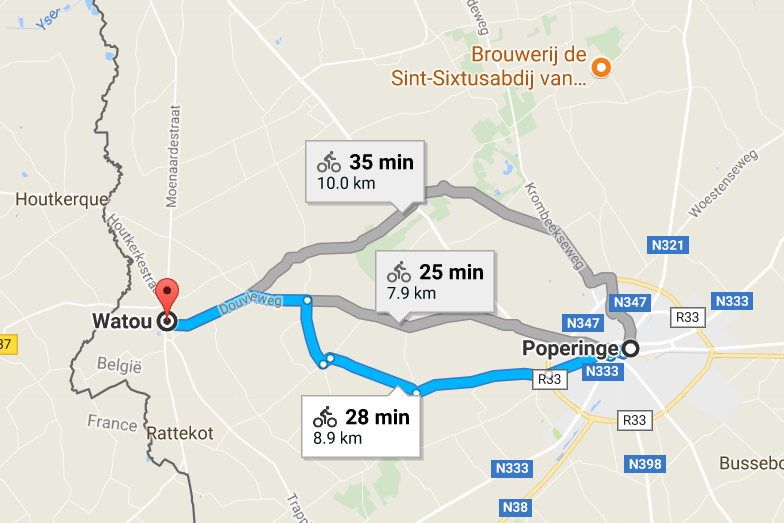
On Tuesday the riding schedule was light, but rich in intangibles, because Poperinge's tourism director Luc Dequidt and his wife joined us as local guides. They took us on a leisurely pace through the country lanes radiating from Poperinge, never very far from the smell of manure and the sight of hop trellises.
It became a pub crawl on human-powered wheels, commencing with a Westvleteren 12-degree Trappist on the terrace of the Café de Vrede opposite the St. Sixtus abbey. After cruising through the woods and fields to the fabled “brewing village” of Watou, there was refreshing Witbier from the hometown Van Eecke brewery.
Then we rode south and east via wooded lanes and more farms, back to Poperinge and a few rounds with the owner Guy at his hotel bar.
Buddy must have taken this one.
Out from Poperinge near Watou at the edge of the Helleketel forest there used to be a small brewery and tasting café known as the Brouwerij de Bie.
With all that flying a good portion is a life raft
but one day one spilled her draught.
The pubgoers thought the new brew was a whopper
and that's how Hellekapelle came to be a topper.
The Bie had character galore, but it wasn't open on our riding day with Luc. Since then, the brewery has relocated twice and now operates out of Dentergem, near Kortrijk.
Amazingly, yet another brewery lies just outside tiny Watou: Brouwerij St. Bernard, which for a half-century (through the 1990s) produced beer under contract for the monks of St. Sixtus (makers of the famous Westvleteren mentioned earlier) under the brand name St. Sixtus.
When the monks expanded their brewing capacity, the contract was terminated, and the St. Bernard brewery responded sensibly by beginning to brew its own line of St. Bernardus abbey-style ales, landing understandably near Trappist style norms, and arguably the finest of all secular recreations.
The point to all this is that for a village so small (population 1,900) and a scene so bucolic, Watou is a happening kind of place, with the two aforementioned breweries as well as ’t Hommelhof, a world-renowned restaurant, which I'll come to in a moment.
First, a closer look at the two breweries. As a prelude to this 2012 link, note that 18,000 hectoliters is the equivalent of roughly 15,000 barrels (31 gallons each) as we know them in America. By comparison, in 2016 the Upland Brewing Company in Bloomington, Indiana brewed 16,000 barrels of beer.
Brouwerij Van Eecke down the street from ’t Hommelhof dates to 1862. It’s still family-owned (one of the 15 members of Belgian Family Brewers) and has only five employees producing about 18,000 hectoliters of beer a year. The brewery maintains a fleet of 10 trucks—each driver has 100 accounts—for villagers who can have their favorite Van Eecke beers delivered to their doorstep as in the olden days.
As for Brouwerij St. Bernard, I can't even touch Michael "Beer Hunter" Jackson's elegant prose.
This whole border region is hop country, especially around the Belgian town of Poperinge, not far from Ieper (Ypres). The town of Watou even has a statue of a brewer on one of its main squares. He is not identified as a particular brewer - he just serves as a symbol of the local industry. I have seen no such statute anywhere else. On another main square is a famous restaurant specialising in cuisine à la bière, 't Hommelhof (the name means hop garden).
At a time of instability in France, the monks from Mont des Cats moved across the border and established a chapter in Watou. "The Chapter" (in Flemish, Het Kapittel) gave its name to a range of fruity-tasting, complex beers still made by the Van Eecke brewery, just off the town square at Watou.
The chapter of monks also established a dairy farm and developed a local market for their cheese. When the monks returned to France, a local family of cheese-makers took over the business. In the recovery period after World War II, the family, called Claus, turned their dairy (also in Watou) into a brewery.
Confusingly the stimulus for this was a request to produce beer for another Trappist monastery, St Sixtus, in nearby Westvleteren. During that half-century, the monks of Westvleteren produced beer for sale at the abbey, while the Claus family brewed a St Sixtus range for wider distribution. When the monastery of St Sixtus replaced its old brewhouse with a bigger one in the 1990s, this arrangement came to an end.
Like the cheese-making monks who inspired it, the Claus family brewery had always been dedicated to St Bernardus. Its beers, in the abbey style, are now sold under the name St Bernardus, and new partners have joined the company to help market this range.
In closing, food.
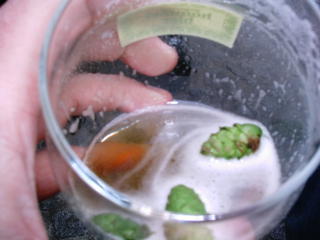
I've been extremely fortunate to have enjoyed more than one meal at the 't Hommelhof restaurant in Watou, founded twenty or so years ago by Stefaan Couttenye and his wife, the late Sabine Dejonckheere. On one early springtime visit, hop shoots were on the menu.
When Chef Couttenye opened 't Hommelhof, the notion of beer cuisine in general, and local food sourcing in particular, remained a minority taste even in a place like Belgium.
It is an understatement to say he was far ahead of his time. I've purchased his most recent book, Cooking with Belgian Beers: Great recipes flavoured with the famous 'Westhoek' beers, written with Stefaan's son Simon, who now runs the beer program at the restaurant. A review is forthcoming.
The exact details elude me, but I remember one time in Poperinge when a few of us wanted to air it out at 't Hommelhof. It's only a few miles away, but we didn't have a way there and back for an evening to be spent eating and drinking. We were staying at the Hotel Palace, and Guy magnanimously volunteered to drive us to dinner.
Overly sated, a ride was fortuitously hitched back to Poperinge with a friendly local couple who overheard us talking during the feast.
There's a reason why I keep coming back to this corner of Belgium.
Every three years, Poperinge's hop festival concludes on a Sunday afternoon during harvest season with an inspirational, and thankfully only faintly commercialized, parade through the center.
The history of the hop serves as pretext, but what the parade really reinforces is Poperinge's ongoing viability and local identity. Probably every family in town is involved in one way or another, and to me, it's like a heritage weekend.
Any 2017 updates I might have will be found here, in time.
Poperinge is a pleasant place to visit year-round, hop fest or none. It is an excellent base for bicycling, with fine food and drink as well as ample history. I believe it was 2008 when I finally got around to visiting the Talbot House -- or, Every Man's Club.
During the Great War, Poperinge was part of unoccupied Belgium. Away from the turmoil of battle in the Ypres Salient, the town became the nerve centre of the British sector. In the heart of this bustling town, the Army chaplains Neville Talbot and Philip "Tubby" Clayton opened a club. From December 1915 onwards, and for more than three years, the House provided rest and recreation to all soldiers coming in, regardless of their rank. Today, as real as then, the place offers a welcoming and friendly stop in Flanders fields.
I found it very moving, indeed.
Poperinge narrowly escaped the fate of so many other cities and towns during World War I, such as nearby Ieper (Ypres), which was reduced to a lunar landscape by more than three years of combat. I'm not the supernatural sort, but in and around Poperinge the now peaceful landscape is populated with ghosts, and it takes very few Poperings Hommelbiers to feel their presence.
In 2018, it will have been a century since the war's conclusion, or one hundred years to learn one very big lesson, which I doubt we have ... or will.
I harbor a great deal of affection for the town of Poperinge, to which I was introduced way back in 1998.
I'd organized a motorcoach tour, wherein 16 of us visited beer pilgrimage spots in Netherlands and Belgium. It came to me attention that the tourist office in Poperinge was dipping its toes into beer tourism, and had an inexpensive program to supply a guide to board our bus for a few hours and officiate.
We went to a countryside roadhouse, learned about old-fashioned pub games, toured the Van Eecke brewery in Watou, and finished at the Hopmuseum Poperinge.
There a strange man approached me and asked if I was the tour leader Roger, whereupon I met Luc Dequidt, then the tourist office's director, and these days happily retired.
Many bountiful returns have accrued from this meeting with Luc, beginning with my first triennial hop festival in September, 1999. I've only missed one since, in 2011.
In 2005, the missus realized she liked beer after all. The revelation came in Brugge, when she absconded with my Trappist ale, a Rochefort 10. Hence this dispatch from Poperinge, where she closed the deal. It was dated September 22, 2005 and written following our return home for publication at The Potable Curmudgeon.
2017 updates will be linked here, in due time.
---
In the grand tradition of beer advertising, we've chosen a beautiful woman to display the product being touted. Trust me - it's really Westvleteren 12, the beer that “disappeared” from circulation when it was selected as the best beer in the world by readers of RateBeer.com. Not that it was easy to find, even in Belgium ... even where it is brewed. The Cafe de Vrede, across the lane from the Sint Sixtus Abbey, was closed for its annual autumn break, which seems usually to occur at the very same time that beer lovers gather in nearby Poperinge for the triennial hop festival. We biked past the venue, and as my old friend Barrie would say, paused to kiss the lock on the door before proceeding into town. Arriving at the marvelous Hotel Palace in Poperinge, we found no Westvleteren at that estimable cafe; actually, it wasn't clear whether Guy had had any from the start, or whether his stock already was depleted by the time we checked on Saturday. Cafe de la Paix? Fine food and a great beer selection, but no, not there, either. Then on Sunday, in preparation for the parade, we dined at the Poussecafe, located just up Ieperstraat from the Palace, and the elusive Trappist elixir was right there, printed on the paper menu, in full view. I asked the server, who proved to be the owner, "Do you really have this beer in stock?" He shrugged and replied: "It wouldn't be listed if I didn't." An incredible lunch followed, and the food was good, too, but I still prefer Rochefort 10, with Westvleteren a close second. Later, comfortably seated along the parade route, I was introduced to a great new way to enjoy Poperings Hommelbier. Pitch the lemons and limes, and go back to the basics.
Mechelen is located north of Brussels, situated roughly equidistant between the capital and Antwerp.
This historic city of 82,000 lies on flat ground astride the Dijle River, with the 320-feet tall cathedral tower of St. Rumbold's visible from the nearby countryside amid fields of endive, asparagus and cauliflower.
In September of 2008, six of us went bicycling through Belgium, occasionally hopping a train between destinations. We began in Haarlem, Netherlands, where we rented bikes, then took the railroad to Mechelen.
From the train station, a short ride brought us to the Het Anker brewery, with an onsite hotel and fully equipped café for our sampling pleasure.
Het Anker’s flagship Gouden Carolus Classic remains a great favorite of mine, and in 2008 I was at the peak of my powers, since largely ceded, to cajole favors from importers and wholesalers. In this case it was a guided brewery tour for the group.
In 2008, we rode around, walked a bit and explored the city. I found it intriguing; as though with a bit of a civic inferiority complex (everyone fixates on Brussels and Antwerp), though right on the cusp of something more.
It took a while to make it back, but Diana and I spent a final night on the continent in Mechelen in 2014 before flying home from nearby Brussels airport (ten minutes away by direct train), and a significant amount of municipal groove seemed to have been reclaimed.
It’s been three years, and I can still taste the superb Moroccan food at the Ronda restaurant on the Vismarkt, where transcendent tagines and couscous stand ready for the tasting. In 2017, Mechelen’s the first night of the trip, not the last, and I bet I already know where we'll be eating ... after a few beers at Het Anker.
I've never written about the 2008 trip, and some day it finally will get done. When photos of 2017 are available, you'll find them here.
NA Confidential's mask-free policy on reader comments.
NA Confidential believes in a higher bar than is customary in the blogosphere, and follows a disclosure policy with respect to reader comments.
First, you must be registered with blogger.com according to the procedures specified. This is required not as a means of directing traffic to blogger.com, but to reduce the lamentable instances of flaming and personal attacks on the part of the anonymous.
Second, although pen names are perfectly acceptable, senior editor Roger A. Baylor must be informed of your identity, and according to your preference, it will be kept confidential.
To reiterate, I insist upon this solely to lessen the frequency of malicious anonymity, which unfortunately plagues certain other blogs hereabouts.
You may e-mail Roger at the address given within his profile and explain who you are. Failure to comply means that your comments probably will be deleted -- although the final decision remains ours.
Thanks for reading, and please consider becoming a part of the community here, one that is respectful of the prerequisites of civilized discourse, and that seeks to engage visitors in substantive dialogue.