Showing posts with label Sunday sales (Indiana). Show all posts
Monday, March 05, 2018
THE BEER BEAT: Sunday sales in Indiana: "Now that we have today out of the way it's just 7 days a week of normalcy."
Shane Pearson is one of the owners of Daredevil Brewing Company, and if you want to know why I think so highly of Daredevil, note this:
As the seminal British rock band The Faces once observed, "Ooh La La."
Meanwhile, Todd "Keg Liquors" Antz contributes this list of media coverage centering on Opening (Sun)Day, 2018.
---
Think people were excited about Sunday sales yesterday? Check out all of the great media coverage:
WDRB
http://www.wdrb.com/story/37642348/march-4-marks-first-sunday-of-legal-alcohol-sales-in-indiana
WAVE
http://www.wave3.com/story/37643831/hoosiers-mark-first-day-of-sunday-alcohol-sales
WHAS
http://www.whas11.com/article/news/local/indiana/hoosiers-celebrate-first-sunday-open-to-liquor-sales/417-525627218
WLKY
http://www.wlky.com/article/hoosiers-able-to-buy-alcohol-on-sundays/19076436
News & Tribune
http://www.newsandtribune.com/news/sunday-alcohol-sales-off-to-brisk-start-in-southern-indiana/article_af49a546-1ffd-11e8-a9a8-2781bef24a8e.html
Thursday, March 01, 2018
ON THE AVENUES: Scoreboard daze of old.
A weekly column by Roger A. Baylor.
On the occasion of Indiana's impending (and long overdue) Sunday Sales Apocalypse, I'm finding myself waxing nostalgic about Scoreboard Liquors.
These reflections were published most recently in 2015 at The Potable Curmudgeon blog; the article actually originated here at NA Confidential back in 2004, and eventually morphed into one of my pre-merger New Albany Tribune columns.
The essay has been updated several times, and lately my memories seem prompted by mental archaeology ... or, the constant excavations of my cluttered cranium as I struggle to recall the details of my 1980s-era travels in Europe, which occurred during the same period of liquor store employment described here.
Another reason is belatedly remembering Ralph, and others who are no longer with us.
There used to be a package liquor store called Scoreboard Liquors on West Spring Street in downtown New Albany. I worked there part-time from 1982 through 1988, when the store moved to a different location, a couple of miles uptown. In fact, I continued to work at Scoreboard after the move, but to tell the truth, it was never the same as it had been at the downtown location.
Scoreboard’s downtown building directly faced the federal courthouse, and it was within spitting distance of numerous bankers, lawyers, title abstractors and others performing their hoary time-honored roles amid the daily antics of a county seat in seemingly terminal decline. For a lad from Georgetown, working the package liquor trade in the core of the historic business district was both a kick and an education.
Surely the 1940’s-era structure housing the business was the ugliest in all of downtown. Tacked onto its frumpy backside was the infamous (trust me) Cadillac Lanes bowling alley, run by a fractious family of immigrants from Pittsburgh eligible for reality television long before the genre was invented. In olden times, the cobbled-together retail space out front had hosted an upscale automobile dealership.
Needless to say, those days were long gone, even in 1982.
The barren north side of Cadillac Lanes faced a gravel parking lot separating it from Elm Street, and it became known among liquor store employees, in purely figurative terms, that to be taken “out behind the bowling alley” meant to be stood against the otherwise useless concrete block wall and shot for crimes against humanity.
In retrospect, this reference seems tactless, but it was used quite often, especially in conjunction with obnoxious, drunken customers – particularly those employed by the Coyle auto dealership down the street.
I worked two or three nights a week, Saturday afternoons and the occasional day shift. The job was good, my pay was hard cash, and included as part of the deal were discounts on merchandise (where most of my paycheck naturally landed). My early travels were plotted from behind the store’s worn Formica counter, using paper, pens and actual books.
Nowadays, whenever I spot a package store clerk with eyes glued to an iPhone or laptop, I think back to my entertainment options on slow business nights: A minuscule black and white television set with rabbit ears, from which many a McNeil-Lehrer News Hour was observed. I probably should have been sweeping or stocking, anyway.
Package stores of Scoreboard’s socioeconomic ilk still are a trip, and an ongoing psychological experiment. During my long-ago tenure, insights into the human condition were plentiful, and sometimes fairly hard to stomach.
At least the owners indulged my interest in imported beers (craft beer had not yet come into existence), and they allowed me to purchase and stock options beyond the norm. I was given one walk-in door and a shelf outside it for warm bottles. We did a fairly good trade in imports, given their obscurity and the fact that whenever I wasn’t on site to explain what they were, consumer requests generally were greeted with a sneer by Duck, the manager.
“Huh? I don’t drink that shit.”
My favorite Duck story (his real name was Lloyd) was the time when he was standing behind the counter, peacefully smoking a cigarette, when a complete stranger walked in. The man gestured toward the door to the rear office, and asked, “Do you mind if I go back there and change my pants?”
YouTube obviously didn’t exist back then, but Candid Camera did, and Duck's immediate, unprintable reply to the unknown man’s request would have played well in syndication, with Allen Funt joyfully suffering the brunt of bleeped-out epithets as the would-be wardrobe shifter was physically chased from the premises.
After a few years, business downtown began declining, and the owners had few good options when the lease expired in 1988. Scoreboard’s relocation took place the same summer. I took a week off from my “real” job in Louisville to help move the store to affordable digs at the traffic-challenged corner of East Spring & Beharrell.
Few tears were shed by New Albany’s historic preservationists when the downtown building was hastily demolished to make way for a vacant lot, and a few years later, the construction of Chase Bank, which still stands there today. The store itself changed ownership, and eventually was shuttered.
Three decades later, I think back to the downtown liquor store stalwarts, and sadly, quite a few of them have died, including Jim, the principal owner. More recently, Mamie and the School Marm both passed away. There was Norman and James Not Jim, the Canadian Club lady with all the books, the Upholsterer, and certainly numerous others. Their faces pass through my dreams on occasion, as though it had come time for a final round before closing.
Among the departed was Gin Lady, originally known to us as Mother Gargle, who usually walked to the liquor store from the East Bloc-designed senior citizen housing tower one hundred yards away. As the day progressed and she stopped for the second or often third time, her red-dyed hair would become more and more unmanageable and frizzy. By late afternoon, her mop would be standing straight up, antenna-like, as though she’d jammed a finger into the power grid.
You see, the Seagram’s was never for her. It was for her gentleman friend, who perpetually called on her, but was never seen then or any other time. Neither was Gin Lady after the store moved across town.
Chemical Man was so dubbed for the spectacular lack of nutrients in his bloodstream, and my rigid certainty that the only thing keeping him alive was infusions of formaldehyde, Kessler whiskey and Sterling beer.
Early on, when I hadn’t come to understand the nuances of alcoholism, I asked Chemical Man why he bought three half-pints of Kessler at points throughout the day rather than a liter of whiskey first thing in the morning, which would be cheaper.
He sputtered indignantly that my college education had taught me absolutely nothing, because any fool knows that if you start the day with a big bottle, you’ll just go and drink it before lunch – and then what?
Later, Chemical Man grew too weak to carry the daily case of Sterling to his house, which fronted the side street fifty yards from the store’s front door. I’d carry it over and put it on the porch for him. A year or so later, his obituary was in the newspaper. I’d have bet money that he was in his 70s, but he was only 59 at the time of his death.
Of all the people I met at Scoreboard, Snake was tops. For decades he kept a series of decrepit pick-up trucks alive just long enough to run a regular route through New Albany, collecting cardboard and taking it to Riverside Recycling for a few bucks, which went into the jar and paid for season tickets to Louisville Redbirds games.
Snake’s life wasn’t easy, but it could have been worse, and he generally kept a cheerful demeanor in the face of the curve balls thrown at him by fate. For example, the nickname came from a tattoo on his right arm, the one that ended just below the elbow, the rest having been removed after an accident decades earlier.
He had a recurring, acrimonious relationship with the New Albany Tribune, our local newspaper of record, and often vowed that if his wife died before him, he’d call to cancel the newspaper first -- and only then ring the funeral home.
Snake worked hard as a bartender, and drank just as hard as a customer until swearing off the bottle in the early 1960’s. He never drank a drop again, ever. When the bartending jobs at New Albany’s neighborhood taverns dried up, Snake turned to cardboard full time, and occasionally filled a shift at the liquor store.
In 2001, Snake’s truck died for the final time, and since cardboard wasn’t paying squat, anyway, it was time for him to get out of it. He’d already decided that ballgames were too expensive and the club’s management too arrogant. A couple years later he stopped by my pub to chat, and it was the last time I ever saw him, for he died shortly thereafter on the day before my birthday.
There were others dear to me, like Gene, Tom and Lewie, and I miss them all – the people, the store, and the time – but I miss Snake the most. Rest in peace, my friend. If you could see what’s become of the local newspaper these days, you just might reconsider that vow of sobriety.
---
Recent columns:
February 22: ON THE AVENUES REWOUND: Money is the ultimate bully (2015).
February 15: ON THE AVENUES REWOUND: No more fear, Jeff (2015).
February 8: ON THE AVENUES: Golden oldie classic comfort beers at an old school pub? Sounds like Pints & Union to me.
February 1: ON THE AVENUES: Did you hear the one about Duggins' deep TASER regrets? I laughed until I cried -- and so did the folks in Keokuk.
A weekly column by Roger A. Baylor.
On the occasion of Indiana's impending (and long overdue) Sunday Sales Apocalypse, I'm finding myself waxing nostalgic about Scoreboard Liquors.
These reflections were published most recently in 2015 at The Potable Curmudgeon blog; the article actually originated here at NA Confidential back in 2004, and eventually morphed into one of my pre-merger New Albany Tribune columns.
![]() |
| Joe K. mans the counter during the Reagan Years. He introduced "retail-itis" to the lexicon. |
The essay has been updated several times, and lately my memories seem prompted by mental archaeology ... or, the constant excavations of my cluttered cranium as I struggle to recall the details of my 1980s-era travels in Europe, which occurred during the same period of liquor store employment described here.
Another reason is belatedly remembering Ralph, and others who are no longer with us.
---
There used to be a package liquor store called Scoreboard Liquors on West Spring Street in downtown New Albany. I worked there part-time from 1982 through 1988, when the store moved to a different location, a couple of miles uptown. In fact, I continued to work at Scoreboard after the move, but to tell the truth, it was never the same as it had been at the downtown location.
Scoreboard’s downtown building directly faced the federal courthouse, and it was within spitting distance of numerous bankers, lawyers, title abstractors and others performing their hoary time-honored roles amid the daily antics of a county seat in seemingly terminal decline. For a lad from Georgetown, working the package liquor trade in the core of the historic business district was both a kick and an education.
Surely the 1940’s-era structure housing the business was the ugliest in all of downtown. Tacked onto its frumpy backside was the infamous (trust me) Cadillac Lanes bowling alley, run by a fractious family of immigrants from Pittsburgh eligible for reality television long before the genre was invented. In olden times, the cobbled-together retail space out front had hosted an upscale automobile dealership.
Needless to say, those days were long gone, even in 1982.
The barren north side of Cadillac Lanes faced a gravel parking lot separating it from Elm Street, and it became known among liquor store employees, in purely figurative terms, that to be taken “out behind the bowling alley” meant to be stood against the otherwise useless concrete block wall and shot for crimes against humanity.
In retrospect, this reference seems tactless, but it was used quite often, especially in conjunction with obnoxious, drunken customers – particularly those employed by the Coyle auto dealership down the street.
I worked two or three nights a week, Saturday afternoons and the occasional day shift. The job was good, my pay was hard cash, and included as part of the deal were discounts on merchandise (where most of my paycheck naturally landed). My early travels were plotted from behind the store’s worn Formica counter, using paper, pens and actual books.
Nowadays, whenever I spot a package store clerk with eyes glued to an iPhone or laptop, I think back to my entertainment options on slow business nights: A minuscule black and white television set with rabbit ears, from which many a McNeil-Lehrer News Hour was observed. I probably should have been sweeping or stocking, anyway.
Package stores of Scoreboard’s socioeconomic ilk still are a trip, and an ongoing psychological experiment. During my long-ago tenure, insights into the human condition were plentiful, and sometimes fairly hard to stomach.
At least the owners indulged my interest in imported beers (craft beer had not yet come into existence), and they allowed me to purchase and stock options beyond the norm. I was given one walk-in door and a shelf outside it for warm bottles. We did a fairly good trade in imports, given their obscurity and the fact that whenever I wasn’t on site to explain what they were, consumer requests generally were greeted with a sneer by Duck, the manager.
“Huh? I don’t drink that shit.”
My favorite Duck story (his real name was Lloyd) was the time when he was standing behind the counter, peacefully smoking a cigarette, when a complete stranger walked in. The man gestured toward the door to the rear office, and asked, “Do you mind if I go back there and change my pants?”
YouTube obviously didn’t exist back then, but Candid Camera did, and Duck's immediate, unprintable reply to the unknown man’s request would have played well in syndication, with Allen Funt joyfully suffering the brunt of bleeped-out epithets as the would-be wardrobe shifter was physically chased from the premises.
After a few years, business downtown began declining, and the owners had few good options when the lease expired in 1988. Scoreboard’s relocation took place the same summer. I took a week off from my “real” job in Louisville to help move the store to affordable digs at the traffic-challenged corner of East Spring & Beharrell.
Few tears were shed by New Albany’s historic preservationists when the downtown building was hastily demolished to make way for a vacant lot, and a few years later, the construction of Chase Bank, which still stands there today. The store itself changed ownership, and eventually was shuttered.
Three decades later, I think back to the downtown liquor store stalwarts, and sadly, quite a few of them have died, including Jim, the principal owner. More recently, Mamie and the School Marm both passed away. There was Norman and James Not Jim, the Canadian Club lady with all the books, the Upholsterer, and certainly numerous others. Their faces pass through my dreams on occasion, as though it had come time for a final round before closing.
Among the departed was Gin Lady, originally known to us as Mother Gargle, who usually walked to the liquor store from the East Bloc-designed senior citizen housing tower one hundred yards away. As the day progressed and she stopped for the second or often third time, her red-dyed hair would become more and more unmanageable and frizzy. By late afternoon, her mop would be standing straight up, antenna-like, as though she’d jammed a finger into the power grid.
You see, the Seagram’s was never for her. It was for her gentleman friend, who perpetually called on her, but was never seen then or any other time. Neither was Gin Lady after the store moved across town.
Chemical Man was so dubbed for the spectacular lack of nutrients in his bloodstream, and my rigid certainty that the only thing keeping him alive was infusions of formaldehyde, Kessler whiskey and Sterling beer.
Early on, when I hadn’t come to understand the nuances of alcoholism, I asked Chemical Man why he bought three half-pints of Kessler at points throughout the day rather than a liter of whiskey first thing in the morning, which would be cheaper.
He sputtered indignantly that my college education had taught me absolutely nothing, because any fool knows that if you start the day with a big bottle, you’ll just go and drink it before lunch – and then what?
Later, Chemical Man grew too weak to carry the daily case of Sterling to his house, which fronted the side street fifty yards from the store’s front door. I’d carry it over and put it on the porch for him. A year or so later, his obituary was in the newspaper. I’d have bet money that he was in his 70s, but he was only 59 at the time of his death.
Of all the people I met at Scoreboard, Snake was tops. For decades he kept a series of decrepit pick-up trucks alive just long enough to run a regular route through New Albany, collecting cardboard and taking it to Riverside Recycling for a few bucks, which went into the jar and paid for season tickets to Louisville Redbirds games.
Snake’s life wasn’t easy, but it could have been worse, and he generally kept a cheerful demeanor in the face of the curve balls thrown at him by fate. For example, the nickname came from a tattoo on his right arm, the one that ended just below the elbow, the rest having been removed after an accident decades earlier.
He had a recurring, acrimonious relationship with the New Albany Tribune, our local newspaper of record, and often vowed that if his wife died before him, he’d call to cancel the newspaper first -- and only then ring the funeral home.
Snake worked hard as a bartender, and drank just as hard as a customer until swearing off the bottle in the early 1960’s. He never drank a drop again, ever. When the bartending jobs at New Albany’s neighborhood taverns dried up, Snake turned to cardboard full time, and occasionally filled a shift at the liquor store.
In 2001, Snake’s truck died for the final time, and since cardboard wasn’t paying squat, anyway, it was time for him to get out of it. He’d already decided that ballgames were too expensive and the club’s management too arrogant. A couple years later he stopped by my pub to chat, and it was the last time I ever saw him, for he died shortly thereafter on the day before my birthday.
There were others dear to me, like Gene, Tom and Lewie, and I miss them all – the people, the store, and the time – but I miss Snake the most. Rest in peace, my friend. If you could see what’s become of the local newspaper these days, you just might reconsider that vow of sobriety.
![]() |
| We often had too much time on our hands. |
---
Recent columns:
February 22: ON THE AVENUES REWOUND: Money is the ultimate bully (2015).
February 15: ON THE AVENUES REWOUND: No more fear, Jeff (2015).
February 8: ON THE AVENUES: Golden oldie classic comfort beers at an old school pub? Sounds like Pints & Union to me.
February 1: ON THE AVENUES: Did you hear the one about Duggins' deep TASER regrets? I laughed until I cried -- and so did the folks in Keokuk.
Saturday, February 10, 2018
THE BEER BEAT: On crowlers, Southern beer terroir and Sunday sales changes in Indiana.
Before I proceed, heartfelt thanks to everyone who commented and asked questions as our big news leaked out earlier this week.
THE BEER BEAT: "Pints & Union to open in New Albany, will be inspired by classic European pubs."
SHANE'S EXCELLENT NEW WORDS: On taverns, pubs, Gaststätten and Bung -- with a Mencken chaser.
ON THE AVENUES: Golden oldie classic comfort beers at an old school pub? Sounds like Pints & Union to me.
I'm never without illusions as to how much work is yet to be done, but the karma is good and we're looking forward to getting it done.
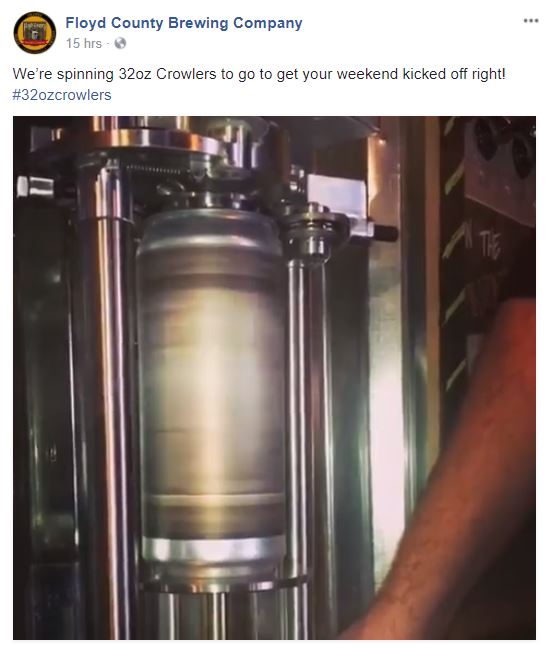
So it was that yesterday I was hanging on for dear life to Floyd County Brewing Company's bar, when I noticed the new gadget behind the bar. The Ball Corporation explains.
INTRODUCING THE CROWLER, WHERE THE CAN MEETS THE TAP.
The beer can revolution is taking on the tap with Ball’s new innovative Crowler can. It’s a 32 ounce, Growler-sized can that allows your customers to take their favorite draft beer home with them. Once filled at the tap, a Crowler lid is sealed with a bar-top seamer, so people can bring home your hand crafted beer in a package that keeps it the way you intended it because the Crowler has the superior qualities of aluminum, like the ability to block out light and oxygen, as well as provide a sharable, 100 percent recyclable container. Call it a big, 32 ounce “cheers” to your craft beer business.
Crowlers aren't new as such, but they're new to New Albany, so stop by FCBC, watch the show, and buy a can of beer to go.
You'll recall that Over the 9 closed in January.
Thank you to all the patrons we have serviced over the years here at Over the 9. Unfortunately, we will be closing our doors for 2018 as a full service restaurant/bar and creating a venue space for exclusive parties and events. For more information regarding the event space and reservations, please contact logan@old502.com.
A few days ago Old 502 Winery (@Old502) tweeted that the event space and enlarged tasting room in the former Over the 9 space was ready. I asked if this new area would offer Falls City beer as well as wine from Old 502.
Yes, we will be offering beer flights in addition to wine tastings. And you will still be able to purchase beers from the bar.
Jeff Gillenwater provides this link to a brief overview of efforts "down South" to conjure a contemporary beer terroir. To me, this sort of thinking makes sense as it pertains to Americanized Saisons and sours.
What Is Southern Beer?, by Bob Townsend (Bitter Southerner)
... we’re talking about terroir, the French word that defines that country’s sacred system of regional wine appellation.
But more and more, that sort of sense of place is being discussed in terms of the unique characteristics of the soil food crops are grown in or the aquaculture of oyster farming.
And all around the South, many breweries have been sprouting up taking a cues from those ideas, while finding inspiration in the Old World farmhouse brewing practices of Belgium and France.
Indiana's legislative season is rapidly drawing to a close. Following is an excellent, locally written overview of the perennial weirdness of Indiana's Sunday (and cold beer sales) restrictions, and how some of these will be changing.
Sunday alcohol sales expected to have little impact. So why was it so controversial?, by Danielle Grady (News and Tribune)
INDIANA — Ask an Indiana resident if he or she favors Sunday alcohol sales, and the answer is likely to be yes.
A June study conducted by Ball State University and Old National Bank found that a majority of Hoosiers, 58 percent, supported allowing stores to sell alcohol on Sunday, which has been outlawed since prohibition ended way back in 1933.
This year, the possibility of being able to walk into an Indiana store and buy a six-pack of beer or a bottle of wine seems more likely than ever.
Thanks to a deal struck between liquor stores and big box retailers in the fall, Sunday sales bills have made it further than they ever have in the state Legislature. Both the Indiana Senate and the House have passed their own version of the legislation. Their bills would allow stores to sell alcohol from noon to 8 p.m on Sundays. The Associated Press reports that final passage of a bill is expected in mid-March, although the law wouldn’t take effect until July.
But the businesses that sell alcohol in Indiana have met the historic news with a lukewarm reception. The state’s liquor, convenience and grocery stores expect to be affected by the new rule if passed in different, but probably not dramatic ways. At the same time, compromises on separate alcohol issues have muted the wins and losses that accompany the ban lift ...
Sunday, January 21, 2018
THE BEER BEAT: This smoked beer story is fine, thank you. Also: Eiderdown and Sunday sales.
![]() |
| The heavenly source, 2003. |
To know me is to know I've loved smoked beer since the first time I tried it, back in the 1980s, which probably was a Kaiserdom Rauchbier. It used to be in Merchant du Vin's repertoire well into the 1990s, although I'm unsure whether it or the Kaiserdom brewery itself still exists -- and I'm too lazy to Google it.
That's because we have Schlenkerla these days.
My first trip to Bamberg came in 1991, and later I learned that yes, Kaiserdom's example was brewed primarily for export -- in 1995, they seemed completely confused that anyone would want to know about smoked beer, even after my letter specified this as the only reason we were interested in visiting -- but I also saw plenty of locals in town queuing up to drink Schlenkerla and Spezial.
This made me indescribably happy.
Today's linked posting at Atlas Obscura strikes me as a perfectly reasonable introduction to the genre of smoky flavored beers, so naturally, I saw the article subsequently mentioned somewhere on Facebook, and found a heated debate among purists as to whether Garrett Oliver's description of a firebox was technically accurate, how such glaring errors as this fatally compromised his stewardship as editor of the Oxford Companion to Beer, and whether every "t" was crossed and "i" dotted -- and I was muttering obscenities to myself.
Give me a freaking break.
I thought: Have any of you ever stood behind a bar and tried to help a real person understand what smoked beer was all about, with the goal of encouraging the customer to try one, and maybe even enjoy it?
While not deserving of a Pulitzer, I actually have done so, and I did it for something like 30 years, so please: silence the bullshit pedantry.
People at the bar just want to know why the beer tastes smoky, and it's very easy to understand that your wet coat hanging next to the fireplace will come away smelling ... well, like smoke, even if only lightly given the smoke is venting through the chimney. So will grain, and more so, when smoke passes through it.
Lesson learned; can we drink yet?
For normal folks wanting to try something new, it really isn't necessary to delve into molecular biology, advanced chemistry, the history of wood and the composition of rare Norwegian yeast. These might help, but what you need on a daily basis is a repeatable story to tell -- not a "fake" story, mind you, but one rooted in fact that is entertaining and will seal the deal.
Now decant an Eiche if you've got one and read this.
Why All Beer Once Tasted Like Smoke, by Jim Clarke (Atlas Obscura)
Those were the days.
... Refreshment isn’t the only reason to drink beer, of course, and some beer drinkers didn’t want to give up their smoky brews. Certain areas in Norway and Poland clung to a smoky style. Grodziskie, a smoked Polish wheat beer, persisted until the 1930s, and has been resurrected by some American craft breweries. Homebrewers in Norway shared communal malting houses using the old, smoky malting process until the 1970s. Homebrewer John Morten Granås resurrected the traditional malt house a few decades ago, and now the Stjørdal area east of Trondheim is home to a few dozen.
Commercially, only in Bamberg, Germany, have several brewpubs persisted in making smoke beers (Rauchbier, in German) since the Middle Ages. Much of the move to pale, smoke-free malts was tied up with industrialization, and bucolic Bamberg, in the heart of Franconia (the northern part of Bavaria), missed out.
“Bamberg is, by German standards, far away from any industrialized areas,” says Matthias Trum, the sixth generation brewmaster and owner of Aecht Schlenkerla. “We never had much industrialization here, especially no coal or steel industry. Coal was somewhat hard to acquire here, and it was easier for brewers to stick with wood as fuel.”
I'm delighted to know that Eiderdown's reboot has been a success, but I can't seem to find the beer list.
Any smoked beer there?
Eiderdown goes back to its roots, remains a delight, by Robin Garr (LEO Weekly)
The new menu gets touched up every now and then, but the basics stay the same. It’s distinctly, but not entirely, German; it’s not overly long, with just six entrées, a half-dozen sandwiches, a variety of house-made sausages and a list of appetizing snacks and starters. The $32 steak au poivre is gone from the menu, replaced by a $16 beef rouladen. The Sunday Sitdown chicken dinner remains, but it’s now $19, a few bucks under its original price. Everything else is $16 or less; house sausages are all $11, and the bar snacks and starters all fall in the single digits. Much of the meats, cheeses and produce are locally sourced, and the sausages, pretzels, beer cheese and desserts are all made in house.
As you’d expect from an eatery whose owners also operate the nearby Nachbar, Eiderdown’s beverages program is worthy, with an extensive, German-accented beer list and 21 taps, credibly promoted as “the most extensive German beer selection in town.” There’s plenty of local craft beer too, along with full bar service and a short, but thoughtful, wine list.
Finally, fresh news from the legislative trenches in Indiana.
Senate panel kills cold beer bill while Sunday alcohol sales gains momentum, by Robert King (Indy Star)
A legislative push to allow wider Sunday alcohol sales gained momentum Wednesday while an effort to expand the sale of cold beer likely suffered a death blow.
The push for Sunday carryout sales — approved Wednesday by a House committee 12 to 1 and passed unanimously last week by a Senate panel — seems on a fast track to passage.
But a bill to allow grocery and convenience stores to sell cold beer was defeated in a Senate committee Wednesday by a 9-to-1 vote, likely signaling its death for this session.
The starkly divergent paths for the bills is neatly following the path key lawmakers predicted months ago but also closely reflects the outline of the deal struck in the fall between the powerful liquor store lobby and big box stores — a deal to support Sunday sales but to oppose cold beer's expansion.
Saturday, December 30, 2017
THE BEER BEAT: Saying goodbye to 2017 with an assortment of links.
In the leadoff slot today, December 30, is this reminder to Hoosiers from Amy Haneline of the Indy Star:
Liquor stores will be closed on New Year's Eve, because Indiana.
You know what to do, and when to do it.
Looking ahead, the fifth anniversary presentation of Tailspin Ale Fest 2018 on February 17 draws ever nearer. We'll be in Portugal, crawling from one port lodge to the next in Vila Nova de Gaia (be still, my throbbing heart), but if you'll be around for Tailspin and want to attend, it's time to start planning.
I'm guessing that NABC's Gravity Head will follow on Friday, February 23, but as Liam Gallagher once sang, it's nothing to do with me.
It may surprise you to learn that as 2018 dawns, I remain a one-third shareholder in the NABC businesses, albeit excluded from participation them since 2015 (welcome to my daily existence of "all risk, no reward") -- none of this being my exact idea when I decided to divorce -- although recently my lawyer has been informed by their lawyer that the long-awaited financial settlement might be concluded by February.
If so, I might even drop by for Gravity Head this year and bask in the warmth of an institution I created.
Life goes on, and businesses come and go; goodbye, BBC St. Matthews. With the death of Steinert's a few years back, my guess is that Vic's Cafe is the oldest licensee in New Albany, even if the tavern isn't located in its original building.
Am I right?
Assuming Pints&Union opens this year (cross your fingers), the establishment will for a time be the newest pub in New Albany. Because each swing of the pendulum leaves a segment of the market undervalued, our plan is to turn back the clock to the notion of daily excellence, and maintain a small, largely fixed selection of very good draft beers.
There will be very good bottles and cans, as well; my original thought was to have a few of the quality imports in bottles, the American craft selection in cans, and for these to be from breweries I'd personally visited, whether here or abroad.
However, this article is so thought provoking that the plan might be modified.
It's been so long since this article was written (in March) that a whole new trend probably has supplanted NEIPA -- perhaps sour IPA, which I was reading about recently.
However, for the record ...
You may have missed this essay from October, which briefly inspired much debate. The discussion might have been even more entertaining had the author actually talked about the elephant and named some names. He didn't, and while he has a valid point, I find the argumentation muddled.
Finally, in 2017 there were 124 posts at NAC tagged with THE BEER BEAT, and the two with the most page views were "The Bechdel Test, and what 1980s lesbians can teach us about beer" (with 636) and "It's a cornucopia of ephemera, from Quaff On to Lazlo Toth" (1,021).
I have only one beer resolution for 2018: End the self-imposed exile, and get back in the saddle.
Wish me luck, and thanks for reading.
Liquor stores will be closed on New Year's Eve, because Indiana.
You know what to do, and when to do it.
Looking ahead, the fifth anniversary presentation of Tailspin Ale Fest 2018 on February 17 draws ever nearer. We'll be in Portugal, crawling from one port lodge to the next in Vila Nova de Gaia (be still, my throbbing heart), but if you'll be around for Tailspin and want to attend, it's time to start planning.
I'm guessing that NABC's Gravity Head will follow on Friday, February 23, but as Liam Gallagher once sang, it's nothing to do with me.
It may surprise you to learn that as 2018 dawns, I remain a one-third shareholder in the NABC businesses, albeit excluded from participation them since 2015 (welcome to my daily existence of "all risk, no reward") -- none of this being my exact idea when I decided to divorce -- although recently my lawyer has been informed by their lawyer that the long-awaited financial settlement might be concluded by February.
If so, I might even drop by for Gravity Head this year and bask in the warmth of an institution I created.
Life goes on, and businesses come and go; goodbye, BBC St. Matthews. With the death of Steinert's a few years back, my guess is that Vic's Cafe is the oldest licensee in New Albany, even if the tavern isn't located in its original building.
Am I right?
Paul Revere drank here: A quest to find Boston’s oldest tavern, by Brian MacQuarrie (Boston Globe)
Boston has been a drinking town through nearly 400 years of Puritan brewers, ale-quaffing patriots, drunken sailors, and picky millennials in search of the latest craft beer infused with grapefruit.
But in a city meticulous about its past, finding the oldest tavern can be a Byzantine quest. Prepare to burrow past dubious marketing pitches bolstered by obligatory knockoffs of Paul Revere portraits hung under rough-hewn beams and low, dark ceilings.
It’s enough to make the curious reach for a pint, and then another, to bring order — or not — to the competing claims and counterclaims of three popular finalists for the bragging rights ...
Assuming Pints&Union opens this year (cross your fingers), the establishment will for a time be the newest pub in New Albany. Because each swing of the pendulum leaves a segment of the market undervalued, our plan is to turn back the clock to the notion of daily excellence, and maintain a small, largely fixed selection of very good draft beers.
There will be very good bottles and cans, as well; my original thought was to have a few of the quality imports in bottles, the American craft selection in cans, and for these to be from breweries I'd personally visited, whether here or abroad.
However, this article is so thought provoking that the plan might be modified.
NEW-LOOK IMPORTS: FROM GREEN BOTTLES TO PREMIUM CANS, by Daniel Hartis (All About Beer Magazine)
... Consumer perception aside, another reason cans have yet to catch on throughout Europe is that most countries there have strong returnable bottle markets, wherein consumers can return glass bottles for a deposit.
While slow to move in their native countries, breweries have begun exporting canned offerings to the States, where there’s no such stigma against putting a premium product in cans. And though cans are en vogue across America, breweries across Europe are not always going lightly into the package.
It's been so long since this article was written (in March) that a whole new trend probably has supplanted NEIPA -- perhaps sour IPA, which I was reading about recently.
However, for the record ...
The beer world's next big trend? Look out for NEIPAs, also known as hazy IPAs, by John Verive (LA Times)
IPA is the undisputed king of the craft beer world. The aromatic, often intensely bitter style stands in sharp relief to the bland brews that defined American beer for decades. And the ever-increasing demand for IPA drives the growing craft brewing industry. It’s a style that’s evolved along with beer drinkers’ tastes, and the latest evolution shows off the softer, less bitter side of IPA.
An East Coast import, and alternately dubbed the “North Eastern IPA” or “New England IPA” (NEIPA in either case) this new breed of IPA is all about showing off fruity hop flavors without the bitter hop bite. As brewers have developed new techniques for squeezing more hops into a beer, they’ve also discovered that many common brewing processes strip out some hop character. While not all craft beers are filtered, most are clarified to some degree to remove particles and increase the brew’s clarity. Not NEIPAs — they range from opaque to downright sludgy as a complex soup of proteins, suspended yeast and hop compounds form the haze that defines the style. Which, alongside the vibrant fruit flavors from modern hop varieties and a higher perceived sweetness led to another nickname: the juicy IPA.
You may have missed this essay from October, which briefly inspired much debate. The discussion might have been even more entertaining had the author actually talked about the elephant and named some names. He didn't, and while he has a valid point, I find the argumentation muddled.
No more free passes: Not every new craft brewery is good and we need to admit it, by Jonathan Wells (Charlotte Five)
We need to talk about an elephant in the room: newly-opened craft breweries putting out subpar beer.
Finally, in 2017 there were 124 posts at NAC tagged with THE BEER BEAT, and the two with the most page views were "The Bechdel Test, and what 1980s lesbians can teach us about beer" (with 636) and "It's a cornucopia of ephemera, from Quaff On to Lazlo Toth" (1,021).
I have only one beer resolution for 2018: End the self-imposed exile, and get back in the saddle.
Wish me luck, and thanks for reading.
Saturday, December 02, 2017
THE BEER BEAT: The pervasive fog of Hoosier regulatory wars.
On Friday, Indiana Lieutenant Governor Suzanne Crouch was in town. State Representative Ed Clere organized a series of meetings in various locations, each addressing a different core topic.
Ed's been a noteworthy friend to Hoosier fermenters and distillers, and I appreciated his invitation to participate in the lunchtime session at Huber's Orchard, Winery and Distillery in Starlight.
The overarching topic of conversation was the ever-expanding intersection of beverage alcohol production, agriculture and tourism. Examples of places where these pursuits come together are farmers markets, special events and fests, and the floor plan of Huber's.
What is the Alcohol and Tobacco Commission's stance on regulating these activities -- and what will it be tomorrow?
Those are the questions.
Local alcohol makers sick of changing Indiana regulations, by Danielle Grady (Jeffersonville News and Tribune)
STARLIGHT — Rick Otey makes and sells beer, but recently he’s started to feel as if he deals in more dangerous goods.
“Sometimes I tell people, it’s like we produce weapons-grade plutonium,” he said. “That’s how it feels sometimes.”
Otey is upset by the regulations imposed upon Indiana brewers and distillers by the legislature. Those laws are sometimes reinterpreted without warning by the Alcohol and Tobacco Commission, which enforces the rules and, in turn, affects Otey’s business.
Otey, along with several other craft brewers, winemakers and distillers voiced their concerns with the ATC to Lt. Gov. Suzanne Crouch on Friday when she visited Huber’s Orchard and Winery for a tour and lunch.
The commission declined to comment on this story through an email to the News and Tribune.
In the commission's defense, the Indiana's alcoholic beverage code is like an unkempt thicket. Each legislative session, new rules arrive for implementation, but old ones aren't always pruned. Even when intentions are good, there's an understandable necessity to make interpretations, then reinterpretations, then fresh new interpretations atop the previous patchwork.
Obviously, it isn't my job to absolve the ATC from blame for the shifting whims of its political appointees. But the entire regulatory edifice needs tearing down and building back into something rational for the present age, and toward this end, something called the Alcohol Code Revision Commission was created to consider recommendations for improvement.
There was media optimism as recently as November 25.
Alcohol changes yield winners, losers, by Scott L. Miley (CNHi Statehouse Reporter)A week later ... well, so much for that. In spite of opinion polls indicating overwhelming public support for cold beer everywhere at any time, it appears Indiana will remain the only state regulating beer based on temperature.
INDIANAPOLIS — Nearly 20 recommendations for alcohol-related legislation floated through a three-hour meeting recently of the Indiana General Assembly-created Alcohol Code Revision Commission.
Here is a breakdown of some preliminary drafts facing the panel that meets again on Dec. 1. Included are suggestions of winners and losers if legislation passes the General Assembly.
• Cold beer and Sunday sales: One preliminary draft of legislation allows a package liquor store, grocery store, convenience store or drug store to sell alcohol for carryout on Sundays. Beginning July 1, 2019, convenience stores, drug stores and groceries could sell cold beer.
Who loses: Package liquor stores, though they could be open Sundays, won't be the only outlets selling cold beer, as they are now.
Who wins: Hoosiers who forgot to buy a six-pack for a Sunday Colts game.
In between: In a unique partnership, the Indiana Retail Council (big box groceries) and the Indiana Association of Beverage Retailers (package liquor shops) support Sunday sales but not the expansion of cold beer sales ...
Effort to expand cold beer sales fizzles in tight vote by legislative commission, by Tony Cook (Indy Star)
The prospect of getting a cold six-pack at your local grocery store has once again fallen flat.
After a nail-biter vote, a panel working to revise Indiana’s alcohol laws will not recommend allowing pharmacies, grocers and convenience stores to sell cold beer — something that has long been the well-protected province of liquor stores.
The recommendation failed even though the vote was 8-7 in favor. That's because 9 of the 17 members had to vote in favor of the recommendation for it to pass. Two members — Gina-Gail Fletcher and Alex Huskey — were absent.
The tight vote was even more dramatic because one member — Judge William Boklund — switched his vote in the middle of the roll call, joining proponents of cold beer access.
The result was a big blow for consumers who want to be allowed to buy cold beer for carryout at convenience, grocery and drug stores. Right now, only liquor stores are permitted to sell cold beer for carryout in Indiana, with few exceptions.
Missing committee members, invasive lobbyists, back room wheeler-dealers; there's a complete panoply of underachievement to consider.
To me, the worst of it isn't the fix being in. It's that ongoing Sunday sales prohibitions and temperature-based considerations achieve nothing apart from treating adults like children.
Monday, October 09, 2017
THE BEER BEAT: From Sunday sales in Indiana to garlic tastings, an overview of informative news items.
Before glancing at a handful of interesting beer-related diversions, New Albanians should note that on Friday, September 13 there will be a day-long renewal of last year's Harvest Craft Beer Hop, as annotated and organized by The Exchange pub + kitchen in New Albany.
More than a dozen establishments in downtown New Albany will be listed on a paper passport, with the idea being to navigate the Harvest Homecoming maelstrom downtown and drink a beer at six of them.
Bartenders will validate the passport "stamps," and then walkers will return their passports to The Exchange to be entered into a drawing for goodies donated by the participating restaurants and bars.
There'll be more on this event as soon as the final version is released, probably later today. Just remember to have your ride arranged beforehand.
---
When it comes to Sunday sales laws in Indiana, it quickly becomes apparent that the various special interests are almost perfectly balanced in terms of political power. It's a WWI-trench-warfare-ready version of absolute stalemate, and so the status quo largely has remained, as discussed only recently hereabouts.
When it has come to carving out little toeholds of competitive turf amid the gaps in the fortifications of the bigger players, as when Sunday sales for craft brewers were legalized, the key figure in the Senate has been Ron Alting.
During my time on the Brewers of Indiana Guild's board, the underlying assumption was that we'd wait to see where Alting came down on an idea, and gauge the subsequent effort accordingly. There were other concerned parties in the House, among them our own Ed Clere, but in the Senate, Alting was (and surely remains) the gatekeeper.
No judging, just a fact. Seeing the senator's name in the context of overall reform is intriguing; however, as the authors concede, it's all about the details.
Kevin Gibson surveys news about Gravely Brewing, Cumberland Brews and a Philosophy on Tap series of lectures (with beer and food) at Louisville's Migo restaurant on Dundee Road, but the item that caught my attention is closer to home.
... it's an excellent time to remind readers that there's no better use for a shuttered church than to trasnform it into a house of beer worship.
Finally, something to give us hope with our libations.
More than a dozen establishments in downtown New Albany will be listed on a paper passport, with the idea being to navigate the Harvest Homecoming maelstrom downtown and drink a beer at six of them.
Bartenders will validate the passport "stamps," and then walkers will return their passports to The Exchange to be entered into a drawing for goodies donated by the participating restaurants and bars.
There'll be more on this event as soon as the final version is released, probably later today. Just remember to have your ride arranged beforehand.
---
When it comes to Sunday sales laws in Indiana, it quickly becomes apparent that the various special interests are almost perfectly balanced in terms of political power. It's a WWI-trench-warfare-ready version of absolute stalemate, and so the status quo largely has remained, as discussed only recently hereabouts.
THE BEER BEAT: Schansberg explains Sunday and Indiana's lingering sales restrictions: "Support for restrictions is driven by greenbacks more than blue laws."
We still refer to restrictive laws like these as "blue," but as Eric points out, the prime motivator usually is green.
When it has come to carving out little toeholds of competitive turf amid the gaps in the fortifications of the bigger players, as when Sunday sales for craft brewers were legalized, the key figure in the Senate has been Ron Alting.
During my time on the Brewers of Indiana Guild's board, the underlying assumption was that we'd wait to see where Alting came down on an idea, and gauge the subsequent effort accordingly. There were other concerned parties in the House, among them our own Ed Clere, but in the Senate, Alting was (and surely remains) the gatekeeper.
No judging, just a fact. Seeing the senator's name in the context of overall reform is intriguing; however, as the authors concede, it's all about the details.
Want to buy booze at the store on Sunday? New developments offer some hope. Maybe, by Tony Cook and Robert King (IndyStar)
If you've been frustrated by Indiana's ban on Sunday alcohol sales, there may be hope on the horizon.
Maybe.
A key lawmaker who has blocked such efforts in the past says he is drafting a bill that would allow grocery stores and other retailers to sell alcohol for carryout on Sundays.
“I think it’s time for Sunday sales," said Sen. Ron Alting, R-Lafayette, chairman of the Senate Public Policy Committee.
But the devil will be in the details. Big questions remain on what conditions the bill might place on Sunday sales. Alting said it is too early to get into the specifics of the legislation.
Kevin Gibson surveys news about Gravely Brewing, Cumberland Brews and a Philosophy on Tap series of lectures (with beer and food) at Louisville's Migo restaurant on Dundee Road, but the item that caught my attention is closer to home.
Beer meets philosophy at Migo, by Kevin Gibson (LEO)Having recently returned from fact-finding mission to Belgium and the Netherlands, and while in Haarlem enjoying enjoyed more than one session at the Jopenkerk ...
A pungent tasting at Donum Dei
Breweries host tastings all the time, usually from a guest brewery or from a series of new releases, but Donum Dei Brewery in New Albany will host a tasting of a different type on Oct. 19 — this one involves tasting garlic.
Yes, garlic.
Sirocco Ridge Farm from Henryville will bring in six different types of garlic for attendees to taste and learn about. It’s part of what the farm calls its Great Garlic Gathering (G3) Event. Hey, garlic is garlic, so the gathering has to be pretty great, right?
Donum Dei owner Richard Otey said the tasting is part of a twice-yearly tasting the brewery hosts. The program has been going on for the last three years, and won’t stop now.
The garlic-tasting event is free and is 6-8 p.m.; all of the different garlics presented, including a special wild garlic, will be available for purchase. Bring your own breath mints. And, hey, I’m just hoping the next one isn’t exotic cucumbers.
... it's an excellent time to remind readers that there's no better use for a shuttered church than to trasnform it into a house of beer worship.
Former churches find new life as breweries; Closed churches find second life as breweries, by Dake Kang (Associated Press)
YOUNGSTOWN – Ira Gerhart finally found a place last year to fulfill his yearslong dream of opening a brewery: a 1923 Presbyterian church. It was cheap, charming and just blocks from downtown Youngstown.
But soon after Gerhart announced his plans, residents and a minister at a Baptist church just a block away complained about alcohol being served in the former house of worship.
“I get it, you know, just the idea of putting a bar in God’s house,” Gerhart said. “If we didn’t choose to do this, most likely, it’d fall down or get torn down. I told them we’re not going to be a rowdy college bar.”
With stained glass, brick walls and large sanctuaries ideal for holding vats and lots of drinkers, churches renovated into breweries attract beer lovers but can grate on the spiritual sensibilities of clergy and worshippers.
At least 10 new breweries have opened in old churches across the country since 2011, and at least four more are slated to open in the next year. The trend started after the 2007 recession as churches merged or closed because of dwindling membership. Sex abuse settlements by the Roman Catholic Church starting in the mid-2000s were not a factor because those payments were largely covered by insurers, according to Terrence Donilon, spokesman for the archdiocese of Boston ...
Finally, something to give us hope with our libations.
Tapping Rural America: Craft Breweries Pour New Life Into Small Towns, by Kirk Siegler (NPR)
Chris Hernstrom was brewing in the craft beer mecca of Bend, Ore., when an ad caught his eye: Want to live somewhere gorgeous and make beer for a small community?
"It just seemed like an interesting challenge to come out to basically the exact opposite of Bend, some place where the brewing industry is still in its fledgling stages," Hernstrom says.
That place, Hernstrom's new home, is the cattle ranching hub of Valentine, Neb., population 2,700, tucked into the Niobrara River valley in the Sand Hills.
Hernstrom is head brewer at the Bolo Beer Company. On a recent weeknight, he was pouring pints of Aquifer Ale and filling carryout growlers of Wild West Wheat. With its modern pendant lights and bar made of reclaimed wood, the newly opened taproom looks as if it would be more at home in Seattle or Denver than in rural Nebraska ...
Subscribe to:
Posts (Atom)