Showing posts with label Baylor New England Getaway 2019. Show all posts

Tuesday, July 09, 2019

New England Vacation Vignette 6: A few good beers while we're at it.


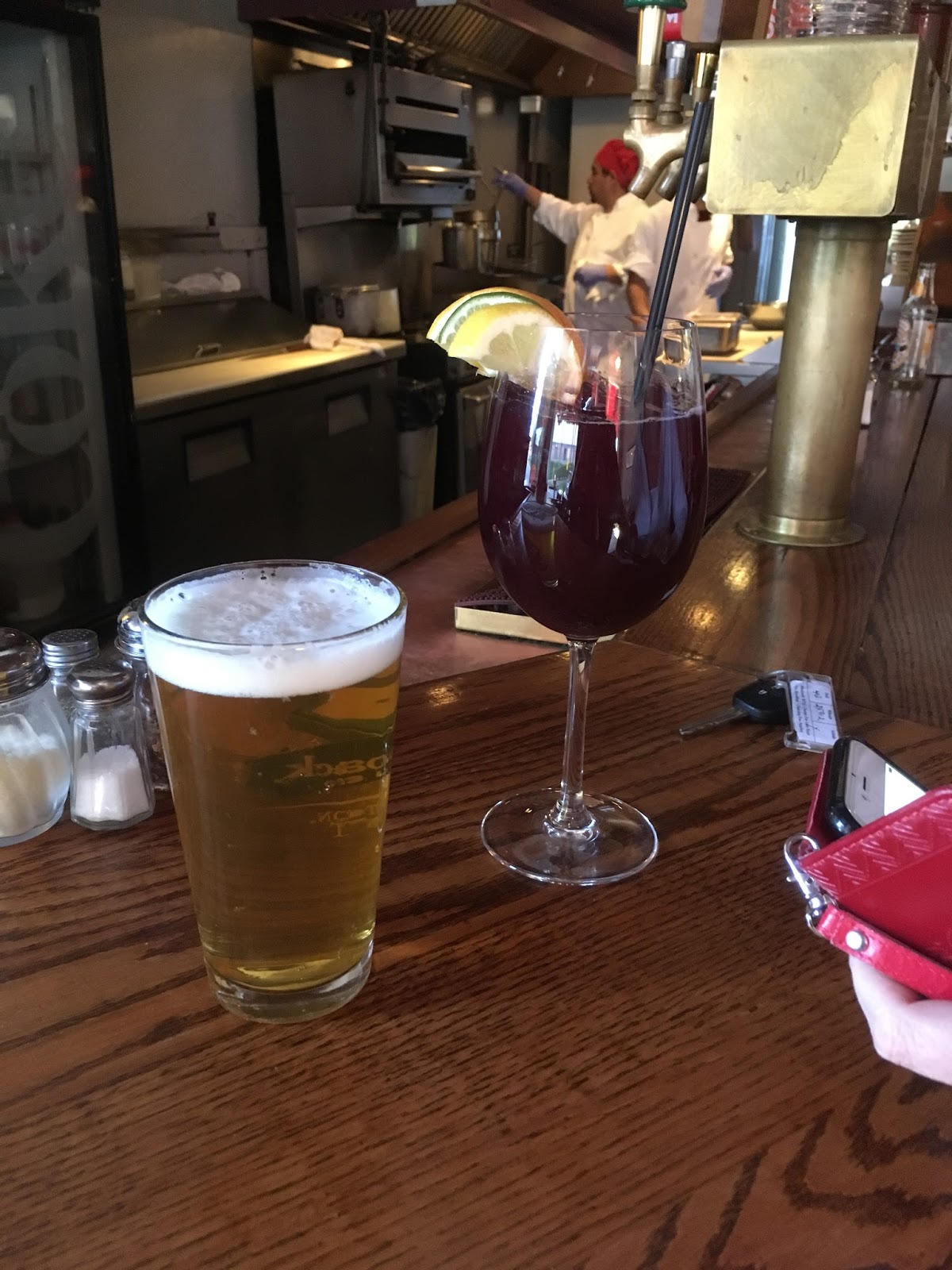
It's what everyone does, right? They string together photos of what they're drinking, and leave it to Pavlov for viewers to drool.

Just this once I will, too. Our week in and around Northampton MA wasn't designed as a beerdrinking excursion, but of course opportunities arose. We made stops at old favorites Northampton Brewery and Whetstone (in Brattleboro VT), and Diana's niece's husband saved a few local beers to sample. They were quite nice.

As an aside, here's a relevant link.

A Sea of Hoppy Sameness — In Search of New England’s IPA, by Bryan Roth (Good Beer Hunting)

... While Brut IPA's bone-dry effervescence is something of an of-the-moment anti-New England IPA, there's no denying the ongoing attachment drinkers have to hazy and juicy beers. In the same way that Dogfish Head is exploring the unclaimed white space of "better for you" beers, Lord Hobo recognizes an opening in the market.

"It's obviously not as crowded at the 11% range," Day says. "Which is fantastic." The expectation for the brewery was to sell as many as 10,000 cases of the beer during its three-month run across Lord Hobo’s entire distribution footprint, the equivalent of 725 BBLs. Museum also fits within a generally accepted idea of what new and on-trend IPA should be in New England.

In short, the evolution of New England IPA now points toward juiciness and high gravity -- or, even more numbing chagrin for an ex-brewery owner who now sees that if we'd only done NABC Hoptimus as a New England IPA, then maybe ...

Whatever. It wouldn't have mattered, and so I return to my Wernesgruner.


Monday, July 08, 2019

New England (New York) Vacation Vignette 4: Spike Dailey's, a great little pub in Dunkirk.


It says so right there on the menu, and I'm inclined to agree: Spike Dailey's "arguably (is) the smallest pub in New York." Located in Dunkirk just a stone’s throw from Lake Erie, the joint is small. The last time I saw a pub this small it was aboard a train (a bar car in Austria).

My only regret is that pub owner Aisling Pheenan, who hails from Dublin, was too busy to have her ear bent. Following are a couple of photos borrowed from her Facebook page, which I hope convey a smidgen of the ambiance (and size). 


An excellent place, indeed. We were staying at a hotel roughly 100 yards away, and Diana spotted the sign for an Irish pub. Spike's was it. Unfortunately I'd already eaten Beef on Weck down the street, or I'd have had one here.

I tracked down a small Irish pub called Spike Dailey’s that had rave reviews for its Beef on Weck. This is essentially a roast beef sandwich served on a kimmelweck roll with a side of hot horseradish. The roll is the secret here. A kimmelweck is like a Kaiser roll, only it’s topped off with big flakes of salt and caraway seeds. This combination is so good, because it’s actually quite simple. All the flavors meld together in a mouthful of deliciousness. After a long day on the water, a hot sandwich, cold beer and potato chips and salad hit the spot.

Our visit to Spike Dailey's came on the final night of the trip. We'd traveled much the same northerly route both directions: I-71 from Louisville to I-171 in Cleveland OH, then down I-90 to Western Massachusetts, via local roads from Albany NY (headed up) and I-91 to Springfield MA (coming back).

The journey was split in half both ways, with nights in Erie PA (outbound) and Dunkirk NY (return). On July 4 the overnight in Dunkirk had the benefit of coming in a hotel by the bay, with the north lawn hosting Independence Day revelers. Just a few steps toward the city's pier, from where the evening's fireworks were detonated, was a delightful strip of tiny commercial spaces in a single building, maybe 8 in number, including at least two bars, a pizza joint, a sweet shop and a boutique or two with restrooms and an ATM located square in the center.

From a beer drinker's perspective, this proved to be a fine layout for a summer's civic fireworks party, given that there apparently are no laws prohibiting cups of beer being carried around.

And they were. It was a mellow crowd spread down the lakeshore, a fireworks display that impressed even this Grinch, and a nice coda to the journey.

Sunday, July 07, 2019

New England Vacation Vignette 3: Amherst MA and an educational overload.

The state of Massachusetts has its own set of problems, just like anywhere else. But it's amazing to consider the brainpower in this one county.

Hampshire County is home to the “Five Colleges,” which comprises Amherst College, Hampshire College, Mount Holyoke College, Smith College, and the University of Massachusetts Amherst. The schools are a stone's throw away from each other, so you can swing by them all in one day and see roughly 30,000 students milling about.


On our third visit to the vicinity, we'd yet to wander Amherst, which probably is better known for the University of Massachusetts at Amherst, a land grant university and flagship of a state-wide university system.

But first, before attempting to fathom this preponderance of knowledge, a man's got to eat. Breakfast for me was an excellent "everything" bagel with lox and cream cheese.


Here is a pedestrian crossing in downtown Amherst with only two components: a painted crosswalk and a slender plastic sign in the middle. Cars yielded. Evidently there is something more to enforcement mechanisms in Massachusetts, as compared with New Gahania.


The Amherst College campus is situated atop a hillock, past the green, and boasts statues of abolitionist Henry Ward Beecher and poet Robert Frost, the latter a long-term faculty member.


It's a gorgeous setting.


The life of the mind. Imagine that.

Friday, July 05, 2019

New England Vacation Vignette 2: Another pleasant visit to Northampton and its classic namesake brewery.

2019 vintage.

Again in 2019, just as before in 2017, we made our base near Northampton at a delightful Airbnb just north of the city. I'm happy to share information about it, so contact me privately if you're headed that way.

There was less time than to roam than our previous trip, as we spent most of our 2019 stay with Diana's niece and her family in nearby South Hadley. However, we still managed to indulge two visits to the outstanding Northampton Brewery. Following is my account from April 18, 2017, which should be largely accurate.

Note: The Airbnb cat was no less friendly the second time. What a sweetheart.


---

New England 2017: The many delights of Northampton, and a digression on Jonathan Edwards.


The old folks (that's us) decided to give the kids a break on Tuesday, and with yet another pretty day dawning, we elected to spend the morning and early afternoon in Northampton.

I'll get straight to the point: I really like Northampton. If it turns out we'll be making regular visits to the vicinity ... well, I can adapt. At our current level of income attainment, living there is out of the question, but visiting is a blast.

Street parking in downtown Northampton is exhaustively metered, and most of these spaces are 50 cents per hour. There's also a large parking garage one block off Main Street, which costs the same as the meters.


Adjacent to the parking garage is a row of buildings that includes the fantastic Northampton Brewery, and a few yards south of the brewery are two surface parking lots. The surface lot fee is only 25 cents an hour, and what's more, one of the city's many shared use paths passes between the two lots.

We parked, bought five hours of car storage for the sum of available quarters in my pocket, and started walking -- though not just yet on the shared use path. First there was the vital matter of coffee, and perhaps a nice doughnut or two.

These we found in abundance at Glazed Doughnut Shop. There are as many Dunkin' Doughnut shops in New England as drug stores in Southern Indiana, and they're to be avoided, seeing as numerous local (better) options usually can be found with a bit of effort.

Duly refueled, the longer-range stroll began. Two hours and stray espressos later, we'd circled northward through lovely neighborhoods, all the way back downtown, where I stopped to peruse one of the historical markers and learned about the life of Jonathan Edwards.


Not Jonathan "Sunshine" Edwards the musician, who lives in Portland, Maine.

Rather, it's Jonathan "Fire and Brimstone" Edwards the 18th-century theologian renowned for his eloquence. Edwards preached in Northampton during the 1730s and 40s, and even then the town was well-heeled, suggesting that spiritual redemption (Great Awakening) was necessary.

Edwards' tenure in Northampton eventually came to a messy end, but I'm fascinated to learn that he apparently was a more complicated thinker than some modern fundamentalists care to acknowledge. In particular, he did not reject science, instead attributing it to God's bounty. In fairness, there were repercussions.

Did you know that Jonathan Edwards died from a small pox inoculation? by Bob Schoone-Jongen (Historical Horizons)

... Edwards embraced the new science of his day, especially new techniques being used to combat diseases. When small pox swept into Princeton, New Jersey during the winter of 1757-58, Edwards, the local college’s newly minted president, got a shot from a reputable doctor. Thirty-seven days later Jonathan Edwards was dead from the shot.

Musings on the life of Edwards made me hungry. It was time for lunch, and where else but Northampton Brewery for sustenance and even more history?


Here is an account of a Best Bitter to return for, as written in September of 2016 after our first visit.

A lovely Best Bitter at Northampton Brewery.

 ... What impressed me most was a Daniel Shays Best Bitter. So few breweries in my neighborhood (anywhere?) bother any longer with stylistically accurate English-influenced styles. Northampton Brewery's version reminded me a bit of the ESB at Broad Ripple Brewing Company, though milder and at a lower alcohol content ... precisely as it should be.

You should be asking, "But Roger, who is Daniel Shays?"

Follow the link to find out about Shays, another interesting regional character.

Tuesday Phase One ended with a walk across the Norwottuck Rail Trail - Connecticut River Bridge. Neither bells nor whistles, just essential functionality. Perhaps some day this lesson will migrate to the heartland.


Our Airbnb hosts have cats, and seldom are felines as friendly to guests as this one.


After a siesta, Tuesday Phase Two commenced with a short drive back into Northampton for carry-out brick oven pies from Pizza Paradiso.


We conveyed the pizzas (mine had lovely anchovies) to South Hadley, where Jen and Ruby were waiting, and Ben was home from work.

He was eager to lead me on a further exploration of his garage beer fridge, especially a collection of high-gravity beers from Greater Good Imperial Brewing Company, which operates exclusively above a threshold of 8% abv.

This gravity sampling came perilously close to intoxicating me, which doubtless was Ben's objective all along.

Craft beer?

Craftier youth.


New England Vacation Vignette 1: Civil War statuary, an officer in Providence RI and an enlisted man in South Hadley MA.


Ambrose Burnside was born in Liberty, Indiana (appropriately, in Union County) near the border with Ohio. He became a Rhode Island resident only after being stationed there while serving in the antebellum US military.

One of the most interesting things about Burnside, apart from his trademark facial whiskers (originally called burnsides, then sideburns), was the woman he didn't marry.

Prior to the Civil War, Burnside was engaged to Lottie Moon. She famously jilted him at the altar. Later during the conflict Moon and her sister became notorious Confederate spies. Eventually the sisters were captured and fell into the custody of none other than Burnside, who detained them but didn't file espionage charges.

Just before the outbreak of war Burnside succeeded in designing and patenting an innovative breech-loading carbine (the Burnside carbine). This might have brought him great wealth when wartime government orders began pouring in, except he'd been compelled to surrender the patents when thrown into debt by business reversals.

As a Civil War general Burnside occasionally was productive in a subordinate's role, but was not a top-flight officer. He was self-aware and recognized his own limitations at all levels of military command. This didn't stop Abraham Lincoln from appointing Burnside to lead the Army of the Potomac, resulting in the catastrophic Battle of Fredericksburg in late 1862.

For all this, but perhaps more so by virtue of a postwar political career as a Rhode Island governor and senator, Burnside posthumously was awarded a small park and equestrian statue in downtown Providence.

I knew nothing of this when we visited the capital, although the statue looked somewhat like Burnside from a distance. The following day I went for a stroll in South Hadley, Massachusetts and found myself somewhat entranced by this simple statue on the village green.

It reads, "This monument is erected to commemorate the loyalty and patriotism of our citizen soldiers who fought for liberty and the union in the Great Rebellion of 1861 - 1865."


In fact, "great rebellion" is a far more accurate description of the war than the terms we use today, and whether one is a pacifist or hawk, "citizen soldiers" reminds us of who did the heavy lifting and made the ultimate sacrifice.

Ambrose Burnside, officer, inventor and politician. To look at his life is to see a popular, well-liked man who knew how to play his hand, and always had a second chance waiting irrespective of how badly he'd botched the previous opportunity.

The soldier at South Hadley symbolizes the men who did the actual work, died and were maimed. Many didn't return from the Civil War, and many of the ones who did came home scarred, whether by wounds or the weight of the experience.

To me, Burnside assuredly was on the "right" side, but I'm not sure there is any better justification to leave his equestrian statue stand unmolested than the one of Confederate officer John B. Castleman at Louisville's Cherokee Triangle.

Give me the guy in South Hadley, any day.

Wednesday, July 03, 2019

One fine afternoon at the Providence Athenaeum.


We drove down to Rhode Island yesterday, and this venerable library was the star attraction.

The Providence Athenaeum was founded as "The Athenaeum" in 1836 as an independent, member-supported library open to the public. Its progenitors were two earlier libraries: The Providence Library Company, founded in 1753, and the Providence Athenaeum, founded in 1831. It became "The Providence Athenaeum" by amendment to its charter in 1850.

Poe came here, but not entirely for the books.

One of the Athenæum’s most famous visitors was Edgar Allan Poe. In September of 1848, he traveled to Providence in order to meet and court the wealthy Rhode Island widow, Sarah Helen Whitman.

The Athenaeum was a convenient rendezvous site, but it turned out badly.

On December 23, 1848, Sarah Helen Whitman broke off her relationship with Edgar Allan Poe in the building. Author H.P. Lovecraft was not a member of the library, but he lived nearby on College Street; he frequented the library and wrote about it in his letters and stories.


Of the two writers, Lovecraft is a tad dicier in terms of legacies, as David Barnett explains.

The question that fans of the horror genre wrestle with today is how Lovecraft can be celebrated when his views were so execrable? You’ll often hear the “man of his time” argument, yet even for the early 20th century these were still extreme views, especially for someone who was raised and lived in New England and New York.

The other often-used argument is that we should be able to separate the man from the work. It is OK to appreciate Lovecraft’s stories and the impact he has had on this particular branch of literature while at the same time pushing his own views to one side?

It’s a conundrum that’s perhaps as unsolvable as any conflict in Lovecraft’s own fiction. Only one thing is certain; HP Lovecraft, and the body of work he embarked upon exactly a century ago when he wrote The Tomb, seemingly endure, though the spectre of the writer’s racism will always lurk in the background like one of the loathsome creatures of his imagination.

Monday, July 01, 2019

New England Vacation Vignette 5: The Bridge of Flowers in Massachusetts is a garden over a river.


It's called the Bridge of Flowers, and it connects two towns in Western Massachusetts.

The Bridge of Flowers is in Shelburne Falls, Massachusetts, connecting the towns of Shelburne and Buckland. The seasonal footbridge – once a trolley bridge – has a garden of flowers covering it. It is only open between April and October.

Built as a trolley bridge in 1908 but abandoned by 1927, the structure was derelict until local housewife Antoinette Burnham had the idea to convert it to the present use -- in 1929.

A fascinating attraction, to be sure.