Follow the link and see the "comments" to read what the church's senior pastor, John Manzo, wrote with respect to the building's future disposition.
Several readers asked for a photo of the property in question. Here is is , looking in a southeasterly direction from the corner of Bank and Spring:
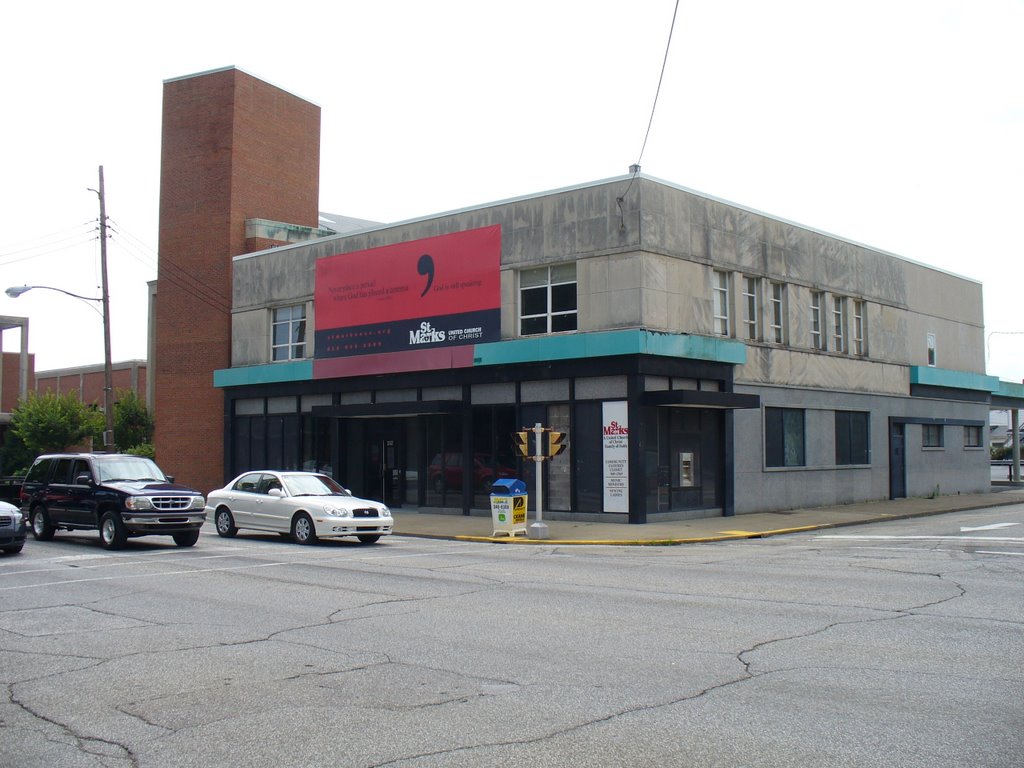
Shifting to a view toward the southwest, here's the main part of the church and the old bank building:
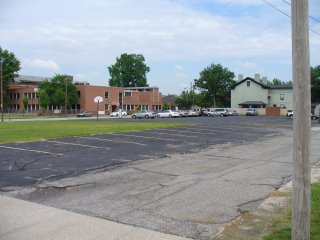
Looking to the south from the corner of 3rd and Spring, we see St. Marks parking on the east side of 3rd:
Shifting to a Market Street vantage point, the vistas to the north and west reveal large tracts of cleared urban land surrounding the church on two sides:
A final note: According to information in the church newsletter, it has received an offer for the bank building from a legal firm -- not, as some persist in believing, from local food and drink entrepreneurs. It is important to understand that the bank building is next to useless for those contemplating entertainment that includes adult-friendly libations, as it would be impossible to obtain an alcoholic beverage sales license from the state of Indiana owing to the building's close proximity to the church.
----
* Thanks to Bluegill for the aerial view (via Google Earth).
7 comments:
Looks like from the photos, and a drive thru town, St Marks is surrounded by parking. Do they worship the almighty car too?
The congregation voted today to reject the offer to purchase the building.
Just an update, the congregation voted to reject the offer to purchase the building, as was reported. To make a correction, the church isn't really surrounded by parking. We have one parking lot on 3rd Street and a very small one behind the Sanctuary and the bank building. The view from especially the one picture makes it appear that we have a great deal more parking than we actually do have.
The aerial photo makes me wonder what used to stand in the cleared areas.
Might I inquire whether the pastor sees this vote as a "victory" for any certain principle, i.e., property rights, responsibility to the neighborhood, the collective interest of the antire city's citizens in the judgment of the Historical Preservation Society?
Must we assume sans meaningful debate that a church by its very nature is good and well meaning when it comes to these topics?
"Might I inquire whether the pastor sees this vote as a "victory" for any certain principle, i.e., property rights, responsibility to the neighborhood, the collective interest of the entire city's citizens in the judgment of the Historical Preservation Society?
Personally, I didn't see this as a 'loss' or 'victory.' I have been neutral on this subject. Here are some facts concerning this building in question.
Around 3 years ago we hired a professional consulting firm (Entheos) to come in and analyze all three of our buildings. We have maintenance/repair needs in all of them, and we needed to have some sense of where our priorities needed to be, what things would cost, and what our plans needed to be to achieve what we needed. The report had a variety of issues we need to face with our Sanctuary building and our Education building. The bank building, however, was determined by them to be in very bad shape. The building had no ability to be made more accessible, it had a bad room, bad air-conditioning/heating, and bad plumbing. Furthermore, the building was a structure that had been added to 2 - 3 times and structurally, with support beams, etc., it had little to no flexibility to be renovated to effectively be useful to us. The building also had become a major financial drain to us with ongoing repairs, inefficient electric usage, plumbing, etc. Furthermore, our Clothes Closet which was upstairs was up a flight of stairs which were very difficult to navigate for those who were elderly or disabled in any fashion. (The Clothes Closet was subsequently moved to the Educational Building.) As the building was considered to be in wretched condition, which it most certainly was, the determination was made to demolish it.
The congregation voted twice to do this, turning down a pretty low bid for the property and the building by a developer.
As is known, we went through the process with the Historic Preservation Commission and another offer came in for the building. a reasonable one. Considering the fact that we were in the middle of the appeals process and that the offer for the building seemed to be a good one, we went back to the congregation. The congregation has opted to continue the appeal's process because it was the majority's wish to keep the property.
My agenda for the meeting was simple. I wanted the people to make a clear choice and I wanted it to be a civil debate. Both were achieved. Was it the right choice? I'm not sure. I'm not saying selling would have been the right choice either. I can say that the meeting was conducted in a highly professional manner, people had their say, and they voted, secret ballot. People shared their opinions, it was no hostile, but it was honest and reasonable.
As to the building itself. The building itself is not an historical people. It's not, I do not believe, one of New Albany's oldest buildings and nothing of note happened there, unless George Washington did, in fact, sleep in one more unaccounted for place. In my mind the building is old, out-dated, not useable for us, and in wretched condition.
We did, at one point, offer plans to the Historic Preservation Commission as to building a prayer garden. It would have been a garden spot, with benches, with walls (but not completely walled some people could walk in and out). The walls were the same design to match the Sanctuary building immediately adjacent to it. The theory was that it would be a great respite area in the downtown where people could sit quietly, or eat their lunch, or just rest. In looking in downtown Louisville, there are a lot of little areas like this which dot the downtown. Our thoughts were that this would be perfect. It would blend in with the architecture of the church and be a wonderful addition to the downtown. We were turned down on this, so, at this moment, our goal is to tear the building down and develop it later. Personally, I don't want to see it converted into a parking lot. With the lot on 3rd Street and behind the bank building, I believe that we have adequate parking.
A second alternative, in the future, would be to put an addition on the Sanctuary and have a gathering area there, rest rooms on ground level, and perhaps some smaller rooms. This, however, isn't even on the drawing board as of yet.
We have responsibilities to the neighborhood and the community, this I would agree:
We have a weekly Soup Kitchen which feeds people every Saturday at noon.
We have our Community Clothes Closet which gives free clothing to people in need.
We've helped countless people in town with a whole variety of needs.
We are a welcoming church in the fact that people from many different walks of life and lifestyles have found a home here.
From a property perspective the removal of an old building in very poor condition, in my opinion, doesn't hurt the city at all. Actually, it helps. I grew up in the New York City suburbs (sunny side of the Hudson River) in New Jersey, and Hudson County, New Jersey wasn't able to have any sort of revitalization until they were able to cherry pick in those cities which buildings were historic and needed to remain, and those which could come down. A lot of little 'park' areas were set up making that part of the country a very attractive region to reside in. St. Marks may have torn old buildings down, but they weren't architectural marvels and they weren't historically of note. And while many churches have abandoned downtown, we have stayed put and plan to do so. Frankly, I think we have been a good neighbor to people downtown.
I for one have found it interesting that there has been debate on this outside the walls of the church. I'm always open to meaningful discussion. I'm hoping by sharing some facts, especially on the building's condition, it makes it more clear that this was a long, well thought out decision, and not a mindless endeavor to just level the landscape.
I hope this helps!
John Manzo
Being a good neighbor downtown includes paying full heed to the historic preservation effort and respecting the decisions of the Historic Preservation Commission. While some members of the church may not view the bank building as significant, it's clear that the HPC and numerous other concerned citizens do.
The HPC has ruled in favor of saving the building more than once, yet St. Marks continues to appeal. It strikes me as odd that the church would would put so much effort into passively respecting its own internal processes while ignoring those of the greater community.
If church members consider quiet acceptance as the civil response to potential conflict, why then do they seem unwilling to show that same level of civility and respect to the HPC and the community at large?
As clearly demonstrated by the aerial photo, the footprint of the bank building is minimal when compared to the overall size of the St. Marks property. They have more than enough space (owing to other demolitions) to expand their sanctuary building, build a prayer garden and to increase parking without demolishing anything.
Selling the bank building would rid them of what they consider to be unnecessary expenses and help finance future projects, allow someone with resources to continue revitalizing downtown and aid in the preservation effort.
The church has an opportunity to set an example to others at a time when downtown is just starting to revive. Let's hope their chosen course reverses so that example portrays the cooperation and respect evident inside church walls rather than just the amorphous self-interest exhibited externally thus far.
Post a Comment