Tuesday, July 09, 2019

Mouth breathers and bicycle lanes: "From congestion to cost, there are many entirely misguided arguments in circulation."


It would be nice if we had a newspaper.

It would be nice if we had a newspaper willing to ask questions of public officials.

It would be nice if we had a newspaper willing to ask questions of public officials, as whenever Jeff Gahan assumes full credit for a new miracle, the reporter asks: and what exactly are you doing to connect these various miracles by some form of mobility that isn't another automobile?

But we don't have a newspaper, and this isn't nice at all, because it means that Gahan and his car-centric ilk continue to utilize the ol' bait 'n' switch, pretending that infrastructure projects are about mobility options, when they're typically no more than another driver pacification scheme.

We don't have a newspaper. It really sucks.

Ten common myths about bike lanes – and why they're wrong, by Peter Walker (The Guardian)

From congestion to cost, there are many entirely misguided arguments in circulation

Cycle lanes have been in the news recently, as have the many often entirely misguided arguments that opponents use against them.

For all the (slight) progress in some UK cities over mass cycling, we are still at a stage where a leaflet from a local branch of the party of government (see below) will state falsehoods about bike lanes as if they were the undoubted truth.

So perhaps it’s time to demolish 10 of the most common myths about cycle infrastructure. Do by all means suggest more in the comments below.

1. Cycle lanes increase congestion (and thus pollution)

This is perhaps the most common myth, possibly because critics confuse what feels like it’s true with what actually is true: the assumption that if you take some road space from motor vehicles, you get more traffic jams – as with (a commonly used parallel) forcing water down a smaller pipe.

But fluid and traffic are not the same thing, as shown by 60 years of governments trying and failing to road-build their way out of congestion. The idea of induced demand – more road space brings more cars – has been known for decades, and it also works in reverse. This is especially so with bike lanes, which are such an efficient use of the same space that they can often mean the same amount of space carrying more people overall.

Yes, traffic jams have worsened in some cities where bike lanes have been built, but studies show this is largely down to other factors, for example the growth in the number of Uber-type private hire vehicles and Amazon delivery vans.

Most compelling of all, of course, is the fact that motor vehicles cause the congestion in the first place, and the only real way to reduce traffic congestion is to have fewer of them on the roads.

Snip

10. There’s no need

This is, in effect, the message of the critics: not this, not now – let’s try to get away with unambitious schemes without proper infrastructure, which will never change much.

You could write a whole column – even a book – about why this is absurd, but it’s always worth stressing this point to the cycling naysayers: OK, what’s your solution to gridlock, pollution, a climate emergency; to cities that are noisy, dangerous and unjust? They will not respond, because there is no answer.

TheatreWorksEDU student productions begin this week at the Riverfront Amphitheater.


Like the e-mail says, "The latest and greatest news on your favorite little playhouse in Downtown New Albany."

For more information visit the TheatreWorks web site.


---

Dear Friends,

The TheatreWorksEDU student productions of Disney’s The Lion King KIDS and Seussical JR begin this week at the New Albany Amphitheater. The performances are July 11, 12, 18, 19, & 20 at 7:30 p.m and they are free to the public. Both productions are directed/music-directed by Katie Maras Haulter, assistant-directed by Brooklyn Chalfant, choreographed by Sarah Gahagen, and tech-directed by Kota Earnhardt.

The 60+ students involved with these two shows have been rehearsing since May. “It has been such a pleasure working with these talented young performers,” said Gahagen. “These kids have willingly given up much of their summer break to practice and that enthusiasm shines through on stage. It is such a positive experience not only for the children, but for us adults as well.”

Gahagen shared, ““These are such great shows with such fun music. It has been such a privilege to work with these kids and see them learning and growing as performers. They have worked so hard all summer, and I think we are all looking forward to seeing all the pieces come together into a great performance!”

Haulter is no stranger to working with student actors of all ages. She directed The Lion King KIDS at Clarksville Little Theater last summer, and is currently the theatre director at Hazelwood Middle School. Haulter shared, “The kids and teens in both Lion King KIDS and Seussical, Jr. have devoted their summer to honing their acting, singing, and dancing skills, and I couldn’t be prouder of all they have accomplished. These are perfect shows for the whole family to join us in celebrating - including little ones - and to share New Albany and Southern Indiana’s love of theatre for all ages.”

These productions are an effort to provide summer activities and positive experiences for students. “The focus of this project has been on the students,” said Dr. Jason Roseberry, Executive Director for TheatreWorks of SoIN. “From the acting, set work, lighting, and sound, these students have worked with professionals and then had the responsibility handed off to them for the performances.”

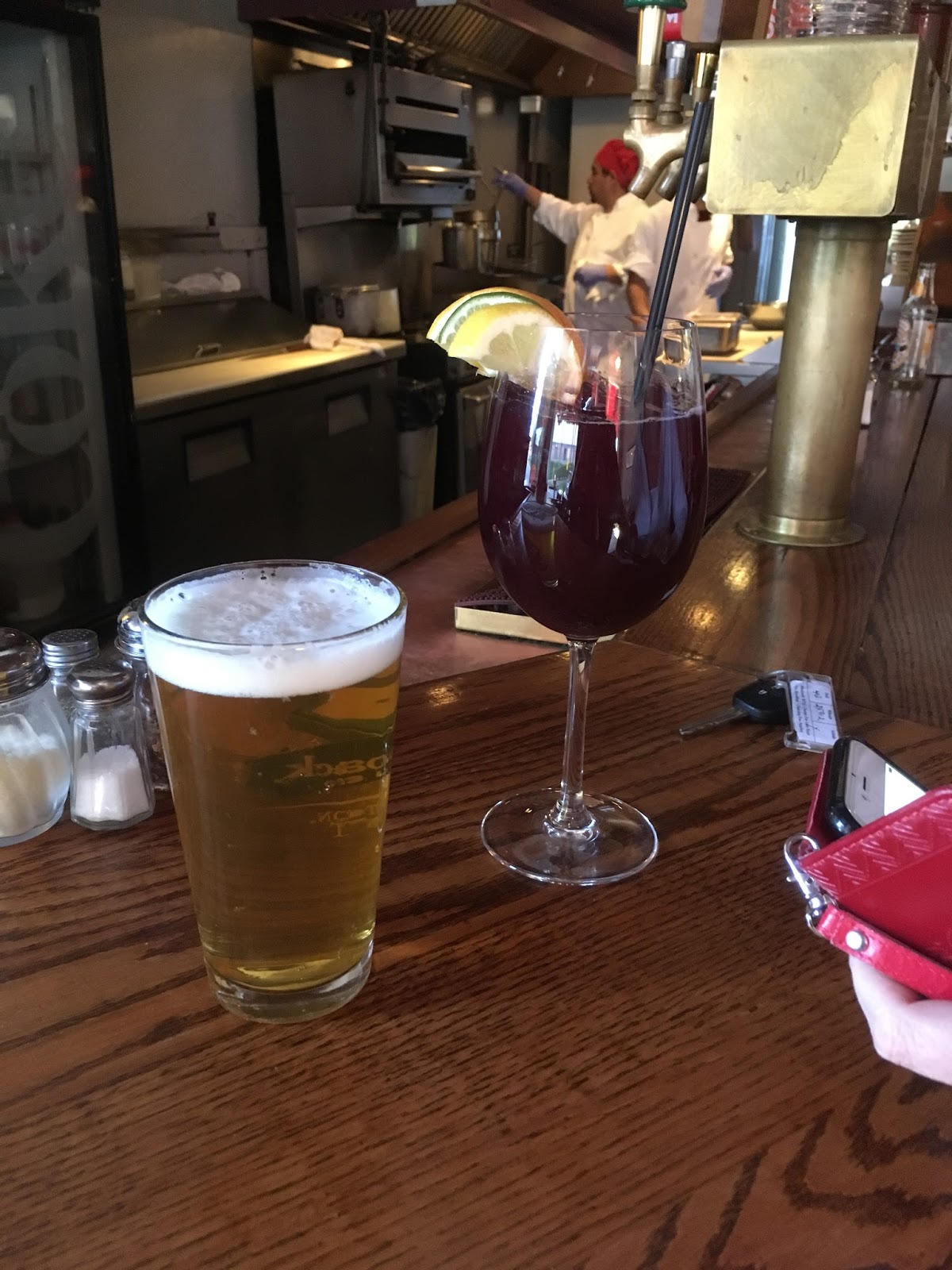
New England Vacation Vignette 6: A few good beers while we're at it.


It's what everyone does, right? They string together photos of what they're drinking, and leave it to Pavlov for viewers to drool.

Just this once I will, too. Our week in and around Northampton MA wasn't designed as a beerdrinking excursion, but of course opportunities arose. We made stops at old favorites Northampton Brewery and Whetstone (in Brattleboro VT), and Diana's niece's husband saved a few local beers to sample. They were quite nice.

As an aside, here's a relevant link.

A Sea of Hoppy Sameness — In Search of New England’s IPA, by Bryan Roth (Good Beer Hunting)

... While Brut IPA's bone-dry effervescence is something of an of-the-moment anti-New England IPA, there's no denying the ongoing attachment drinkers have to hazy and juicy beers. In the same way that Dogfish Head is exploring the unclaimed white space of "better for you" beers, Lord Hobo recognizes an opening in the market.

"It's obviously not as crowded at the 11% range," Day says. "Which is fantastic." The expectation for the brewery was to sell as many as 10,000 cases of the beer during its three-month run across Lord Hobo’s entire distribution footprint, the equivalent of 725 BBLs. Museum also fits within a generally accepted idea of what new and on-trend IPA should be in New England.

In short, the evolution of New England IPA now points toward juiciness and high gravity -- or, even more numbing chagrin for an ex-brewery owner who now sees that if we'd only done NABC Hoptimus as a New England IPA, then maybe ...

Whatever. It wouldn't have mattered, and so I return to my Wernesgruner.


Yanis told you so: "How Syriza’s capitulations allowed the Greek right to escape the dustbin of history."


As we've observed here in New Albany at a grassroots level, breaking free from the tentacles of business as usual is a daunting task. As an example, there are too many beak-wetting imperatives to justify local government perpetually spending money on shoddy annual repaving projects rather than examining the realities of car-centrism and alternatives to it -- and if you believe against all prevailing evidence that "leaders" like Bob Caesar have any interest in learning new tricks, think again. They're too busy nuzzling the effete pants legs of oligarchy-drunk entities like One Southern Indiana, hoping they might be tossed a tattered bone.

Where was I?

Oh yes, Greece.

In an essay at New Statesman, Yanis Varoufakis explains the invariable result when the Left, forever unwilling to stand by the veracity of its own political principles, caves to the Right -- itself forever willing to seize opportunity when the vacuum presents it.

How Syriza’s capitulations allowed the Greek right to escape the dustbin of history

The left-wing party’s embrace of austerity created the conditions for a parasitic and cruel oligarchy to return.

 ... What the people of Greece had said to us, their government, in that 2015 referendum, made perfect sense: “We don’t want to leave the euro or to clash with the European Union. But, if the European Union is demanding of you, of our government, the intensification of the austerity-insolvency doom loop that forces our youngsters to emigrate and the expropriation of what is left of our public assets, don’t you dare surrender — even if Grexit is the price we must pay.”

That night, while our people were out on the streets celebrating their remarkable victory, the political representatives of Greece’s oligarchy were in tatters. The leader of New Democracy resigned, the party’s cadres wallowed in deep despair, the oligarchy they represented was in a state of panic. Alas, they worried unnecessarily. For at the same time, a coup against the people was being hatched in the office of my colleague, the prime minister.

Monday, July 08, 2019

R.I.P. Alfred E. Neuman (1952 - 2019), or how "Mad Magazine Told the Truth About War, Advertising, and the Media."


"(Mad founder Harvey) Kurtzman didn’t inherit his parents’ (left-wing) politics, but his background left him hostile to conventional American culture, which he regarded as filled with lies."

Don Martin may have been my personal favorite, but Mad was a many-splendored piece of work for a very long time.

Here's Don Martin's classic National Gorilla Suit Day, soon to be a DNA fundraiser.


One Fine Day in Front of Jimmy's Music -- with apologies to the late, great Don Martin.


The Nation gets it.

‘Mad’ Magazine Told the Truth About War, Advertising, and the Media, by Jeet Heer (The Nation)

Patti Smith: “After Mad, drugs were nothing.”

... Born in the troubled era of McCarthyism, Mad is dying in another squalid political epoch. Mad was arguably America’s greatest and most influential satirical magazine, a strange claim to make of a publication that was mostly read throughout its existence by children and teenagers, but still justifiable.

Mad was often rude, tasteless, and childish—which made it all the more potent as a tributary of youth culture. The kids who read Mad learned from it to distrust authority, whether in the form of politicians, advertisers or media figures. That was a lesson that successive generations took to heart. Without Mad, it’s impossible to imagine underground comics, National Lampoon, Saturday Night Live, The Simpsons, The Daily Show, or Stephen Colbert. In the historical sweep of American culture, Mad is the crucial link between the anarchic humor of the Marx Brothers and the counterculture that emerged in the 1960s ...

Mr. Skin: Spirit's stellar drummer Ed Cassidy, a forgotten rock legend.


In a previous post pondering the perfect symmetry of Deaf Gahan performing in the Reisz Mahal as Sardonicus, we naturally came to the rock band Spirit and its 1970 album Twelve Dreams of Dr. Sardonicus. In turn this started me thinking about the overlooked career of a true original, Spirit's drummer Ed "Mr. Skin" Cassidy, who died at the age of 89 in 2012.

Spirit remain one of rock and roll's unsung entities. Formed in 1966 by guitarist Randy California, bassist Mark Andes and singer Jay Ferguson, the band would become complete with the addition of drummer Ed Cassidy, who was Randy California's stepfather, and several years older than the other band members. Cassidy's glaring bald head was an anomaly in the heyday of long hair, just one of many paradox's within the world of Spirit. So dig in and explore our little salute to this great lost band as we dish out our Top 10 Spirit Songs.

Cassidy's incredible life and career are described in this video. It isn't the best quality, but the point is to remember Cassidy's underrated contribution to the story of rock.

New England (New York) Vacation Vignette 4: Spike Dailey's, a great little pub in Dunkirk.


It says so right there on the menu, and I'm inclined to agree: Spike Dailey's "arguably (is) the smallest pub in New York." Located in Dunkirk just a stone’s throw from Lake Erie, the joint is small. The last time I saw a pub this small it was aboard a train (a bar car in Austria).

My only regret is that pub owner Aisling Pheenan, who hails from Dublin, was too busy to have her ear bent. Following are a couple of photos borrowed from her Facebook page, which I hope convey a smidgen of the ambiance (and size). 


An excellent place, indeed. We were staying at a hotel roughly 100 yards away, and Diana spotted the sign for an Irish pub. Spike's was it. Unfortunately I'd already eaten Beef on Weck down the street, or I'd have had one here.

I tracked down a small Irish pub called Spike Dailey’s that had rave reviews for its Beef on Weck. This is essentially a roast beef sandwich served on a kimmelweck roll with a side of hot horseradish. The roll is the secret here. A kimmelweck is like a Kaiser roll, only it’s topped off with big flakes of salt and caraway seeds. This combination is so good, because it’s actually quite simple. All the flavors meld together in a mouthful of deliciousness. After a long day on the water, a hot sandwich, cold beer and potato chips and salad hit the spot.

Our visit to Spike Dailey's came on the final night of the trip. We'd traveled much the same northerly route both directions: I-71 from Louisville to I-171 in Cleveland OH, then down I-90 to Western Massachusetts, via local roads from Albany NY (headed up) and I-91 to Springfield MA (coming back).

The journey was split in half both ways, with nights in Erie PA (outbound) and Dunkirk NY (return). On July 4 the overnight in Dunkirk had the benefit of coming in a hotel by the bay, with the north lawn hosting Independence Day revelers. Just a few steps toward the city's pier, from where the evening's fireworks were detonated, was a delightful strip of tiny commercial spaces in a single building, maybe 8 in number, including at least two bars, a pizza joint, a sweet shop and a boutique or two with restrooms and an ATM located square in the center.

From a beer drinker's perspective, this proved to be a fine layout for a summer's civic fireworks party, given that there apparently are no laws prohibiting cups of beer being carried around.

And they were. It was a mellow crowd spread down the lakeshore, a fireworks display that impressed even this Grinch, and a nice coda to the journey.

SHANE'S EXCELLENT NEW WORDS: Deaf Gahan has become Sardonicus, but what is to be our verdict?


Deaf Gahan has a new nom de plume at Twitter, and it's perfect for a cash-infused, well-oiled, imperial re-election campaign.

Nom de plume: a name that a writer uses instead of his or her real name; pseudonym, pen name. 

But who is Sardonicus?

It begins with the adjective sardonic, which means grimly disdainful or cynical, and bitter, scornful derision to the point of malevolence. The word sardonic is derived from Greek.

Sardonic comes from the Greek adjective Sardonios, which actually describes a plant from a place called Sardinia that supposedly made your face contort into a horrible grin ... right before you died from its poison. The Greeks used sardonic for laughter, but we only use it when someone's humor is also mocking or ironic.

This facial contortion worked its way into the medical literature and is now used to describe an actual condition.

Risus sardonicus or rictus grin is a highly characteristic, abnormal, sustained spasm of the facial muscles that appears to produce grinning. Risus sardonicus may be caused by tetanus, strychnine poisoning or Wilson's disease, and has been reported after judicial hanging.

Much later science proved the ancient Greeks were on to something.

In 2009 scientists at the University of Eastern Piedmont in Italy wrote that they had identified hemlock water dropwort (Oenanthe crocata) as the plant historically responsible for producing the sardonic grin. This plant is the most likely candidate for the "sardonic herb", which was a neurotoxic plant used for the ritual killing of elderly people in pre-Roman, Nuragic Sardinia.

"Mr. Sardonicus" became a 1961 Hollywood horror film directed by Wiliam Castle, based on short story by Ray Russell.


But let's not forget the way most music fans of a certain age were introduced to Sardonicus, via the rock group Spirit's 1970 release, The Twelve Dreams of Dr. Sardonicus, which was reviewed in Rolling Stone at the time by none other than the estimable literary figure Nick Tosches. He explains.

Any illusions that might still be clung to along the order of Spirit's being an Epic house organ anthropomorphization-of-eclecticism shuck, complete with baldpated, cerebral - looking leftover from the bongo drums and black beret era, should be flushed down the old metaphysical crapper as quickly as one would dispose of just so much Nathan's ® chicken chow mein sandwich puke, because this here Twelve Dreams of Dr. Sardonicus (a hep reference to William Castle's great 1963 horror flick Mr. Sardonicus, which was about this mick who had his face paralyzed by banshees into a super-hideous grin when he crashed his father's casket to get a winning lottery ticket out of the old geezer's jacket pocket and then went around wearing this creepy plastic mask and bringing women down his cellar to ball except you should've seen the shit that went down whenever he would take off the mask) lay languidly upon the very steps to Parnassus.

The album contains the song most geezers like me associate with Spirit, as it was an FM radio staple during the 1970s -- and appropriately named considering the subject matter of today's column.


"It's nature's way of telling you something's wrong" strikingly conveys the very idea of a third term for Jeff Gahan. Consequently, the answer lies in Castle's movie.

Castle, with his reputation as the "king of gimmicks" to market his films, built the marketing for the film around the idea of the two possible endings.


Near the end of the film, audiences were given the opportunity to participate in the "Punishment Poll". Each movie patron was given a glow-in-the-dark card featuring a hand with the thumb out. At the appropriate time, they voted by holding up the card with either the thumb up or down as to whether Sardonicus would live or die.

Come November, the verdict on Deaf Gahan Sardonicus is as clear as the malevolent grin on the faces of his special interest donors.


#FireGahan2019

Sunday, July 07, 2019

Jeffersonville News and Tribune hits rock bottom as evangelism columnist Tom May argues for theocratic fascism, Pence-style.


Sheer drivel from Bill Hanson’s pastor. 

Does Tom May still rank a second "general interest" column in addition to the Sunday sermon?

When will free thinkers and non-theists get equal time, not with piecemeal "guest column" replies to the newspaper's two resident evangelists, but via a weekly counterpoint of our own?

COLUMN: Freedom, faith and our future by Tom May in the Jeffersonville Hansonian Devotional, soon to be renamed the Tom May Content Aggregation Mechanism

 ... Is there a way that a person of faith can be patriotic today? Across our country, people of the United States are encouraged to show their patriotism – their love for their country and the freedom that it represents – on this special time of the year, but is there a place for my faith to fit it to the celebrations?

Ominously, May continues.

When it comes to the general public, the majority of Americans affirm the belief of this definition. “True religious freedom means that all citizens must have freedom of conscience, which means being able to believe and practice the core commitments and values of your faith.” A slight majority of 55 percent held to this opinion. This definition is down from almost 70 percent in a similar survey in 2012. It appears that while most still agree, Americans are feeling less certain about the definition.

You just know what's coming.

We are not sure about what faith means in our culture. We are even less sure of how to live that faith each day. Perhaps it is because we are not doing as clear a job teaching our faith, handing the mantel to the next generation.

What should a person of faith do? Foremost the person of faith should not be silent. Tom Minnery, in his book, “Why You Can’t Stay Silent: A Biblical Mandate to Shape Our Culture,” writes, “Being salt and light in this age means contending responsibly for godly standards. There is no escaping the mixture of religion and politics, because nearly every law is the result of somebody’s judgment about what is good and what is bad.”

Famous evangelist Billy Graham’s son Franklin writes on his father’s website, “While followers of the Lord Jesus Christ should never resort to violence, we must do all we can to resist evil. As Mr. Pence has said, we are not to remain silent when moral anarchists are attempting to extinguish any influence of Biblical morality in our government, schools and businesses.”

May then relates a tired Red Skelton anecdote about the Pledge of Allegiance -- no, seriously.


But don't take this pagan's word for it. There was an impeccably faith-based reply at the pews-paper web site, and it's a powerful rejoinder.

As a pastor in town I'm very cautious in writing to the newspaper to share my opinions on religion. I use extreme caution so as not to offend people. I firmly believe in everyone's freedom of religion and their opinions.

I read Tom May pretty much every week. Our religious and theological traditions are very different and I find myself often disagreeing with him. Having said that, he is entitled to his perspective and I applaud his willingness to share his faith with others. He seems like a fine person and while I often disagree with him, it's just a simply different perspective.

His most recent article, however, crosses a line. Faith, freedom, and culture are, of course, worthy of conversation. In his observation on freedom of religion, I would agree that we are free to practice our religion without interference from the government. Yes. Absolutely. I would also say that religious freedom also accommodates people who are not people of faith. People of faith are free to practice their faith; people who are not people of faith have a right to not practice faith. The United States does not have an official religion and that is, I believe, a good thing. I don't know if we are in agreement to the right of people not to practice faith but we certainly agree that people should have the freedom to practice their faith as they so choose.

All of my education has been in seminaries----I entered the seminary at age 18. I am a person of faith and have always been. My entire adult life has been focused on different aspects of ministry. My faith is something I take seriously. Mr. May included this passage in his article that was very irritating. He wrote:

"Famous evangelist Billy Graham’s son Franklin writes on his father’s website, 'While followers of the Lord Jesus Christ should never resort to violence, we must do all we can to resist evil. As Mr. Pence has said, we are not to remain silent when moral anarchists are attempting to extinguish any influence of Biblical morality in our government, schools and businesses.' "

First, Mr. Pence is a politician. He is not a religious leader. He is not a person who has expressed a great deal of support for religious freedom. His verbiage 'any influence of Biblical morality,' is exclusive terminology. By Bible is he referring to both the Hebrew Scriptures and the New Testament? If his concept includes the New Testament, he's leaving out people who are Jewish. Is he including the Koran? The Book of Mormon? Buddhism? Hinduism? When Mr. Pence was the Governor of Indiana his religious freedom bill was not about allowing people freedom of religion, but allowing religious people the right to discriminate against people whose lifestyles he found morally wrong. He was called out for it and had to backtrack. Having said all of this, Mr. Pence is a politician. As a minister I have found many politician's religious convictions to be as plentiful and reliable as $9 shoes. He shouldn't be cited as a religious leader.

And Franklin Graham. I didn't criticize is father. I think Billy Graham was an honorable man who found himself burned by may of his political connections. Badly burned. But Billy tried, really hard, to stay above the fray. Franklin has jumped into the fray and is more interested in political ideology than he is with God. He loves to quote Scripture----often grotesquely out of context----to make his point of view sound like Christianity. For many of us, Franklin Graham is the prototype preacher to NOT become.

As a person of faith, I really do believe people faith can and should attempt to influence ethical conversations and I am a profound fan of the religious liberty we have. This article, in my opinion, has lowered a rich, theological, ethical conversation into the partisan political morass our nation is currently wallowing in. Please know there are people of faith with differing perspectives who are willing to talk about their faith, share their ethical perspectives, and live patriotically, without falling into the partisan game of Mr. Pence and Mr. Graham.

Sincerely,

Rev. Dr. John Manzo

Ah, that dreary fraud Frankin Graham.

When theists and atheists alike agree that something smells, maybe it's time for Bill and Susan to re-examine a few of their faulty premises. Why is the local newspaper shilling for one variation of organized religion to the exclusion of others -- or none at all?

New England Vacation Vignette 3: Amherst MA and an educational overload.

The state of Massachusetts has its own set of problems, just like anywhere else. But it's amazing to consider the brainpower in this one county.

Hampshire County is home to the “Five Colleges,” which comprises Amherst College, Hampshire College, Mount Holyoke College, Smith College, and the University of Massachusetts Amherst. The schools are a stone's throw away from each other, so you can swing by them all in one day and see roughly 30,000 students milling about.


On our third visit to the vicinity, we'd yet to wander Amherst, which probably is better known for the University of Massachusetts at Amherst, a land grant university and flagship of a state-wide university system.

But first, before attempting to fathom this preponderance of knowledge, a man's got to eat. Breakfast for me was an excellent "everything" bagel with lox and cream cheese.


Here is a pedestrian crossing in downtown Amherst with only two components: a painted crosswalk and a slender plastic sign in the middle. Cars yielded. Evidently there is something more to enforcement mechanisms in Massachusetts, as compared with New Gahania.


The Amherst College campus is situated atop a hillock, past the green, and boasts statues of abolitionist Henry Ward Beecher and poet Robert Frost, the latter a long-term faculty member.


It's a gorgeous setting.


The life of the mind. Imagine that.

Saturday, July 06, 2019

80 years after Lou Gehrig's famous goodbye, Dave Zirin examines baseball's declining popularity.

Photo credit.

It's been 80 years since Lou Gehrig made his famous closing remarks, and the contemporary game seems so far removed from Gehrig's era that we might be speaking of different planets.

I've changed, too. Sporting endeavors mean far less to me now than before, and these days I seldom allot time to watch games of any sort. They all take too damn long; there are books to absorb and words to write, and whatever little contribution I can make toward refusing to view advertisements, it's an easy call to opt out. I can always read about the games.

Thus noted, the ongoing NBA free agent sweepstakes have been fascinating. The Clippers, contenders?


Of course I'm monitoring the major league baseball results, and with the season half finished, Oakland remains in contention. At the same time I'm not enthused enough to actually devote three and a half hours to watching a game. We saw one in April in Cincinnati, and that's enough for now.

Dave Zirin is one of the few sportswriters who genuinely matter, and he's pretty much on target here, noting that the human element seems to be disappearing from baseball.

Analytic approaches to hitting have now become conventional wisdom, with players trying to extend pitch counts, draw walks and swing for the fences, going for a home run or a strike out. The first-ball hitter or the sacrifice bunt are considered antiquated. This slows the game down. It also decreases the number of fielding possibilities, which not only grinds the game down, but makes it more—and here is that word—boring.

There'll be a counterrevolution. There always is. I'll just curl up in the corner with a good book and wait for the pendulum to swing back.

Why No One Watches Baseball Anymore, by Dave Zirin (The Nation)

The sport is experiencing its lowest levels of support since 1937. The reasons are obvious, but owners and executives have no incentive to look for answers.

The New York Yankees and Boston Red Sox just played a historic series in London, bringing the national pastime across the pond. Two of the greatest rivals in the history of sports competed in two games over the weekend, and it felt like much of the sports world barely noticed. There has been far more buzz about the US women’s national soccer team, currently advancing to the semi-finals of the World Cup in France, and the wild and wacky NBA free-agency period. People—particularly young people—appear to be more interested in where NBA players are going than what Major League Baseball players are doing.

As someone who grew up loving baseball (tragically, as a diehard Mets fan) and whose own kids would sooner make their beds than go to a game, I feel like I have an answer to the question of why young people want no part of this. The games are too damn long. On Saturday, the Red Sox-Yankees contest, for example, lasted four hours and 42 minutes. The Sunday game was a brisk four hours and 24 minutes. Though a typical game falls more in the three-hour range, this is too damn long. Last year Los Angeles Dodgers pitcher Kenley Jansen scoffed at this notion, saying, “The Super Bowl is four and a half hours.” That is undoubtedly true. The Super Bowl is also once a year. It is not part of a 162-game dirge, many of the games played outdoors in a summer heat that—thanks to climate change—isn’t getting any cooler ...

It isn't so much that we don't have baseball players like Gehrig nowadays. We don't make people like this.

Eighty Years On, Lou Gehrig’s Words Reverberate, by Richard Sandomir (New York Times)

There is little record of the speech known as baseball’s Gettysburg Address, but there is that movie.

Lou Gehrig had finally made it to the Yankees’ clubhouse that afternoon, drained and drenched with perspiration, having delivered a speech of such simple eloquence that it would one day be called baseball’s Gettysburg Address.

Lou had wept as he spoke — as did many of the nearly 62,000 other people in Yankee Stadium on that Fourth of July 80 years ago.

Back in the comfort of the clubhouse with teammates and friendly reporters around him, he asked, “Did my speech sound silly?” It was a humble man’s question with an easy answer: it did not.

Much of the speech no longer exists as an intact recording; poor preservation of newsreels has left only four known surviving lines ...

This social democrat agrees: "AOC, Sanders, and Warren Are the Real Centrists Because They Speak for Most Americans."

Photo credit.

An old one but a good one, generally credited to Dan Hagen.

“See, the American people have to realize that universal health care is just a dream. It's too expensive. It's too impractical. It's impossible. No other country in the world has been able to establish it, except for Canada, Uruguay, Brunei, Hong Kong, India, Kuwait, Qatar, United Arab Emirates, Israel, Japan, Malaysia, South Korea, Sri Lanka, Taiwan, Thailand, Austria, Belgium, Bosnia and Herzegovina, Bulgaria, Croatia, the Czech Republic, Denmark, Estonia, Finland, France, Georgia, Germany, Greece, Hungary, Iceland, Iraq, Ireland, Italy, Latvia, Liechtenstein, Lithuania, Luxembourg, Malta, the Netherlands, Norway, Poland, Portugal, Romania, Russia, Serbia, Slovakia, Slovenia, Spain, Sweden, Switzerland, Ukraine, the United Kingdom, Australia, New Zealand and pretty much the entire civilized modern world.”

I dunno. We might be forced to reduce the profit margins of the 1%.

AOC, Sanders, and Warren Are the Real Centrists Because They Speak for Most Americans, by Mehdi Hasan (The Intercept)

DO YOU KNOW what really annoys me about the media’s coverage of U.S. politics, and especially the Democratic Party?

Google the words “moderate” or “centrist” and a small group of names will instantly appear: Michael Bloomberg, Amy Klobuchar, Joe Biden, and, yes, Howard Schultz.

Bloomberg is considered a “centrist thought leader” (Vanity Fair). Klobuchar is the “straight-shooting pragmatist” (Time). Biden is the “quintessential centrist” (CNN) and the “last hurrah for moderate Democrats” (New York magazine). Shultz is gifted with high-profile interview slots to make his “centrist independent” pitch to voters.

Now Google the freshman House Democrat Alexandria Ocasio-Cortez. She’s been dubbed a member of the “loony left” (Washington Post), a “progressive firebrand” (Reuters), and a “liberal bomb thrower” (New York Times).

Got that? Biden, Schultz and Co., we are told, sit firmly in the middle of American politics; Ocasio-Cortez stands far out on its fringes.

This is a brazen distortion of reality, a shameless and demonstrable lie that is repeated day after day in newspaper op-eds and cable news headlines.

“It’s easy to call what AOC is doing as far-lefty, but nothing could be farther from the truth,” Nick Hanauer, the venture capitalist and progressive activist, told MSNBC in January. “When you advocate for economic policies that benefit the broad majority of citizens, that’s true centrism. What Howard Schultz represents, the centrism that he represents, is really just trickle-down economics.”

“He is not the centrist,” continued Hanauer. “AOC is the centrist.”

Hanauer is right. And Bernie Sanders is centrist too — smeared as an “ideologue” (The Economist) and “dangerously far left” (Chicago Tribune). So too is Elizabeth Warren — dismissed as a “radical extremist” (Las Vegas Review-Journal) and a “class warrior” (Fox News).

The inconvenient truth that our lazy media elites do so much to ignore is that Ocasio-Cortez, Sanders, and Warren are much closer in their views to the vast majority of ordinary Americans than the Bloombergs or the Bidens. They are the true centrists, the real moderates; they represent the actual political middle ...

Pacharán for breakfast as I pay homage to San Fermin and Le Tour.


Every year is the same, and I feel it again: San Fermin and Le Tour. I understand there'll be numerous rejoinders to both, ranging from cruelty to animals to performance enhancing drugs.

At the same time, they're major annual markers in this Europhile's life. Some day ... anyway, first the bicycles in France and adjoining lands.

Frustrated Europhile, first of two: "Beercycling with or without Le Tour."

I’ve seen brief snippets of Le Tour in person on two occasions, in 2001 and 2004. Oddly, both glimpses came not in France, but in Belgium. The first viewing was in Lo, a very small town, and the second came in Liege, a very large city. Rural or cosmopolitan, the vibrations were identical, and it’s a thrill to be in proximity to the festive atmosphere surrounding the Tour, watching people of all ages gather to witness what can be the most fleeting of sporting seconds.

And, up in Basque country, so many fond memories.

Frustrated Europhile, second of two: "Red scarf, white shirt and San Miguel beer."

San Fermin is a primitive, almost mythological outburst balancing seemingly disparate elements. Confrontations between man and bull, gatherings of grandparents and grandchildren sharing hot chocolate, feasting and contrition, outpourings of religious and political conviction, incessant musical cacophony and extraordinary alcoholic lubrication all suffice as snapshots of the grandeur and debauchery.

Anyone around here sell patxaran?

Pacharán is a Spanish liqueur which is made from crushed and fermented sloes, the black-purple coloured fruits of the blackthorn tree. This particular alcoholic drink is almost exclusively made in the Spanish region of Navarre where it is also known as Patxaran in the Basque language. The drink has been made in the region since the Middle Ages and has since, begun to expand.

Friday, July 05, 2019

New England Vacation Vignette 2: Another pleasant visit to Northampton and its classic namesake brewery.

2019 vintage.

Again in 2019, just as before in 2017, we made our base near Northampton at a delightful Airbnb just north of the city. I'm happy to share information about it, so contact me privately if you're headed that way.

There was less time than to roam than our previous trip, as we spent most of our 2019 stay with Diana's niece and her family in nearby South Hadley. However, we still managed to indulge two visits to the outstanding Northampton Brewery. Following is my account from April 18, 2017, which should be largely accurate.

Note: The Airbnb cat was no less friendly the second time. What a sweetheart.


---

New England 2017: The many delights of Northampton, and a digression on Jonathan Edwards.


The old folks (that's us) decided to give the kids a break on Tuesday, and with yet another pretty day dawning, we elected to spend the morning and early afternoon in Northampton.

I'll get straight to the point: I really like Northampton. If it turns out we'll be making regular visits to the vicinity ... well, I can adapt. At our current level of income attainment, living there is out of the question, but visiting is a blast.

Street parking in downtown Northampton is exhaustively metered, and most of these spaces are 50 cents per hour. There's also a large parking garage one block off Main Street, which costs the same as the meters.


Adjacent to the parking garage is a row of buildings that includes the fantastic Northampton Brewery, and a few yards south of the brewery are two surface parking lots. The surface lot fee is only 25 cents an hour, and what's more, one of the city's many shared use paths passes between the two lots.

We parked, bought five hours of car storage for the sum of available quarters in my pocket, and started walking -- though not just yet on the shared use path. First there was the vital matter of coffee, and perhaps a nice doughnut or two.

These we found in abundance at Glazed Doughnut Shop. There are as many Dunkin' Doughnut shops in New England as drug stores in Southern Indiana, and they're to be avoided, seeing as numerous local (better) options usually can be found with a bit of effort.

Duly refueled, the longer-range stroll began. Two hours and stray espressos later, we'd circled northward through lovely neighborhoods, all the way back downtown, where I stopped to peruse one of the historical markers and learned about the life of Jonathan Edwards.


Not Jonathan "Sunshine" Edwards the musician, who lives in Portland, Maine.

Rather, it's Jonathan "Fire and Brimstone" Edwards the 18th-century theologian renowned for his eloquence. Edwards preached in Northampton during the 1730s and 40s, and even then the town was well-heeled, suggesting that spiritual redemption (Great Awakening) was necessary.

Edwards' tenure in Northampton eventually came to a messy end, but I'm fascinated to learn that he apparently was a more complicated thinker than some modern fundamentalists care to acknowledge. In particular, he did not reject science, instead attributing it to God's bounty. In fairness, there were repercussions.

Did you know that Jonathan Edwards died from a small pox inoculation? by Bob Schoone-Jongen (Historical Horizons)

... Edwards embraced the new science of his day, especially new techniques being used to combat diseases. When small pox swept into Princeton, New Jersey during the winter of 1757-58, Edwards, the local college’s newly minted president, got a shot from a reputable doctor. Thirty-seven days later Jonathan Edwards was dead from the shot.

Musings on the life of Edwards made me hungry. It was time for lunch, and where else but Northampton Brewery for sustenance and even more history?


Here is an account of a Best Bitter to return for, as written in September of 2016 after our first visit.

A lovely Best Bitter at Northampton Brewery.

 ... What impressed me most was a Daniel Shays Best Bitter. So few breweries in my neighborhood (anywhere?) bother any longer with stylistically accurate English-influenced styles. Northampton Brewery's version reminded me a bit of the ESB at Broad Ripple Brewing Company, though milder and at a lower alcohol content ... precisely as it should be.

You should be asking, "But Roger, who is Daniel Shays?"

Follow the link to find out about Shays, another interesting regional character.

Tuesday Phase One ended with a walk across the Norwottuck Rail Trail - Connecticut River Bridge. Neither bells nor whistles, just essential functionality. Perhaps some day this lesson will migrate to the heartland.


Our Airbnb hosts have cats, and seldom are felines as friendly to guests as this one.


After a siesta, Tuesday Phase Two commenced with a short drive back into Northampton for carry-out brick oven pies from Pizza Paradiso.


We conveyed the pizzas (mine had lovely anchovies) to South Hadley, where Jen and Ruby were waiting, and Ben was home from work.

He was eager to lead me on a further exploration of his garage beer fridge, especially a collection of high-gravity beers from Greater Good Imperial Brewing Company, which operates exclusively above a threshold of 8% abv.

This gravity sampling came perilously close to intoxicating me, which doubtless was Ben's objective all along.

Craft beer?

Craftier youth.