Showing posts with label Tawerna Mestwin. Show all posts

Saturday, November 03, 2018

Gdansk Pilgrimage 2018 (5): Polish hoops, mustard soup and bison lager.


I've prefaced the travel narrative of our visit to Poland (itself backdated to the actual days we were there) with a series called Eight Days of Gdansk, which provides background on a European destination that's scandalously little known to Americans.

Previously: A deeply moving visit to the European Solidarity Centre.

Fusy Miętusy, a cafe and pub around the corner from the hotel, was the choice for our only non-hotel breakfast during the trip. It was comfy; the food and coffee were good. I liked the decor, which reminded me of Joe's interior touches at Pints&union.


There's nothing like an afternoon pro basketball game, so we boarded another SKM train, this time past Sopot to Gdynia, and a contest between MKS Dąbrowa Górnicza and the homestanding Asseco Prokom Gdynia.


It would have been a lengthy bus ride for MKS Dąbrowa Górnicza, but American players Cleveland Melvin and Trey Davis combined for 58 points as the visitors overcame a slow start and cruised to an 86-76 win.


From 2004 through 2012, the team won nine straight Polish championships. Curiously, during the first six championship seasons the team played in neighboring Sopot, then moved to Gdynia for the last three titles. Sopot promptly created a new team, leaving Gdansk, the most populous municipality of the Tricity conurbation, without a basketball team.


The price for a beer at the arena was only slightly higher than one purchased in a typical restaurant.


It fascinated me that Jacek Winnicki, the hyperactive coach of MKS Dąbrowa Górnicza, wore both a beard and a bun.


Back to Gdansk ...


 ... and a return to the eccentric and endearing Kashubian eatery Tawerna Mestwin for dinner. I wanted borscht (beet soup) and an entree-sized portion of marinated herring in cream sauce. Unfortunately the borscht was gone, and I decided to try mustard soup with sliced hard-boiled eggs, something I’ve never had in my life.

It was amazing. The photo isn’t mine; phone was dead, so I’ve borrowed this view from the Interwebz. I’ll be recreating this delicious soup at home.


For a nightcap, a quick trot to the neighborhood mini-mart yielded the official beer of New Albany's Summit Springs hilltop strip mine retail development: Żubr, a tasty beer and a species of European bison.

Dojlidy Brewery /dɔɪˈliːdə/ (Polish: Browar Dojlidy [ˌbrɔvar dɔjˈlidɨ]) is a brewery located in Białystok, Poland, and owned by Kompania Piwowarska SA, the Polish subsidiary of SABMiller. The brewery was modernized between 1997 and 1999, then in 2003 it was purchased by Kompania Piwowarska SA. The Dojlidy Brewery used to make many different brands of beer, after being bought by Kompania Piwowarska S.A. their main product is Żubr. Żubr is one of the most popular beers in Poland and is also on sale throughout Europe.


I mention Żubr primarily because Dojlidy's excellent Porter once was a great favorite of mine, although I haven't seen it stateside for at least a decade.

Next: Museum of the Second World War in Gdansk.

Tuesday, October 30, 2018

Gdansk Pilgrimage 2018 (1): Introduction to the Old Town on a pleasant late autumn day.


I've prefaced the travel narrative of our visit to Poland (this and other installments backdated to the actual dates we were there) with a series called Eight Days of Gdansk, which provides background on a European destination that's scandalously little known to Americans.

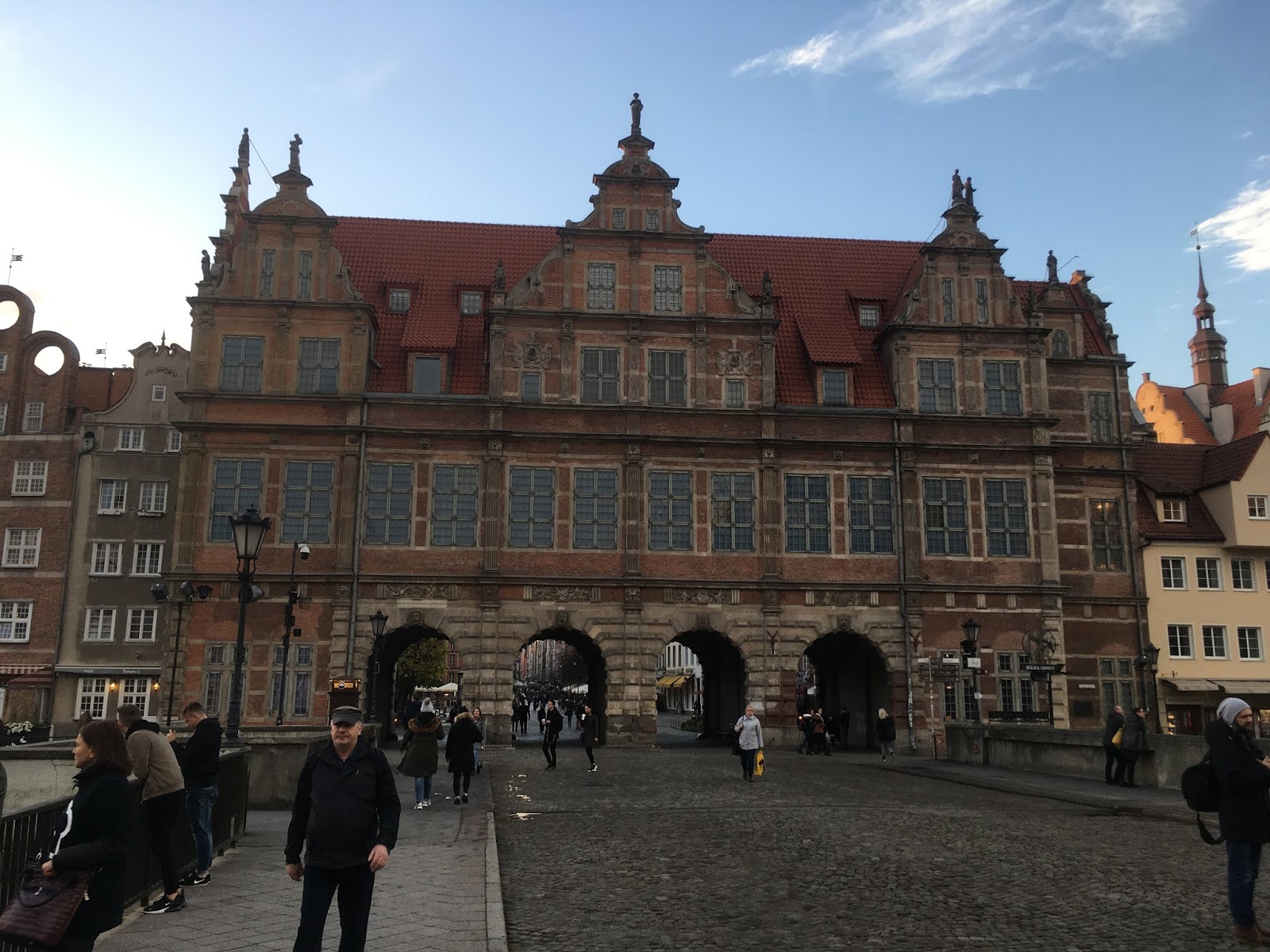
We were on the ground in Gdansk a little after lunch, and the Hotel Admiral was able to give us our room earlier than scheduled. As always, the first task was orientation, and given the hotel's excellent location on the north edge of the Old Town, this didn't take long. It's a dream setting for walking.


The yellow highlighting is the Long Market (Długi Targ), the traditional epicenter of Gdansk. The Motława River flows into the Martwa Wisła, a channel of the Vistula, skirting the docklands and shipyards just north of our hotel. The European Solidarity Centre is perhaps a half-mile walk, also north, as is the Museum of the Second World War. The main railway station and public transit hub lies to the west, roughly a ten-minute walk.

Strolling south along the river, our first stop was the Goldwasser Restaurant for a cheese plate and draft beers. Many of the bars and cafes in Gdansk had their patios winterized and ready, with various outdoor heaters fired up and plenty of mulled wine. I saw mulled beer, too, but couldn't pull the trigger on that one.


There was generalized aimlessness prior to returning to the hotel for a short restorative nap, and we took a lap around the old town's perimeter.


You may not be aware that Daylight Savings Time occurs in Poland, too. Clocks "fell back" on October 28, meaning it was dark around 4:30 p.m.; recall that the southern shore of the Baltic is on the same latitude as Newfoundland in Canada. In the end, we fell back in Gdansk, then repeated it upon arriving back home.

The eccentric but exceedingly good Tawerna Mestwin was our choice for dinner. It refers to itself as an art gallery and appears to be run by an entirely female staff. We arrived long before scheduled closing, only to be told by a group of prospective customers, who apparently were in full retreat, that the tavern had decided to close early.

We stepped into the dining room (the only room) to have a look and turned to leave, only to be told by a woman that we were welcome to stay and eat, but we'd be the last customers of the day.


Less than a hundred yards from our hotel, just outside the city walls (scattered fragments of which remain), there is a monument from the communist period.


This requires an explanation. Essentially, the monument honored anyone who suffered for being ethnically Polish -- for 627 years!

A monument commemorating those who fell in a fight for the Polish character of the city in the period from the Gdańsk massacre (1308) until the end of II World War. It was erected in 1969, on the square at Podwale Staromiejskie Street. The monument symbolising an axe stuck in the ground was erected according to a design prepared by Wawrzyniec Samp and Wiesław Pietroń.

In short: there were Kashubians, then Poles, but from the time of the massacre by the Teutonic (read: German) Knights in 1308, the Poles always have had to fight to preserve the Polish character of the city. This reminds us that prior to World War II, the city was known as Danzig, its German name, and was not part and parcel of the free Polish state.

Note also that in 1969, communism had an incentive to direct historical invective west, and not east -- toward capitalist Germany, not communist USSR. In 2018, Germany is Poland's biggest trading partner, and it isn't even close.


Next: An autumn day at the beach in Sopot.