Showing posts with label Chicago IL. Show all posts

Wednesday, September 05, 2018

Emanuel, Gahan and the campaign finance iceberg -- can it be reformed?


Surprisingly, Rahm Emanuel isn't running for another term as mayor of Chicago -- but he needn't leave his campaign war chest behind.

(Emanuel) also has deep pockets: For his mayoral bid, he raised five times the amount ten of his rivals raised together. For all of these reasons, some on Twitter speculated today that he might be eyeing the 2020 presidential race after he relinquishes his mayoral duties. Whether or not that turns out to be true, he is not likely to disappear into the background.

“Obviously the guy’s got $10 million dollars in his campaign war chest, so he's going to be a player moving forward,” said Ron Holmes, a political strategist in Chicago with ten years of experience in Illinois politics.

In case you're wondering, $10,000,000 divided by 2.7 million people (the population of Chicago) equals $3.70 per person.

Conversely, using Mayor Jeff Gahan's CFA-4 filing in January as a point of reference, Gahan came into 2018 with roughly $87,000 in future campaign funds. Divided by New Albany's population of 38,000, this equals $2.29 for each man, woman and child in the city.

In a city where 25% of residents exist below the poverty line, Gahan's campaign finance documents routinely feature donations in $1,000 to $5,000 increments from firms and individuals benefiting from city contracts. I've displayed many of them in this space.

Obviously, these donations represent what has been calculated by donor and recipient as justifiable for those gifts being reported. As adults, we all know that these donations probably are the tip of an iceberg.

No polemics, no rhetoric, just this: Emanuel or Gahan; same problem about big money in politics, just a different municipal scale. Rahm's not running. Jeff almost certainly will. Next year when our mayor lofts those nice depictions of bright shiny objects to solicit your vote, two questions should come to mind: how much did these wonders actually cost us, and how much did the engineers and contractors donate to Gahan as a token of their esteem?

I'd ask only that you consider these points before voting. Is this really the way you want local government to work?

Cities Take Aim at the Spiraling Costs of Local Elections, by Sarah Holder (CityLab)

It’s well known that a run for a big office needs big money backing it, but up and down the ballot, budgets have been swelling, and not only in the U.S.’s largest cities. Several localities—including Portland, Denver, and Baltimore—have initiatives in motion to overhaul the system either by driving down the dollar amounts each person can give or solicit, piloting public financing projects that make each donated dollar go further, or both. The overarching goal is to keep big money and its influence out of local politics, and to give all candidates a fair shot.

Saturday, December 02, 2017

Man crush.


One Two Three Four
If I had ever been here before
I would probably know just what to do
Don't you?
If I had ever been here before on another time around the wheel
I would probably know just how to deal
With all of you
And I feel
Like I've been here before
Feel
Like I've been here before
And you know it makes me wonder
What's going on under the ground, hmmm
Do you know? Don't you wonder?
What's going on down under you
We have all been here before, we have all been here before

(Déjà Vu, by Crosby, Stills, Nash & Young)

“American Pharaoh: Mayor Richard J. Daley — His Battle for Chicago and the Nation” by Adam Cohen and Elizabeth Taylor (Salon)

A big biography tells the full story of the legendary politician, with a sharp focus on his battle to keep the Windy City segregated.


Like former Alabama Gov. George Wallace, Chicago's legendary Mayor Richard J. Daley became a national figure in the 1960s as a symbol of working-class white backlash against the civil rights movement and the student left. Both men embodied 20th century political institutions that were bound for history's scrapheap -- in Daley's case, the patronage-driven urban political machine. And both were Democrats, though the demographics they respectively represented -- disaffected white Southerners and rapidly suburbanizing Northern white ethnics -- became the bedrock constituency of the Reagan revolution and the Republican congressional majority.

Despite the subtitle that Adam Cohen and Elizabeth Taylor have given their engrossing and massively detailed new biography of Daley -- "His Battle for Chicago and the Nation" -- the authors depict a man who was rarely concerned with national politics or with political theory or philosophy. The Daley of "American Pharaoh" is a shrewd manipulator who approaches every issue, every conflict, as either a threat to his power or an opportunity to consolidate it. For all his famous malapropisms ("The policeman is not there to create disorder, the policeman is there to preserve disorder"), Daley was always intensely focused on his prime objective: preserving political power at any cost whatsoever.

He achieved his greatest national fame, and infamy, for defending and even celebrating the almost barbaric violence his police force inflicted on anti-Vietnam War protesters outside the 1968 Democratic National Convention. Ironically enough, Daley personally opposed the war and had privately urged President Lyndon B. Johnson to withdraw from Vietnam. But in Daley's worldview, this stance was perfectly compatible with brutally crushing antiwar demonstrations before a national television audience; he saw both the Vietnam conflict and the New Left that arose to protest it as threats to his authoritarian rule over the Cook County Democratic Party, his personal fiefdom ...

Sunday, July 09, 2017

Chatting on Fb about the street grid in NA: "The push to start reclaiming some of our streets and spaces for users and uses other than cars isn't a radical change."


My friend and colleague Jeff Gillenwater posted the following to New Albany Indiana, a Facebook group that functions somewhat like the discussion groups of old. Italics are the omniscient narrator (that's Roger), with Jeff's comments in normal font. He begins by explaining a photo we use often at NAC.

This overhead view of Downtown New Albany was created several years ago by Josh Poe, then an urban planning graduate student and New Albany resident. Everything in red is off-street automobile parking. With the exception of the parking garage on the corner of State and Market, it's all surface parking (and, of course, doesn't include all the on-street parking that's readily available.) Given how much more densely developed the city used to be, commercial buildings and/or houses were torn down in most cases to create those parking lots. The next time someone tries to tell you New Albany hasn't done enough to accommodate cars, feel free to share. The push to start reclaiming some of our streets and spaces for users and uses other than cars isn't a radical change. It's a response to and corrective for the past few decades of radical change that has already happened.

Also worth noting, here's what was demolished to create the parking lot that eventually became Bicentennial Park.


And the bank and mostly parking next door.


For good measure, Jeff included parking documentation:

Here is a PDF showing a few hundred parking spots in downtown New Albany; publicly owned and free after 5 pm and on weekends.

Downtown New Albany Public Parking Guide

It seemed to one reader that such comments about auto-centrism were designed to discourage auto use downtown, thus defeating the purpose of revitalization by implementing a "European model" to serve the needs of the few, not the many.

People very invested in defending automobile centric culture are, whether they realize it or not or mean to or not, are speaking from a position of significant privilege. Though New Albany, like a lot of other older U.S. cities, was initially designed for multimodal street usage, most of our infrastructure spending has been aimed squarely at automobiles at the expense of other forms of travel for the past few decades. That's actually a short time in our overall history, but has been true for just long enough now that people don't remember it being any other way. Thus, they tend to see calls for more equity between various forms of transportation and any talk of curtailing automobile dominance as demonizing cars and car drivers. What the posts actually do is point out that it's not always been that way. If we could decide to change it fifty or sixty years ago, we can decide to change it now. Realizing what we've given up, what we've lost and are still losing in the process of converting to automobile dominance, is a first step in deciding to pursue change.

As for the "European model" in a pejorative sense ...

New Albany was built by European immigrants on a European model. That's how it was designed to properly function (and functioned well, for 150 or more years. Over and over again for years people have provided links to research, case studies, and successful approaches that have pointed directly to greater overall public good via what you call a European model. That some folks simply choose to not acknowledge that doesn't make the people sharing that information a narrow interest group. If you can show how automobile centric models have proven to be better for us in terms of fiscal responsibility, public health, and environmental wellbeing, I'm all ears (or eyes, as relevant).

Another reader asked whether it is possible to have a vibrant urban area without "cheap" parking on abundant surface lots. Parking garages like the one we used in Chicago last week weren't mentioned.

One of the more interesting aspects of the "hard to park" scenario has to do with perception. People often walk farther from their parking spots and back to their cars at WalMart than they do downtown, but will still insist that WalMart has close-in parking and downtown doesn't. Try to suggest that the environment in which people are asked to walk has something to do with it, though, and ...

Jeff elaborated.

It really is a trip how quickly downtown parking perceptions changed. When my mom got married, she moved from the west end of New Albany... all the way to Sellersburg. LOL. When I was a kid, we still came to downtown New Albany all the time. In the 70s and early 80s, a lot of the older stores were still here. We never expected, even at that late date, being able to park directly in front of a place most of the time. I mean, you might get lucky and something would open up along the way, but we mostly just went straight to the parking garage (formerly located next to what's now Big Four Burgers) and assumed we'd have to walk a few blocks to the places we were going. Now, to hear some folks talk about it, parking on Bank Street to go to a place on Pearl is some sort of inordinate hardship. Oddly enough, a lot of those same people don't think twice about parking in the middle of the Meijer parking lot and walking quite a bit farther to the department they actually need, to the checkout counter, and then back to the car. It might have something to do with the environment in which the walk is occurring.

I mentioned out having just returned from Chicago, where people regularly pay outlandish prices to park downtown. For the record, we parked the car in a garage for four days ($122) and bought two three-day CTA transit passes for $20 each. One reader rightfully pointed to the absence of these transit options in New Albany.

At one point in their respective histories, the Southern Indiana/Louisville metro area rivaled Chicago in transit development. It's one of the things that gives me a chuckle when some folks refer to New Albany's automobile-centered heritage. It just ain't so.

Jeff posted these three explanatory links.

Passenger Rail The Way It Used To Be

Louisville’s Incredible Elevated Rapid Transit Trains

JEFFERSONVILLE/NEW ALBANY TRANSIT HISTORY

The point in sharing examples from other places and comparative histories isn't to say that those places are the same or should be. More than anything, the idea is that places can change themselves and what they emphasize or value and have many times over, New Albany included. Per the original Chicago reference about parking, people pay a lot to park in Chicago because (Rahm's privatization scheme aside for a moment) they think it's worth it to be there. That's a very scalable concept. Funny aside: I deal with Chicagoans pretty regularly now at work, including getting them parked sometimes. When I tell them all-day parking is $6, they laugh at me like I told them a really good joke.

In advocating two-way streets and other components of urban street grid reform, we've always referenced research and experience. We've pointed to successful reforms in other cities, and not just in Europe. I've come to expect a specific rebuttal, which constitutes a form of exceptionalism: "But New Albany is different. Biology and gravity might work the same here, but not street grids."

For a lot of Americans, merely pointing out that a concept came from elsewhere is the equivalent of saying it's obviously wrong. Beyond that, it's often a matter of insisting that WE have always been one way and THEY have always been another. Like "scalable", that applies to a lot more than parking and cars, too. In all seriousness, privilege and the language and power dynamics of privilege are always a big part of conversations around cars and other street users. You can swap out the "we" and " they" parts and a lot the arguments are so similar to other social issues that involve a majority addressing a minority that they're nearly interchangeable on a linguistic level.

Too much information? 

Unfortunately, no one ever said learning was easy. Ten years ago, I understood very little of this. Now I understand more, and if a slow learner like me can do it -- so can anyone. 

Friday, July 07, 2017

Chicago fact-finding tour, 2017: A serene Chicago Botanic Garden, a bustling Chinatown and the re-delicious Baderbräu (Friday, July 7).


(backdated ... previously, day three)

The Chicago Botanic Garden is situated past even Evanston, roughly 23 miles north of the Loop. For this trip out of the urban area, we purchased tickets on the Metra suburban train, leaving from the Oglivie Transportation Center a couple of blocks from our hotel.

Alighting at Braeside, it was a 15-minute stroll to the Botanic Garden, which is free to enter. It's an impressive park.

The Chicago Botanic Garden opened more than 40 years ago as a beautiful place to visit, and it has matured into one of the world's great living museums and conservation science centers. In 2015, more than one million people visited the Garden's 27 gardens and four natural areas, uniquely situated on 385 acres on and around nine islands, with six miles of lake shoreline. The Garden also has a renowned Bonsai Collection.

For the Fitbitters among you, the fact that 10,000 steps had been recorded by the time we boarded the return train says it all.

Did I mention being with a Brit?


This train back to Chicago was packed with Cubs fans, as there was another afternoon game at Wrigley. It turns out that the Oglivie Transportation Center has a remarkable French Market food court. We bowed to temptation and ate Belgian-style frites with mayonnaise for lunch. I failed to properly examine the Montreal-style pastrami.

It's a trencherman's regret.

Having spent the morning in the north, it was time for a foray to the South Side and Chinatown, via the Red Line. The original plan was to eat there, but we'd already gorged on potatoes.

Still, having devoted a fair amount of time earlier this year reading and writing about Chinese food, it was a pleasure just to read the menus.

BOOK REVIEW: Chop Suey – or how Chinese food came to be taken for granted in America.

Our last visit to Chicago came in 2005. The cheapest hotel we could find was in Chinatown, and it was perfectly acceptable. We flew into Midway, bought public transport tickets, changed from Orange Line to the Red Line somewhere at the Loop, and noticed that the next stop past Cermak/Chinatown was (whatever the stadium that should be called Comiskey Park was named then), where the White Sox play.

Chinese restaurants: “Do you know why Americans don’t like eating meat with bones in it? They’re too lazy!”

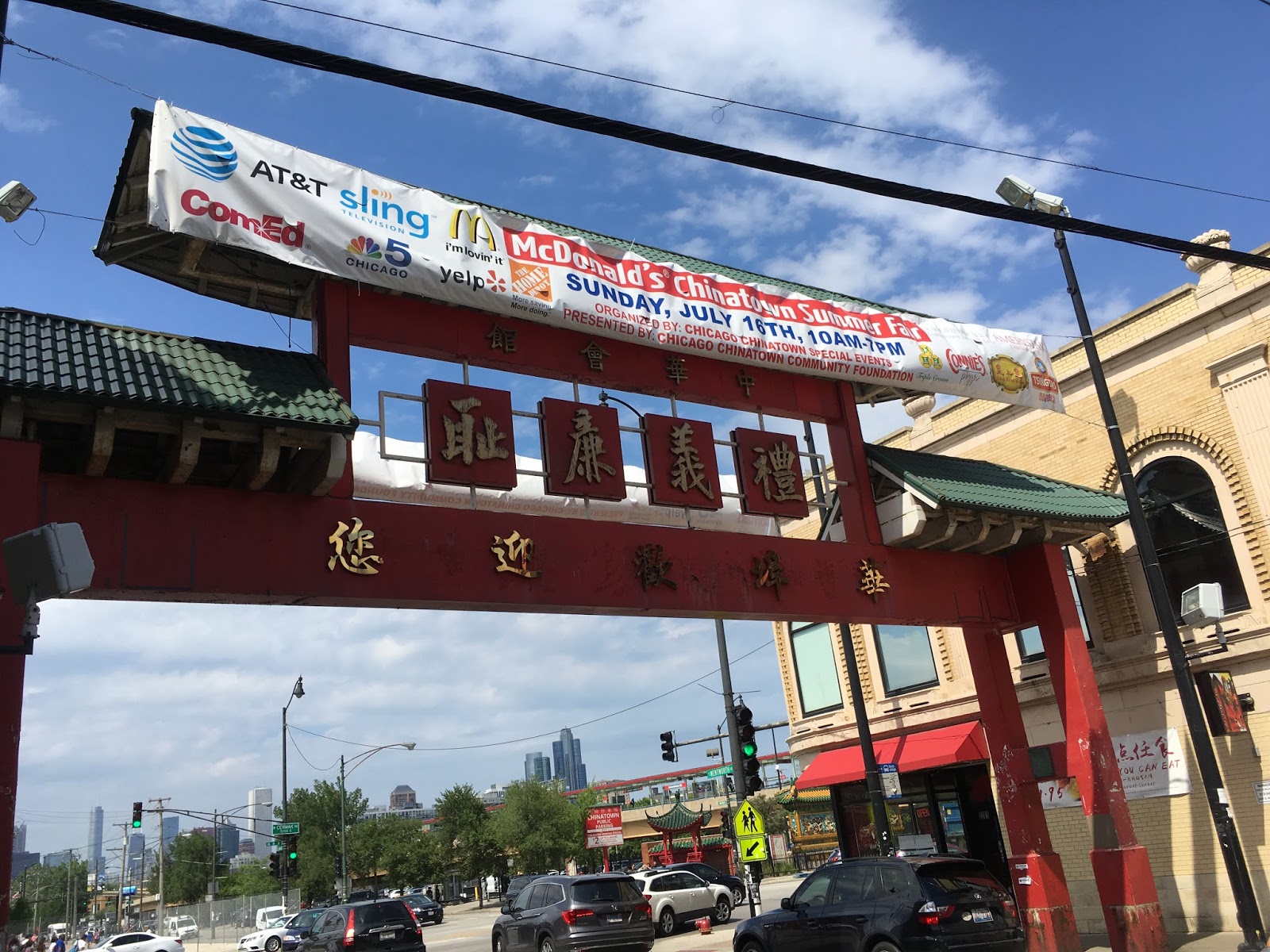
The Chinese in Chicago have a long history, stretching to the 1860s grouped downtown, then with the establishment of the present-day Chinatown in 1912. Several blocks of Wentworth might as well be in Asia.


On the other hand, Chinatown is so American that McDonald's sponsors it. But a Chinese company might own McDonald's by now. It's moot.

After cursory shopping, it was determined that beer might restore our appetites. Diana delved into Google, and I was surprised to learn that a brewery was close by: Baderbräu, truly a name out of the past, though now doing business on S. Wabash, a 15-minute walk.

At the dawn of craft beer history in New Albany (that'd be 1992 or thereabouts), I traveled to Chicago for an interview with the State Department -- you don't want to know the sad details -- and while there, visited my first-ever American brewpub: Goose Island, long before it was absorbed by the Great Satan.

Soon I was involved with the Public House, and word came down through the grapevine that the finest beer in Chicago wasn't Goose at all. Rather, it was Baderbräu, which brewed only a Pilsener and a Bock, and was owned by the world's most incredible salesman, a former policeman named Ken Pavichevich.

Someone with connections in Chicago gave me his number, and I called him out of the blue to ask if we could get the Pilsener in Indiana. We had a few nice chats, and eventually he got some of his beer into the state, but unfortunately the brewery didn't last long.

For more on this story, old and new, go here. It's fascinating.

In any event, Baderbräu is back, with new owners, a few old recipes, and many new ones. The old/new Chicago Pilsener is just grand. After two of them, I was hungry; at this point, there was no use walking back to Chinatown, so our final Chicago meal became Reuben sandwiches and soft pretzels appetizers.


The best conceivable ending would have been a White Sox game, but the team was on the road.

If any loyal readers go to Chicago and drop by Baderbräu, please pick up some Chicago Pilsener for Papa. I'll happily pay cash for a couple six packs of cans, or even a case. 

On Friday, I didn't want to carry beer on the bus. So, we stopped at a bar on Randolph for a final Chicago drink, and motored out of town on Saturday morning ... with me probably ten pounds heavier, and with at least one of us craving steak & kidney pie, Marmite and a shandy.

Thursday, July 06, 2017

Chicago fact-finding tour, 2017: Destiny's appointment on Thursday, July 6, with delectable food in Greektown and a nightcap at Monk's Pub.


(backdated; previously, there was a ballgame)

Now, for the appointment.

Diana's mother was born and raised in Plymouth, England. It's in the county of Devon, an area considered part of the West Country (or southwestern England). My wife's mom married a Mainer, and the rest is herstory, which took a fresh turn on July 6, when Diana reclaimed her mother's British nationality.

Diana now is a dual national, American and British. On a daily basis, there will be little if any change for us. You'll understand that this journey has been a deeply personal one, so there isn't much more that I care to add, apart from being very proud and 100% supportive that she has followed her conscience and honored her mother in this way.


It's why we went to Chicago, and with the appointment and ceremony concluded, we caught a bus back to the hotel, changed, and set out for Greektown on foot, perhaps a 20 minute walk.

Chicago's Greektown originally was located nearby. It was displaced by the expressway and a university expansion, and moved to the current location. I remember dining at one of the restaurant 25 years ago, and being told by the server that few Greeks still lived in the neighborhood, though they remained interested in preserving their collective heritage there.

I confess to Googling "best Greek restaurant in Chicago" and being told that the winner is Greek Islands, at least according to Trip Advisor.

Greek Islands bills itself as "America's most popular Greek restaurant," and a list of indie eateries in the United States shows it ranking 99th in gross sales, with just under $13 million in 2016.

Whatever. It was a damned fine meal.

We split warm and cold lima bean appetizers. Diana had a Greek salad with grilled chicken, and I dug into a savory plate of beef kapama with homemade noodles. My beverage of choice was a half-liter of Retsina, white wine with the subtle yet noticeable flavoring of pine sap.


The afternoon was hot and humid. We slowly made our way back to the hotel for a three-hour nap, venturing back outside at almost 7:30 p.m. for an ice cream on the Chicago Riverwalk, then a nightcap at Monk's Pub at Lake & Wells, just around the corner from the hotel.


In my case, make it three nightcaps and a salad. Diana was more restrained, but I took one look at the well-stocked Belgian contingent on the Monk's beer list and formed an immediate strategy.


Another great Chicago pub.


Next: Winding it up on Friday with a look at the Chicago Botanic Garden, Chinatown and a new/old brewery.

Wednesday, July 05, 2017

Chicago fact-finding tour, 2017: Cubs vs. Rays at Wrigley Field and the Red Lion Pub on Wednesday, July 5.

(backdated ... previously, we drank near the Haymarket)

It was my first visit to Wrigley Field for a game since the late 1980s, and Diana's first time ever.


The interleague matchup between the Cubs and Rays was slated for a 1:20 p.m. start, and as every real fan knows, there's nothing quite like day drinking in concert with day baseball. They go together like day drinking and day museum visits, or something like that.

From our downtown hotel, we had started the day by walking to Michigan Avenue via the Chicago Riverwalk (20 minutes), eventually boarding the Red Line at Grand, and emerging at Addison perhaps 20 minutes later.


Thinking back to the U2 show at Papa John's Cardinal Stadium in June, and how practically everyone in attendance drove in cars to get there, the joy of being able to ride to a ballgame on a subway train and walk a few hundred feet to enter the stadium ... to be able to drink and not worry about driving ...

It's simply priceless.


The Sports Corner Bar & Grill was as good a choice as any for baseball brunch, and we somehow managed to appear just as the doors opened, nabbing a sidewalk table in the shade and enjoying a healthy, restorative meal of loaded nachos and Chicago-style dogs.

This was our view of the Billy Williams and Ron Santo statues.


For my three beers before noon, I decided to try the same "import," three times) Urban Chestnut Schnickelfritz Bavarian Weissbier from St. Louis, in a big mouth tallboy can, one of the finest Hefeweizens I've ever had from an American brewery, and quite possibly the very best.

Diana did the modeling.


Our seats were at the very back of the grandstand on the first base side, completely sheltered from the sun on a day when a healthy breeze was blowing in from Lake Michigan. Too bad about the Budweiser sign; such are the indignities of life.


Of course, the late Harry Caray constantly pounded the ol' Budweiser, and rumors persist that during his many years in St. Louis, he sampled certain other pleasures pertaining to the Busch empire. We'll never know for sure, but Caray is immortalized with a press box image.


As for the game itself, the Cubs continued their 2017 struggles through the first five innings, meekly stranding a handful runners against an obscure Tampa starter named Snell. The Rays scratched out three runs by getting runners on base at the top of the order, stealing the occasional base and advancing others on grounders, with a couple of well-timed hits and a sacrifice fly to bring them home.

The lead had all the appearance of being safe, but Snell was relieved in the 6th by the reliever Ramirez, who came to the mound toting a huge gas can and blowtorch.

He promptly surrendered a three-run, pinch-hit homer from Jay, and the Cubs added four more runs in the last three innings against an imploding Tampa bullpen. The home crowd left happy.


Behind our seats on Addison, a large new mixed-use building is being constructed. We noticed that during the national anthem, activity stopped and the construction workers faced Wrigley with hard hats in hand.

Well played.


Later in the game, Diana noticed a strange phenomenon of hovering port-a-lets.


Perhaps Harvest Homecoming should consider these.

---

After the game, we strolled down Sheffield to Bittersweet Pastry on West Belmont, absorbed energy from sugar and caffeine, then hopped back on the subway for a quick ride to the Fullerton stop, and the Red Lion Pub on Lincoln Avenue.

An excellent short tap list at the Red Lion includes Bombardier, Fuller's London Pride, Fuller's ESB and Young's Double Chocolate Stout. Our evening meal consisted of Scotch eggs, chicken curry and bangers and mash, served in a gorgeous Anglo setting of wood, brick, books and booze. I'l borrow a website photo to make my case.


We chatted with the owner/bartender Colin, who apparently is somewhat the local legend, remarking that his pub is the last "adult" bar in the vicinity. A regular customer looked and acted like Joe Biden, and a couple from Australia were seated next to us at the bar.

I wish we could have made it back to the Red Lion for a longer session. Next time for sure. Wednesday evening closed with a walk along the Chicago Riverwalk, back to the hotel from Michigan Avenue.


Next: Some official paperwork, Greektown and Monk's Pub.

Tuesday, July 04, 2017

Chicago fact-finding tour, 2017: One or the other Haymarkets on Tuesday, July 4.

Greektown is right down Halsted ...

(backdated)

The Confidentials had an appointment in Chicago on July 6, and I'll have more to say about it. Why drive all the way up and back without spending a day or three seeing the town?

I'd have preferred an Airbnb in a place like Oak Park, but the last-minute nature of the exercise found the choicest rooms already booked. Diana gave Priceline a spin, and the result was an inexpensive room at the Kimpton Allegro downtown at Randolph and Wells in the theater district.

But when the parking costs as much as a discounted room, I recommend Spot Hero. It was flawless, and saved 60% off the hotel's parking fee. The car was 100 feet away in a garage across the street. Granted, there are restrictions. We knew we'd be walking or riding CTA with 3-day passes ($20), so it was worth it to let the car sit.

We arrived at noon on Tuesday, July 4. There'd be fireworks later in the evening, and crowds already were thronging Millennium Park in early afternoon. Still, many businesses were closed for the day. We found a passable Mexican joint for lunch, studied the map and found that a brewpub was within walking distance of the hotel -- west, over the river and under the transit hub.

This was Haymarket Pub & Brewery, located at the corner of Randolph and Halsted. The interstate passes between the brewery and the site of the Haymarket Affair.

The crowd gathered on the evening of May 4 on Des Plaines Street, just north of Randolph, was peaceful, and Mayor Carter H. Harrison, who attended, instructed police not to disturb the meeting. But when one speaker urged the dwindling crowd to “throttle” the law, 176 officers under Inspector John Bonfield marched to the meeting and ordered it to disperse.

Then someone hurled a bomb at the police, killing one officer instantly. Police drew guns, firing wildly. Sixty officers were injured, and eight died; an undetermined number of the crowd were killed or wounded.

Taken together, the bombing's agitated prelude and the overwrought reaction to it contributed mightily to the concept of May Day worldwide. That's right -- it all started in Chicago. I bet you thought it was Moscow.

We were told that the Haymarket Memorial near Desplaines and Randolph streets has been temporarily displaced for a building project and will return in the fall of 2017. Here's a file photo.


At the brewery, the doors were open facing the street on a temperate day, and we enjoyed beers and nibbles while watching baseball on television. I'd guess that Belgian derivatives and IPAs made up two-thirds of the draft list on the day of our visit. Seeing as I've finally relented to the notion of samplers, my choices ranged across the menu. Every Haymarket beer I drank, whether hoppy or malty, was very good -- with a single exception, the Kölsch.

Call me old-fashioned, but hop aromatics redolent of honeydew melon and strawberry are better deployed elsewhere. Somehow the characteristic Kölsch crispness was buried in fruit. It wasn't my gig; however, make no mistake. The Haymarket Pub & Brewery is outstanding, and I'd return there in a heartbeat.

We bought wings to go and returned to the hotel for a nightcap, only to find the bar closed for the holiday. Fortunately there is a Seven-Eleven right around the corner, and it yielded a six-pack of Revolution Gumballhead Sun Crusher cans.

Red alert to the trencherman in me, because Chicago was going to be caloric.

On Wednesday: Cubs and Rays at Wrigley Field and beers at the Red Lion. 

Monday, May 01, 2017

THE BEER BEAT: Schaller’s Pump has closed, but why was Chicago's oldest bar called a "Pump," anyway?


My longtime beer biz friend, John "Mr. Chicago" Freyer, brings us this story about the passing of an institution. While sad, it's also fascinating on several levels, and I recommend you read in full the accounts referenced here.

The demise of any 136-year-old bar is both newsworthy and regrettable. What strikes me about Schaller's Pump is the name itself. Nowadays, you simply don't see too many bars referring to themselves as "pumps," although there are a few newer establishments around the country that have borrowed the rare old-school usage.

I asked John about it.

Roger: I'm assuming "pump" refers to the act of pouring beer, like a throwback to hand pumps?

John: It used to be part of a brewery that was next door (Ambrosia Brewery).

Roger: So, it's to be taken in the sense of pumping beer from brewery to drinking point? I'm fascinated by the usage. Is "pump" a synonym for "tap"?

John: There used to several places with Pump in its name, like Stump's Pump. It's gone the way of the supper club.

He's on the money. The Chicago Bar Project profiles Schaller's Pump:

According to Newcity Chicago's David Witter, the bar's name stems from its neighbor: "The Ambrosia Brewery, one of dozens of neighborhood beer makers of the era, was located in what is now the parking lot next door. Beer was supposedly pumped in straight from the brewer's giant casks, giving the room its moniker, 'Schaller's Pump.'" Back in those days there were more than 30 post-Prohibition breweries in the neighborhood. Now that's Bridgeport!

The Chicago Tribune corroborates.

The bar took "Pump" as part of its name because of the brewery next door pumping beer directly into the tavern. It was a short walk from the former home of Richard J. Daley and across the street from the 11th Ward Democratic headquarters.

I didn't spend much time looking for more detailed background, although as an aside, what may or may not be New York City's oldest tavern had "pump" in its name long before Andrew Jackson became president.

In its beginnings at 1829, Neir’s was called The Blue Pump Room and owned by Cadwallader R. Colden, manager of the famed Union Course Race Track.

Owing to the vagaries of Chicago's laws pertaining to property tax relief for senior citizens, the fate of Schaller's Tap looks to have been sealed when 92-year-old Jack Schaller died in 2016. Unfortunately, no Jack -- no tax break.

Jack wasn’t hard to find. Until his death, he lived in an apartment above the bar. Over the last five decades, countless neighborhood folks have walked through the tavern’s signature wooden door looking for the man who kept it running for so many years.

“They’d ask, ‘Is Jack around?’” Thompson said, “And then he’d come down the stairs.”

My favorite social media comment is this one.

On Friday nights, they had an accordion player who knew every Chicago Catholic League fight song.

Goodbye, Schaller's Pump.

Schaller’s Pump, oldest bar in Chicago, set to close Sunday, by Sam Charles and
Matthew Hendrickson (Chicago Sun-Times)

The oldest bar in Chicago, Schaller’s Pump in Bridgeport, poured its final drink Saturday night.

The bar, owned by the same family since 1881, will not open Sunday, according to its owner Kimberly Shinnick. It holds Chicago liquor license No. 6.

Shinnick, reached by phone at the bar Saturday afternoon, declined to provide specifics but told a Chicago Sun-Times reporter, “Yes, the bar is shutting down.”

“This is a really hard time right now,” she added before hanging up ...

Cubs this, Cubs that. There's another baseball team in Chicago, folks.

“It’s sad to hear that this Bridgeport institution — just blocks from our ballpark — is closing,” Scott Reifert, team spokesman for the White Sox, said in an email Saturday evening.

“Generations of White Sox fans made a stop at Schaller’s part of their tradition when attending a Sox game. I am sure that fans who can not get to Schaller’s tonight are still likely to raise a glass wherever they are to honor this icon of Chicago history.”

"Schaller's Original Pump," according to the sign.

Thursday, February 09, 2017

Time to learn facts, Democrats: Myths and misperceptions about public housing ... and lessons from Chicago's reform effort.


It doesn't come as any great surprise that Jeff Gahan would like to replace affordable housing in New Albany with various manifestations of "luxury."

Gahan's Grab: Yes, principled Democratic positions on public housing actually DO exist, and here's one of them. But first, some Kool Aid!

It's no more surprising that City Hall's forthcoming public housing putsch, as abetted by a Democratic Party gone entirely off the rails, is based on myth. I've given precious little "tease" to this article, because if you're genuinely interested in learning the facts, you'll click through and then follow up by expressing your outrage to the elected officials who are tolerating this classic instance of Gahanian and Dickeysian depravity.

Myths and misperceptions surrounding public housing and the people who live in it, by Pete Rodrigue (Greater Greater Washington)

A lot of Americans believe things about federally subsidized housing that simply aren’t true. You’ll sometimes hear things like, “most federal housing assistance just means people living in government-owned high rises,” or “people who get housing assistance don’t work.” Thankfully, we have data to investigate these beliefs. Let’s look at four of the biggest myths.


  1. Myth: Most public housing means big projects
  2. Myth: Most housing assistance recipients don’t have jobs, and they’re all black
  3. Myth: Subsidized housing generally lowers surrounding property values and increases crime
  4. Myth: Housing subsidies worsen recipients’ lives

Chicago and New Albany exist on vastly different scales, but certain of the lessons are transferable. The verdict: "We can accomplish only so much with better housing and slightly better circumstances. It was naïve to think that relocation was going to address all the problems families were having."

And Gahan is addressing these problems ... how?

Didn't think so. Those crickets never lie.

Hard Lessons From Chicago’s Public Housing Reform, by Susan Popkin (CityLab)

Two decades ago, the city embarked on an ambitious—and controversial—plan to transform its troubled public housing system, uprooting thousands of low-income residents. Today, researcher Susan Popkin reflects on what worked—and what failed.

 ... It was the era of Clinton-style welfare reform and the beginning of efforts to shrink the federal role; that meant that private developers—both for-profit and nonprofit—would own and manage these new properties. Today, the effect on Chicago’s West and South Sides is evident: The forbidding high-rises are gone. Though the pace of new construction has been frustratingly slow, the area now has seven new safe and attractive communities (with three more in the works), as well as parks, stores, and other signs of economic renewal.

As many critics have noted, the Plan for Transformation meant involuntary displacement for many thousands of African-American residents, a process that was painful and stressful for most of them. Only a portion of the units in the new developments were meant for public-housing families, and relatively few original residents moved back. Most either took vouchers and rented private-market housing or moved to another refurbished public-housing community. Still, when contacted years later, nearly all the relocated CHA residents I studied said they were living in better housing in safer neighborhoods. The fact that no child is growing up in a place as bad as Robert Taylor Homes was when I first walked into it is a real and important victory.

But it is only a partial one. The majority of the families who moved still live in places that are poorer, more racially segregated, and more violent than the rest of the city. Such places will not fundamentally change children’s life trajectories.

Tuesday, July 26, 2016

1968: A mere 48 years ago, in Chicago with Mayor Daley for the Democratic National Convention.


The video source is unknown. It's a shaky reproduction without opening or closing credits, but remains a credible overview nonetheless.

For accompanying text, go here:

1968 Democratic Convention, by Haynes Johnson (Smithsonian)

The 1968 Chicago convention became a lacerating event, a distillation of a year of heartbreak, assassinations, riots and a breakdown in law and order that made it seem as if the country were coming apart. In its psychic impact, and its long-term political consequences, it eclipsed any other such convention in American history, destroying faith in politicians, in the political system, in the country and in its institutions. No one who was there, or who watched it on television, could escape the memory of what took place before their eyes.

Wednesday, August 13, 2014

On urban progressive visions and our area's absence of same.

The Guardian's correspondent may or may not have the Chicago situation sussed, but he passes along a handful of astute observations as to cities as a laboratory for progressive change. Not that you'd notice any of it as a resident of the metropolitan Louisville area, which enjoys thinking of itself as something it isn't. More on that here:

Chart of the Week: The most liberal and conservative big cities, by Drew DeSilver (Pew Research Center)

Spoiler alert: Louisville, Indianapolis and Lexington ain't San Francisco, folks.

Tales of the cities: the progressive vision of urban America, by Gary Younge (Guardian)

 ... Public imagination when it comes to political geography is skewed. People think in terms of red and blue states, but the real distinction is between town and country. With just a handful of exceptions, every city of more than 500,000 inhabitants votes Democrat; in all of the 10 largest cities in America white people are a minority. More than two-thirds of Obama’s lead against Mitt Romney in 2012 came from the three largest US cities – New York, LA and Chicago, and their surrounding areas. It’s not difficult to see why. People come to cities to escape isolation and find opportunity. So cities become home to a disproportionately large number of gay and lesbian people, immigrants and religious minorities. To function they demand social tolerance and public investment for everything from transport to parks.

Sunday, December 30, 2012

Chinatown on Charlestown Road, and a "rewind" to "On the very nature of nay-saying."

In all sincerity, it's good that Earth Friends is relocating to Louisville, and the Exchange already is up and running at its new downtown New Albany location.

But the departures leave two vacancies in the commercial area just inside the beltway on Grant Line Road, near the original location of my own beer and food business. Granted, these could be filled soon, and the overall situation is by no means bad in my Northside neighborhood.

It also could be better, and there doesn't seem to be any firm public plan on the part of local, various economic "development" entities or business owners themselves to improve prospects therein, although getting the Grant Line Road construction project finished certainly helps. To me, the ultimate goal remains connecting IUS with Community Park, and maintaining a locally-owned economy as much as possible in between.

Arguably, matters are far less hopeful on Charlestown Road, roughly between Slate Run Road and Silver Street. There are quite a few commercial vacancies there, especially amid the zombie fast food row by McDonald’s. The ideal solution would be to raze all of it and replant trees, but American capitalism probably precludes such a reason-based course.

A long time ago – 2005, to be exact – when downtown was as yet moribund and revitalization meant anywhere else except here, we returned from a trip to Chicago and it struck me that metro Louisville needed an Asian community like the Windy City’s thriving Chinatown. I looked at the empty buildings downtown and thought, hmm, this looks like a fine place for it; if we can’t do it, I bet the Chinese could. China has the investment capital and the work ethic. Just let ‘em have the buildings, and get out of the way.

Perhaps now that the doughnut hole has moved to Charlestown Road, so has the ideal location of our Chinatown, with Indonesian where the Wendy’s used to be, and Filipino at the old KFC. Colonial Manor could function as NA’s Iroquois, with a grocery as good as ValuMarket. I’m not sure where this leaves Sonic, but we'll figure it out.

Here’s the article I wrote seven years ago. The pink spitwad blogyard has yielded to decaying tabletop linoleum, and while much has been accomplished, much more needs to be done. We might need a Russian oligarch for this.

---

Rog's rant: On the very nature of nay-saying (June 21, 2005)

We spent the weekend in Chicago, and as is the case every time I return home from a trip, it takes a few days to adjust to the state of mind.

The culture shock stands to be a bit greater this time.

Our hotel in Chicago, chosen because it was the cheapest in close proximity to downtown, was located in the heart of Chinatown, one hundred yards from the subway stop and several thousand miles away from just another place to stay.

By this I mean that Chicago’s Chinatown is just that – touristy to an expected degree, but filled to the brim with, well, people from China (and some from Vietnam, Malaysia and other Asian locales). Sometimes none of the voices to be heard are speaking English. It’s easy to catch yourself thinking that you’re somewhere else, not Illinois.

Stand at the right spot, and the aromas of cooking fill the street, emanating from ubiquitous restaurants with dining rooms often tucked away on upper floors, eateries relieving tourists like us of our cash while pulling extra duty as community centers.

Early Sunday morning we entered a bakery and were shooed into the almost hidden rear section, where the satellite television was entirely in Chinese. The staff spoke English, but the customers in the crowded room paid little heed to it. I checked off breakfast choices, including dim sum and doughy pastries, on a card and handed it to the waitress, who returned with tea and hot sauce.

What were the men talking about? I’ll never know what the men smoking by the no smoking sign were talking about, but their conversation was animated and filled with laughter.

------

We returned home today, and after checking e-mail, I perused the local blogs and other usual daily sites, thinking all the while that while it’s a clear case of apples and oranges to compare the range of options and attractions in an immense metropolitan area like Chicago to those in and around Louisville, at the same time, why must we perpetually insist that superstition and backwardness are our best friends?

I’m not speaking here about Scribner Place, Cannon Acres, the City Council, the Mayor, or any of the specific local political topics that have been discussed at NA Confidential since its inception last year.

Rather, with the memory of Chicago’s vibrant neighborhoods and can-do spirit fresh in my mind, I’m referring to the recurring phenomenon hereabouts that currently enjoys its most prominent, and saddest, manifestation in apoplectic opposition to progress in the city of New Albany, an opposition that unfortunately doesn’t confine itself to screaming that present circumstances stand in the way of progress, but that taken together, all past mistakes by any and all politicians and community leaders indicate that we simply can’t do anything right, and should never, ever try.

I am utterly sickened by this cancerous attitude.

Why, if not stemming from unadulterated envy, is it that people who lack the ability to understand insist that their incomprehension is sufficient reason to deny others the opportunity to learn?

Why, if not from simple self-loathing, is it that people take pride in their ignorance, rather than take the steps necessary to gain knowledge?

Why, if not from our own timidity and a respect for fair play that goes far beyond that accorded us in return, should people like these be allowed to use their own lack of imagination and creativity as veto power over varieties of progress that will benefit the remainder of the community?

Of course, these shrieking cyber-punks are not the truly downtrodden, genuinely poverty-stricken, disenfranchised "little people" they so fancifully imagine themselves to be, and since no one else will say it, I will: These "Concern Taxpayers" and "New Albany Residents" don't care one jot for those in this town who really do have it badly.

It's all about tearing down ideas and people that they wrongly perceive to be "above them," not lifting up those they're comfortably sure are below, and even though this is nonsensical at best and repugnant at worst, it's the way it is.

In defense of people like these, it was recently stated elsewhere that they:

“Are not stupid, ignorant, recessive thinking globs of people. (They) are people who happen to have a different opinion, or aren't quite convinced that this (progress) is a good idea.”

Fine.

Readers, if you haven't already done so, go to the pink spitwad blogyard and feel the hatred oozing between the angry words. Consider the anonymity that cloaks it. Remember that its readers support all-American concepts like censorship. Now, ask yourself: What is it that would make these people happy beyond the confines of their own four walls, and the knowledge that not one cent of their taxes went to fund a better community?

It isn't pretty, is it?

In fact, it's often vicious, and goes far beyond reasoned debate and benign disagreement.

Stupid? Ignorant? Recessive (sp – regressive, Laura)?

Their words. Not mine. And if the shoes fit ... then wear them to exit New Albany, like our best and brightest young people continually do, because always standing between them and the remaking of a city in the future tense are the nay-saying Brambleberries, prepared for no sacrifice or gainful efforts of their own beyond that necessary to brutally kneecap progress in any form and preserve their own fiefdoms of futility.

Or, as I've done, you can stay right here and join me in fighting the Luddites every step of the way. To those who have no plan of their own, and want to make sure that progressivism is not allowed to have one, either, because they hate the future just as much as they hate the capable and talented, I've got this to say: you cannot win. You cannot stop the globe from spinning, or the pages of the calendar from turning.

We'd prefer their cooperation in making this city a better place to live, but we're quite prepared to do it without them.

Heh heh. I feel much better now.